Freeze-thaw after rain
The most destructive weather sequence on the North Shore is not the storm itself. It is the clear, cold night that follows: three days of rain soak every crack and pore in the concrete, then the sky clears, the temperature drops through zero, and the water freezes where it sits. Buildings at elevation run that sequence dozens of times a winter, and it is why their cracks come out of March wider than they went into November.
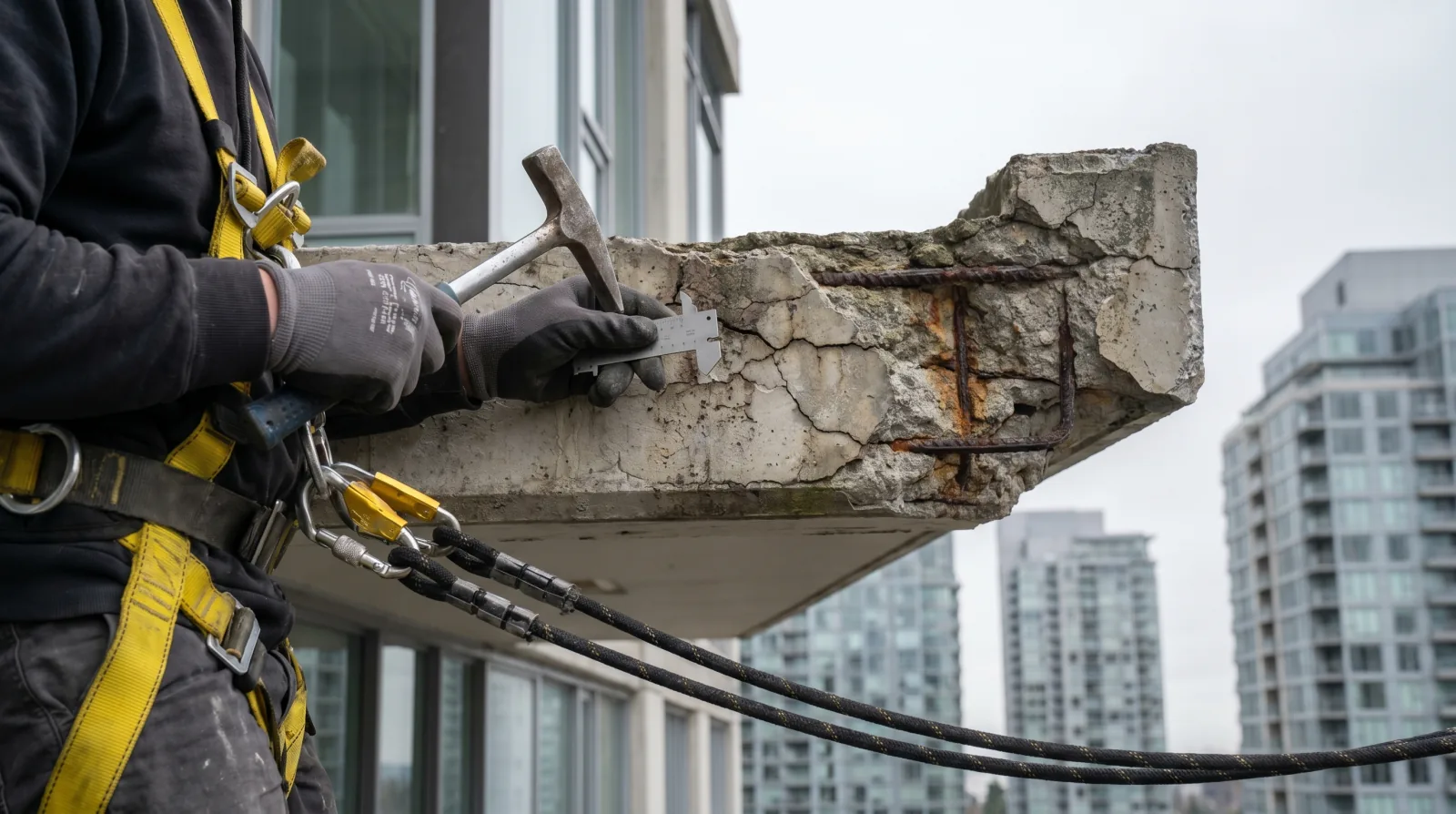
Ice is a machine for opening cracks
Water expands when it freezes. In an open bucket that expansion is harmless. Confined inside a pore or a crack in concrete, it becomes pressure that the surrounding material has to carry. Sound concrete with entrained air has microscopic relief chambers for exactly this; saturated, cracked, or aging material does not, and the pressure does mechanical work on the weakest geometry available, which is almost always the tip of an existing crack.
The coastal pattern makes it worse than colder climates in one specific way. In a Prairie winter, materials freeze once and stay frozen for months, limiting the number of cycles. Here, the temperature crosses zero and comes back over and over, and every crossing of a wet assembly is one more turn of the machine. Wet, then frozen, then wet again: that alternation, more than the depth of cold, is what breaks coastal buildings apart.
The cycle, step by step
Rain saturates the assembly
A multi-day storm fills the pores of concrete and stucco and pushes water into every open crack, joint, and delamination. The wetter the material when the temperature drops, the more work the ice can do. This is why freeze-thaw damage on the coast follows rain events rather than cold snaps alone.
The temperature crosses zero overnight
Clear skies after a storm let surface temperatures fall fast. Water in the outer layer of the material freezes while the interior stays wet. On the North Shore slopes and at higher elevations, this crossing happens many more nights each winter than it does downtown at sea level.
Ice expands inside the material
Water expands as it turns to ice. Trapped in a pore or a crack tip, that expansion becomes internal pressure the material has to resist. Sound, air-entrained concrete tolerates it; cracked, saturated, or poorly consolidated material does not, and the pressure concentrates exactly where the water gathered: in the cracks.
Thaw lets water move deeper
Morning warmth melts the ice, and the meltwater, plus the next rain, moves further into the slightly widened crack than it could before. The damage from each cycle is small, but it is cumulative and it compounds: every cycle leaves the crack a little larger and holding a little more water for the next freeze.
Repeat, dozens of times a winter
By spring, hairline cracks have visibly widened, crack edges have crumbled, surface layers have scaled or flaked, and in the worst cases delaminated patches have let go. What looks like one winter of sudden damage is really that mechanical cycle run again and again on a building that entered the season wet and cracked.
Where it bites on Metro Vancouver buildings
Geography sorts the exposure. Sea-level downtown towers see a few freezing nights a year; buildings on the North Shore slopes, in the British Properties, and up Lonsdale cross zero routinely all winter, and the higher-elevation stock in Coquitlam and Maple Ridge sits in the same band. On any given building, the damage concentrates where water lingers: parapet tops, balcony edges and their drip lines, horizontal trim, planters, and the base of walls where splash keeps the concrete wet. Waterfront buildings add salt to the mix, which keeps surfaces damp longer and attacks the reinforcing steel through the same cracks; that combination is covered in exposed and oceanfront buildings.
Freeze-thaw also rarely works alone. A crack opened over one winter admits more rain the next fall, feeds the corrosion of the rebar behind it, and gives the following winter's ice a bigger purchase. That handoff, from ice damage to rust damage, is how a cosmetic crack becomes a spall repair. The rain events that load the assembly in the first place are described in atmospheric rivers and your building.
What actually limits the damage
Deny the machine its water. Cracks sealed in the dry season cannot fill during the storms, so the freeze finds nothing to expand; this is the least dramatic and most effective freeze-thaw intervention there is, and it is ordinary sealant and crack repair work when done on time. Keeping drains, scuppers, and drip details working matters for the same reason: water that leaves the building cannot freeze in it.
Watch the trend, not the snapshot. A crack photographed at the same spot each month, per the routine in monitoring between storms, shows whether winter is opening it, and a widening crack earns a spring repair before it graduates into concrete restoration. Where spalling and rust staining have already appeared, the scope is bigger than sealing, and that is where our building envelope repair service takes over. The seasonal context for all of it, when to inspect, when to seal, when to schedule, is the storm season readiness hub.
Quick answers
What is freeze-thaw damage on a building?
Freeze-thaw damage is the progressive breakdown of porous materials, concrete, stucco, masonry, and mortar, caused by water freezing inside them. Water expands as it turns to ice, and when that expansion happens inside pores and cracks it pressurizes the material from within. Each freeze-thaw cycle does a small amount of mechanical damage, and a wet coastal winter runs many cycles, so the effect accumulates into widened cracks, scaling surfaces, and spalled patches.
Why is freeze-thaw worse after heavy rain?
Because the damage mechanism needs water in the material at the moment of freezing. A dry wall crossing zero degrees suffers little; a saturated wall crossing zero freezes throughout its outer layer. Metro Vancouver's pattern of multi-day rain followed by clearing, cooling nights is close to the worst case: storms load the assemblies with water, then radiative cooling under clear skies freezes them before they can dry.
Which Metro Vancouver areas get the most freeze-thaw cycling?
Elevation drives it. The North Shore slopes, the British Properties, upper Lonsdale, and buildings toward the mountains in Coquitlam and Maple Ridge cross the freezing point on many more nights than the downtown peninsula at sea level, where the water and the urban mass keep overnight temperatures milder. A building a few hundred metres up the slope can see freeze-thaw cycling weekly through winter while a False Creek tower sees a handful of freezing nights a year.
Freeze-thaw questions
What is freeze-thaw damage on a building?
Freeze-thaw damage is the progressive breakdown of porous materials, concrete, stucco, masonry, and mortar, caused by water freezing inside them. Water expands as it turns to ice, and when that expansion happens inside pores and cracks it pressurizes the material from within. Each freeze-thaw cycle does a small amount of mechanical damage, and a wet coastal winter runs many cycles, so the effect accumulates into widened cracks, scaling surfaces, and spalled patches.
Why is freeze-thaw worse after heavy rain?
Because the damage mechanism needs water in the material at the moment of freezing. A dry wall crossing zero degrees suffers little; a saturated wall crossing zero freezes throughout its outer layer. Metro Vancouver's pattern of multi-day rain followed by clearing, cooling nights is close to the worst case: storms load the assemblies with water, then radiative cooling under clear skies freezes them before they can dry.
Which Metro Vancouver areas get the most freeze-thaw cycling?
Elevation drives it. The North Shore slopes, the British Properties, upper Lonsdale, and buildings toward the mountains in Coquitlam and Maple Ridge cross the freezing point on many more nights than the downtown peninsula at sea level, where the water and the urban mass keep overnight temperatures milder. A building a few hundred metres up the slope can see freeze-thaw cycling weekly through winter while a False Creek tower sees a handful of freezing nights a year.
Why do small cracks grow over winter?
Cracks concentrate the mechanism. Water collects in a crack, freezes, and the ice pressure works on the crack tip, the mechanically weakest point, extending it slightly. The thaw then lets water reach deeper into the extended crack, and the next freeze repeats the process with more water and more depth. Run dozens of cycles over a winter and the hairline crack of November is a visibly open crack by March, now admitting more water year-round.
Does freeze-thaw damage concrete or just coatings?
Both, differently. In concrete, freeze-thaw causes surface scaling, crack growth, and spalling, and it accelerates existing problems like corrosion-induced delamination by opening more paths for water and chloride to reach the reinforcing steel. On coatings and stucco, water freezing behind a coating or in the plaster layer breaks the bond, producing blisters, flaking, and detached patches. In every case the prerequisite is the same: water in or behind the material when it freezes.
Can water freeze inside a wall assembly?
Yes, wherever water has accumulated and the temperature at that depth crosses zero: in rainscreen cavities with blocked drainage, behind delaminated stucco, in saturated insulation near the exterior face, and inside window frames whose weep holes are plugged. Freezing inside an assembly is doubly bad, because the ice damage is invisible until something detaches, and because it usually signals a drainage failure that was already keeping the assembly wet.
When should cracks be sealed to limit freeze-thaw damage?
Before the wet season, in the dry weather when sealants and repair mortars can be applied properly, which is one more argument for the fall inspection cycle. Sealing a crack in October denies the whole winter's worth of cycles their water supply. Chasing cracks in January between storms is possible for urgent cases but slower and weather-dependent. Cracks that appear or widen mid-winter should be logged, monitored, and scheduled rather than ignored until spring.
What does spalling after winter mean?
Spalling, patches of concrete surface breaking away, after a winter usually means one of two mechanisms, often working together. Freeze-thaw pressure broke out material around saturated cracks or scaling surfaces, or corrosion of the reinforcing steel underneath had already delaminated the cover concrete and the winter's cycles finished the job. Rust staining in the spall points to the corrosion mechanism, which is the more serious finding because it continues year-round.
Are North Shore buildings more exposed to freeze-thaw than downtown Vancouver?
As a rule, yes. North Vancouver and West Vancouver buildings sit higher and closer to the mountains, so they see more nights below zero and more snow-then-rain transitions than the downtown core at sea level. The same storm can fall as rain downtown and as wet snow at the top of Lonsdale. For those buildings, the post-rain freeze is a routine winter event and the envelope maintenance cycle should assume it, particularly for horizontal surfaces and parapets that hold water.
Can coatings protect concrete from freeze-thaw?
A sound elastomeric or penetrating coating helps by reducing how much rainwater the concrete absorbs in the first place, which lowers its saturation when the freeze arrives. The caveats matter: the coating must be applied to dry, sound, properly prepared concrete, cracks must be repaired first rather than bridged and forgotten, and a coating over saturated or actively cracking concrete can trap moisture and make the mechanism worse. Coating is a preventive layer, never a repair for freeze-thaw damage already underway.
Cracks that grew over last winter?
We seal cracks and joints before the wet season and repair the concrete where freeze-thaw has already done its work, across North Vancouver, West Vancouver, Vancouver, and Coquitlam.