Soft wash vs. pressure washing overhead glass
A glass canopy is not a sidewalk. It is a glazed assembly with gaskets between the panels and a sealant joint holding water out where it meets the building, and a pressure wand drives water into both. That is the whole argument. The moss comes off, the invoice is low, and six weeks later something starts dripping over the entrance that was not dripping before the clean.
Soft washing gets the same panel just as clean by replacing force with chemistry and contact time: dry debris off first, a solution matched to the soiling applied at low pressure, real dwell time, soft agitation, then a deionized water rinse so the glass dries without spotting. It takes longer and it costs more on the day. This page sets out what the glass industry actually permits, what pressure does to the frame finish and the sealant bead, and the eight questions that separate a canopy clean from a canopy rinse.
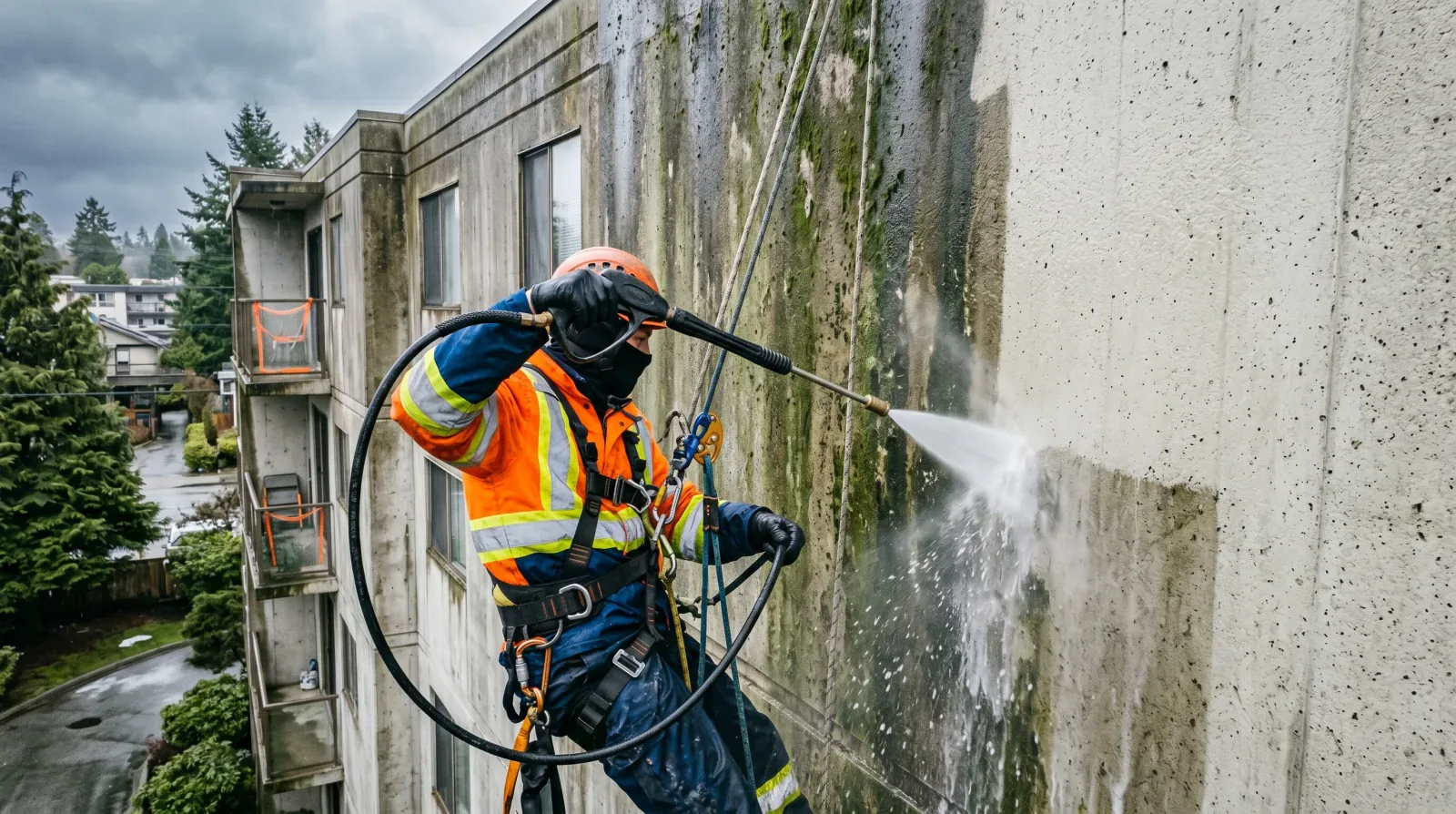
What pressure actually does to a canopy
Water under pressure does not fall, it travels. Aimed at a glazed assembly it goes wherever there is a gap, and on a canopy there are three: the gaskets between panels, the perimeter seal at any glazing bar, and the sealant joint where the whole assembly meets the wall. Every one of those is designed to shed water running down under gravity. None of them is designed to resist water being driven at them from below and from the side.
The wall joint is the one that matters most. It sits at the top of the canopy, right where an operator naturally aims to clear the dirtiest band of glass, and it is usually the oldest sealant on the assembly because nobody has ever inspected it. A bead that has been quietly aging for a decade will hold against rain running down a wall and let go when a jet is put under its edge. The failure does not show that day. It shows in the first sustained rain afterwards, which is why the connection between the clean and the leak is so often missed.
The frame is the visible casualty. Repeated high-pressure passes strip anodizing and powder coating off aluminum, leaving a chalky, blotchy finish in bands where the wand passed closest. That is not recoverable by cleaning; it becomes a coatings job. Plenty of retail plazas have entrance frames that look ten years older than the building, and the cause is an annual wand rather than the weather.
Grit is the real abrasive, not the water
Water at pressure does not scratch glass by itself. What scratches glass is everything the water is carrying. A canopy that has sat through a Metro Vancouver autumn holds a mat of needles, leaf matter, seeds, road grit, and brake dust, and that mat holds together when wet. Aim a jet at it and you are not removing an abrasive, you are accelerating one across the panel.
This is why the first step of a proper canopy clean happens before any water: the debris comes off dry. It is unglamorous work with hands and soft tools, and it is the step that decides whether the panel is scratched. The scratches this produces are fine and directional, invisible under overcast Vancouver skies and unmistakable the first time low winter sun hits the glass at an angle. By then nobody connects it to a cleaning visit eight months earlier.
The same logic rules out abrasive pads and scouring on stubborn spots. If something will not come off with the correct chemistry and adequate dwell time, escalating the abrasion is the wrong direction. Either the chemistry is wrong for the soiling, or the mark is not on the glass at all, which is the case with etched glass, covered in our guide to mineral staining versus surface dirt.
What the glass industry actually says
There is a published standard for this and it is short enough to read. The Glass Association of North America bulletin on proper procedures for cleaning architectural glass products sets out three points that decide most canopy jobs.
On blades: GANA does not condone scraping glass surfaces with blades or scrapers for routine cleaning, and where a blade is used in a non-routine situation it should be limited to the affected area, be new, and be worked in one direction only. Razor blades are never to be used on coated glass, because scraping a coated surface removes the coating and produces a visible change in light transmittance. That last point matters more than most owners realise: a great many canopies carry a low-e or reflective coating on one face, and nobody on site knows which face it is on.
On sequence: cleaning should begin at the top and continue downward, so that solution and dissolved dirt are not left running across glass that has already been finished. On a canopy this scales down to working the band nearest the wall before the leading edge, and finishing the top face before the underside, rather than the reverse.
On method generally: the bulletin describes soaking surfaces with clean water and a soap solution to loosen dirt and debris before anything else happens. Loosen first, then remove. That is the soft wash sequence in one sentence, and it is the opposite of putting a jet on the panel and expecting force to substitute for contact time.
Chemistry and dwell time do the work
Soft washing is often described as "low pressure," which undersells it. The pressure is low because something else is doing the work, and the something else is a solution matched to what is actually on the glass, left on long enough to act.
Three kinds of soiling turn up on a Vancouver entrance canopy and they need three different answers. Organic growth (moss, algae, and the tannin staining hiding underneath it) needs a solution that kills and releases the biological material, with enough dwell time to reach what is underneath. Grease and traffic film on the underside needs a degreasing chemistry, because force aimed upward at an oily film mostly just soaks the frame. Mineral deposit from wall runoff needs an acidic treatment and the longest dwell of the three, and it is the one most often under-treated, which is why an owner concludes after a disappointing clean that the glass is permanently ruined when it is not.
The rinse matters as much as the wash. Rinsing with untreated tap water on a warm day and letting it dry on the panel deposits minerals as the water evaporates, which is the exact staining mechanism you are trying to reverse. A deionized or purified water final rinse dries clear, which is why a water-fed pole system with a filtration stage is standard equipment on this work rather than a selling point.
What a proper canopy clean looks like end to end
Access and protection go up first, because this is overhead work above a doorway. Where the work is done from ropes it falls under WorkSafeBC OHS Regulation Part 11 fall protection, and ladders and elevating work platforms bring Part 13 into it. Either way the area beneath is controlled while somebody is up there, and on a restaurant or retail entrance the sensible answer is early morning before opening.
Then the sequence: dry debris off, solution applied at low pressure to the top face working from the wall outward, dwell, soft agitation, underside treated with the appropriate chemistry, drainage channel and any scupper at the leading edge cleared and flow-tested, deionized rinse, and a look at the parts that are not glass while the access is still set up. That last step is where a soft wash earns its difference in price. Somebody is already close enough to see the sealant joint, the fittings, and the panel edges, and a split bead or a corroding bolt reported now is a planned repair instead of an emergency.
If the canopy is already leaking, none of this is the first move. Water going into an assembly with an open path makes the diagnosis harder, so the leak gets traced first. The three usual causes and how to tell them apart are set out in canopy leaks: wall joint versus glazing gasket versus drainage. Where the sealant at the wall has genuinely failed, that is ordinary building envelope work, covered on our sealant and caulking service page.
Four Metro Vancouver scenarios
Restaurant canopy pressure washed for a low price, leaking six weeks later
A restaurant takes the cheapest of three quotes for its two entrance awnings. A crew arrives with a pressure washer, the moss disappears in under an hour, and the glass looks fine. Six weeks later, in the first real November rain, water starts running down the inside face of the wall above the door and dripping onto the entrance mat. What happened is not mysterious. The jet was aimed upward at the junction where the canopy meets the building, and it drove water past a sealant joint that was already aging, tearing the bond at the top edge. The canopy was not leaking before the clean. Now the fix is a sealant replacement at that joint, done properly with the surfaces cut back, cleaned, primed, and a movement-capable bead tooled in, and it costs several times what the difference between the quotes was.
Call: The cheap clean bought a sealant repair.
North Vancouver strata lobby canopy under cedars
A North Vancouver strata has a glass canopy over the lobby doors sitting directly under mature cedars. Every autumn it collects a thick mat of needles and organic debris, and by February it is green. The instinct is to blast it, because the mat is heavy and wet. The correct sequence is the opposite: get the mat off dry first, by hand and with soft tools, because a wet needle mat contains grit and blasting it drags that grit across the panel. Then soft wash the growth with the right solution and enough dwell time, clear the drainage channel at the leading edge where the needles have packed in, and rinse with deionized water. The drainage is the part that actually reduces next year's problem, because water standing on the panel is what lets the growth take hold.
Call: Dry debris off, soft wash, then clear the drain.
Anodized frame stripped patchy after three years of wand cleaning
A Burnaby retail plaza has had its entrance canopies pressure washed annually for several years by the same janitorial contractor. The glass is acceptable. The aluminum frames are chalky, blotchy, and lighter in bands where the wand passed closest. This is what repeated high-pressure passes do to an anodized or powder-coated finish, and it is not recoverable by cleaning. The options now are to live with it, or to have the frames properly prepared and refinished, which is a coatings job rather than a cleaning one. The lesson for the plaza is worth more than the frames: the cleaning method was chosen by whoever held the janitorial contract, with nobody asking what it was doing to a glazed assembly. Put the canopy cleaning specification in writing and it stops being a matter of habit.
Call: Specify the method in the contract, not the price.
Downtown office atrium glazing with a grease film and a hard water haze
A downtown Vancouver office building has sloped atrium glazing over the entrance that has both a greasy film from street traffic and a white haze near the wall where runoff has been sitting. A single-method clean will fail here, and escalating the pressure will fail louder. These are two different problems. The traffic film needs a degreasing chemistry with dwell time and soft agitation. The white haze needs to be diagnosed first with the wet test. If it disappears while wet it is surface mineral deposit and needs an acidic treatment with real dwell, and if it stays it is etched and no cleaning method will touch it. Doing this properly is two passes with two chemistries, which is a longer visit and a higher quote than a single rinse, and it is the only version that works.
Call: Two problems, two chemistries, one diagnosis first.
Decision framework: nine situations and the right method
| Situation | Method | Reason |
|---|---|---|
| Glass canopy over an entrance, any condition? | Soft wash | There is a sealed joint at the wall and gaskets between panels. Any method that drives water into those details is trading a clean canopy for a leak over a doorway. |
| Heavy moss and leaf mat on the top face? | Soft wash, dry debris first | Remove the mat dry before any water touches it. Blasting a wet mat of moss and grit across the glass is the most reliable way to put fine scratches into a panel. |
| Coated, low-e, or reflective glass? | Soft wash, no blades | GANA is explicit that razor blades must never be used on coated glass, because a scraper removes the coating in a visible stripe. Pressure and abrasives are the same problem at lower resolution. |
| Greasy film on the underside near a kitchen exhaust? | Soft wash, degreasing chemistry | Grease is a chemistry problem, not a force problem. A pressure jet aimed upward at the underside of a canopy soaks the frame and the joint and still leaves the film behind. |
| White haze that does not respond to a normal clean? | Diagnose before re-cleaning | Mineral deposit needs an acidic treatment and dwell time; etched glass needs polishing or replacement. Escalating the pressure on either one damages the assembly and changes nothing. |
| Aluminum frame with an anodized or powder-coated finish? | Soft wash only | Repeated high-pressure passes strip the finish and leave a chalky, patchy frame that then needs refinishing. The frame is the part of a canopy most often ruined by cleaning. |
| Concrete sidewalk or the plaza under the canopy? | Pressure washing is fine | That is the surface pressure washing is for. Just sequence it so the canopy is cleaned and the overspray is controlled, rather than blasting the deck and then rinsing the canopy with what bounces up. |
| The canopy already drips when it rains? | Investigate first, do not wash | A leaking canopy has an open path somewhere. Putting any water into it under pressure before the path is found makes the diagnosis harder and can turn a small split into an active leak. |
| Contractor quoting the lowest price with a wand? | Ask the follow-up question | Ask how they will keep water out of the sealant joint at the wall. There is no good answer to that question with a pressure wand, and the answer you get tells you whether they have thought about the assembly at all. |
The two methods compared
Soft wash
Dry debris removed first, then a pH-appropriate biodegradable solution applied at low pressure and left to dwell, agitated with soft tools, and rinsed with deionized water so the glass dries without spotting. The chemistry does the work and the pressure does almost none of it.
Pressure washing
A high-pressure water jet drives dirt off the surface mechanically. The pressure does the work. It is the right tool on hard, monolithic, unsealed surfaces such as a concrete sidewalk or a parkade deck, and the wrong tool on a glazed assembly.
Questions to ask before you approve the scope
Canopy cleaning quotes vary more than almost any other line item on a building, and the variation is method, not margin. These eight questions surface the difference before the crew arrives.
- What method will you use on the glass and the frame? Good answer: Dry debris removal, low-pressure application of a solution matched to the soiling, dwell time, soft agitation, and a deionized water rinse. Red flag: Any answer built around pressure. A wand is fast and it is the wrong tool on a glazed assembly with a sealed joint to the building.
- How will you keep water out of the sealant joint where the canopy meets the wall? Good answer: By not applying water under pressure at that junction, and by inspecting the joint while up there so anything already split is reported rather than flooded. Red flag: The question has never come up. That joint is the most common canopy leak, and a contractor who has not thought about it is about to introduce the problem you called them to avoid.
- Is any of this glass coated? Good answer: We check before we touch it, and we treat all of it as coated unless proven otherwise. No blades, no abrasives. Red flag: An assumption that it is plain glass. Plenty of canopies carry a low-e or reflective coating on one face and nobody on site knows which face, and a scraper finds out permanently.
- Will you use a scraper or a blade on stubborn spots? Good answer: Not routinely, and never on coated glass. Where a blade is the only option on non-coated glass, it is limited to the affected spot, a new blade, one direction only. Red flag: Blades as a normal part of the method. GANA does not condone scraping glass for routine cleaning, and a scraped canopy is visible from the sidewalk for the rest of its life.
- What order do you clean in? Good answer: Top down, so solution and dissolved dirt do not run across panels that are already finished. Red flag: No sequence at all. Working bottom-up leaves residue on the finished glass, and that is exactly the streaking the owner then blames on the product.
- How is the final rinse done? Good answer: Deionized or purified water, so the glass dries without leaving mineral spots as the water evaporates. Red flag: A rinse with untreated tap water on a hot day. The water evaporates on the panel and leaves behind the very mineral deposit you are trying to prevent.
- How much dwell time does the solution get? Good answer: Enough for the chemistry to work on the soiling present, stated as part of the method, with the understanding that mineral deposit needs longer than surface dirt. Red flag: Spray and immediately rinse. That is a rinse, not a clean, and it is why the haze is still there afterwards.
- What is the plan for working over the entrance? Good answer: Barriers and drop protection under the work, fall protection appropriate to the access method, and early-morning scheduling so the entrance is clear before opening. Red flag: A ladder leaned against the canopy over an open doorway during business hours. That is the version of this job that ends with an incident report.
For how often this needs doing on your exposure, and why a restaurant entrance is on a different schedule from an office lobby, see restaurant grease film on entrance glass, and the full glass canopy and awning hub links the rest.
Quick answers
Can you pressure wash a glass canopy?
You can, and it is the wrong tool. High pressure drives water sideways into the glazing gaskets between panels and into the sealant joint where the canopy meets the building wall, which is the detail keeping water out of your entrance. It also drags grit across the glass and strips the finish off anodized or powder-coated aluminum frames over repeated visits. Soft washing gets the same canopy just as clean without any of that, which is why it is the default method on overhead glass rather than a premium option.
What is soft washing, exactly?
It is a sequence, not a product. Dry debris (leaves, needles, moss mats, grit) is removed first, before any water touches the glass. Then a biodegradable solution matched to the soiling is applied at low pressure and given real dwell time so the chemistry does the work. The surface is agitated with soft brushes or microfibre rather than force. Finally the glass is rinsed with deionized or purified water so it dries without leaving mineral spots. The whole method is built around chemistry and contact time replacing pressure.
Why does the debris have to come off dry first?
Because wet organic debris holds grit, and grit under water pressure becomes an abrasive dragged across the panel. A mat of wet cedar needles blasted off a canopy leaves fine scratches that are invisible on a grey day and obvious the first time low sun hits the glass. Removing the mat dry costs a few extra minutes and removes the abrasive before any water arrives.
Canopy cleaning method questions
Can you pressure wash a glass canopy?
You can, and it is the wrong tool. High pressure drives water sideways into the glazing gaskets between panels and into the sealant joint where the canopy meets the building wall, which is the detail keeping water out of your entrance. It also drags grit across the glass and strips the finish off anodized or powder-coated aluminum frames over repeated visits. Soft washing gets the same canopy just as clean without any of that, which is why it is the default method on overhead glass rather than a premium option.
What is soft washing, exactly?
It is a sequence, not a product. Dry debris (leaves, needles, moss mats, grit) is removed first, before any water touches the glass. Then a biodegradable solution matched to the soiling is applied at low pressure and given real dwell time so the chemistry does the work. The surface is agitated with soft brushes or microfibre rather than force. Finally the glass is rinsed with deionized or purified water so it dries without leaving mineral spots. The whole method is built around chemistry and contact time replacing pressure.
Why does the debris have to come off dry first?
Because wet organic debris holds grit, and grit under water pressure becomes an abrasive dragged across the panel. A mat of wet cedar needles blasted off a canopy leaves fine scratches that are invisible on a grey day and obvious the first time low sun hits the glass. Removing the mat dry costs a few extra minutes and removes the abrasive before any water arrives.
Are razor blades ever used to clean canopy glass?
Not routinely, and never on coated glass. The Glass Association of North America bulletin on cleaning architectural glass is explicit that GANA does not condone scraping glass surfaces with blades or scrapers for routine cleaning, and that razor blades should never be used on coated glass, because a scraper removes the coating and leaves a visible change in the panel. Where a blade is genuinely the only option on non-coated glass, its use is limited to the affected spot, with a new blade, worked in one direction only.
Why does the cleaning have to start at the top?
So that solution and dissolved dirt do not run down across glass that has already been finished. GANA calls for cleaning to begin at the top of a building and continue to the lower levels for exactly this reason. On a canopy the same logic applies at a smaller scale: work the upper face and the panels closest to the wall before the leading edge, and clean the top before the underside, or you will finish the underside and then rinse the top face over it.
Does soft washing work on heavy moss and algae?
Yes, and it is what you want on heavy growth specifically. The mat comes off dry first, then the residual biological staining is treated with a solution given enough dwell time to kill and release it. The reason this beats blasting is that the growth is not the only thing on the panel. Underneath it there is usually tannin staining from decayed leaf matter, and blasting the moss off simply exposes stains that then need chemistry anyway. Doing it in the right order is one visit instead of two.
Will soft washing remove the white haze on my canopy?
That depends on what the haze actually is. A mineral deposit sitting on the surface responds to an acidic treatment with real dwell time, which is a soft wash with different chemistry rather than a different method. Etched glass, where water has sat long enough to leach alkali out of the surface, cannot be removed by any cleaning process. Wet the glass and watch: haze that disappears while wet and returns as it dries can be cleaned, haze that stays visible while wet cannot.
Is pressure washing ever appropriate around an entrance?
Yes, on the right surface. The concrete sidewalk, the plaza, and the hard unsealed paving under the canopy are exactly what a pressure washer is for. What matters is sequence and control: clean the glass first or protect it, keep the wand away from the wall junction and the glazing, and manage the overspray so grit-laden water is not bouncing back up onto finished panels. The rule is about assemblies with seals in them, not about the machine.
Want the canopy cleaned without opening the wall joint?
We soft wash both faces, clear the drainage, and inspect the seals and fittings on entrance canopies across Vancouver, North Vancouver, West Vancouver, and Burnaby.