Metal Flashing Detail Failures in BC Rainscreen Walls
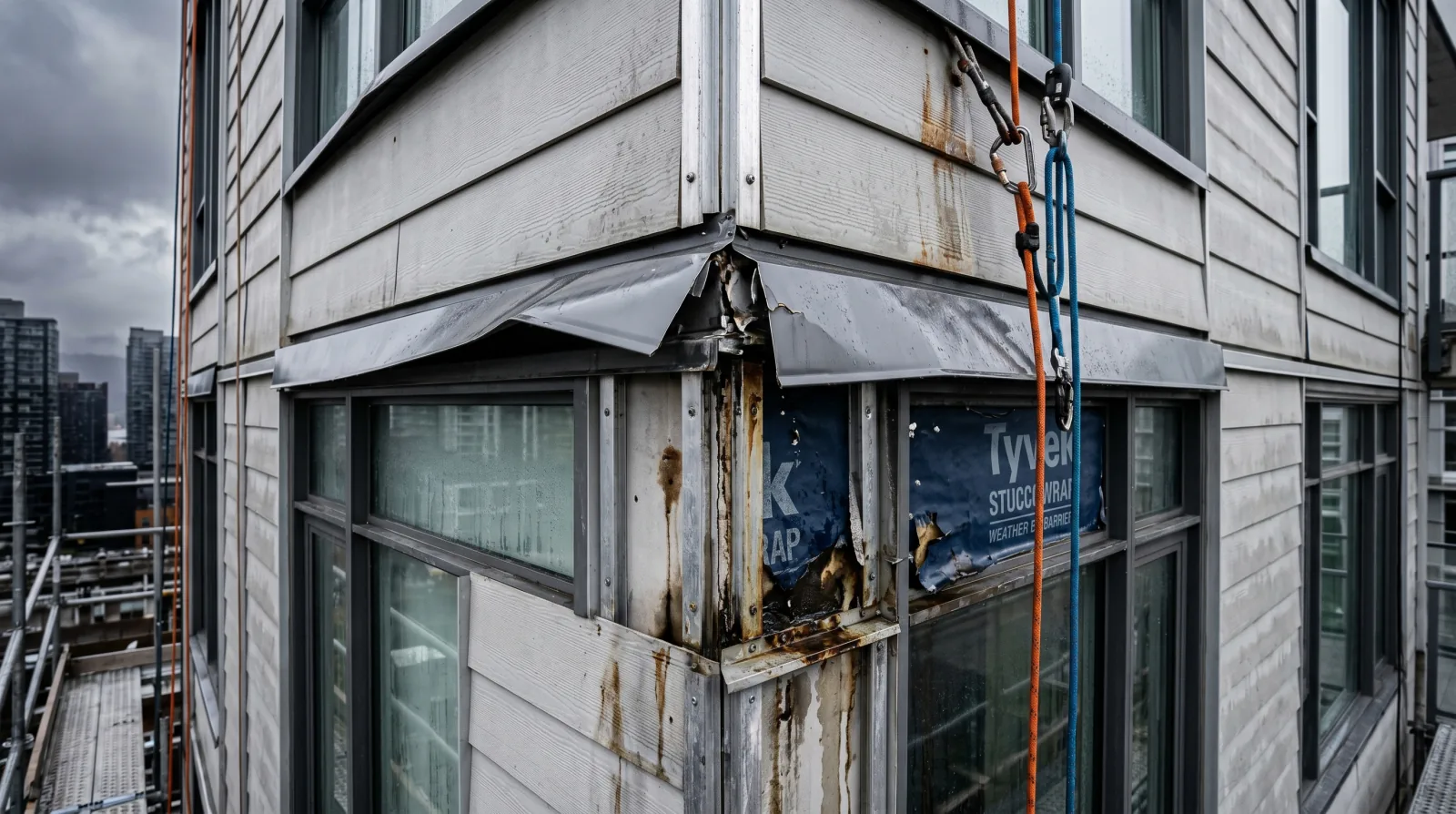
A property manager in Burnaby has repainted the same water stain under the same third-floor window three times. The cladding looks fine. The window sealant was redone last year. The leak keeps coming back every winter. The contractor finally opens up the wall above the window and finds the answer in a strip of bent metal: the head flashing was installed with its ends open and no upturn, so it caught water and dumped it straight back into the wall.
That metal is flashing, and it’s the part of a rainscreen wall that does the most work while getting the least attention. Cladding gets all the scrutiny. Flashing — the thing that actually decides whether the water that gets behind the cladding leaves the building or rots it — sits behind the panels where nobody looks.
A rainscreen wall expects water to get in
This is the part that trips people up. A rainscreen wall is not designed to keep every drop of rain out of the cladding cavity. It assumes water will get behind the cladding — driven by wind, drawn in by pressure differences, finding its way through joints. The system is built around that assumption.
The way it works: the cladding sheds most of the rain. Behind it sits a drained, back-ventilated cavity. Any water that gets through runs down inside that cavity and is meant to exit at controlled points. The flashing is what catches that water at each of those points and sheds it back out before it reaches the structure. The cladding is the umbrella. The flashing is the drainage. A perfect umbrella over a blocked drain still floods.
That’s why good cladding over bad flashing leaks. The water gets in — as designed — and then has no proper way out, because the detail that was supposed to manage it is funneling it inward instead. The full range of water ingress causes in multi-storey buildings keeps coming back to this: it’s rarely the cladding, and very often the flashing.
The three failures that show up again and again
Flashing failures aren’t exotic. The same handful of mistakes appear across Metro Vancouver buildings, old and new.
Reverse laps. Overlapping materials should be layered like shingles — upper over lower — so water sheds outward and down. A reverse lap is when a flashing is tucked behind the material below it instead of over it. Now water running down the wall hits that joint and is funneled into the wall instead of shedding over it. The flashing isn’t just failing to help; it’s actively channeling water inward at every lap.
Missing end dams. A head or sill flashing should have upturned ends — end dams — that stop water from running off the end and back into the cladding cavity. Without them, the flashing collects water along its length and then pours it off its open ends straight into the wall. A flashing with no end dams can be worse than no flashing at all, because it gathers water and then delivers it to a concentrated point inside the structure.
Sealant used as flashing. Someone finds a bad detail or a gap and smears sealant over it as a field fix. Sealant is a wear item: it dries out, cracks, and fails. Flashing is a permanent physical path that sheds water by its shape and gravity, with no expiry date. When sealant is doing a flashing’s job, the leak will almost always return, and now it’s hidden under a bead of failed caulking that looks like someone addressed it.
Why coastal BC makes it worse
Flashing is usually metal, and metal corrodes — faster in the salt-laden air of coastal Metro Vancouver. So on an older building you can have two problems stacked: flashings that were badly detailed when they went in, and the same flashings now physically deteriorated by decades of coastal exposure and Pacific Northwest rain. A reverse-lapped flashing that was leaking slowly from day one can become a wide-open path once the metal corrodes through and the sealant at its laps dries out.
This is also the through-line to the rainscreen and leaky condo legacy. Many of the BC buildings that failed in the 1980s and 90s were face-sealed walls with little or no flashing to manage water that got past the exterior. The move to rainscreen construction was supposed to fix that by making proper flashing a core part of a drained system. The design is right. But flashing is only as good as its installation, and bad flashing details are still where a lot of newer buildings leak — through workmanship, not through bad code.
Where flashing failures hide
If your building has recurring leaks despite cladding and sealant repairs, the pattern of the damage often points at flashing. Watch for:
- Water staining or interior damage concentrated below windows, at floor lines, or where the wall changes shape — exactly where head, sill, and transition flashings live
- Rust streaks or corroded metal visible at flashing edges and weep points
- Sealant smeared over flashing joints as an obvious field fix
- Leaks that come back after the cladding and the sealant have already been redone
The same logic applies at windows specifically. Window perimeter sealant failure gets the blame for a lot of leaks, but the sill and head flashing around the window is just as often the real culprit — and re-sealing a window with a bad head flashing above it just delays the next call.
You usually have to open the wall to know
Here’s the honest part. Flashing is hidden behind cladding, so you can’t fully assess it from the outside. Some accessible flashings — at windows or wall bases — can be inspected and repaired with limited cladding removal around the detail. But flashings buried behind panels, or systemic problems across many details, mean opening up representative areas of the wall to see what’s actually there.
That’s why a real building envelope assessment doesn’t just look at the cladding surface. A proper building envelope condition assessment opens up representative flashing details at windows, wall bases, transitions, and penetrations to see the metal and the laps behind the panels. Skipping that leaves the single most common leak source unexamined. An assessment that won’t open a wall to check the flashing isn’t telling you where your building is most likely to leak — it’s telling you what’s easy to see.
What to do about it
Flashing problems don’t fix themselves, and they don’t get cheaper with time — a leak that starts at a missing end dam eventually reaches insulation, sheathing, and framing. If you suspect flashing is behind your leaks:
- Get an assessment that opens up details. Insist that flashing at windows, bases, and transitions is examined, not just the cladding face.
- Stop using sealant as a flashing substitute. If the field fix was a bead of caulking over a bad detail, the detail still needs correcting.
- Fix the detail, not just the symptom. Correct the reverse lap, add the end dam, replace the corroded metal — so the water that gets behind the cladding has a real way out.
The cladding is what everyone sees, so it’s what everyone blames. But on a rainscreen wall, the metal you can’t see is what keeps the building dry. Get the flashing right and the cladding can do its job. Get it wrong and the best cladding in Metro Vancouver won’t save you.
Related guides
- Concrete Restoration Hub — envelope and structural repair work
- The Rainscreen and Leaky Condo Legacy in Vancouver — how BC walls evolved
- What Causes Water Ingress in High-Rise Buildings — the full picture of envelope leaks
- Window Perimeter Sealant Failure on Curtain Wall Towers — sealant and flashing at windows
Frequently Asked Questions
More from Flat Roof Systems Guide
Roof Drain and Scupper Maintenance on Vancouver Strata Flat Roofs
A clogged roof drain is the cheapest leak you'll ever ignore — until ponding water destroys the membrane. How Burnaby strata roofs fail at the drains.
Read article →EPDM vs TPO Flat Roof Membranes for BC Strata Buildings
Choosing between EPDM and TPO single-ply membranes on a Burnaby strata low-rise comes down to seams, reflectivity, and how each ages in Pacific NW rain.
Read article →Spray Polyurethane Foam Roofing on BC Commercial Buildings: When It Makes Sense
Spray polyurethane foam (SPF) roofing is well established in colder North American climates but used sparingly in coastal BC. Where it works, where it fails, and how it compares to the membrane systems that dominate Metro Vancouver flat-roof installations.
Read article →