Silicone vs Polyurethane Sealant for Expansion Joints in BC Buildings
Two materials, two jobs, one common mistake
Walk any Metro Vancouver high-rise with us and you will find both silicone and polyurethane sealant on the same building — sometimes within a few feet of each other. That is not inconsistency. It is the right answer. These two materials do different jobs, and the most expensive sealant mistakes we see come from using one where the other belonged.
A sealant joint looks like the simplest thing on a building. It is a bead of flexible material filling a gap. But that gap is usually an expansion joint — a deliberate break that lets the structure move as it heats, cools, and shifts — and the sealant has to stretch and compress through every one of those cycles for years, in the rain, in the sun, without losing its grip on either face. Choosing the wrong material, or installing the right one badly, is why so many buildings leak through joints that were resealed only a few years earlier.
Silicone: the UV champion that won’t take paint
Silicone is an inorganic polymer, and that single fact drives most of its behaviour. Because it is not built on the carbon chemistry that sunlight attacks, silicone does not degrade in UV light the way organic sealants do. On an exposed, sun-blasted facade joint, that weathering resistance translates directly into service life.
Silicone also handles movement extremely well. High-performance silicones meet the top movement classes under ASTM C920 — a Class 50 sealant accommodates ±50% joint movement — which makes them well suited to the wide thermal cycling a south or west elevation sees in Burnaby or Vancouver. For an exposed, high-movement expansion joint that nobody needs to paint, neutral-cure silicone is usually the strongest choice.
The catch is in that last clause. Paint will not stick to standard silicone. If a joint sits in a painted or coated concrete wall and needs to disappear into the color, silicone leaves you stuck — you cannot coat over it. That limitation, more than anything, is what sends us to polyurethane on coated elevations.
Polyurethane: paintable, tough, and traffic-tolerant
Polyurethane is the organic counterpart, and its strengths are exactly where silicone is weak. It bonds tenaciously to concrete and masonry, it can be painted over, and it stands up to foot and vehicle traffic — which is why polyurethane, not silicone, goes into parkade deck joints and balcony thresholds where people and tires cross the seam.
On a coated concrete tower, polyurethane lets the joint be color-matched into the wall finish, so a resealed elevation looks uniform instead of striped with visible beads. It also tends to be more forgiving on damp or freshly cleaned substrates than some silicones, though every product has its own primer and moisture requirements.
Where polyurethane gives ground is UV. Under direct, prolonged sun it chalks and degrades faster than silicone, so on the most exposed high-movement joints it generally needs replacing sooner. Both materials can carry an ASTM C920 rating; the standard sets the performance floor, but it does not erase the chemistry difference that decides which one belongs in a given joint.
Why installation matters more than the label
Here is the uncomfortable truth from decades of cutting out failed joints: the product choice matters, but bad installation kills good sealant faster than the wrong material ever does. We routinely find premium sealant — the right product, properly specified — failing years early because of how it went in.
The two faults we see most:
- Three-sided adhesion. A working joint should bond to only two faces so it can stretch across the gap. That requires a bond breaker — a backer rod or tape at the back of the joint — so the sealant does not grab the third surface. When installers skip it, the sealant adheres on three sides, cannot move, and tears the first cold snap that opens the joint.
- Wrong profile. The bead needs the right width-to-depth ratio, tooled into an hourglass shape over a backer rod, so the thin middle can flex without over-stressing the bond line. A flat, overfilled smear of caulk troweled across the joint face looks fine on day one and splits within a season.
Get the joint design and the installation right and a mid-grade sealant outperforms a premium product installed carelessly. This is the part of the job that does not show up on a spec sheet and makes the difference between a 15-year joint and a 3-year one.
Side-by-side comparison
| Factor | Silicone | Polyurethane |
|---|---|---|
| UV / weathering resistance | Excellent (inorganic, UV-stable) | Moderate (chalks under prolonged sun) |
| Movement class (ASTM C920) | Up to Class 50 (±50%) | Up to Class 35 |
| Paintable / coatable | No (standard formulations) | Yes |
| Adhesion to concrete | Excellent with correct primer | Excellent |
| Traffic tolerance | Low | High (parkades, thresholds) |
| Typical service life in coastal BC | 15–25 years (exposed joints) | 10–15 years (exposed); longer in shade |
| Best application | High-movement, uncoated facade joints; glazing perimeters | Coated walls, parkade deck joints, balcony thresholds |
| Cost (approx.) | Moderate to high | Moderate |
| Hybrid alternative | — | Silyl-terminated polyether (STP) — paintable + UV-stable |
The exposure reality on the coast
Metro Vancouver punishes sealant. Wind-driven rain on exposed North Vancouver and West Vancouver elevations drives water into any joint that has lost its grip, and the long wet season means a failed joint leaks for months, not days. Sea-salt exposure on the North Shore and along the water adds another stress. None of that changes the chemistry, but it shortens the margin for error — a joint that might limp along inland fails outright on an exposed coastal face.
That is why we tend to specify silicone on the most exposed, highest-movement joints where weathering drives the decision, and reach for polyurethane where coatability or traffic governs. The building’s geometry, finish, and exposure decide the mix.
Where hybrid sealants and the right primer fit
The silicone-versus-polyurethane choice is not always either-or. There is a third category worth knowing about, and a detail about primers that decides whether any of them holds.
Hybrid sealants — silyl-terminated polyethers and similar chemistries — try to combine the strengths of both families: better UV resistance than straight polyurethane, with the ability to be painted over that silicone lacks. On a coated concrete elevation in Burnaby or Surrey where we want both weatherability and a finish that disappears into the wall colour, a quality hybrid can be the right specification. They are not a miracle product, and they cost more, but they fill a real gap for joints that need to do two jobs at once. We reach for them when neither pure silicone nor pure polyurethane cleanly fits the exposure and the finish requirement together.
Whatever the chemistry, the primer is the quiet variable that makes or breaks adhesion. Different sealants need different primers on different substrates — concrete, aluminum window frames, painted surfaces, and glass each behave differently, and the manufacturer specifies which primer goes where. Skipping the primer, or using the wrong one, produces a joint that looks perfect on installation day and peels off the substrate within a season. This is one of the most common hidden failures we find: the sealant itself is intact, but it has let go of the wall because it was gunned onto an unprimed or incompatible surface. On a mixed facade — concrete panels, metal window frames, glass — a single building can need several different primer-and-sealant combinations to seal every joint type correctly.
Substrate condition matters just as much. A joint face that is dusty, damp, or contaminated with old sealant residue will not hold new material no matter how good the product or primer. Proper preparation means cutting the old sealant fully out, cleaning the joint faces back to sound substrate, and confirming they are dry before priming. On a coastal building that has soaked up a wet Vancouver winter, that “confirming they are dry” step is not a formality — sealing a damp joint traps moisture and undermines the bond from the first day.
This is why we are wary of anyone quoting a reseal purely on which sealant brand they will use. The product is one input. The primer, the substrate prep, the joint design, and matching the right system to each joint type on the building are what actually determine whether the reseal lasts fifteen years or fails in three.
One joint or the whole building?
When a strata calls about a single leaking joint, the real question is usually bigger than that joint. If a building’s sealant was all installed at the same time with the same material — as it usually is — those joints age together and reach end of life together. Chasing one failed joint at a time on a 20-year-old elevation means coming back for the next one, and the next, while water keeps finding the gaps.
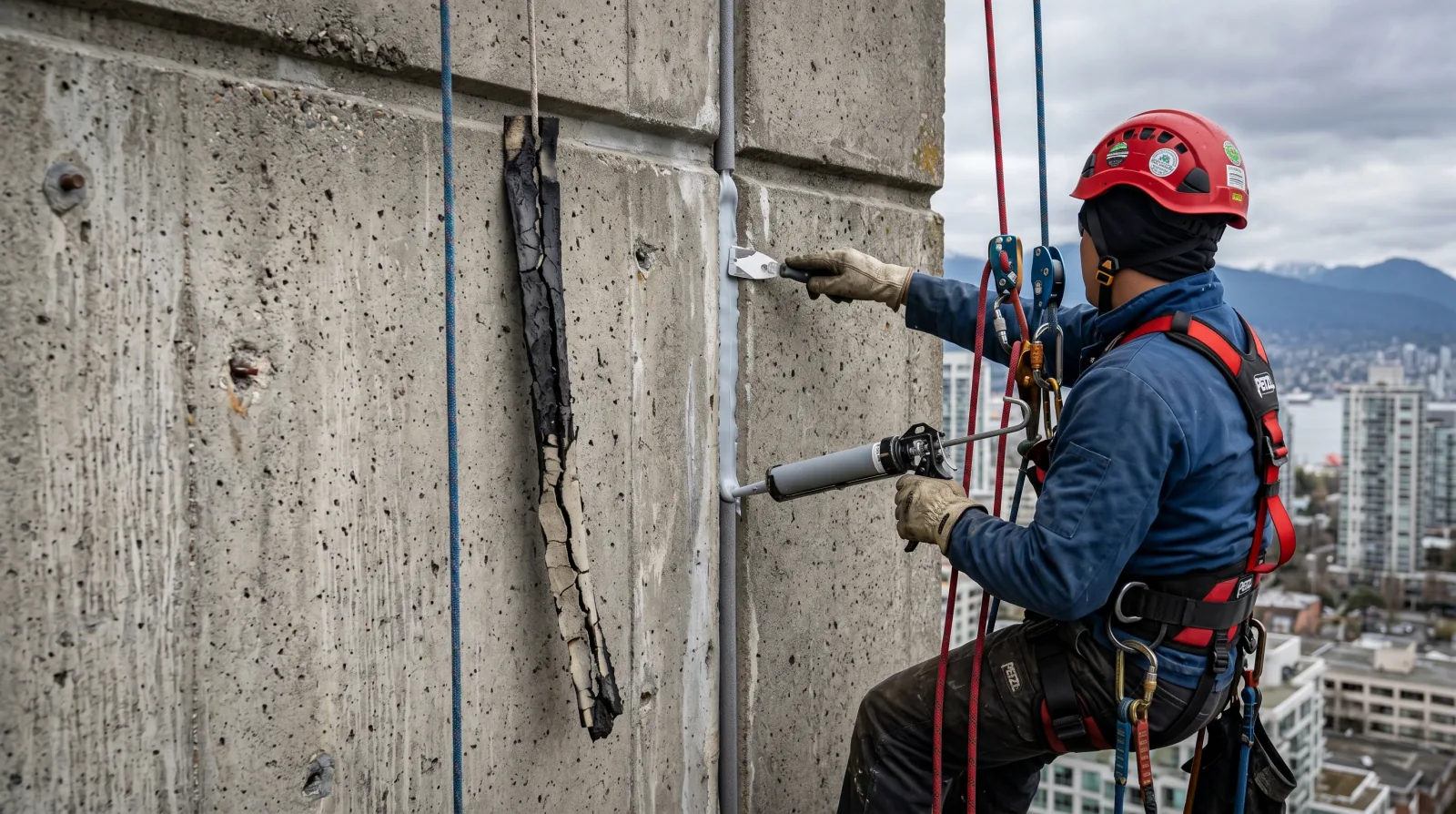
A planned, building-wide reseal is almost always the better value on a building whose joints have reached their service life as a group. Certified rope access crews can work down a facade joint by joint — cutting out the old material, cleaning and priming, installing new backer rod, and tooling fresh sealant — reaching every joint on a Vancouver or Coquitlam tower without scaffolding. That access efficiency is what makes a building-wide reseal affordable enough to do once and properly, rather than in endless reactive patches.
Our polyurethane versus silicone sealant guide goes deeper on material selection, and the sealant and caulking service page covers how we approach facade joint renewal. If your building’s joints are the same age and starting to fail, that is the signal to look at the whole envelope, not just the joint that happened to leak first.
Frequently Asked Questions
More from Sealant & Caulking Guide
Field Sealant Adhesion Testing on BC Restoration Projects
A sealant that won't stick is a leak waiting to happen. Why a hand pull test on a Surrey restoration project catches the failure before it ever ships.
Read article →Expansion Joint Failure Between Precast Concrete Panels in Vancouver
The joints between precast panels on a Vancouver high-rise move constantly, and sealant is the only thing keeping rain out. Why they fail and how to fix them.
Read article →Window Perimeter Sealant Failure on Vancouver Curtain Wall Towers
The sealant around window and curtain wall joints is the first line of defence against wind-driven rain on a Vancouver tower — and the first thing to fail. How to spot it, why it happens, and what restoration actually involves.
Read article →