Building drainage on Metro Vancouver strata and commercial buildings
Every membrane, flashing, and sealant joint on a building assumes the water keeps moving. The drains, scuppers, gutters, and grading that keep it moving get far less attention than the membranes they protect, and they fail more often. This is the working reference we hand strata councils and property managers across Vancouver, Burnaby, and the North Shore when water starts showing up where it should not.
Why drainage is the first thing we check on the coast
Average annual precipitation at Vancouver International Airport (1991 to 2020), and every drop that lands on a roof or deck has to leave through a drain, scupper, or gutter.
Damage from the "leaky condo" crisis across 900+ Lower Mainland buildings, where concentrated, poorly drained water overwhelmed assemblies that could not dry.
The depreciation-report cycle required of BC strata corporations of 5+ lots under the Strata Property Act, where roofing and drainage are tracked as funded components.
Ten guides, from the roof down to the ground
Water moves through a building's drainage in one direction, so the guides are ordered the same way: the systems from roof to grade first, then how the maintenance is done, then how to read the warning signs when something is already wrong.
 Systems
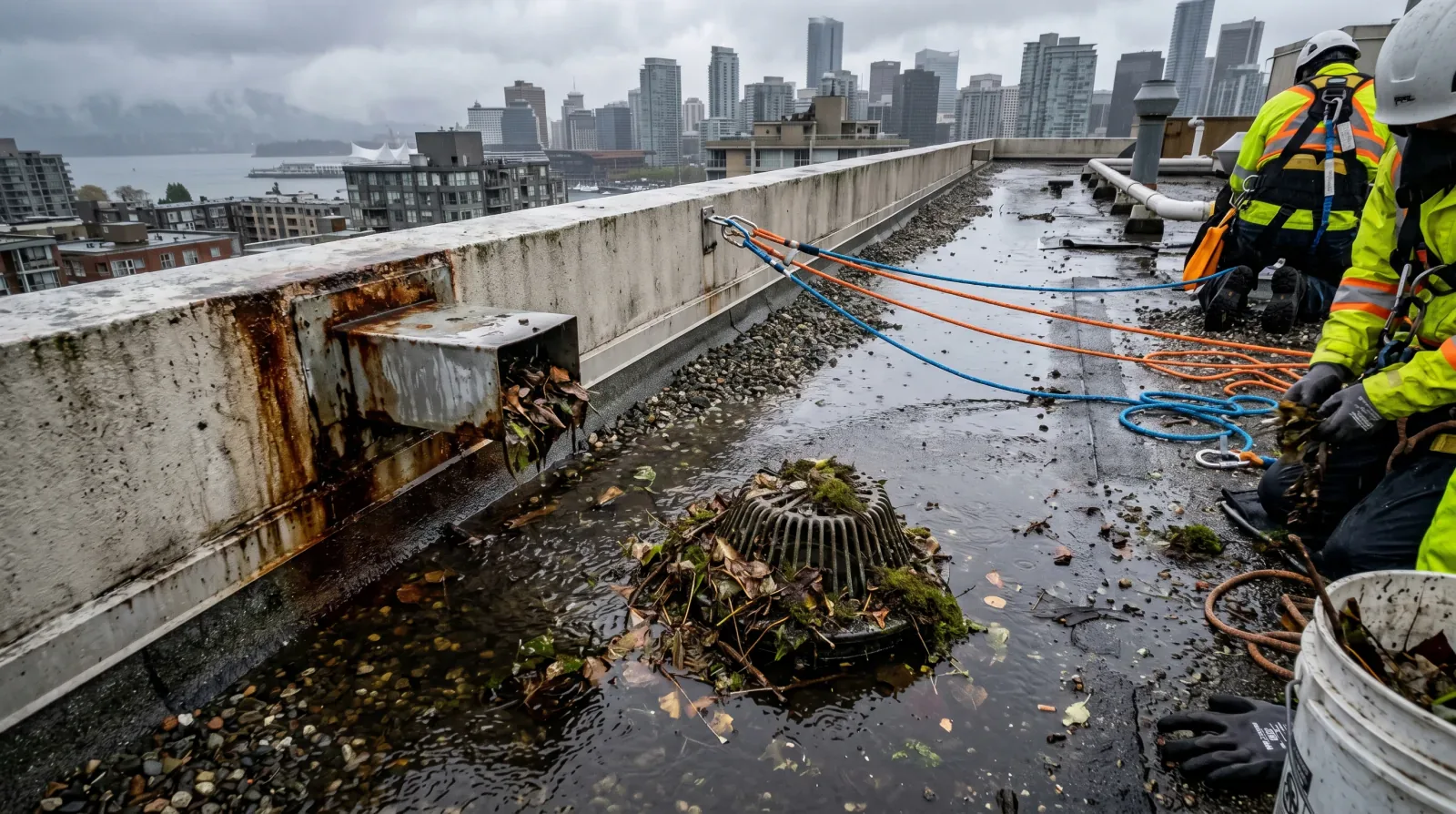
 Flat roof drains and overflows
How internal roof drains work, what the overflow is actually for, and why a blocked primary drain plus a dead overflow turns a flat roof into a swimming pool during a November storm.
Read the guide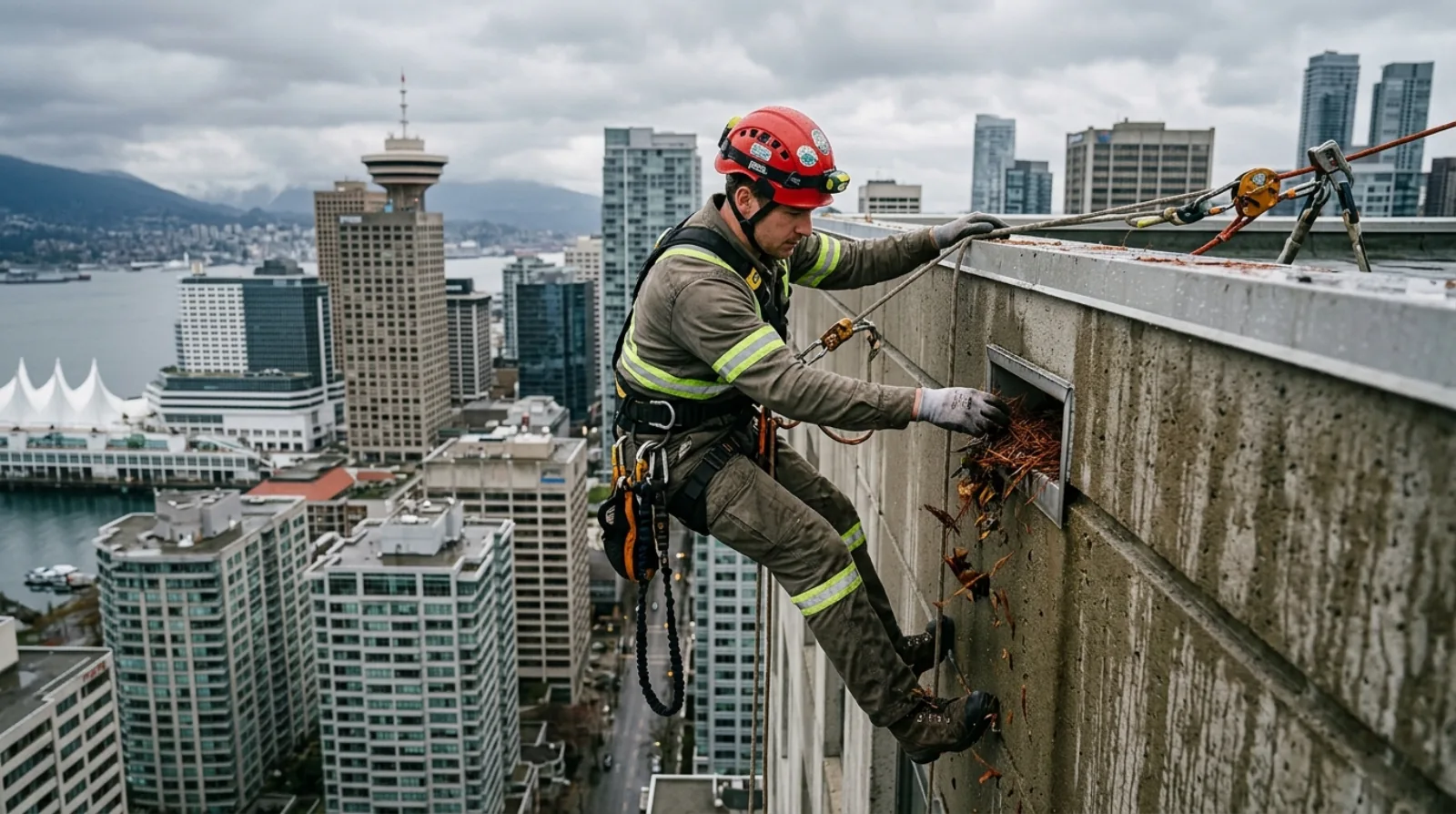 Systems
 Scuppers explained
The through-wall openings that drain parapet roofs and decks. Parapet scuppers versus deck scuppers, how they blind off with debris, and why a scupper blockage hides until the water is already high.
Read the guide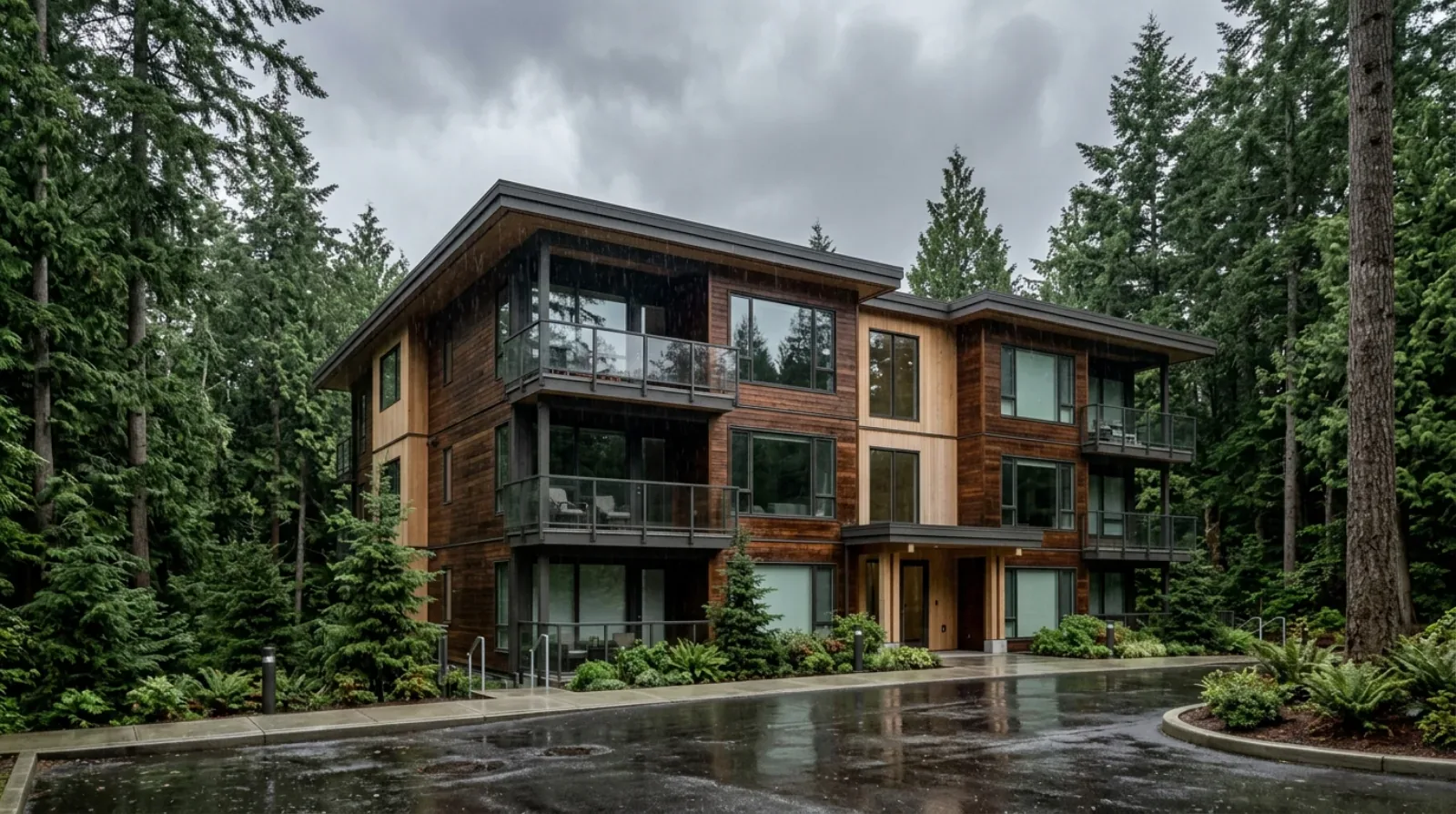 Systems
 Gutters and downspouts on strata buildings
Eavestroughs, downspouts, and rainwater leaders on low-rise strata. What overflow staining on the fascia is telling you, and why the downspout outlet matters as much as the gutter itself.
Read the guide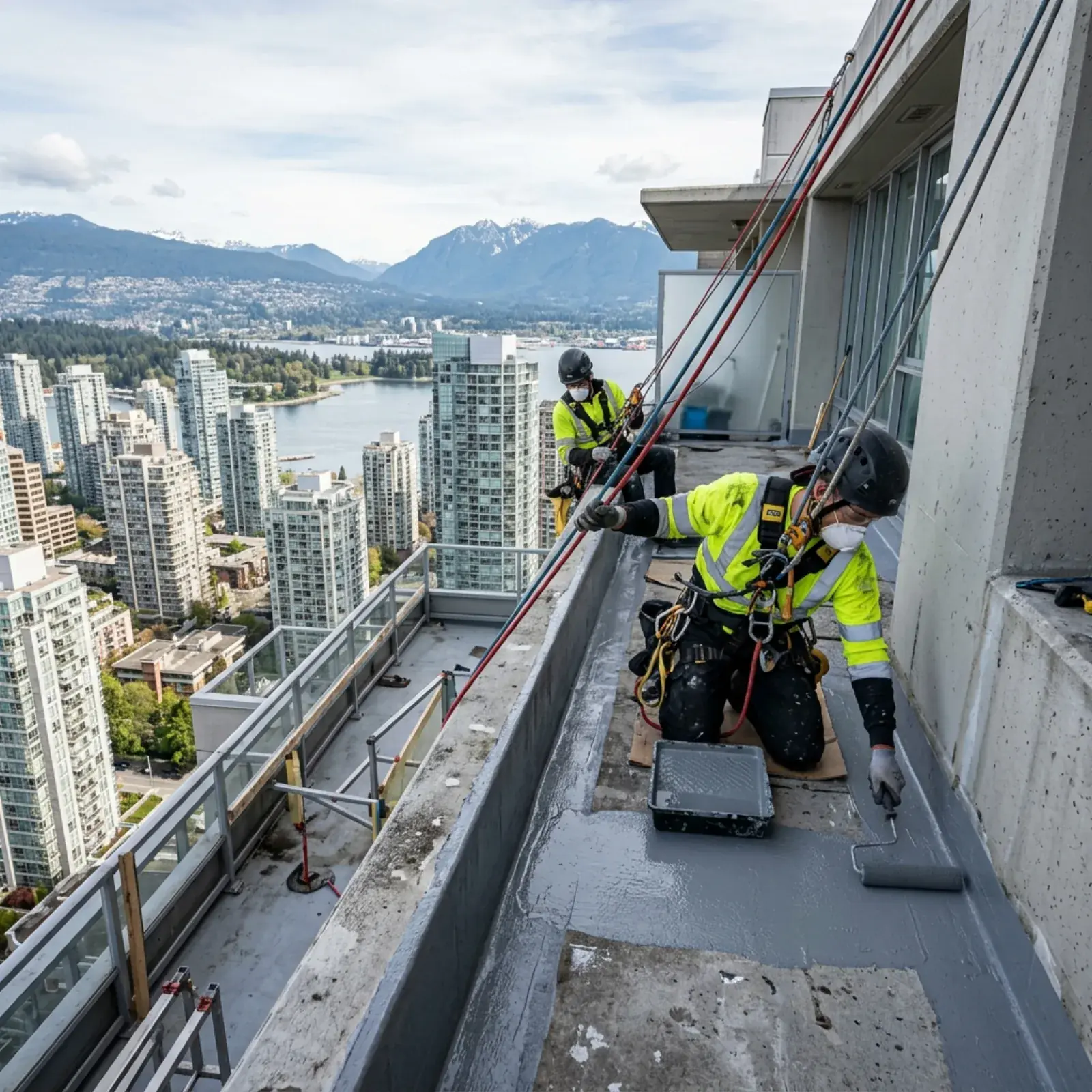 Systems
 Balcony and deck drains
Deck drains, slope-to-drain, and why standing water is the fastest way to age a membrane. The drainage half of the balcony story, with the membrane half in its own hub.
Read the guide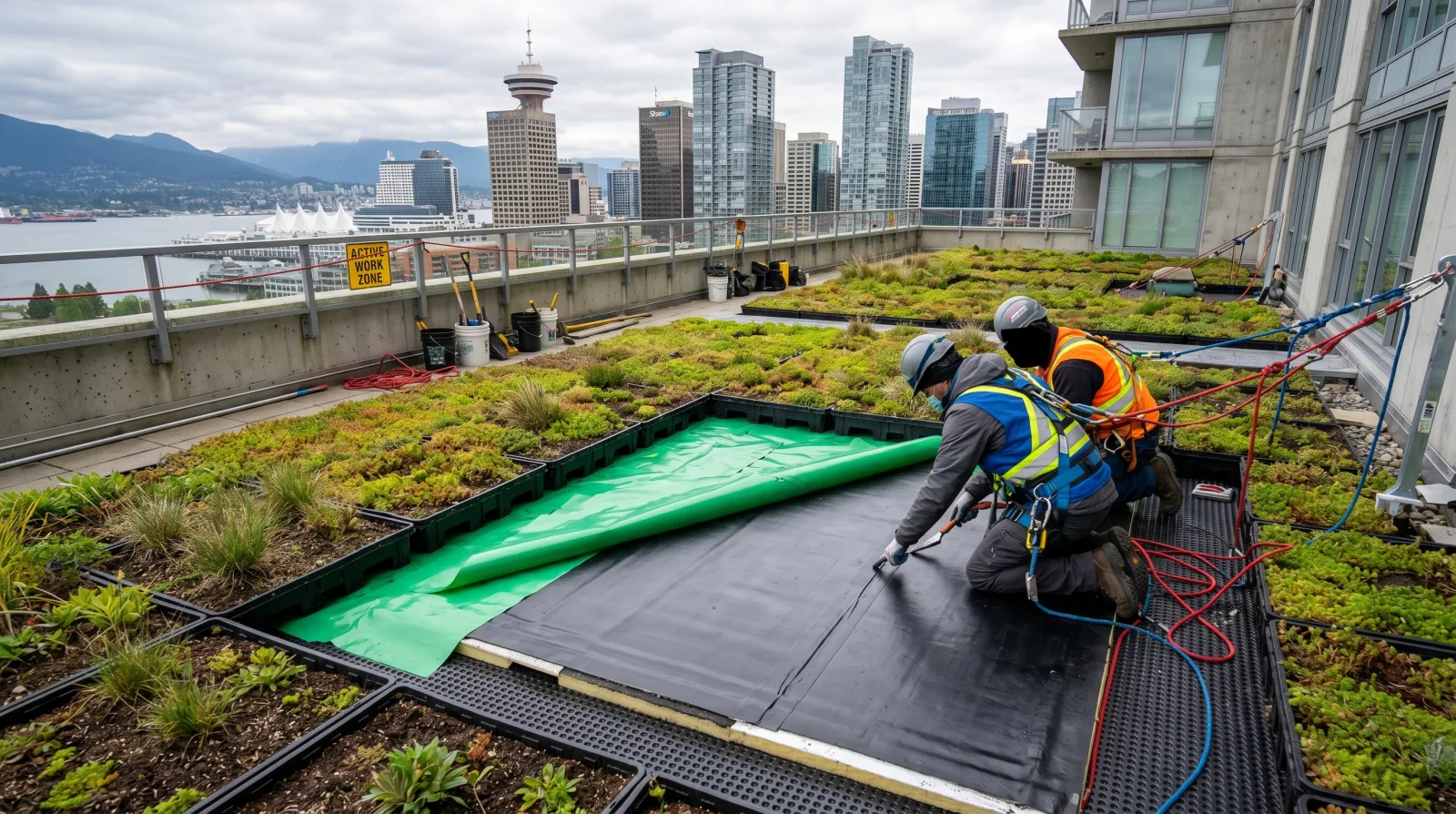 Systems
 Podium and planter drainage
Podium decks and planters sit over occupied space, so their drains, drain mats, and protection boards are buried under soil and pavers. What is down there and how it clogs.
Read the guide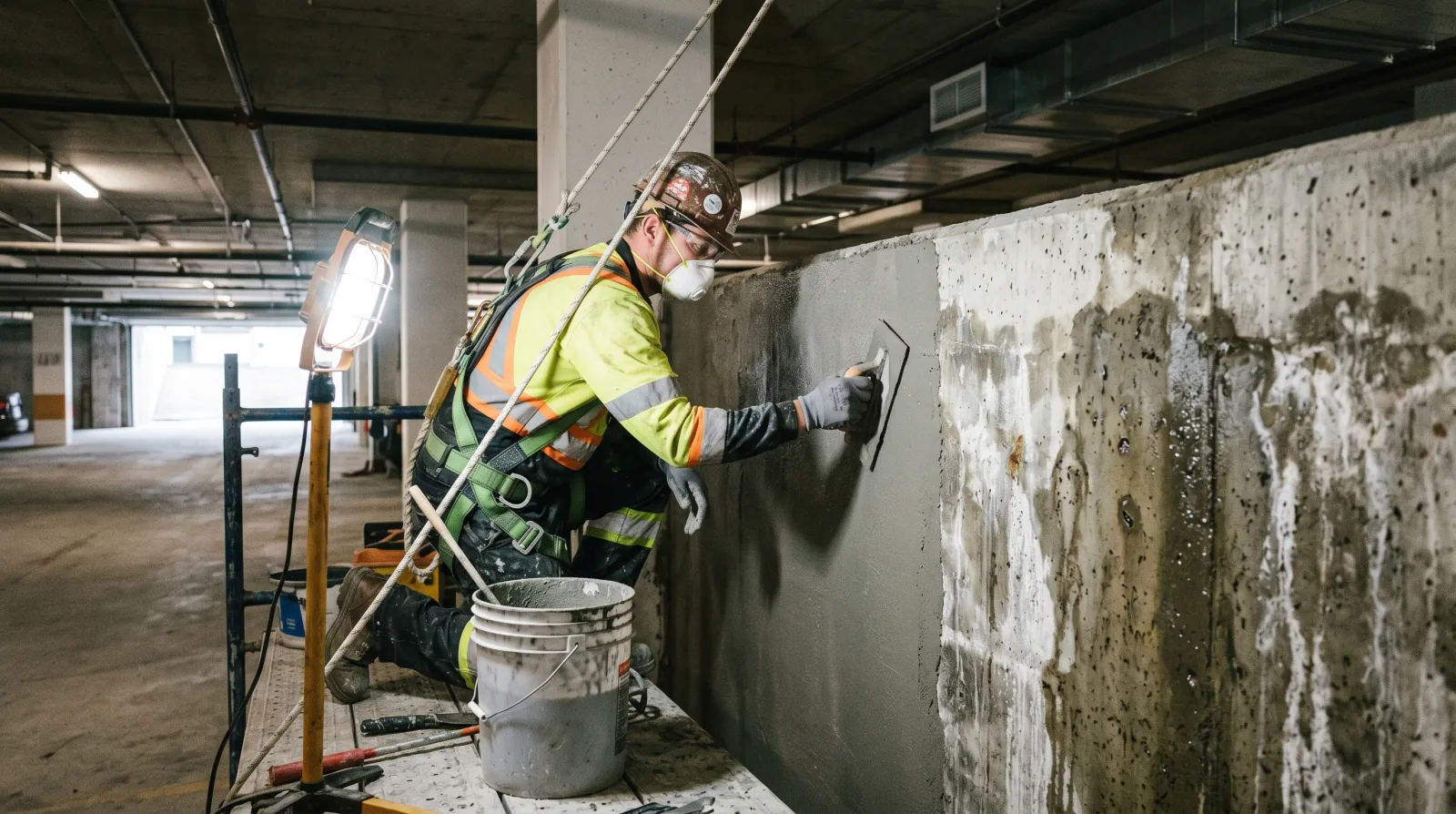 Systems
 Site grading and perimeter drains
Grade that slopes toward the walls, window wells that fill like buckets, and the perimeter drainage that keeps below-grade rooms dry on low-rise strata buildings.
Read the guide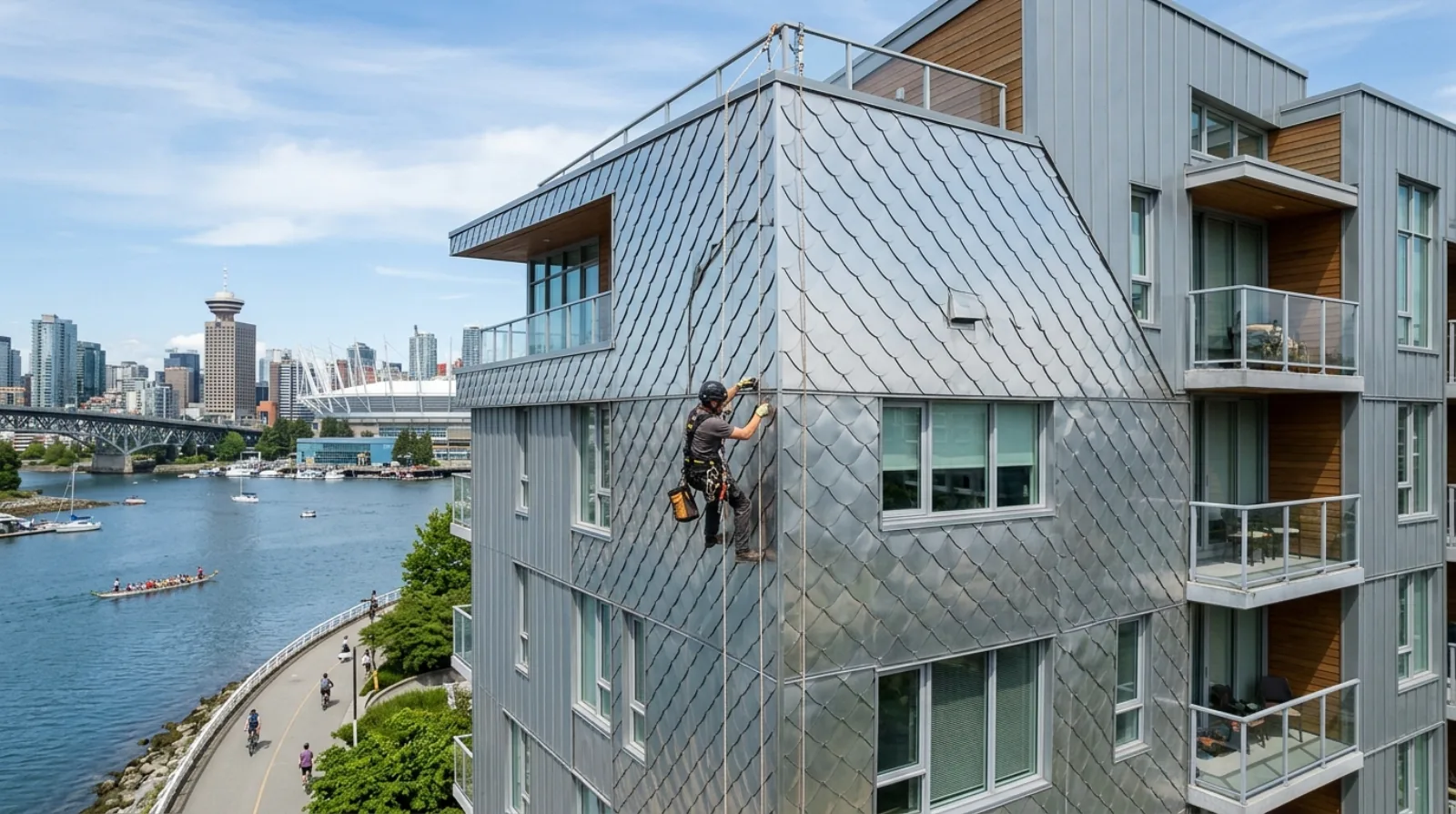 Maintain
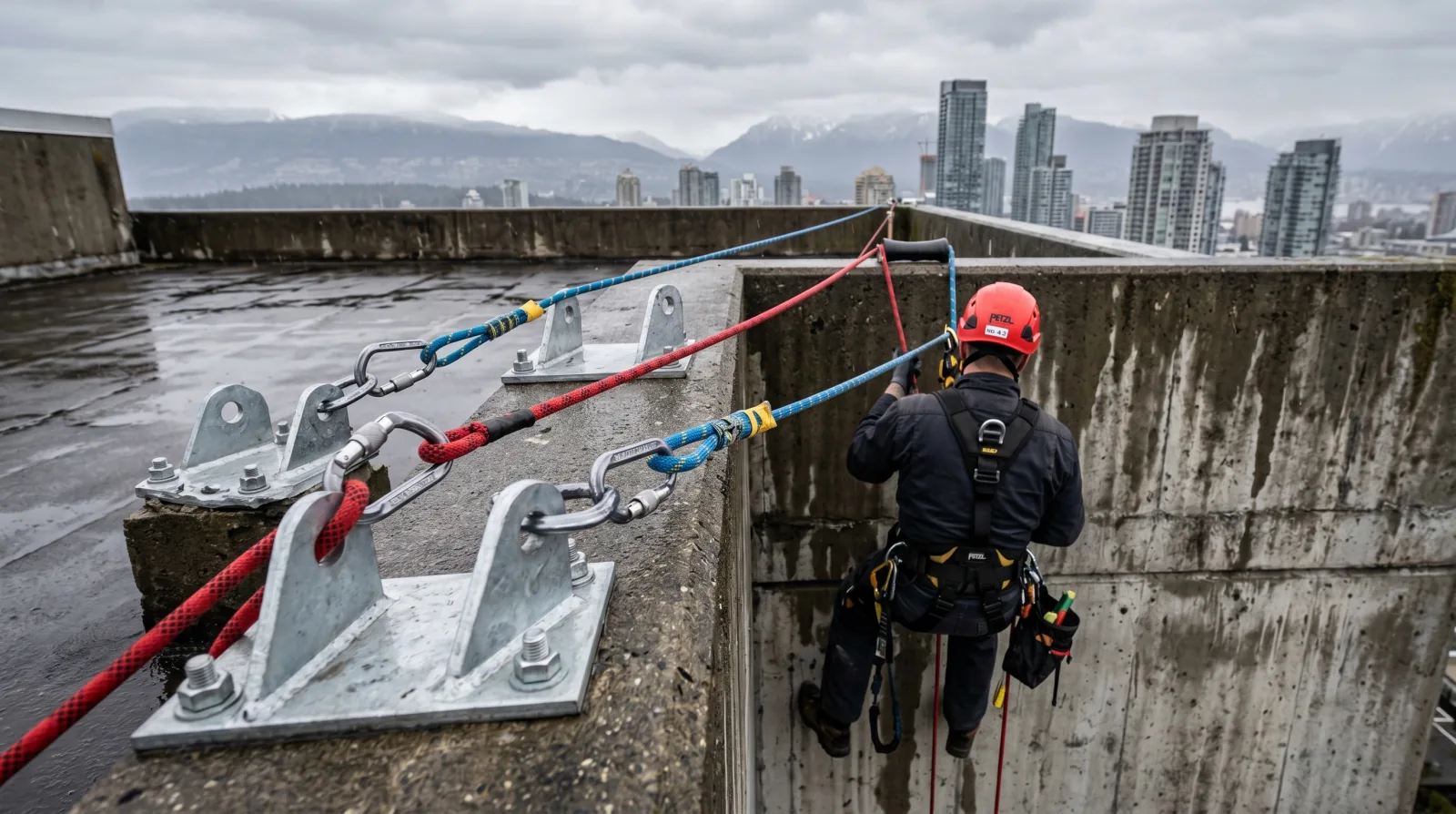
 Drain maintenance by rope access
How IRATA and SPRAT certified crews clear scuppers, gutters, and roof drains at height on two independent lines under WorkSafeBC Part 11, without scaffolding the building.
Read the guide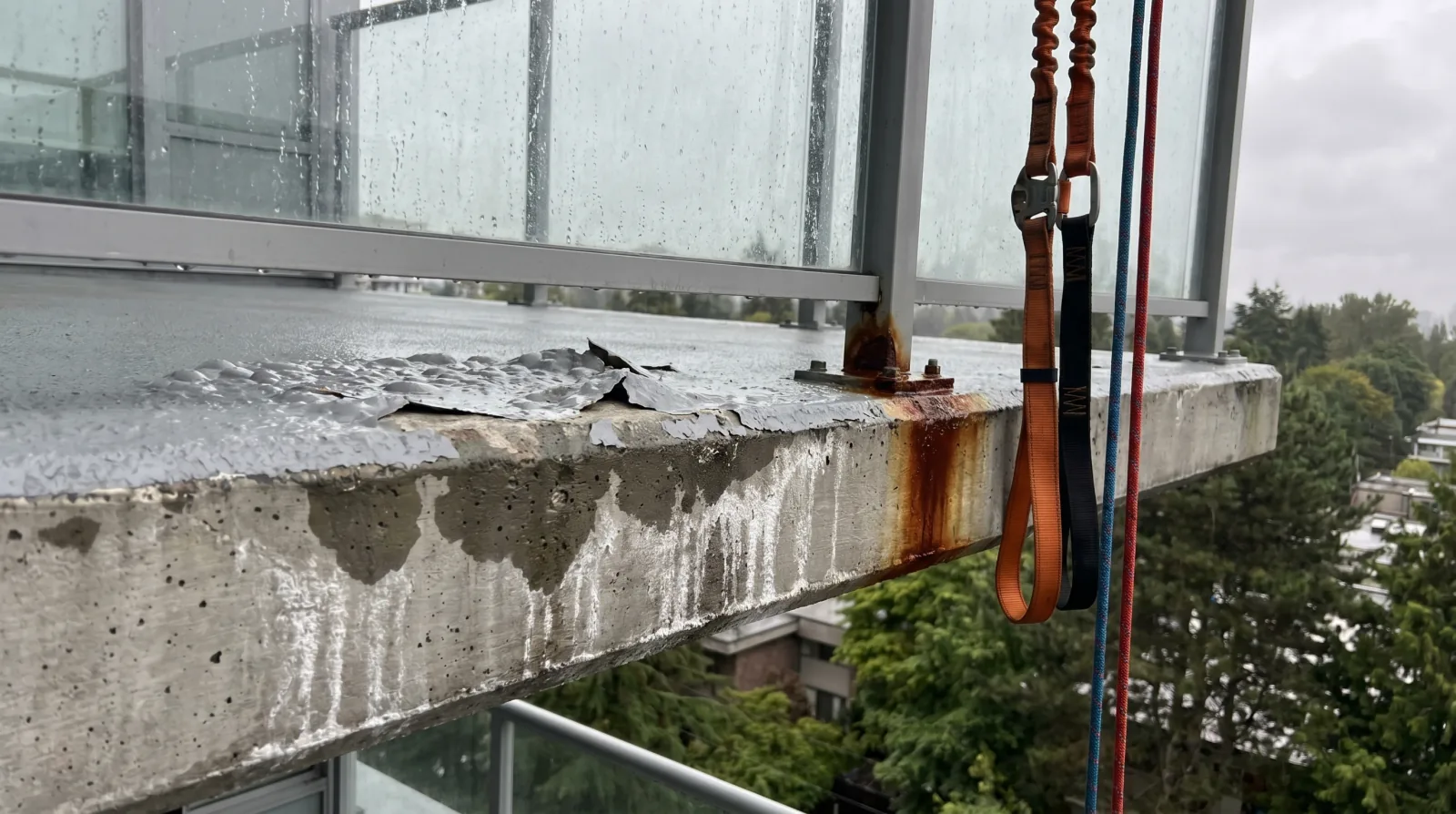 Diagnose
 Ponding water warning signs
Ponding rings, algae lines, sagging gutters, and overflow stains. How to read them, and how to tell a drainage problem from a slope or structure problem before scoping repairs.
Read the guide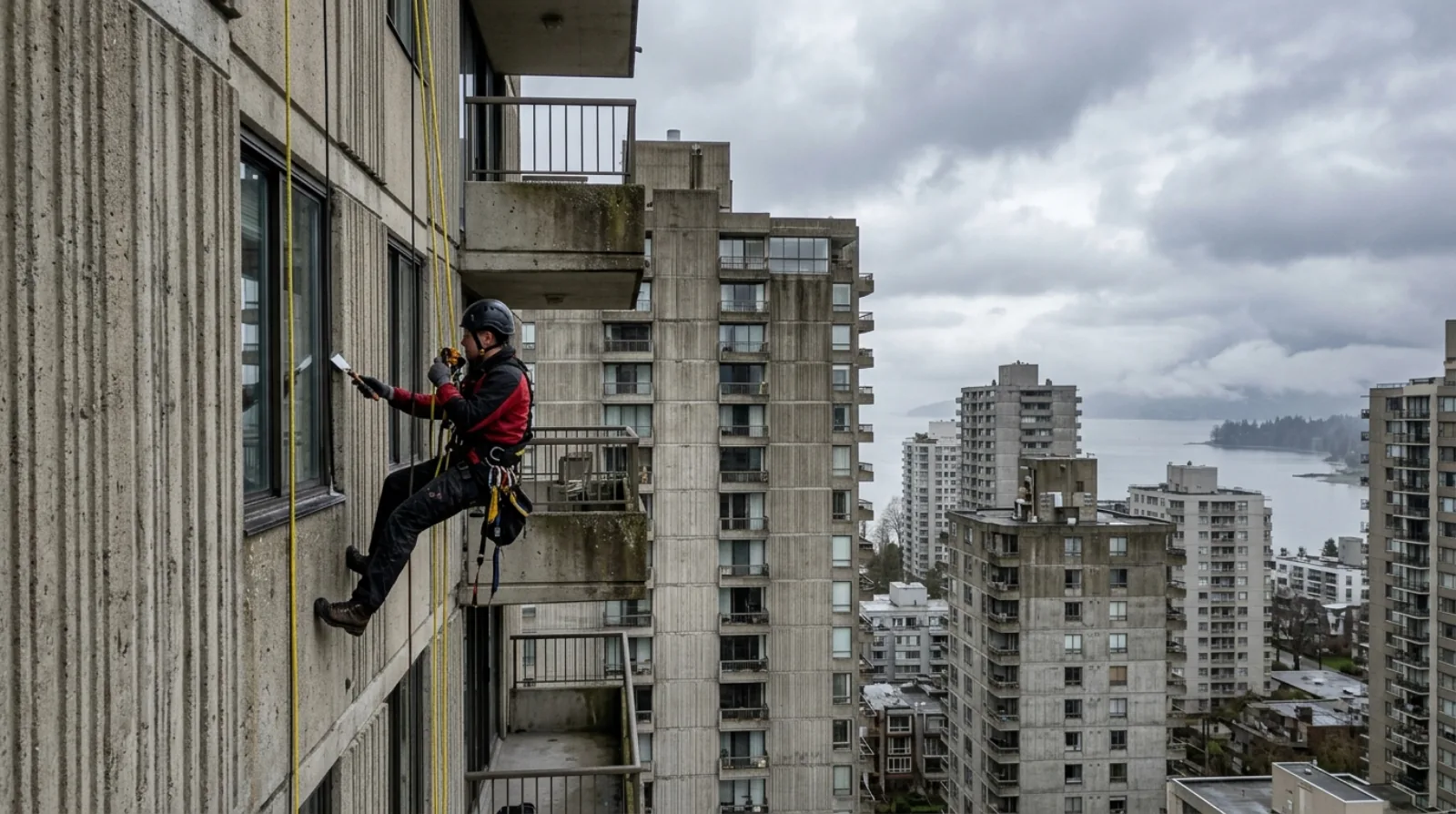 Diagnose
 Drainage in heavy rain events
What an atmospheric river does to an undersized or blocked drainage path, and the cascade that runs from one blinded scupper to an interior leak three floors down.
Read the guide Maintain
 Seasonal drainage maintenance calendar
The fall, winter, and spring cadence for Metro Vancouver: leaf drop, the first storms, freeze events, and what gets checked at each point in the year.
Read the guideThe drainage paths a coastal building depends on
Follow one storm's worth of rain across a typical Burnaby strata tower. Some of it lands on the flat roof and runs to internal roof drains or exits through scuppers in the parapet. Some lands on balconies and podium decks and leaves through deck drains buried in the membrane. Some runs down the facade and is collected, on lower buildings, by gutters and downspouts. And all of it ends up at grade, where the slope of the site and the perimeter drains decide whether it moves away from the foundation or against it.
Each path has its own failure mode. Internal drains clog at the strainer. Scuppers blind off with leaf mats. Downspouts pack at the elbow. Planter drains silt up invisibly under half a metre of soil. None of these failures announce themselves in dry weather, which is why they get found in November, during the first atmospheric river of the season, as a leak.
Drainage failures masquerade as membrane failures
A strata council watching a stain spread across a ceiling usually assumes the roof membrane has failed. Often the membrane is fine and drowning. A membrane termination is detailed to shed rain running downhill, and it does that job well. Hold three or four centimetres of standing water against the same detail for a week and the water passes over the termination and into the assembly. The fix in that case is a drain cleaning, and the reroofing quote is solving the wrong problem.
The reverse also happens. A deck that drains perfectly can still leak through a failed membrane seam, and the diagnosis path for that lives in our water ingress hub. The discipline is sequence: confirm the water is leaving the surface first, then investigate the membrane. Our guide to ponding warning signs covers how to make that first call from what you can see after a storm.
This hub covers the water's path, other hubs cover the membranes
Drainage and waterproofing are two halves of one system, and we keep them in separate hubs on purpose. Membrane selection for flat roofs lives in the flat roof systems hub. Balcony coatings live in the balcony waterproofing hub, and suspended slabs over parking live in the parkade waterproofing hub. This hub covers what those membranes all depend on: the drains, scuppers, gutters, slopes, and grading that take the water away before it can test the seams.
The reason for the split is practical. Membranes are capital projects, scoped through engineers and funded through the depreciation report. Drainage is mostly maintenance, done from ropes or a roof hatch on a recurring cycle for a fraction of the cost. Stratas that hold the two apart in their budgets clean drains on schedule and replace membranes when the membrane is actually done, instead of paying capital prices for problems a maintenance visit would have solved.
How the maintenance actually gets done
On a three-storey walk-up, drainage maintenance is a ladder and an afternoon. On a concrete tower it is a rigging plan. Our crews clear high-level gutters, scuppers, and drain outlets on two independent rope lines from engineered roof anchors, following WorkSafeBC Part 11 fall protection requirements, which keeps sidewalks open and avoids scaffold costs entirely. The rope access guide explains the method, and the seasonal calendar covers when each check should land in a Metro Vancouver year.
Quick answers
What counts as building drainage on a strata or commercial building?
Building drainage is every path that moves rainwater off the structure and away from it: internal roof drains and their overflows, scuppers through parapet walls, gutters and downspouts, balcony and deck drains, podium and planter drains buried under landscaping, and the site grading and perimeter drains at ground level. On a Metro Vancouver building each of those paths carries real volume for most of the year, and any one of them can fail on its own.
Why does building drainage matter so much in Metro Vancouver?
Because of the sheer volume of water. Vancouver International Airport averages 1,189 mm of precipitation a year, most of it between October and March, and every drop that lands on a roof, deck, or podium has to leave through a drain, scupper, or gutter. When a path blocks, the water does not wait. It ponds, finds the weakest seam in the membrane, and shows up as a leak in a suite.
How often should roof drains and scuppers be checked on a strata building?
On most Metro Vancouver strata buildings the drains and scuppers need a check after leaf drop in late fall, again after the first big storm run, and once more in spring. Buildings under heavy tree cover, or with podium planters that shed soil and bark mulch, need more frequent visits. A single annual clean in summer misses the season when the drains actually do their work, which is why our seasonal calendar spreads the checks across the year.
From the resources library
Roof Drain and Scupper Maintenance on Vancouver Strata Flat Roofs
A clogged roof drain is the cheapest leak you'll ever ignore — until ponding water destroys the membrane. How Burnaby strata roofs fail at the drains.
Read article ArticleWhy Gutter and Scupper Cleaning Belongs in Your Rope Access Maintenance Visit
Blocked gutters, scuppers, and roof drains send water where it was never meant to go — usually into the parapet or down the face of the building. Why this belongs in the same rope access visit as window cleaning and sealant inspection, not a separate call.
Read article ArticleSpring and Fall Building Maintenance Checklist for Vancouver Strata Councils (2026)
A dual-season checklist for Vancouver strata councils and commercial property managers — spring post-winter recovery (April–May) and fall pre-storm prep (August–September). Covers balcony membranes, window sealants, parkade drainage, roof anchors, and concrete condition.
Read article ArticleWhat Causes Water Ingress in High-Rise Buildings?
Water ingress can cause major structural damage. We break down the top causes of leaks in concrete structures, from wind-driven rain bypassing failed window perimeters to structural expansion joint tears and cracked stucco.
Read articleServices this guide connects to
Building drainage questions
What counts as building drainage on a strata or commercial building?
Building drainage is every path that moves rainwater off the structure and away from it: internal roof drains and their overflows, scuppers through parapet walls, gutters and downspouts, balcony and deck drains, podium and planter drains buried under landscaping, and the site grading and perimeter drains at ground level. On a Metro Vancouver building each of those paths carries real volume for most of the year, and any one of them can fail on its own.
Why does building drainage matter so much in Metro Vancouver?
Because of the sheer volume of water. Vancouver International Airport averages 1,189 mm of precipitation a year, most of it between October and March, and every drop that lands on a roof, deck, or podium has to leave through a drain, scupper, or gutter. When a path blocks, the water does not wait. It ponds, finds the weakest seam in the membrane, and shows up as a leak in a suite.
How often should roof drains and scuppers be checked on a strata building?
On most Metro Vancouver strata buildings the drains and scuppers need a check after leaf drop in late fall, again after the first big storm run, and once more in spring. Buildings under heavy tree cover, or with podium planters that shed soil and bark mulch, need more frequent visits. A single annual clean in summer misses the season when the drains actually do their work, which is why our seasonal calendar spreads the checks across the year.
Who is responsible for drainage maintenance in a BC strata?
Roof drains, scuppers, gutters, and perimeter drains sit on common property in almost every BC strata plan, so the strata corporation carries the maintenance duty, usually through its council and property manager. Under the Strata Property Act, strata corporations of five or more lots must also obtain a depreciation report on a five-year cycle, and that report treats roofing and drainage as funded components. Owners are typically responsible only for fixtures inside their own strata lot.
What happens when a roof drain blocks during a storm?
Water rises across the roof until it either finds the overflow, if one exists and is clear, or reaches the top of the flashings and parapet upturns. Membrane terminations are detailed for shedding rain, and standing water at depth will pass over them and into the assembly. The load also climbs fast, because ponded water is heavy, and a deep pond over a large roof area adds weight the structure was never asked to hold day to day.
Is drainage covered in a strata depreciation report?
Yes, in the sense that the report inventories roofing, membranes, gutters, and drainage as components with an estimated remaining life and a funding plan. What the report does not do is clean anything. A depreciation report can show a roof with fifteen years of life left while the drains on that roof are blocked right now. The report funds renewals on a five-year planning cycle, while drain clearing is routine maintenance the strata schedules separately.
Can building drains be cleared without scaffolding or a swing stage?
On most buildings, yes. IRATA and SPRAT certified rope access technicians rig from engineered roof anchors on two independent lines under WorkSafeBC Part 11 fall protection rules and work down to gutters, scuppers, and drain outlets directly. That avoids scaffold rental, street use permits for a sidewalk closure, and the long setup time of a swing stage, which is why drain cleaning programs on high-rise strata buildings are usually priced and scheduled as rope access work.
What is the difference between a roof drain and a scupper?
A roof drain is an internal outlet, a grated bowl set into a low point of the roof that carries water down through piping inside the building. A scupper is an opening straight through the parapet wall or deck edge that lets water exit the side of the building, often into a leader head and downspout. Internal drains clog at the strainer and inside the pipe. Scuppers blind off at the opening, where debris mats against the wall.
How do I tell a drainage problem from a membrane problem?
Watch the roof or deck after rain stops. If water sits in rings around a drain, along an edge, or against a wall for days, the drainage path or the slope is the problem, and the membrane is being punished for it. If the surface drains clear but stains still appear inside, the membrane or a detail has likely been breached. The two problems feed each other, which is why we diagnose drainage first, then membrane, in that order.
Does clearing drains actually prevent leaks?
It removes the most common trigger. Most storm-day leak calls we attend on Vancouver strata buildings trace back to water that had nowhere to go: a blinded scupper, a strainer buried in leaves, a downspout packed at the elbow. Clearing the path drops the water level back below the flashing lines and the leak stops. Clearing does not repair a membrane that has already failed, but it prevents the ponding that drives most failures in the first place.
When should a strata prepare its drainage for storm season?
Before the first sustained October rain, with a follow-up after leaf drop finishes in November. The failure pattern in Metro Vancouver is predictable: deciduous trees shed just as the storm track arrives, so a drain cleaned in September can be buried by mid-November. Booking a pre-storm clean and a post-leaf-drop return visit as a pair costs little more than one visit and covers the actual risk window instead of the calendar.
How did drainage failures contribute to the leaky condo crisis?
The leaky condo crisis caused roughly $4 billion in damage across more than 900 Lower Mainland buildings, and while the core failure was face-sealed wall assemblies that could not dry, water concentration made it worse. Decks without functioning drains, missing overflows, and downspouts discharging against walls loaded the weakest details with far more water than they would otherwise have seen. Modern rainscreen walls tolerate more wetting, but they still depend on drainage paths that work.
Water sitting where it should not?
We assess and clear roof drains, scuppers, gutters, and deck drains on strata and commercial buildings across Vancouver, Burnaby, North Vancouver, and West Vancouver, and we tell you whether the problem is the drainage or the membrane before anyone scopes a repair.