Flat roof drains and overflows
A flat roof with a parapet is a basin, and the drains are the only thing keeping it from acting like one. The primary drain does the daily work, the overflow exists for the day the primary fails, and a roof only floods when both are out of service at once. On Metro Vancouver buildings that day almost always lands in November.
A flat roof is a basin with two exits
Nothing about a flat roof is actually flat. The deck or the insulation package is built with slope, gentle enough that you barely see it, directing every square metre of roof toward a small number of internal drains. Each drain is a cast bowl set into the low point, with the membrane clamped into it and a strainer dome over the top, feeding a rainwater leader that runs down through the heart of the building. On the way up through a Vancouver or Burnaby tower you will pass those pipes in the parkade ceiling without noticing them.
The second exit is the one most owners have never looked at. Somewhere above the roof surface sits an overflow provision: a second drain on a raised curb, or more commonly on local buildings, an overflow scupper cut straight through the parapet. In dry weather and in ordinary rain it does nothing at all. It flows only when standing water has climbed above the primary drain's capacity, which makes it the single best indicator on the whole roof. An overflow that is running is a roof that is already in trouble.
The parts, and how each one fails
The strainer or dome
The cage over the drain bowl that stops debris entering the pipe. It is the first thing to disappear under leaves, and a missing or crushed strainer lets debris into the pipe where blockages are far harder to clear.
The bowl and clamping ring
The cast body set into the roof deck, with a ring that clamps the membrane into the drain so water cannot slip between membrane and bowl. A loose or corroded clamping ring is a leak path that looks exactly like a membrane failure from inside the building.
The rainwater leader
The pipe that carries water down through the building to the storm connection. Blockages here come from debris that got past a damaged strainer, and from decades of sediment. A blocked leader backs water up to the roof even when the drain bowl looks clear.
The overflow provision
A second, higher outlet: either a separate overflow drain, or a scupper through the parapet set above the roof surface. It only flows when the primary path has failed, which means it can sit unused for years and be blocked on the one day it is needed.
The pattern across all four parts is the same: cheap to inspect, expensive to ignore. Lifting debris off a strainer takes a minute. Augering a packed rainwater leader takes a day. Drying out three floors of a tower after a roof flood takes months, and the restoration trades will be working around residents the entire time.
How a roof actually floods
Walk through the failure in sequence, because every step is preventable. Through summer, needles, leaves, and wind-blown litter collect on the roof. Nobody visits. In late October the deciduous trees let go and the debris load doubles in two weeks. The first sustained storm washes all of it toward the low points, which are, by design, exactly where the drains are. The strainer mats over. Water rises.
Now the overflow earns its keep, or does not. An overflow scupper that was checked and cleared holds the pond at a few centimetres and discharges conspicuously down the facade until someone clears the primary. An overflow that has quietly blinded off behind a decade of debris does nothing, and the pond keeps climbing: over the membrane terminations, over the base flashings, into the assembly at whichever detail gives up first. The leak that follows can surface rooms away from the entry point, a behaviour we cover in our guide to high-rise water ingress causes.
Weight arrives with the water. Ponded rain across a large roof area adds load the structure carries silently, but the margin is not infinite, and a roof carrying a deep pond in a wind storm is a bad place to be discovering the limit. Getting the water moving again is urgent work, which in practice means getting a crew to the drains during or immediately after the storm rather than waiting for a calm week.
Slope problems wear a drainage costume
Not every pond traces back to a blockage. Insulation crushes around rooftop units where service techs walk, structures deflect as they age, and each re-roof changes the surface geometry a little. The result is water settling in rings that the drains cannot reach, even with every strainer spotless. That is a roof geometry problem, and the durable fix is a tapered insulation package at the next membrane replacement, scoped through the flat roof systems hub rather than through a maintenance visit. Telling the two apart from the evidence on the surface is the subject of our ponding warning signs guide.
What a proper drainage check covers
A useful roof drainage visit is more than lifting leaves off strainers. The crew confirms each strainer is present, intact, and seated. They check clamping rings for corrosion and loose bolts, because a slack ring leaks even on a clear drain. They clear and flow-test the overflows, which are the components nobody else touches. And they look at the edge outlets: scuppers that drain setback roofs and terraces, where the blockage forms on the outside face of the wall and is invisible from the roof itself.
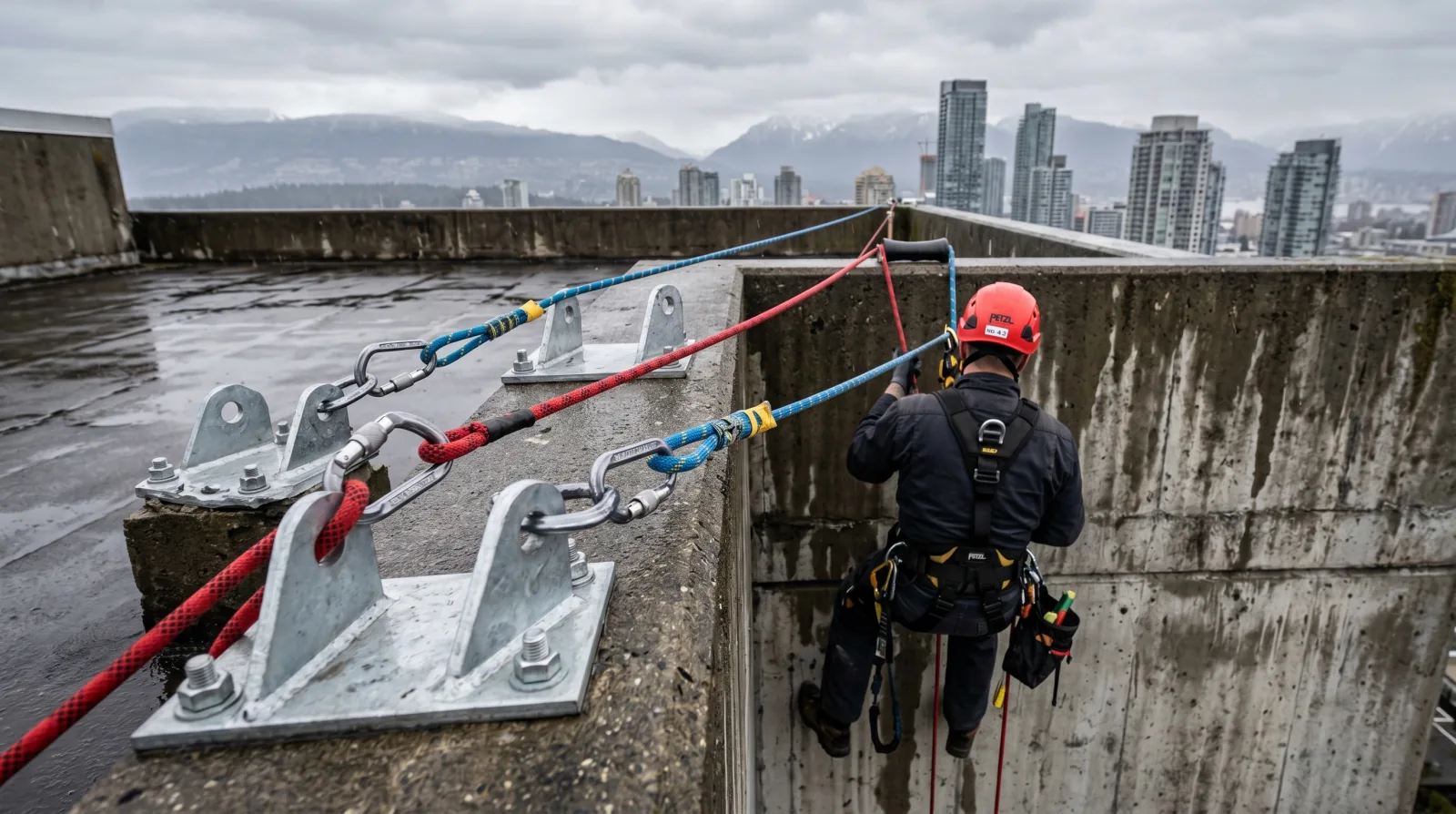
On towers, those edge details are the reason the work runs on ropes. Our technicians descend from engineered anchors on two independent lines under WorkSafeBC Part 11 fall protection rules and clear every outlet on the way down, a method covered in detail in the rope access maintenance guide. Scheduling that visit against the Metro Vancouver storm calendar, rather than at a random point in summer, is what makes the spend count, and the building drainage hub lays out that timing across the whole year. When a roof has already flooded and water is inside, our leak repair service handles the tracing and the fix.
Quick answers
How does an internal roof drain work on a flat building roof?
An internal roof drain is a low point built into the roof. The structure or the insulation is sloped so water runs to a cast bowl set into the deck, the membrane is clamped into that bowl with a ring, and a strainer dome keeps debris out of the rainwater leader, the pipe that carries water down through the building to the storm connection. Everything above the roof is simple. The performance depends on the strainer staying clear and the pipe staying open.
What is a roof overflow and why does a flat roof need one?
An overflow is a second escape route for water, set higher than the primary drain: a separate overflow drain or a scupper through the parapet a few centimetres above the roof surface. Its whole purpose is to cap how deep water can get when the primary drain blocks. A flat roof with a parapet is effectively a basin, and without a working overflow the only limit on water depth is the height of the parapet itself.
What happens when both the roof drain and the overflow are blocked?
The roof holds water like a pool and the level keeps rising as long as the rain lasts. Standing water passes over membrane terminations and flashing details that were only ever designed to shed falling rain, so water enters the assembly at the edges and penetrations. The weight of the ponded water also builds across the whole roof area. Deep ponding over a wide roof is a structural loading problem on top of a leak problem.
Roof drain and overflow questions
How does an internal roof drain work on a flat building roof?
An internal roof drain is a low point built into the roof. The structure or the insulation is sloped so water runs to a cast bowl set into the deck, the membrane is clamped into that bowl with a ring, and a strainer dome keeps debris out of the rainwater leader, the pipe that carries water down through the building to the storm connection. Everything above the roof is simple. The performance depends on the strainer staying clear and the pipe staying open.
What is a roof overflow and why does a flat roof need one?
An overflow is a second escape route for water, set higher than the primary drain: a separate overflow drain or a scupper through the parapet a few centimetres above the roof surface. Its whole purpose is to cap how deep water can get when the primary drain blocks. A flat roof with a parapet is effectively a basin, and without a working overflow the only limit on water depth is the height of the parapet itself.
What happens when both the roof drain and the overflow are blocked?
The roof holds water like a pool and the level keeps rising as long as the rain lasts. Standing water passes over membrane terminations and flashing details that were only ever designed to shed falling rain, so water enters the assembly at the edges and penetrations. The weight of the ponded water also builds across the whole roof area. Deep ponding over a wide roof is a structural loading problem on top of a leak problem.
How can I tell a roof drain is blocked without going on the roof?
Watch the overflows during heavy rain. Water discharging from an overflow scupper means the primary drain has already failed, because the overflow sits higher and only flows once water has backed up. Other ground-level signs: a downspout that runs dry in a storm while others run hard, new staining below a scupper outlet, and water sheeting down the facade from roof level. Any of those justifies getting someone onto the roof promptly.
Why is water ponding around a roof drain that is not blocked?
Usually because the roof no longer slopes to the drain the way it did when built. Insulation crushes under repeated foot traffic around mechanical units, the structure deflects over time, and re-roofing layers can flatten the original slope package. Water then settles in a ring near, but not at, the drain. The drain itself tests clear, and the fix is a slope correction with tapered insulation at the next roofing project, which we cover in the flat roof systems hub.
Can a blocked roof drain cause a leak several floors below the roof?
Yes, and it happens regularly on Metro Vancouver towers. Once ponded water enters the assembly at a flashing or a clamping ring, it travels along the deck, down columns, and through service penetrations before it shows on a finished surface. The suite that reports the stain is frequently not directly under the entry point. That travel is why we trace leaks from the drainage path downward instead of opening the ceiling that shows the stain first.
Do roof drain strainers really matter that much?
They are the cheapest part of the whole assembly and the most consequential. A strainer holds debris where it can be lifted off by hand in seconds. Without one, the same debris goes into the rainwater leader, where clearing it means augering or flushing a pipe inside the building. On roofs under tree cover we treat a missing, crushed, or corroded strainer as a deficiency to correct on the spot, and it is one of the most common finds on first visits.
How often should internal roof drains be checked on a strata tower?
Match the checks to the debris cycle, and Metro Vancouver has a sharp one. The heavy load arrives with leaf drop in late October and November, exactly when the storm track arrives. A practical minimum for most towers is a clean before the first fall storms, a return visit after leaf drop finishes, and a spring check. Roofs with overhanging trees, rooftop planting, or a history of ponding need more visits, and the seasonal calendar in this hub maps them.
Who should maintain roof drains on a high-rise, a roofer or a rope access crew?
For the drains on the main roof, anyone competent with fall protection can do the work from the roof itself. The gap is everything at the edge: scupper outlets, overflow discharge points, gutters on lower tiers, and drain bowls on setback roofs with no hatch access. IRATA and SPRAT certified rope access technicians rigged on two independent lines under WorkSafeBC Part 11 cover those points in the same visit, which is why tower drainage programs usually run as rope access work.
Does ponding on a flat roof mean the roof has failed?
Not by itself. Ponding means water is not leaving, and the cause is one of three things: a blocked path, a slope that no longer directs water to the drain, or a drain assembly that has physically failed. A roof can pond for years before the membrane gives up, but every week of standing water shortens the membrane life and raises the stakes of the eventual failure. Ponding is the warning stage, and it is the cheap stage to act in.
Are overflow scuppers supposed to drip in normal weather?
No. An overflow sits above the roof surface, so in a roof that is draining normally it stays dry through ordinary rain. An overflow that trickles in light weather is telling you the primary drain is partly blocked and water is already standing at overflow height, or that the roof has settled enough that the overflow now sits at pond level. Either way, water is living on the roof full time, and the drain and slope need attention before storm season.
When did anyone last check your overflows?
We inspect and clear roof drains, overflows, and scuppers on strata and commercial buildings across Vancouver, Burnaby, and the North Shore, timed to the storm season instead of the calendar year.