Drain maintenance by rope access
The drainage components that fail most on Metro Vancouver towers sit at the edges: scupper mouths on the outside of the parapet, leader heads bolted to the wall, gutters on setback roofs no hatch reaches. Roof-side access stops a metre short of all of them. Rope access covers that metre, and everything below it, from two lines and a pair of certified anchors.
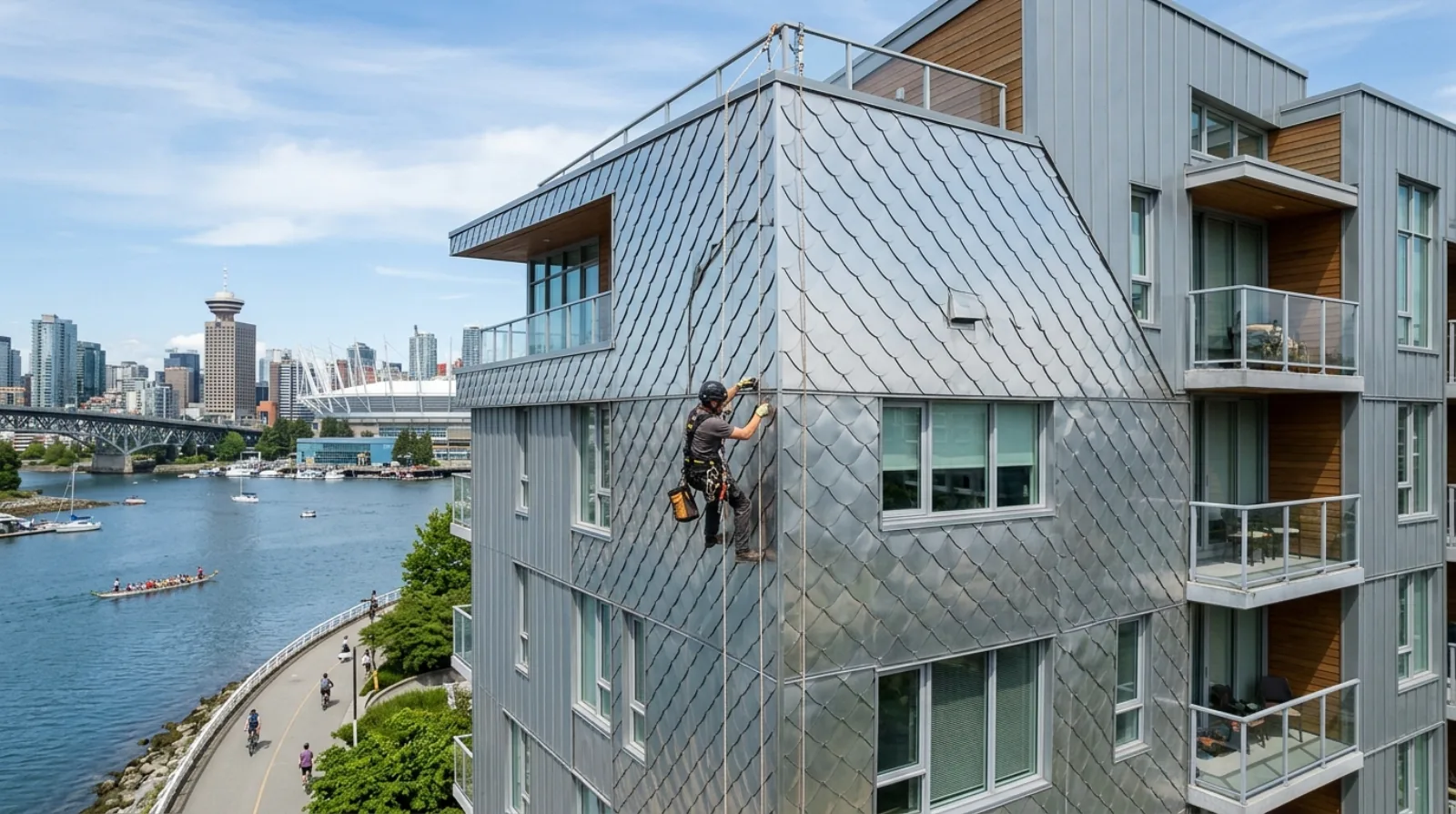
Why drainage work ends up on ropes
Picture the drainage on a typical Vancouver or Burnaby tower. The main roof drains sit in the field of the roof, reachable on foot. Everything else hangs off the building: scuppers punched through the parapet with their blockages matting on the outside face, leader heads collecting debris a storey below the roof line, gutter runs on the townhouse podium at level three, deck outlets on forty balconies whose owners answer the access notice at forty different rates.
Scaffolding that geometry is absurd, and a swing stage covers one elevation at a time with days of rigging between moves. The work itself is small and scattered: minutes per outlet, dozens of outlets, distributed around the full perimeter and down the height of the building. Rope access matches that shape exactly. A technician rigs once, descends a line of the building, and services every drainage component on the way down, then moves the ropes and takes the next line. The full method, applied across all of a building's exterior maintenance, is described on our rope access building maintenance service page.
The safety system underneath the work
Rope access in BC operates under WorkSafeBC Part 11, the fall protection section of the occupational health and safety regulation. The visible expression of those rules is redundancy. Each technician works on two ropes, independently anchored: a working line that carries them, and a backup line running through a device that locks on if anything in the primary system lets go. Anchors are engineered and certified. Equipment is inspected and logged. A rescue plan exists before the first descent, because regulation and good practice both assume the day something goes wrong.
Certification runs through IRATA and SPRAT, the international and North American rope access trade associations, whose three-level technician systems require supervised hours and formal assessment. For a strata council, the practical meaning is simple: the person clearing your scuppers holds a current certification for working at height, under a supervisor, inside a documented safety system, and the paperwork exists to prove all three.
What a drainage descent actually looks like
Rig from engineered anchors
The crew identifies the certified roof anchors, checks their inspection status, and rigs two separate systems per technician: a working line and an independent backup line. Rigging plans, exclusion zones below, and a rescue plan are in place before anyone loads a rope.
Descend the drainage line
Each descent follows a vertical run of the building's drainage: parapet scuppers at the top, overflow outlets, leader heads, gutter runs on lower tiers, and deck outlets on the way down. The technician clears each component by hand, bags the debris rather than dropping it, and photographs conditions before and after.
Flow-test every outlet
A cleared opening is only half the job. Water goes through each scupper, leader head, and drain to confirm the path actually flows to grade. A blockage below the visible opening, in an elbow or a buried section, only shows up under flow, and finding it during the visit beats finding it in November.
Document and report
The visit produces a record: which outlets were clear, which were blocked and with what, which components show corrosion, failed liners, or loose fasteners, and photographs of each. That record feeds the strata's maintenance planning and turns the next visit from exploration into a checklist.
The flow test is the step owners underrate, because it is the difference between clearing and confirming. A scupper mouth can be spotless while the leader head below it is packed solid, and only water finds that out. The components most likely to hide a downstream blockage, scuppers feeding leader heads and downspouts, are covered in detail in the scuppers guide, and the roof-side half of the visit, strainers, clamping rings, and overflows, in the flat roof drains guide.
One rigging, several jobs
The economics of rope access reward bundling. Getting a certified technician safely over the edge is the expensive part; what they do while they hang there is comparatively cheap to extend. A drainage descent passes every window, sealant joint, and cladding panel on its line, so pairing drain clearing with window cleaning, caulking inspection, or facade condition photography shares the rigging cost across several scopes. Our article on why gutter and scupper cleaning belongs in the rope access visit makes the case in detail, and the companion piece on roof drain and scupper maintenance covers the scope from the strata council's side.
The scheduling half of the equation matters as much as the method. A perfectly executed descent in July protects a building far less than the same descent in mid October, ahead of the storms, with a return pass after leaf drop. The seasonal drainage maintenance calendar maps those windows across the Metro Vancouver year, and the building drainage hub connects this maintenance method to every system it serves, from parapet to perimeter drain.
What the strata gets out of it
Beyond clear drains, the lasting value of a rope access drainage program is the record it builds. Every outlet photographed on every visit, blockage patterns tracked season over season, corrosion and failing details flagged years before they become capital work. Depreciation report consultants work from exactly this kind of evidence, and councils that hold it negotiate maintenance budgets from knowledge rather than guesswork. The drains get cleared either way. The building that documents them gets smarter every year.
Quick answers
What does drain maintenance by rope access involve?
Drain maintenance by rope access means certified technicians descend the building on ropes rigged from engineered roof anchors and clear the drainage components on the way down: parapet scuppers, overflow outlets, leader heads, gutter runs, and deck drains. Each outlet is cleared by hand, flow-tested, and photographed. The method reaches the edge details that cannot be safely reached from the roof itself, and it does so without scaffolding or a swing stage.
What does WorkSafeBC Part 11 require for rope work?
WorkSafeBC Part 11 sets the fall protection rules for work at height in BC, and for rope access that means a fall protection plan, certified anchors, equipment inspection, and systems that protect the worker if any single component fails. In practice crews work on two independently anchored lines, follow written rigging and rescue plans, and log equipment checks. The rules exist because the work happens where a mistake has no second chance.
What is the difference between IRATA and SPRAT certification?
IRATA and SPRAT are the two main rope access trade associations, IRATA international in origin and SPRAT North American. Both run a three-level technician system with supervised hours, formal assessments, and recertification, and both publish safe practice standards the industry works to. For a strata hiring drain maintenance, the certifications signal the same thing: technicians trained and assessed for exactly this kind of work, operating under a documented safety system.
Rope access drain maintenance questions
What does drain maintenance by rope access involve?
Drain maintenance by rope access means certified technicians descend the building on ropes rigged from engineered roof anchors and clear the drainage components on the way down: parapet scuppers, overflow outlets, leader heads, gutter runs, and deck drains. Each outlet is cleared by hand, flow-tested, and photographed. The method reaches the edge details that cannot be safely reached from the roof itself, and it does so without scaffolding or a swing stage.
What does WorkSafeBC Part 11 require for rope work?
WorkSafeBC Part 11 sets the fall protection rules for work at height in BC, and for rope access that means a fall protection plan, certified anchors, equipment inspection, and systems that protect the worker if any single component fails. In practice crews work on two independently anchored lines, follow written rigging and rescue plans, and log equipment checks. The rules exist because the work happens where a mistake has no second chance.
What is the difference between IRATA and SPRAT certification?
IRATA and SPRAT are the two main rope access trade associations, IRATA international in origin and SPRAT North American. Both run a three-level technician system with supervised hours, formal assessments, and recertification, and both publish safe practice standards the industry works to. For a strata hiring drain maintenance, the certifications signal the same thing: technicians trained and assessed for exactly this kind of work, operating under a documented safety system.
Why do rope access technicians use two ropes?
Rope access technicians use two ropes so that no single failure can drop the worker. The working line carries the technician's weight and movement, while a second, independently anchored backup line follows through a fall-arrest device that locks if the working line, its anchor, or the descent device fails. The two-line principle runs through the whole system: two anchors, two attachment points, two chances at every link in the chain.
What is an engineered roof anchor?
An engineered roof anchor is a structural attachment point on the roof, designed and certified for fall protection and rope access loads, with documented inspection and recertification. Rope access work starts from these anchors, which is why their condition and paperwork get checked before rigging. Buildings without certified anchors need alternative rigging solutions or an anchor installation before drainage work at height can run on ropes.
Which drainage components can be cleared from ropes?
Ropes reach the drainage components that roof-side access cannot: scupper openings and their outside faces, overflow outlets, leader heads mounted on the wall, gutter runs on setback roofs and lower tiers with no hatch, downspout top elbows, and deck drains on balconies where suite access has failed. Main roof drains are usually cleared from the roof itself, so a full drainage visit combines roof work with descents for the edges.
Does rope access drain work disturb residents?
Rope access drain work is among the least disruptive maintenance a building can host. There is no scaffold on the sidewalk, no swing stage parked outside windows for weeks, and no street use permit closing the frontage. Residents see a technician pass a window for a few minutes per drop. The strata issues a notice so nobody is surprised, exclusion zones keep the ground below clear, and the visit is typically finished in days rather than weeks.
What weather stops rope access work?
High wind is the main stop condition for rope access, and crews monitor it at height rather than at the ground, where readings can differ sharply. Heavy rain makes descents slower and less pleasant without necessarily stopping them, and drainage work in particular sometimes runs in wet weather deliberately, because flowing water shows exactly which outlets are failing. Ice and lightning stop everything. Scheduling drainage visits for fall means building weather flexibility into the plan.
Why choose ropes over a swing stage for drain clearing?
Drain clearing is point work: many small stops distributed around the building edge, each needing minutes of access. A swing stage suits sustained work on one elevation, and it carries rigging time, equipment costs, and often street-level closures. Ropes move a technician vertically and laterally between scattered outlets with minimal setup, which fits the shape of drainage work. What drives the choice is the pattern of the work, and drainage strongly favours the ropes.
What should the report after a drainage descent include?
A drainage descent report should list every outlet visited, its condition on arrival, what was removed, and its flow-test result, with before and after photographs. It should also flag adjacent findings: corroded scupper liners, loose leader heads, failing sealant, membrane damage near drains, and missing strainers. That record gives the strata evidence for its maintenance file and depreciation planning, and it turns recurring visits into trend data rather than isolated snapshots.
How do crews reach drains on buildings without roof anchors?
Buildings without certified roof anchors still get rope access drainage work through alternative rigging: engineered temporary anchor systems, structural members assessed and rigged by a qualified person, or davit and parapet clamp arrangements where the structure allows them. Each keeps the two-independent-lines principle intact. Where nothing on the roof can be rigged safely, the honest answer is an anchor installation project first, which then serves every future maintenance visit the building will ever need.
When were your scuppers last cleared from the outside?
Our IRATA and SPRAT certified crews clear and flow-test scuppers, leader heads, gutters, and drains on towers across Vancouver, Burnaby, and the North Shore, with photographs of every outlet for your maintenance file.