Drainage in heavy rain events
An atmospheric river examines a building. Hours of peak rainfall land on whatever condition the drainage was in the day before, and every marginal outlet, buried overflow, and half-silted pipe gets tested at full load, all at once, in the dark. The buildings that flood in November were almost always ready to flood in September, quietly.
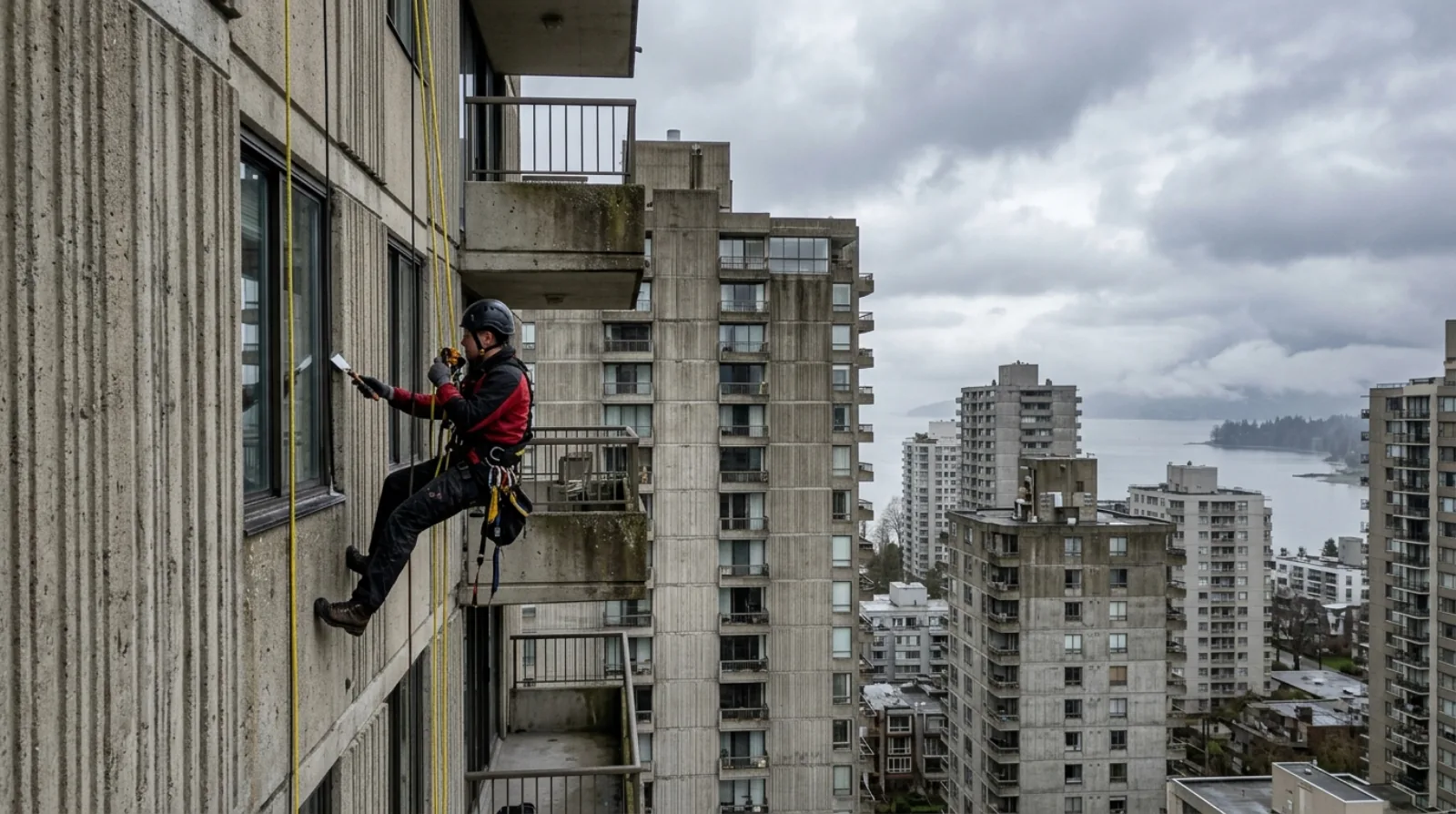
What an atmospheric river actually delivers
An atmospheric river is a corridor of concentrated water vapour, often thousands of kilometres long, that releases intense and prolonged rain when it makes landfall, typically with strong wind behind it. The south coast of BC sits directly in the path of these systems through the wet season. Vancouver International Airport averages 1,189 mm of precipitation a year (1991 to 2020 normals), much of it delivered by exactly these events, and the North Shore mountains wring out considerably more.
The building-science significance is in the shape of the delivery: sustained peak intensity for hours, rather than a burst that passes. Short showers let a struggling drainage path catch up between bands. An atmospheric river never pauses, so any outlet passing less than the full inflow falls steadily behind, and the deficit accumulates on the roof as depth. Our companion article on what atmospheric rivers do to building envelopes covers the wall and window side of these storms. This page follows the water that lands on top.
The cascade: from blinded scupper to interior leak
Storm damage from drainage failure follows a sequence so consistent that we can usually reconstruct it afterward from the stains. It runs in five steps.
The debris is already in place
Weeks of leaf drop, needles, and wind-blown litter sit on the roof, harmless in dry weather. The storm's first hour washes all of it toward the low points, which are exactly where the drains and scuppers wait. The blockage assembles itself in the opening minutes of the event it will make worse.
The primary outlet blinds over
A debris mat seals against the scupper mouth or buries the drain strainer, and the flow drops to a trickle. From the roof surface nothing looks different in the dark and the rain. The water level begins to climb across the whole area the outlet was serving.
The pond finds the overflow, or does not
A clear overflow caps the pond and discharges conspicuously down the facade, buying time. An overflow that blinded off quietly years ago does nothing, and the only remaining cap on the water level is the height of the parapet or the door threshold.
The water passes the terminations
Membrane upturns, base flashings, and door sills were detailed to shed falling rain. Hours of standing water at depth passes over or behind them and enters the assembly at whichever detail gives up first. By this point the envelope is being asked to hold a pool, a condition far past anything it was detailed for.
The leak surfaces somewhere else
Water inside the assembly travels along decks, columns, and service penetrations before it shows on a finished surface, often floors below and rooms away from the entry point. The suite that calls in the leak is rarely under the blinded scupper, which is why storm-night diagnosis starts at the drainage, above, rather than at the stain.
Notice where the sequence is interruptible. Steps one and two are prevented by maintenance: outlets cleared before the storm season have nothing to blind with. Step three is prevented by the one check almost nobody does, flow-testing the overflows. From step four onward the storm owns the outcome, and the costs shift from clearing debris to drying assemblies. Every dollar in the sequence gets more expensive with each step, and the cheap steps are all before the storm. The mechanics of the outlets themselves are covered in the scuppers guide and the flat roof drains and overflows guide.
Undersized, blocked, or both
After a flood, the argument starts: was the drainage blocked, or was it never big enough? The distinction matters because the remedies differ completely. Blockage is maintenance. Undersizing is design, fixed by adding capacity when the roof is next renewed, and diagnosed by pattern: the same overflow point failing at the same storm intensity, every time, regardless of cleaning history.
In practice most Metro Vancouver storm failures are blockage, or blockage stacked on marginal capacity. A drainage path sized tightly by an optimistic original design still works when perfectly clear, and fails the moment debris takes any of it away. Buildings like that live one leaf mat from a flood every November, and their councils usually know it only as a vague history of storm-time trouble. A drainage assessment that measures what exists against what the roof area demands converts that vague history into a decision.
During and after the event
Mid-storm, the useful work happens at ground level. Walking the perimeter with a flashlight shows which downspouts run hard, which sit dry while their neighbours surge, which overflows are discharging, and where water stands against the building, observations detailed in our ponding warning signs guide. Photograph everything. The storm is the one moment the whole drainage system operates at full load, and the diagnostic value of watching it run is enormous, from the ground, in ten minutes.
Roofs are for trained crews only in those conditions, and even for them, storm work is exceptional. When an outlet must be cleared mid-event because water is entering suites, that is an emergency call handled with proper fall protection, and it is also the moment a council tends to become permanently persuaded about pre-storm maintenance. Water already inside is traced and stopped through our leak repair and water ingress service, and the deeper patterns of how storm water moves through towers are covered in our guide to high-rise water ingress causes.
The boring answer is the right one
Nothing about heavy rain performance is exotic. The buildings that pass their November audits are the ones whose scuppers were cleared in October, whose overflows have been flow-tested within living memory, and whose councils walk the site during the first big storm to see what the water is doing. The storm calendar for all of it is laid out in the seasonal drainage maintenance calendar, and the systems it protects are mapped across the whole building drainage hub. Atmospheric rivers will keep arriving on schedule. The only variable a strata controls is what condition the building is in when they do.
Quick answers
What is an atmospheric river?
An atmospheric river is a long, narrow corridor of concentrated water vapour that carries moisture from the tropics toward the coast and releases it as intense, prolonged rain on landfall, usually with strong wind. Metro Vancouver takes several of these events each wet season, and they produce the region's heaviest sustained rainfall. For a building, an atmospheric river is hours of peak inflow arriving on whatever drainage condition the building was in the day before.
Why do drainage systems fail during atmospheric rivers rather than ordinary rain?
Drainage systems fail during atmospheric rivers because the events remove the margin that hides existing problems. A half-blocked scupper passes ordinary showers without symptoms, so nobody knows it is half blocked. Sustained peak flow needs the whole opening, finds half of it missing, and the pond starts building. The storm also delivers its own debris load, washing weeks of accumulation onto the outlets in the first hour. The failures were all pre-existing. The storm is just the audit.
How does one blocked scupper end in an interior leak?
One blocked scupper raises the water level across the whole roof or deck area it serves. The pond climbs past the membrane upturns and flashings, which were detailed for shedding rain rather than holding a pool, and water enters the assembly at the weakest detail. It then travels along the structure, down columns and penetrations, and surfaces floors below as a ceiling stain in a suite that has nothing above it but more building. The distance between cause and symptom is what makes storm leaks hard to trace.
Heavy rain drainage questions
What is an atmospheric river?
An atmospheric river is a long, narrow corridor of concentrated water vapour that carries moisture from the tropics toward the coast and releases it as intense, prolonged rain on landfall, usually with strong wind. Metro Vancouver takes several of these events each wet season, and they produce the region's heaviest sustained rainfall. For a building, an atmospheric river is hours of peak inflow arriving on whatever drainage condition the building was in the day before.
Why do drainage systems fail during atmospheric rivers rather than ordinary rain?
Drainage systems fail during atmospheric rivers because the events remove the margin that hides existing problems. A half-blocked scupper passes ordinary showers without symptoms, so nobody knows it is half blocked. Sustained peak flow needs the whole opening, finds half of it missing, and the pond starts building. The storm also delivers its own debris load, washing weeks of accumulation onto the outlets in the first hour. The failures were all pre-existing. The storm is just the audit.
How does one blocked scupper end in an interior leak?
One blocked scupper raises the water level across the whole roof or deck area it serves. The pond climbs past the membrane upturns and flashings, which were detailed for shedding rain rather than holding a pool, and water enters the assembly at the weakest detail. It then travels along the structure, down columns and penetrations, and surfaces floors below as a ceiling stain in a suite that has nothing above it but more building. The distance between cause and symptom is what makes storm leaks hard to trace.
How can you tell an undersized drainage path from a blocked one?
A blocked path fails unpredictably, one storm fine and the next flooding, and it improves immediately after a cleaning. An undersized path fails on a pattern: every storm above a certain intensity produces the same overflow at the same spot, cleaning or not, and the failure has usually been happening since the building was new. Blockages are maintenance. Undersizing is a design question for an engineer, usually addressed when the roof or drainage is next renewed.
What can be checked safely during a storm?
From the ground, during a storm, you can check a great deal safely: which downspouts are running hard and which are strangely dry, whether overflow scuppers are discharging, where water is sheeting down the facade, whether the perimeter is puddling against the walls, and whether window wells are filling. Ten minutes with a flashlight and a phone camera builds a diagnostic record that is impossible to reconstruct after the sky clears. Stay off roofs and away from anything at height.
Should anyone go on the roof during a heavy storm?
Nobody untrained should go on a roof during a heavy storm, and even trained crews treat storm-condition work as an exception with its own risk assessment. Wet membranes are slick, wind at parapet height is stronger than at the ground, ponds hide their own depth, and darkness hides everything else. The useful storm-time observations are the ones from the ground. If an outlet must be cleared mid-event, that is a job for a crew with fall protection, done from the safest available access.
Why do storm leaks start hours into the event rather than at the beginning?
Storm leaks lag the storm because the failure has stages. The drainage path blocks early, but the pond needs time to build depth, the water needs time to pass the flashings and saturate its way through the assembly, and the travel path to a visible surface can be long. A stain appearing at hour six traces to an outlet that blinded in hour one. The lag misleads people into blaming the storm's later intensity when the cause was set before the first band of rain arrived.
Does wind change where storm rain enters a building?
Wind transforms where rain lands and where it enters. Wind-driven rain loads walls, window heads, and cladding joints that vertical rain barely touches, and it pushes sheeting water sideways across surfaces into details that never see water otherwise. It also drives waves across roof ponds, splashing water over upturns that would have contained a still pond. An atmospheric river with strong wind therefore tests both the drainage paths and wall details simultaneously, which multiplies the possible entry points.
What should be checked after a big storm passes?
After a big storm, walk the building while the evidence is fresh. Look for new staining fans below scuppers and gutter lips, debris tide marks showing how high ponds got, standing water that has outlived the rain, silt deposited around drains, and any new interior stains reported by residents. Then get the outlets that failed cleared before the next event, because storm systems arrive in trains through a Metro Vancouver winter and the next one rarely waits long.
Can a storm block drains that were clean the week before?
A single storm can absolutely block drains that were recently cleaned, because the storm brings its own material: leaves stripped from trees by the wind, branches, litter, and everything loose on the roof, all washed to the outlets in the first hour. This is why fall maintenance uses two visits, one before the storm season and one after leaf drop, rather than one cleaning treated as full protection. A pre-storm clean shortens the odds considerably without making the building stormproof.
How should a strata prepare its drainage for a forecast atmospheric river?
With days of warning, a strata can clear roof drains, scuppers, and gutter outlets, check that overflows actually flow, walk the perimeter to confirm downspouts discharge away from walls, empty window wells, and remind residents to keep balcony drains unblocked. With hours of warning, the ground-level items still fit. The deeper preparation is the standing maintenance calendar, because a building that keeps its outlets clear all season faces a forecast with very little left to do.
Ready for the next atmospheric river?
We clear and flow-test the full drainage path on strata and commercial buildings across Vancouver, Burnaby, and the North Shore before the storm season, and we answer the emergency calls when a building was not ready.