EPDM vs TPO Flat Roof Membranes for BC Strata Buildings
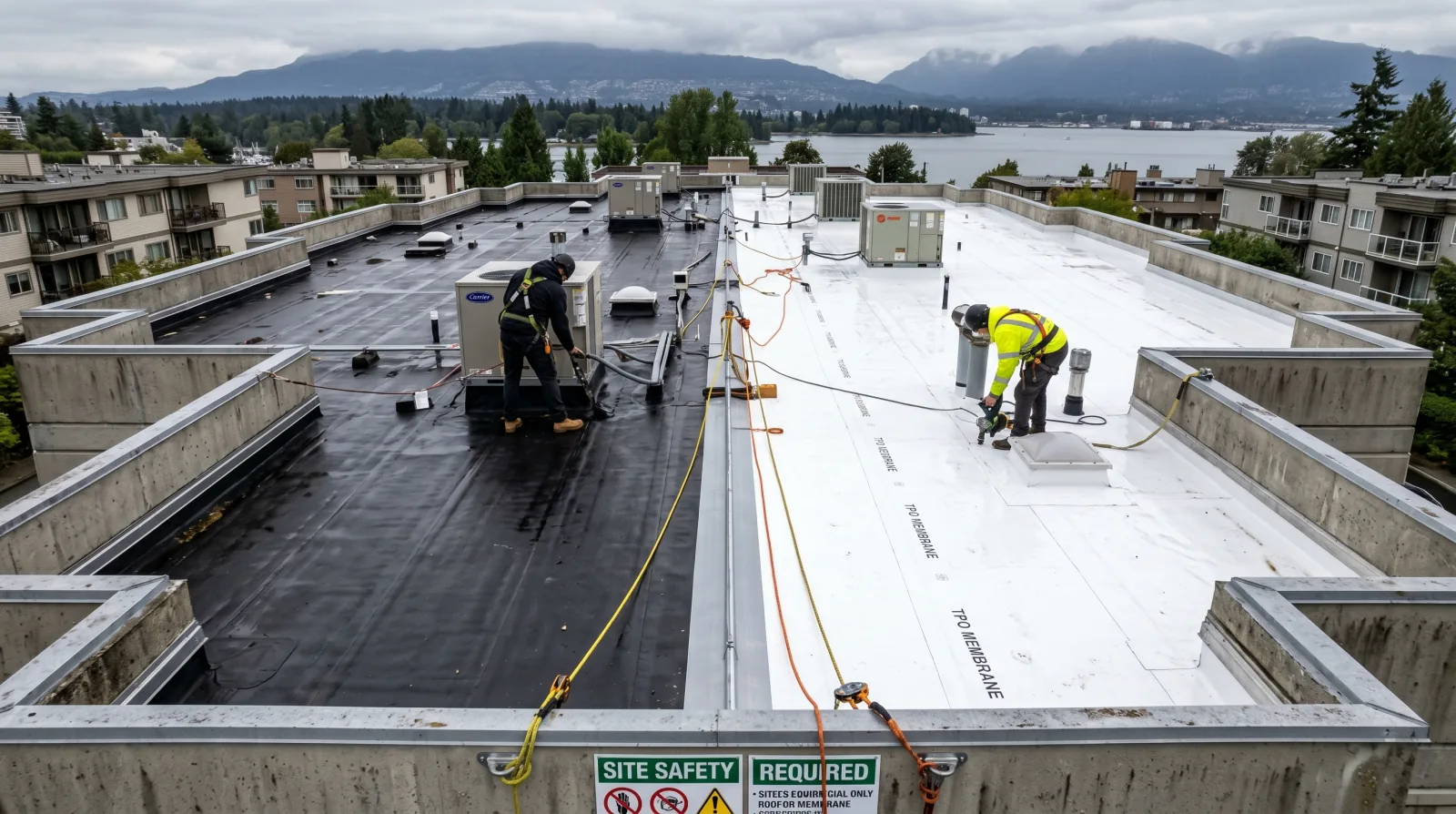
Two roofs sit side by side on a Burnaby strata low-rise. One is black, one is white. Both are single-ply membranes, both are supposed to keep water out of the building, and both will probably last around 25 years if nobody neglects them. But they are made of different stuff, they fail in different ways, and the choice between them isn’t about which is “better” in the abstract — it’s about which suits your building.
EPDM and TPO are the two membranes most strata councils end up comparing on a low-slope roof. Here is how they actually differ, where each one earns its place, and what to watch in a quote.
What they’re made of
EPDM is a synthetic rubber. Ethylene propylene diene monomer, if you want the full name, but everyone calls it EPDM or just “the rubber roof.” It comes in large sheets, usually black, and it has been on North American flat roofs for decades. It is one of the most stable roofing materials against ultraviolet light and ozone, which is why a black EPDM roof ages so slowly and predictably.
TPO is a thermoplastic polyolefin. It is a plastic-based membrane, usually white, and it is the newer of the two on the market. The defining property of a thermoplastic is that it softens when heated and re-fuses as it cools — which is the whole basis of how its seams are made.
That single difference, rubber versus thermoplastic, drives almost everything else.
The seam is the real story
On any single-ply roof, the field of the membrane rarely fails first. The seams do. Water finds the joints between sheets long before it finds a hole in the middle of a sheet. So how the seams are made matters more than almost anything else.
EPDM seams are joined with adhesive — either a seam tape or a liquid adhesive between the overlapping sheets. Modern EPDM tape seams are good, far better than the older liquid-only methods, but they are still an adhesive bond. Over 20 or 30 years of thermal cycling and weather, adhesive is the part that ages.
TPO seams are heat-welded. A technician runs a hot-air welder along the overlap, melting the two sheets into one continuous piece of membrane. Done correctly, the seam is effectively as strong as the membrane itself — there is no separate adhesive to age, because the two sheets have become one. That is the single biggest argument for TPO, and it is a real one.
The catch is in “done correctly.” A TPO weld is only as good as the technician setting the welder temperature and speed. Too cold and the weld peels apart. Too hot and you scorch and weaken the membrane. A good TPO roof depends on a crew that knows how to set the machine and probe-test every seam. EPDM’s adhesive seams are more forgiving of average workmanship, which is worth something on a job where you can’t watch every metre.
Reflectivity and summer heat
White reflects sunlight; black absorbs it. A white TPO roof stays markedly cooler in the sun than a black EPDM roof, which keeps the top-floor units cooler and reduces cooling load. As Metro Vancouver summers get hotter and longer — we are well past the days when air conditioning was rare in a Burnaby or Richmond low-rise — that reflectivity is worth more than it used to be.
You can buy EPDM with a reflective white surface, but it costs more and gives up some of the simplicity that makes standard EPDM attractive. If reflectivity is high on your list, TPO is the natural choice.
There is a caveat. The reflectivity advantage is biggest on a fully exposed roof that bakes all afternoon. A roof shaded by taller neighbouring towers — common in downtown Vancouver and around Metrotown — sees far less solar gain, so the energy argument weakens and the decision swings back to seams, repairability, and budget. The same logic that governs exterior coatings that protect buildings applies here: reflectivity matters most where the sun actually hits.
How each one ages in our climate
Both membranes can run 20 to 30 years when installed correctly and maintained. In coastal BC, where the roof takes roughly 1,150 to 1,200 millimetres of rain a year per Environment Canada climate normals, the lifespan-limiting factor is rarely the membrane chemistry. It is drainage, ponding, and maintenance.
EPDM rubber is genuinely stable. It hardens slightly over decades but resists UV and ozone breakdown better than almost anything. TPO had a rough start — early-generation membranes from the 2000s suffered premature weathering and surface cracking, which earned the product a mixed reputation that lingers. Modern TPO formulations are far more stable, and the problem is largely solved, but it is the reason an old roofer might still distrust TPO. If you are comparing quotes, the membrane thickness in mils matters as much as the brand. A thin TPO is a false economy on a roof you want to last.
Repairability and details
EPDM is easy to patch. A trained roofer can clean the area and apply an adhesive patch with basic tools, which makes field repairs quick. TPO repairs need a hot-air welder and someone who knows how to use it — a cold or scorched weld is a future leak. Neither is difficult for a competent crew, but EPDM is more forgiving of a fast repair, while a properly welded TPO patch is arguably stronger because it fuses to the membrane.
On a roof crowded with penetrations — vent stacks, drains, HVAC curbs, the kind of mechanical clutter you find on any occupied strata building — TPO’s welded flashings and prefabricated corners and pipe boots give consistent, fused details. EPDM penetration details rely more on uncured rubber flashing and adhesive, which work but depend on the installer’s hand skill. The more penetrations on the roof, the more TPO’s consistency helps.
When recoating beats replacing
Not every aging single-ply roof needs a tear-off. A sound but weathered membrane with good seams can sometimes be cleaned and recoated with a compatible liquid-applied system, adding years of service and a reflective surface without the cost and disruption of a full replacement. This only works if the membrane and seams are structurally sound — if the seams are failing or the sheet is split, a coating buys little. The same evaluation that applies to a spray polyurethane foam roof on a BC commercial building applies here: an honest assessment tells you whether the existing roof has enough life left to justify recoating, or whether you are throwing good money at a roof that needs replacing.
Fitting it into the bigger plan
A roof replacement on a strata almost never happens in isolation. It usually surfaces in the depreciation report, gets scheduled against other envelope work, and competes for the same contingency dollars as sealant, balconies, and concrete repair. The smart move is to time the roof decision against the rest of the building’s needs rather than treating it as a standalone emergency. Building roof inspection into the fall maintenance checklist for strata buildings — checking drains, seams, and flashings before the wet season — catches the small problems that turn into leaks, regardless of which membrane you chose.
EPDM and TPO are both good roofs. The black rubber gives you stable, forgiving, easy-to-patch service. The white thermoplastic gives you welded seams and a reflective surface. Match the membrane to the building, watch the seam quality and the membrane thickness, and the roof will outlast the council that approved it.
Related guides
- Exterior Coatings Hub — coating systems, membranes, and surface protection
- Spray Polyurethane Foam Roofing for BC Commercial Buildings — another low-slope roofing option compared
- Fall Building Maintenance Checklist for Strata Buildings — pre-storm roof and drainage checks
- How Exterior Coatings Protect Buildings — reflectivity, weather resistance, and service life
Frequently Asked Questions
More from Flat Roof Systems Guide
Metal Flashing Detail Failures in BC Rainscreen Walls
Good cladding doesn't keep a Burnaby wall dry — flashing does. Reverse laps, missing end dams, and bad transitions are why rainscreen buildings still leak, and why the metal almost nobody looks at deserves the attention.
Read article →Roof Drain and Scupper Maintenance on Vancouver Strata Flat Roofs
A clogged roof drain is the cheapest leak you'll ever ignore — until ponding water destroys the membrane. How Burnaby strata roofs fail at the drains.
Read article →Spray Polyurethane Foam Roofing on BC Commercial Buildings: When It Makes Sense
Spray polyurethane foam (SPF) roofing is well established in colder North American climates but used sparingly in coastal BC. Where it works, where it fails, and how it compares to the membrane systems that dominate Metro Vancouver flat-roof installations.
Read article →