Expansion Joint Systems on Vancouver Parkade and Plaza Decks
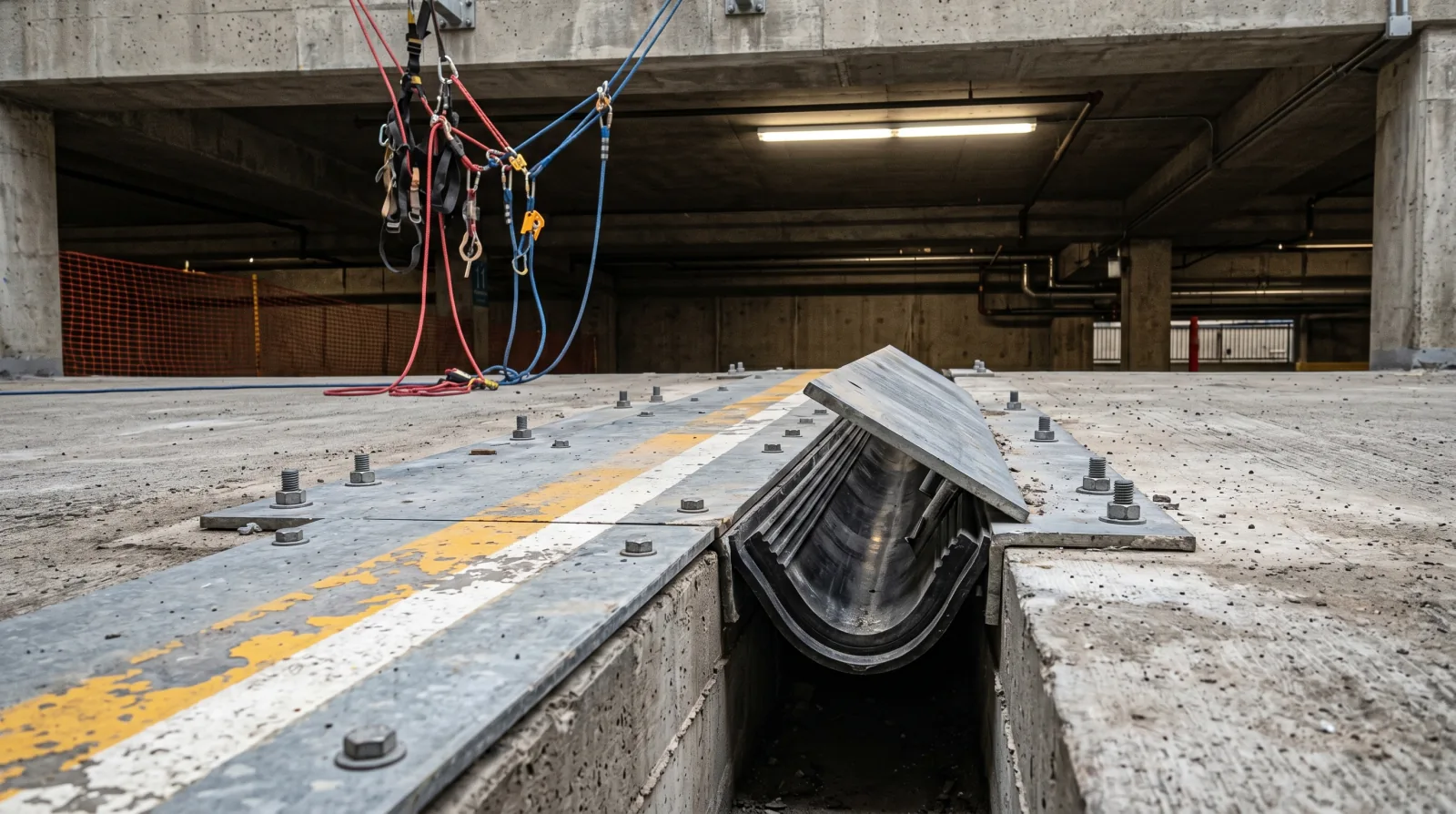
A Vancouver strata called about water dripping onto cars on the upper parking level. The council had already decided the fix: recoat the deck membrane. They wanted a price. When we got on the deck, the membrane was in decent shape. The water was coming through an expansion joint that ran the width of the deck, directly above the wet patch below. Recoating the membrane would have cost them money and changed nothing.
Deck expansion joints are one of the most misdiagnosed leaks in a parkade. The water shows up below, people assume the broad membrane failed, and the actual culprit is a narrow seal in a moving gap that most owners do not even know is there.
What an expansion joint is doing
Concrete moves. It expands when it warms, contracts when it cools, and a large deck would tear itself apart if it were poured as one rigid slab. So decks are built in sections separated by expansion joints — deliberate gaps that let the structure breathe.
The catch is that the joint still has to keep water out while the gap opens and closes. A seal across a static crack is straightforward. A seal across a gap that moves every single day, under traffic, through Metro Vancouver’s temperature swings, is a genuinely hard problem. That moving gap is exactly where deck waterproofing is most likely to fail, and on a suspended deck it sits directly over the parking level below — so anything that gets past the seal drips onto whatever is parked underneath.
The three joint systems you’ll see
There are several ways to seal a moving joint, and the right one depends on how much the joint moves and how much traffic it takes.
Compression seals are preformed elastomeric elements — often neoprene — squeezed into the gap so they stay sealed by constant compression against both faces. As the joint opens and closes, the seal compresses and springs back to keep contact. They work well inside their movement range, but they are at the mercy of two things: if the joint ever opens wider than the seal’s range, it loses contact, and as the neoprene hardens with age it loses the springy recovery that kept it pressed against the concrete. An old, hardened compression seal stops following the joint and starts leaking.
Strip seals use a flexible gland — a preformed rubber or neoprene strip — mechanically locked into metal edge rails set into the concrete on each side of the gap. The gland flexes as the joint moves while the steel rails protect the concrete edges from being chewed up by tires. Strip seals handle larger movement than compression seals and stand up to vehicle loading, which is why you see them on decks that actually carry traffic. Their weak point is the steel: corrode the rails and you lose the bearing surface the gland depends on.
Membrane-type joints bridge the gap with a flexible membrane or a preformed membrane assembly that ties into the deck’s traffic membrane on each side. Instead of sealing the gap itself, this kind of joint carries water across it. It integrates cleanly with a liquid-applied or sheet deck membrane, but it lives or dies on the transition detail — where the joint assembly meets the field membrane is a junction that has to be executed carefully or it leaks regardless of how good either piece is on its own.
Why the leak ends up on the cars
The path from a failed joint to a stained parkade ceiling is short and direct. The joint runs across the deck, the gap goes all the way through the structure, and the parking level sits right underneath. When the seal hardens, tears, debonds, or the membrane transition fails, water follows the gap straight down and the stain appears on the underside, below the joint line.
What wears the seal out is the same combination every time. Age hardens the elastomer. Daily thermal and traffic movement works it until it tears or loses adhesion. Grit and debris pack into the joint and abrade the seal. Metro Vancouver’s colder winters bring enough freeze-thaw to stress the joint edges, and the de-icing salt cars track in does real damage — chloride attacks the steel rails on strip seals and migrates into the concrete, driving the rebar corrosion and edge spalling that destroys the seal’s bearing surface. Coastal moisture keeps the whole assembly wet so none of it ever dries out. Most failures are several of these at once, not a single cause.
The joint and the membrane are one system
This is the part councils miss, and it is the reason recoating the membrane alone so often fails to stop a leak. The expansion joint and the traffic membrane are not two separate jobs. The membrane waterproofs the broad deck surface; the joint waterproofs the moving gap; and the transition between them is where a lot of leaks actually begin.
A sound detail terminates the deck membrane into the joint assembly so water cannot sneak under the membrane edge at the joint. If you restore the membrane and ignore a failed joint, the joint keeps leaking. If you fix the joint but leave a poor membrane transition, water finds the untouched edge. Either way you have paid for half a repair. The membrane choice itself matters here too — the traffic coating system on the deck has to be compatible with how the joint is detailed, and both have to be planned together.
How a joint restoration is sequenced
Restoring a leaking deck joint properly follows a logical order, and it almost always touches the concrete, not just the seal.
First, assess the joint and the deck around it — the seal condition, the concrete edges, any corroded rails, the rebar, the membrane, and the drainage. Then remove the failed seal along with any unsound concrete and corroded hardware. Repair the concrete edges and the rebar, because a seal has nothing to bear against if the edges have spalled away. Install or reset a joint system suited to the actual movement the joint sees — not just whatever was there before, if that system was wrong for the movement. Finally, tie the deck membrane into the new joint with a properly detailed transition so the whole assembly is watertight.
That sequence is part of a broader parkade slab restoration on most jobs, because a joint that has been leaking for a while has usually caused concrete damage nearby that has to be addressed in the same mobilization. Sorting out the recoat timing across the whole deck — including a sensible traffic coating recoat schedule — keeps the joint and the membrane on the same maintenance cycle so they do not fail out of step.
Get it assessed as a system
A leaking deck joint should be looked at by someone who works on parkade and deck waterproofing, ideally with a building envelope consultant or structural engineer involved if there is concrete damage. The assessment has to cover the joint, the surrounding concrete and rebar, the membrane, and the drainage, because the leak is almost always a system problem rather than a single bad seal. From there the right joint system and a proper scope can be specified — and the membrane recoat the strata thought they needed either gets folded into a real fix or set aside until the joint is dealt with.
Related guides
- Concrete Restoration Hub — deck, slab, and structural concrete repair in BC
- PMMA vs Polyurethane Traffic Membranes for Parkade Decks — choosing the deck membrane that ties into the joint
- Parkade Slab Restoration in Vancouver — the larger deck restoration a joint repair usually sits within
- Parkade Membrane and Traffic Coating Recoat Schedule — keeping the membrane and joint on the same cycle
Frequently Asked Questions
More from Parkade Waterproofing Guide
Negative-Side Waterproofing of Below-Grade Walls in Vancouver
When you can't dig up a leaking foundation wall in Richmond's high water table, you waterproof from the inside. How crystalline coatings work, what they can and can't do, and where their limits are.
Read article →Cathodic Protection for Chloride-Contaminated Parkades in Vancouver
Road salt drives chloride deep into Surrey and Vancouver parkade slabs, and patch repair alone won't stop the corrosion it starts. When cathodic protection makes sense, how it works, and what it costs you to ignore it.
Read article →When to Recoat a Parkade Traffic Membrane in Vancouver
Deferring a parkade traffic-coating recoat is how a Richmond strata turns a maintenance bill into a slab replacement. How to read wear before it's too late.
Read article →