When to Recoat a Parkade Traffic Membrane in Vancouver
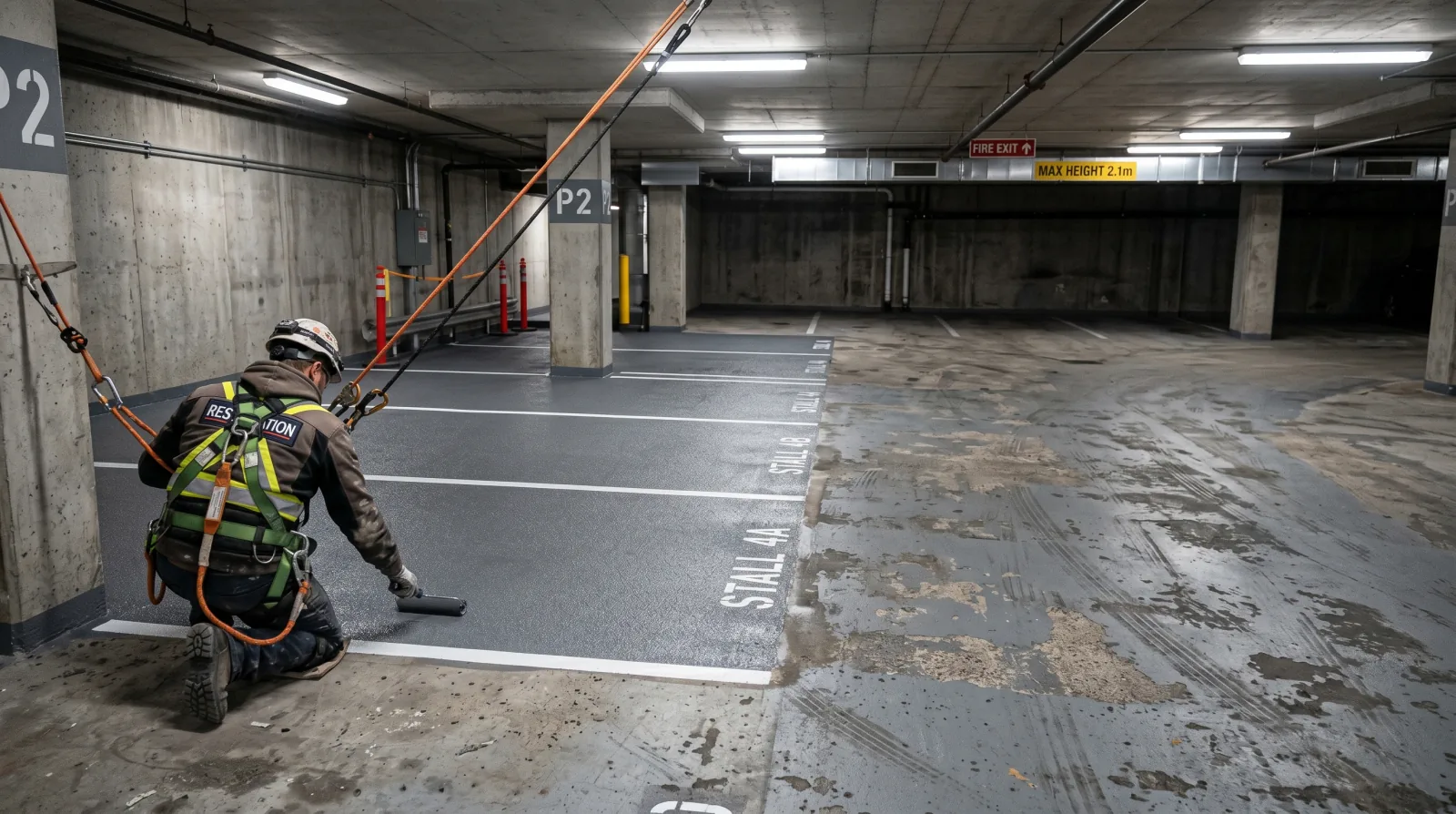
Walk down the ramp into almost any Metro Vancouver strata parkade and look at the floor where the tires turn at the bottom. That spot tells you more about the building’s waterproofing budget than any report. If the gritty, coloured surface is worn down to a smooth patch of a different colour, the membrane is sending a warning — and how the strata responds in the next year or two decides whether this stays a cheap maintenance job or becomes a structural repair.
A parkade traffic-bearing membrane is a layered system. The waterproofing happens in the base coat against the concrete. On top of that sits a wearing topcoat with embedded aggregate that gives the gritty, non-slip surface you drive and walk on. That topcoat is sacrificial. It is built to wear out — that is its entire purpose, to take the abrasion of tires so the waterproofing underneath stays intact. The recoat cycle is simply the discipline of renewing the sacrificial layer before it’s gone.
How to read the wear
You don’t need an engineer to spot the early signs. You need to look in the right places.
- Drive lanes and ramps — the topcoat thins fastest where vehicles travel constantly. Watch for the coloured wearing surface giving way to a different-coloured base coat underneath.
- Tire-turning areas — the bottom of the ramp, the entrance to each parking aisle, anywhere wheels scrub sideways. This is where wear concentrates and where failure starts. Check these first and check them closely.
- Loss of grit — the non-slip aggregate wears away, leaving bald, shiny patches. Beyond the waterproofing concern, this is a slip hazard.
- Cracking, blistering, or peeling — surface defects that let water under the membrane.
- The ceiling below — damp patches, staining, white mineral bloom, or active dripping on the level underneath mean water is already getting through.
Parking stalls, where a car sits still most of the time, wear far more slowly than the lanes. That difference is the basis of a sensible program.
Recoating is not a calendar event
The common question is “how often should we recoat?” The honest answer is: it depends on wear, not on a fixed number of years. As a rough guide, the wearing topcoat in drive lanes and turning areas often needs renewal every 5 to 10 years, while low-traffic stalls can go much longer. But traffic volume, studded winter tires, leaking vehicle fluids, and drainage all change that timeline.
The smarter approach is to treat the parkade in zones. Renew the high-traffic drive lanes and ramps on a shorter cycle, and leave the low-wear stalls until they actually need it. Recoating the entire deck on a single schedule wastes money on areas that have barely worn. A zoned program matches the spend to the actual wear, which is exactly the kind of thinking that belongs in a parkade slab restoration plan before any damage starts.
Why deferral destroys the slab
This is the part that turns a manageable expense into a crisis, and it is worth spelling out step by step, because the cost curve is brutal.
When the topcoat wears through, traffic starts abrading the waterproofing base coat. Once that goes, the concrete is exposed. Water — and in our climate, the road salt and de-icing chemicals dragged in on tires through the winter — reaches the slab directly. The concrete is porous, so the salt-laden water soaks in and travels down to the reinforcing steel.
Steel in good, alkaline concrete is protected from rust by a passive layer. Chloride from road salt breaks that protection down. The rebar starts to corrode, and corroding steel expands to several times its original volume. That expansion cracks the concrete from the inside out — the spalling and delamination that turns up on parkade ceilings across the region. This is the same mechanism behind rebar corrosion and concrete delamination on coastal buildings, just driven from the deck above instead of the weather face.
At that point you are no longer recoating a membrane. You are doing structural concrete repair: chipping out delaminated concrete, cleaning or replacing corroded rebar, patching, and then rebuilding the waterproofing on top. That work costs many times the recoat that would have prevented it. A worn topcoat is a few-thousand-dollar problem. A spalled slab is a special-levy problem.
Topcoat recoat versus full system replacement
If you catch the wear in time, the fix is a recoat: clean the surface, check adhesion, and renew the topcoat and non-slip aggregate. The waterproofing base coat stays in service. This is the cheap, fast, low-disruption outcome you are aiming for.
If the base coat is already compromised — worn through over large areas, debonded, or sitting over damaged concrete — a recoat won’t save it. Then you are into a full system replacement: stripping back to the concrete, repairing the slab as needed, and rebuilding the whole membrane. The difference in cost and disruption between these two outcomes is enormous, and the only thing that decides which one you face is whether you renewed the sacrificial layer in time.
Material matters for the rebuild or recoat. Polyurethane systems are proven, widely used, and generally less expensive, but they cure more slowly. PMMA cures very fast — useful when you need the garage back quickly or are working in colder weather — but costs more. The full trade-off is laid out in the comparison of PMMA versus polyurethane traffic membranes for parkade decks. For a recoat specifically, compatibility with the existing system usually narrows the choice, because the new topcoat has to bond to what’s already there. Putting an incompatible product over an existing membrane is a fast route to peeling and delamination.
Drainage is half the battle
A membrane that sits under standing water breaks down faster than one that drains. Poor drainage is one of the most common reasons a Metro Vancouver parkade membrane wears out ahead of schedule — water pools in low spots, sits on the coating, and accelerates breakdown while also finding any weak point in the waterproofing. Blocked drains, flat spots in the slab, and clogged trench drains all show up in the common parkade waterproofing problems worth watching. Fixing drainage often does as much for membrane life as the recoat itself.
Put it in the plan, not the emergency budget
A parkade waterproofing system is a major building component with a finite, predictable service life. The recoat is a recurring maintenance expense, and it belongs in the depreciation report and the contingency funding — not in the line item labelled “emergency” that surfaces the winter the ceiling below starts dripping.
The buildings that handle this well are the ones that schedule a close-up inspection of the high-wear zones every couple of years, recoat the lanes on a planned cycle, keep the drains clear, and fund it as the routine cost it is. The buildings that handle it badly are the ones that never look at the bottom of the ramp until a resident on the level below reports a stain. By then the membrane is gone, the slab is wet, and the rebar has already started to go.
The topcoat is supposed to wear out. Let it do its job — and replace it before it’s done.
Related guides
- Concrete Restoration Hub — slab repair, waterproofing, and structural protection
- PMMA vs Polyurethane Traffic Membranes for Parkade Decks — choosing the recoat or replacement material
- Parkade Slab Restoration in Vancouver — what happens when deferral leads to structural repair
- Parkade Waterproofing Problems to Watch — drainage, wear, and early warning signs
Frequently Asked Questions
More from Parkade Waterproofing Guide
Cathodic Protection for Chloride-Contaminated Parkades in Vancouver
Road salt drives chloride deep into Surrey and Vancouver parkade slabs, and patch repair alone won't stop the corrosion it starts. When cathodic protection makes sense, how it works, and what it costs you to ignore it.
Read article →PMMA vs Polyurethane Traffic Membranes for Vancouver Parkade Decks
Comparing PMMA and polyurethane traffic membranes for Metro Vancouver parkades and balconies — cure speed, service life, cold-weather use, and resident disruption.
Read article →Parkade Slab Restoration in Vancouver: What's Eating Your Concrete From Below
Underground parkades fail from a different direction than balconies — de-icing salt, standing water, and chloride driving corrosion through suspended slabs and columns. Here's how Vancouver parkade restoration actually works.
Read article →