Brick Masonry Repointing on Vancouver Heritage and Older Buildings
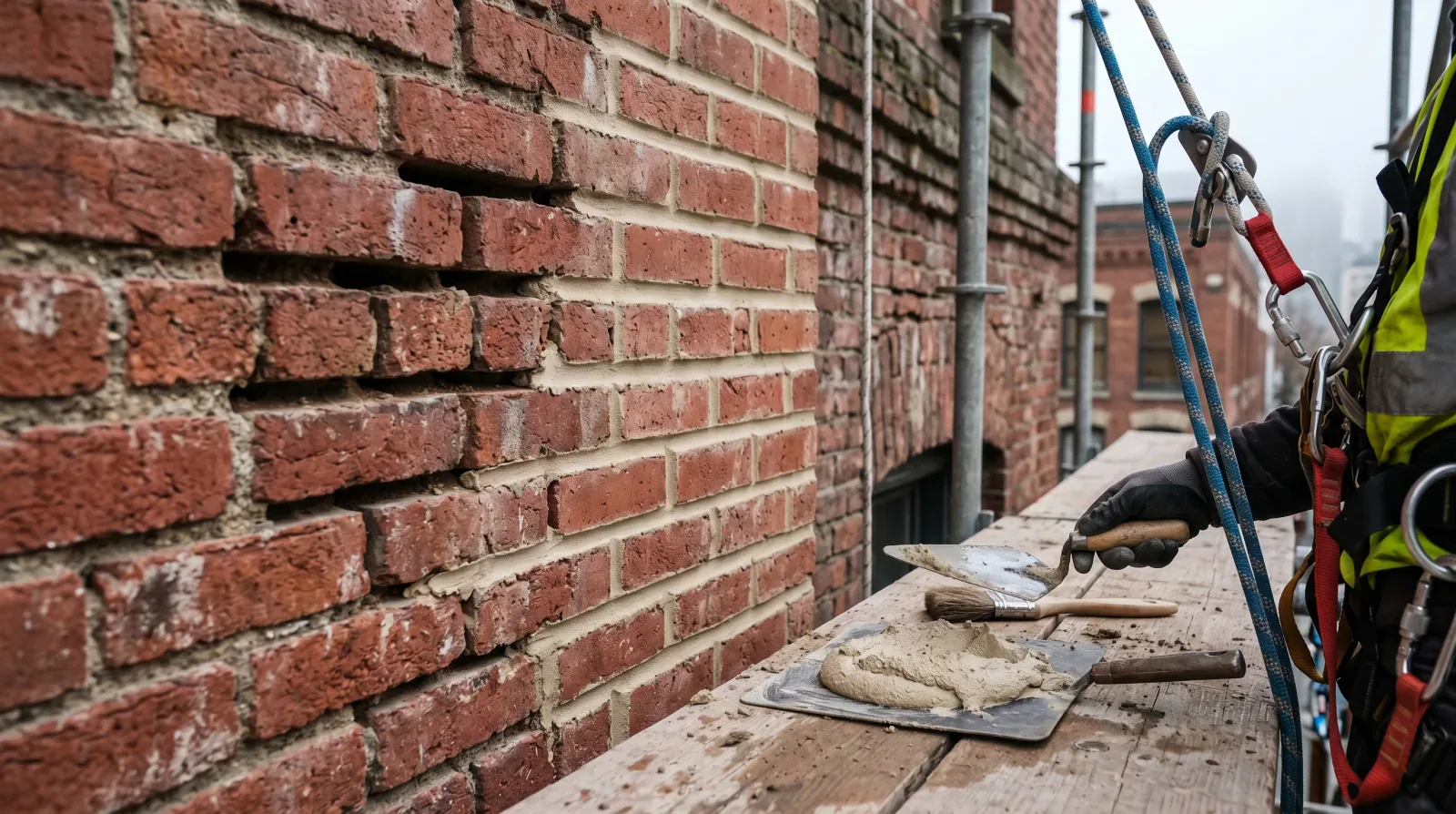
A property owner in a heritage neighbourhood — Mount Pleasant, Strathcona, the older parts of New Westminster — notices the mortar joints on a brick building have gone soft and recessed. They hire a contractor to repoint. A few years later the brick faces are cracking and flaking off in chips. The mortar looks great. The brick is failing. And the well-meaning repointing job is the reason.
This happens constantly, and it comes down to one principle that’s older than the building itself: in a masonry wall, the mortar must be softer than the brick.
What the mortar is actually for
People assume the mortar in a brick wall is the glue holding it together. It does bond the units, but its more important job is to be the sacrificial element. The mortar is supposed to be softer, weaker, and more permeable than the brick around it, so that when the wall moves, when moisture gets in, and when salts crystallize and expand, all of that stress and damage is absorbed by the joints — not the brick.
The brick is the part you can’t replace. A heritage brick, fired a century ago in a now-vanished local brickworks, has a colour and texture you cannot buy at a building supply. The mortar joint, by contrast, is meant to be renewed every several decades. That’s the whole design: the cheap, replaceable element protects the expensive, irreplaceable one.
Repointing renews the sacrificial layer. But only if the new mortar respects the original hierarchy.
Lime versus portland — and why it isn’t a style choice
Most Vancouver-area buildings from before roughly 1920 were built with lime-based mortar and relatively soft, porous brick. Lime mortar is flexible, breathable, and mildly self-healing — dissolved lime migrates with moisture and re-deposits in fine cracks. It’s weak by modern standards, and that weakness is the feature. It moves with the wall and lets moisture pass through.
Portland cement mortar, the default for modern construction, is the opposite: hard, rigid, strong, and far less permeable. On a modern wall built with hard, dense brick, that’s appropriate. On a soft heritage brick, it’s a slow-motion disaster.
When you repoint a soft-brick wall with a hard portland mix, you invert the hierarchy. The joints become harder than the brick. Now the brick is the weakest element, so when the wall expands and contracts and when moisture freezes and thaws, the damage migrates into the brick faces. They spall. The mortar, meanwhile, holds up beautifully — which is exactly the problem, because the brick is what you were trying to save.
The right repointing mortar matches the original’s physical properties: compressive strength, permeability, and flexibility. On a true heritage wall that usually means a lime or lime-rich mix, not straight portland.
How moisture moves through a solid masonry wall
A solid masonry wall — several wythes of brick with no cavity, no rainscreen, no membrane — manages water completely differently from a modern wall. It doesn’t keep water out. It absorbs water at the surface during rain and releases it by evaporation when the weather clears. The wall breathes.
That matters in our climate. With 1,150 to 1,200 millimetres of rain a year on the South Coast, a heritage wall takes on a lot of water through a wet winter, and it needs to be able to dry. The soft lime mortar and porous brick handle that cycle together.
Seal that wall — with hard mortar, a cement render coat, or an impermeable paint — and you trap the moisture inside. It can’t get out the way it came in, so it migrates to wherever it can: into the brick, where it freezes and spalls, or to the interior, where it shows up as damp and efflorescence. This is the same water-management logic behind every envelope leak, and it’s why understanding how water gets into a building matters even on a low-rise brick wall. The failure modes look different, but the cause is the same — water getting in faster than the assembly can let it out.
The deterioration you can see
Failing mortar tells you it’s time before any brick is harmed, if you know what to look for:
- Receding joints — the mortar has worn back from the face, leaving the brick edges exposed and creating ledges that hold water
- Crumbling and sanding — you can rake the mortar out with a key or a screwdriver, and it sheds loose sand
- Cracking — fine cracks through the joints, or gaps where the mortar has pulled away from the brick
- Efflorescence — white, powdery salt staining on the surface, a sign that water is moving through the wall and depositing dissolved salts as it evaporates
- Vegetation and biological growth — plants rooting in joints widen them and hold moisture
Catch it at the mortar stage and repointing solves it cleanly. Wait until the brick faces are spalling — the same way rebar corrosion drives concrete delamination on a tower, just in a different material — and the repair scope grows from the joints to the units themselves.
Repoint or rebuild?
Repointing renews joints. It cannot fix brick that has already failed, and it cannot stabilize a wall that’s moving. The honest distinction:
Repoint when the brick units are sound and only the mortar has deteriorated. This is the large majority of cases. You rake out the failed joints — and only the failed joints — to a proper depth, clean them, and fill with matched mortar in lifts, tooled to match the original profile.
Rebuild when the brick itself has gone — widespread spalling, crushed or cracked units, bulging or leaning sections, or displacement showing the wall has lost integrity. At that point partial rebuilding with salvaged or matched brick is the real answer. Repointing over a structurally compromised wall is cosmetic, and it papers over a problem that will keep moving.
A close-up assessment is what tells the two apart. From the ground you can’t judge joint depth or brick condition reliably, especially several storeys up. On a taller building, that assessment — and the repointing itself — needs access at height. For many masonry facades, rope access versus a swing stage comes down to the extent of the work and the building’s constraints; rope access reaches scattered repair zones efficiently, while extensive full-facade repointing may justify staging.
Matching matters more than it looks
On a heritage building, the appearance of the repointing isn’t vanity. The joint width, profile, colour, and tooling all affect how water sheds off the wall — a struck joint sheds water, a raked joint collects it. Matching the original keeps both the performance and the character intact, which is not optional when the building sits on a heritage register or in a conservation area.
Get the mortar right and the repointing disappears into the wall, doing its quiet sacrificial job for another fifty to a hundred years. Get it wrong and you’ll see the mistake within a few Vancouver winters — written in spalled brick that no repointing can ever bring back.
Related guides
- Masonry Repointing vs. Rebuild: how to tell which one your building needs, with real Vancouver cost ranges
- Concrete and Masonry Restoration Hub — restoration approaches across materials
- What Causes Water Ingress in High-Rise Buildings — the water-management principles behind every envelope
- Rebar Corrosion and Concrete Delamination on Coastal Buildings — how spalling works in reinforced concrete
- Rope Access vs Swing Stage — choosing access for facade restoration
Frequently Asked Questions
More from Concrete Restoration Guide
Concrete Carbonation on Coastal BC Buildings
Not all rebar corrosion is salt. On older Victoria concrete buildings, carbonation quietly lowers the concrete's pH until the steel loses its protection.
Read article →Vapour Barrier Failure and Interstitial Condensation in BC Walls
The water staining a Coquitlam condo's interior wall isn't always a leak. Sometimes the wall makes its own water — warm air condensing inside the cavity.
Read article →Corroding Balcony Guardrail Anchors on Vancouver Strata Towers
The rust staining at the base of a balcony railing post in Burnaby isn't cosmetic — it's a corroding anchor pushing the concrete apart, and a safety problem.
Read article →