Masonry repointing vs. rebuild: how the call gets made
A brick wall with failing mortar joints does not automatically need rebuilding, and a wall with visibly spalling brick cannot be saved by repointing alone. The two repairs solve different problems. Here's how to tell which one your building needs, and what each actually costs in Vancouver.
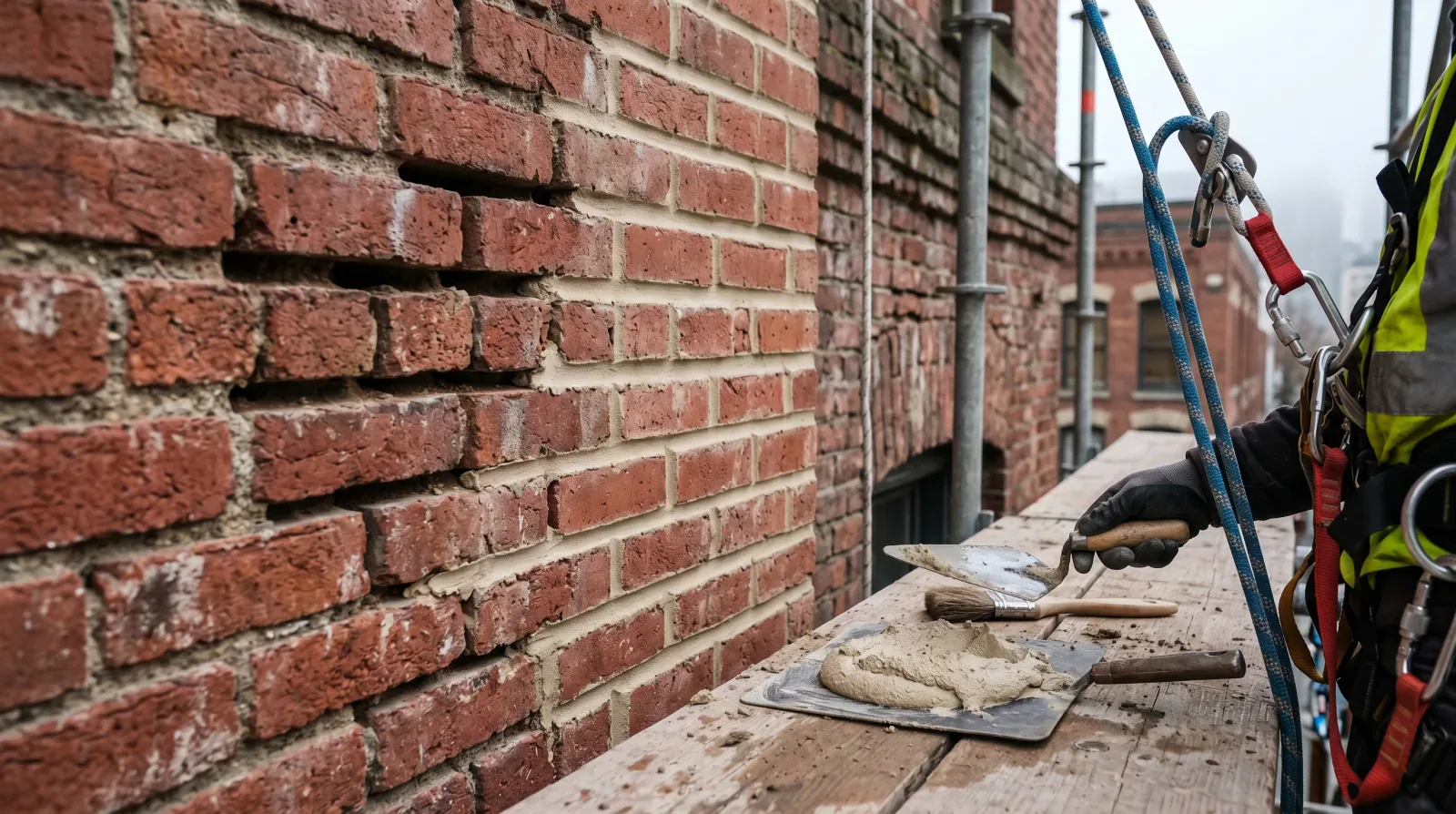
What repointing actually renews
Repointing rakes out deteriorated mortar from between the brick or stone units and replaces it with fresh, properly matched mortar. It renews the joints — it does not touch the brick units themselves. That distinction is the whole basis for the repoint-or-rebuild decision: if only the mortar has failed, repointing is the complete fix. If the brick has failed, repointing cannot reach the actual problem.
When repointing is the honest answer
- The brick units themselves are sound — only the mortar joints have deteriorated, receded, or crumbled.
- Deterioration is limited to isolated zones (window heads, parapets, ground-level courses) rather than spread across the whole elevation.
- The wall is not bulging, leaning, or showing displacement that would indicate a structural movement problem underneath.
- A mortar analysis confirms what the original mix was, so the repointing mortar can be matched for hardness and permeability rather than guessed at.
This covers the large majority of masonry repair calls. Done properly — joints raked to full depth, matched mortar mixed for the right hardness and permeability, tooled to match the original profile — repointing on a heritage wall can last 50 to 100 years, comparable to the brick's own service life.
When rebuild wins
- Brick units have failed — widespread spalling, cracked or crushed faces, or units that have lost structural integrity.
- The wall shows bulging, leaning, or displacement, which points to a structural or moisture problem the mortar alone did not cause.
- More than roughly 20 to 30 percent of the brick faces across a section show spalling or moisture damage.
- A previous repointing job used mismatched hard mortar and has already accelerated brick face damage — the wall needs the failed brick replaced, not another round of the same mistake repeated.
At that point, partial rebuilding with salvaged or matched brick is the honest answer. Repointing over brick that has already failed is cosmetic — it papers over a problem that keeps moving, and on a heritage building it also risks damaging brick faces you cannot replace with an off-the-shelf product.
The mistake that causes rebuild-level damage where repointing would have worked
Mortar is meant to be the sacrificial, softer element in a masonry wall — it absorbs movement and moisture stress so the brick does not have to. Most Vancouver-area buildings built before roughly 1920 used soft, porous brick with lime-based mortar. Repoint that brick with hard modern portland cement mortar and the hierarchy inverts: the joints become harder than the brick, so the next round of movement and moisture damage goes into the brick faces instead of the joints. The mortar holds up fine. The brick — the part you cannot replace — is what fails.
This is why a mortar analysis matters before repointing a heritage wall. Getting the mortar hardness wrong turns a routine repointing job into the kind of brick-face spalling that pushes a section from a repoint scope into a rebuild scope. Our guide to repointing on heritage buildings covers the lime-versus-portland distinction in more depth.
What each option costs in Vancouver
| Scope | Typical Range | Notes |
|---|---|---|
| Spot repointing (isolated joints, small area) | $10 to $25 per square foot | Typical for localized deterioration around window heads, parapets, or ground-level courses |
| Full elevation repointing | Priced per project — access and joint condition drive cost more than square footage | Rope access can reduce mobilization cost versus a full scaffold for scattered repair zones |
| Individual brick replacement | $15 to $30 per brick, including matching and installation | Matching heritage brick colour and texture adds cost — salvaged or custom-fired brick may be needed |
| Full wall section rebuild | $25 to $45 per square foot | Depends on scope, wall height, brick selection, and whether the section requires structural review |
These are general market ranges, not a quote. Access method, brick matching requirements, and heritage-register conditions all move the actual number — a site assessment gives you a real figure.
Access drives the cost more than square footage does
On a multi-storey building, how the crew reaches the wall matters as much as how much wall needs work. For scattered repair zones — a few problem areas across a tall facade rather than the whole elevation — IRATA or SPRAT certified rope-access technicians reach the joints on two independent lines under WorkSafeBC Part 11 fall-protection rules, without the cost and mobilization time of a full scaffold. For extensive full-facade repointing, swing stage or scaffold access is often the more practical call because it gives the crew sustained, close access across a wide area. See rope access vs. swing stage for how that decision plays out on other envelope work.
Quick answers
How do I know if my building needs repointing or a rebuild?
Look at the brick first, not just the mortar. If the mortar joints are receding, crumbling, or cracked but the brick faces are intact, repointing solves it. If the brick itself is spalling, cracked, or crushed — or the wall shows bulging or leaning — repointing cannot fix that, because it only renews the joints. A close-up condition assessment is the only reliable way to tell the two apart, especially several storeys up where ground-level viewing cannot judge joint depth or brick condition accurately.
How much does brick repointing cost in Vancouver?
Spot repointing of isolated deteriorated joints typically runs $10 to $25 per square foot. A full elevation repointing project is priced against the specific building rather than a flat rate, because access method and joint condition drive the cost more than raw square footage does. Individual brick replacement, where units need to be swapped rather than just the mortar, runs $15 to $30 per brick including matching and installation. These are general ranges; an accurate quote needs a site assessment.
Why does mortar hardness matter for repointing?
Mortar is designed to be the sacrificial, softer element in a masonry wall — it should absorb movement and moisture damage so the brick does not have to. Most Vancouver-area buildings from before roughly 1920 were built with soft, porous brick and lime-based mortar. Repointing that brick with hard modern portland cement mortar inverts the hierarchy: the joints become harder than the brick, so movement and moisture damage migrate into the brick faces instead of the joints. The brick spalls while the mortar holds up fine — the opposite of what should happen.
Services this guide connects to
Masonry repointing questions
How do I know if my building needs repointing or a rebuild?
Look at the brick first, not just the mortar. If the mortar joints are receding, crumbling, or cracked but the brick faces are intact, repointing solves it. If the brick itself is spalling, cracked, or crushed — or the wall shows bulging or leaning — repointing cannot fix that, because it only renews the joints. A close-up condition assessment is the only reliable way to tell the two apart, especially several storeys up where ground-level viewing cannot judge joint depth or brick condition accurately.
How much does brick repointing cost in Vancouver?
Spot repointing of isolated deteriorated joints typically runs $10 to $25 per square foot. A full elevation repointing project is priced against the specific building rather than a flat rate, because access method and joint condition drive the cost more than raw square footage does. Individual brick replacement, where units need to be swapped rather than just the mortar, runs $15 to $30 per brick including matching and installation. These are general ranges; an accurate quote needs a site assessment.
Why does mortar hardness matter for repointing?
Mortar is designed to be the sacrificial, softer element in a masonry wall — it should absorb movement and moisture damage so the brick does not have to. Most Vancouver-area buildings from before roughly 1920 were built with soft, porous brick and lime-based mortar. Repointing that brick with hard modern portland cement mortar inverts the hierarchy: the joints become harder than the brick, so movement and moisture damage migrate into the brick faces instead of the joints. The brick spalls while the mortar holds up fine — the opposite of what should happen.
Can a spalling brick wall be saved with repointing alone?
No. Repointing renews mortar joints; it cannot restore brick units that have already spalled, cracked, or crushed. Once the brick face itself has failed, the honest options are individual brick replacement (for scattered, isolated damage) or partial-to-full rebuild with salvaged or matched brick (once damage covers a significant share of the wall). Repointing over failed brick is cosmetic and does not stop the deterioration underneath.
How is repointing done safely on a multi-storey building?
For scattered repair zones across a tall facade, IRATA or SPRAT certified rope-access technicians reach the joints on two independent lines under WorkSafeBC Part 11 fall-protection rules, without the cost and footprint of full scaffolding. For extensive full-facade repointing or where sustained close access is needed, swing stage or scaffold access is often more practical. The right method depends on how much of the wall needs work and the site's constraints.
Does repointing count as waterproofing?
Indirectly. Failed mortar joints are a primary way water enters a solid masonry wall, so sound, properly matched repointing restores the wall's ability to shed water at the surface and release what it absorbs. But repointing works with a masonry wall's natural moisture management — it does not seal the wall. Sealing a breathable heritage wall with an impermeable coating traps moisture inside and causes more damage than the leak it was meant to stop.
Not sure if your masonry needs repointing or rebuild?
We assess brick and masonry condition on buildings across Vancouver, North Vancouver, West Vancouver, and Burnaby, and scope the repair against what the brick and mortar actually need — not a guess from the ground.