Vapour Barrier Failure and Interstitial Condensation in BC Walls
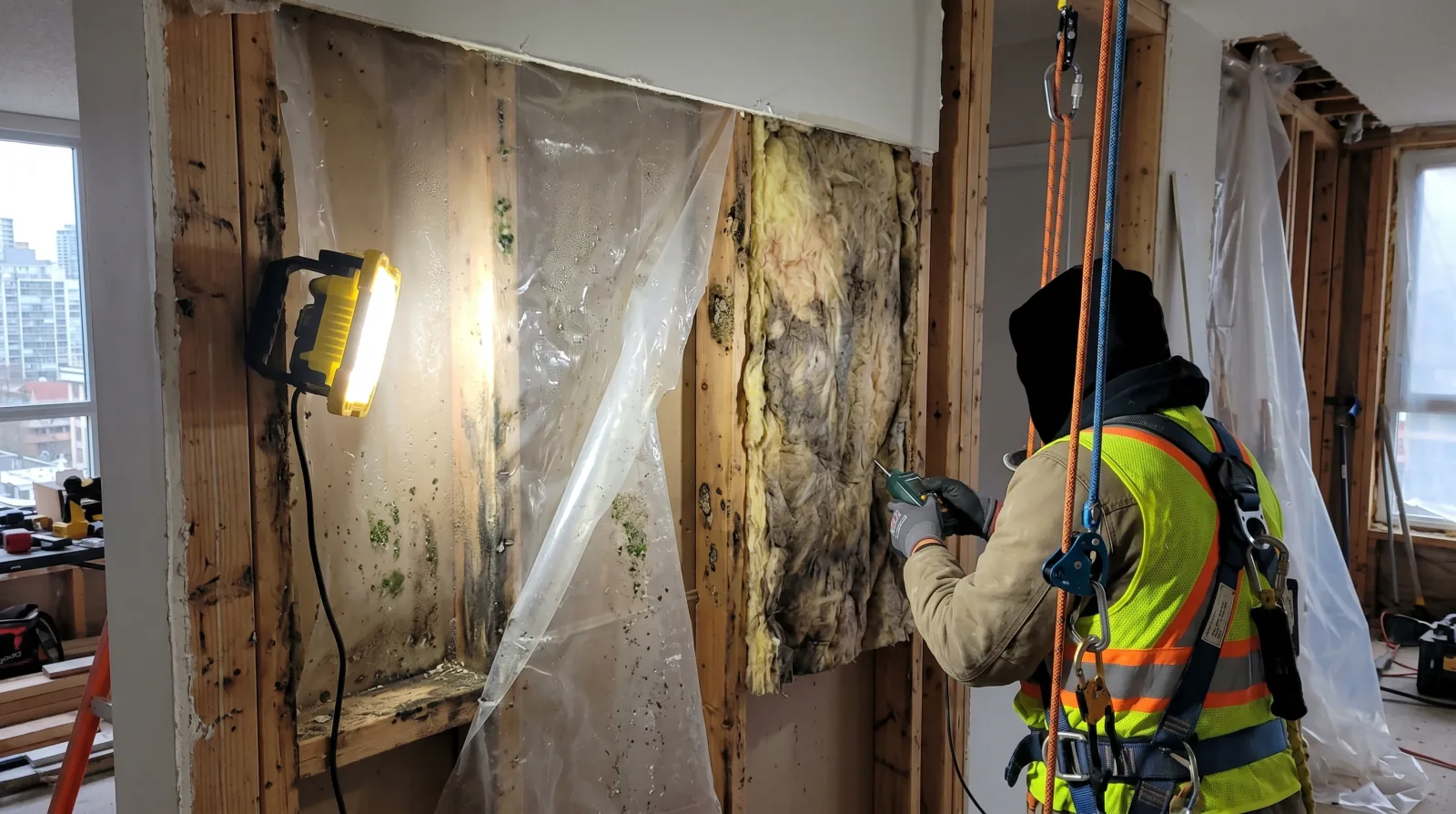
A resident in a Coquitlam condo reports a damp patch and some mould on an interior wall. The obvious assumption is a leak — a failed window seal, a roof problem, water getting in from somewhere outside. The building re-seals the windows, checks the flashing, inspects the roof. The wall stays wet. Months later, after a fair bit of money spent looking outside, someone opens up the wall and finds the answer: the water was never coming in from outside. The wall was making its own water, from the heated air inside the building.
That’s interstitial condensation, and it’s one of the most consistently misdiagnosed moisture problems in BC building envelopes — because it produces every symptom of a leak while having nothing to do with rain.
The physics, in plain terms
Warm air holds more moisture than cold air. The interior of a heated building in winter is full of water vapour — from showers, cooking, laundry, houseplants, and simply the people breathing inside it. That warm, moist air wants to move toward the cold exterior, through the wall.
As the air travels through the wall toward the cold outside, it cools. And at a specific temperature — the dew point — it becomes saturated and can no longer hold all its moisture. The water vapour condenses into liquid water. If the dew point happens to fall on a surface inside the wall cavity, like the back of the cold exterior sheathing, that’s where the water forms. Inside the wall. Out of sight.
The word “interstitial” just means it happens in the spaces inside the assembly, between the interior finish and the exterior cladding, rather than on a surface you can see. Where exactly the dew point lands inside the wall is what decides whether the assembly stays dry or quietly gets soaked all winter.
What the vapour barrier is supposed to do
The job of preventing this falls to the vapour barrier — usually a polyethylene sheet or a vapour-retarding coating installed on the warm interior side of the insulation. Its purpose is to slow the movement of water vapour from the heated interior into the cold wall cavity. By limiting how much moist air reaches the cold surfaces inside the wall, it keeps that air from condensing there.
When the vapour barrier is missing, torn, discontinuous, or installed on the wrong side of the insulation, moist interior air moves freely into the cavity, reaches the cold sheathing, and condenses. Older buildings often have no vapour barrier or a poorly installed one. And there’s a modern version of the problem too: buildings that have been air-sealed tightly for energy efficiency, without adding mechanical ventilation, trap moisture inside and drive interior humidity high enough to overwhelm even a functioning barrier.
It’s worth being clear about what a vapour barrier is not. It is not a weather-resistive barrier or a rainscreen. Those sit on the exterior face of the wall and manage liquid water and wind-driven rain coming from outside — the systems we cover in our piece on the rainscreen and leaky condo legacy. The vapour barrier sits on the interior face and controls vapour moving outward from inside. They solve opposite problems at opposite faces of the wall, and a wall can have a flawless rainscreen and still rot from interstitial condensation if its interior vapour control has failed.
Why BC walls are so exposed to this
The coastal BC climate is almost purpose-built to drive interstitial condensation. The heating season is long, cool, and wet. Outdoor humidity stays high. So the wall cavity stays cold for months while the interior is heated and loaded with moisture. That sustained difference — warm, humid inside; cold, damp outside — is exactly the condition that pushes vapour from the interior toward cold wall surfaces, day after day, through the whole winter.
It’s the same wet-climate pressure that makes water ingress such a persistent problem in our buildings, approached from the opposite direction. With water ingress, the water comes from outside. With interstitial condensation, the climate keeps the wall cold while the building’s own air supplies the moisture from inside. Both end with a wet wall; the source is reversed.
The damage, and why it hides
Because the condensation forms inside the cavity, it can go on for a long time before anyone sees a symptom. In that time it does real damage: mould grows on framing and sheathing, wood structural members begin to rot, metal fasteners and connectors corrode, and wet insulation loses much of its R-value, which makes the cold surfaces colder and the condensation worse. Only after months or years of this does staining, mould, or damp finally show on the interior finish where a resident notices it.
That hidden, ongoing quality is what makes interstitial condensation arguably more dangerous than a visible leak. A rain leak announces itself at a specific point and during storms. Condensation works quietly across the entire cold face of the wall, every heating season, with nothing to see until the damage is already done.
Diagnosing it: condensation or a leak?
Telling the two apart is the entire battle, and it’s why a proper building envelope condition assessment is the right starting point rather than a contractor guessing at the window seals. A real diagnosis looks at:
- Pattern and location — condensation tends to appear broadly across cold surfaces; a rain leak tracks to a specific entry point.
- Timing — condensation correlates with the heating season and interior humidity; a rain leak correlates with wind-driven rain events.
- Opening the assembly — looking inside the wall to see where the water is actually forming, and whether there’s a vapour barrier and what condition it’s in.
- Measurements — interior humidity readings, moisture meters in the assembly, and thermal imaging to find the cold surfaces where condensation is likely.
Get this step right and the rest follows. Get it wrong — diagnose condensation as a leak — and the building spends its money re-sealing an exterior that was never the problem.
Fixing the right thing
Remediation depends entirely on what the diagnosis found, which is the whole point of diagnosing first. Depending on the cause, it can involve repairing or installing a proper vapour barrier on the warm side, removing and replacing mould-damaged framing, sheathing, and insulation, improving insulation so there are fewer cold surfaces inside the wall for vapour to condense on, adding or upgrading mechanical ventilation to bring interior humidity under control, and in some cases reworking the assembly so the dew point falls in a location where any condensation can dry harmlessly.
Often it’s a combination — a failed barrier and high interior humidity working together. Managing the moisture load through ventilation is as much a part of the fix as the barrier itself, because a barrier alone can’t keep up with a building that’s generating more vapour than it can exhaust.
The lesson worth holding onto: when a wall is wet and the entry point won’t reveal itself no matter how much of the exterior you re-seal, stop assuming the water is coming in. Consider that the wall might be making it.
Related guides
- Building Envelope Condition Assessment: What It Covers — how a proper diagnosis works
- What Causes Water Ingress in High-Rise Buildings — the exterior-source side of wall moisture
- Rainscreen and the Leaky Condo Legacy — exterior water management in BC walls
- Concrete and Masonry Restoration Hub — restoration of moisture-damaged structure
Frequently Asked Questions
More from Concrete Restoration Guide
Concrete Carbonation on Coastal BC Buildings
Not all rebar corrosion is salt. On older Victoria concrete buildings, carbonation quietly lowers the concrete's pH until the steel loses its protection.
Read article →Corroding Balcony Guardrail Anchors on Vancouver Strata Towers
The rust staining at the base of a balcony railing post in Burnaby isn't cosmetic — it's a corroding anchor pushing the concrete apart, and a safety problem.
Read article →Brick Masonry Repointing on Vancouver Heritage and Older Buildings
Use the wrong mortar to repoint a heritage brick building in New Westminster and you'll spall the brick faces within a few winters. Why hardness matters.
Read article →