Corroding Balcony Guardrail Anchors on Vancouver Strata Towers
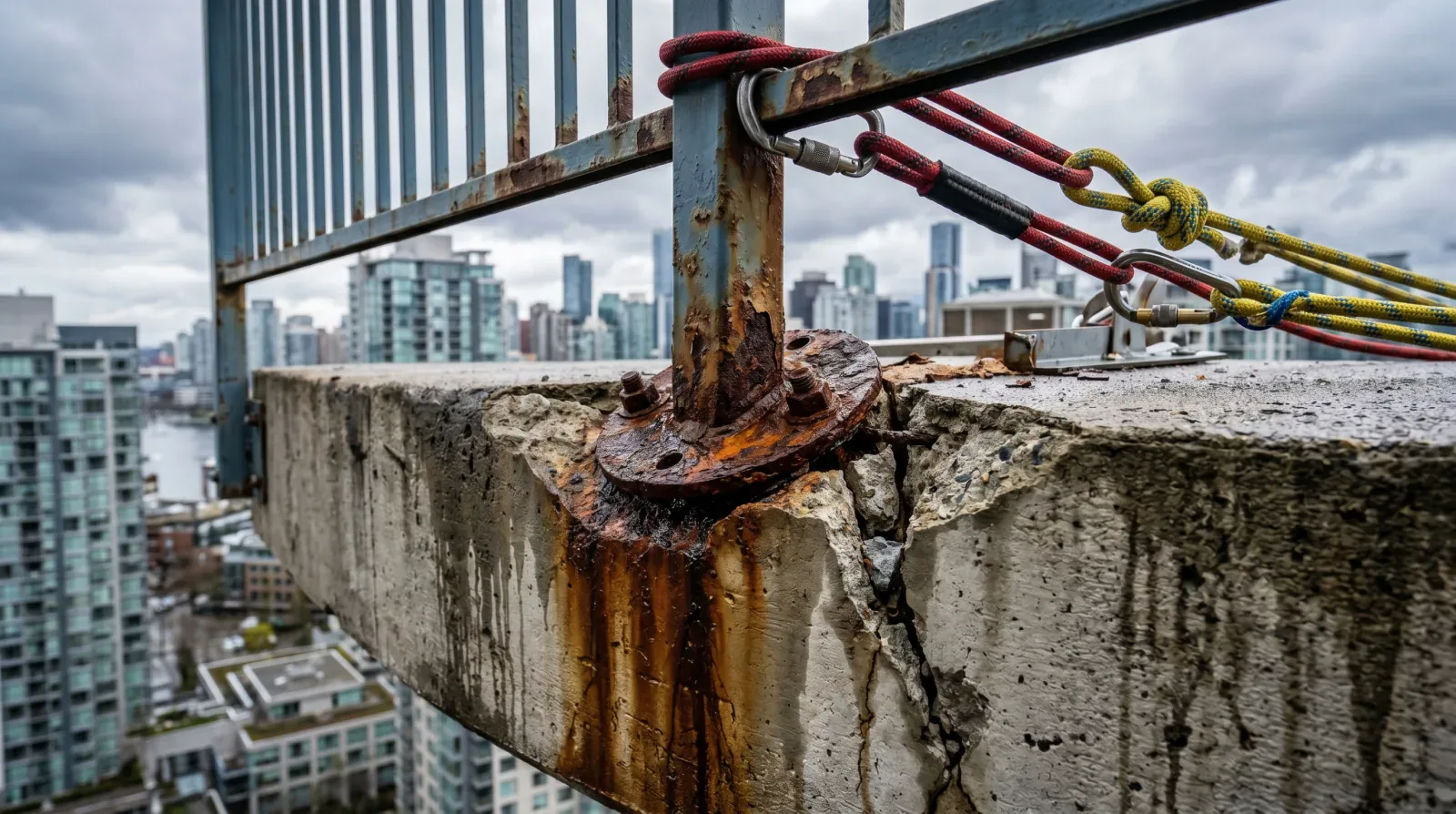
It starts as a rust-coloured streak running down from the base of a balcony railing post, the kind of thing that looks like it needs a coat of paint. It is not a paint problem. That stain is the visible end of a process happening inside the concrete — a steel anchor corroding, swelling, and slowly breaking the slab edge apart from within. And because that anchor is what keeps the guardrail attached to the building, it’s also a safety problem hiding behind a cosmetic one.
On Vancouver strata towers, corroding guardrail anchors are one of the more serious concrete conditions we find, precisely because people read them as superficial right up until the railing starts to feel loose.
How the water gets in
Every balcony guardrail post has to be anchored into the structure — either embedded directly in the concrete slab edge or bolted to a base plate over an embedded fixing. That connection is exposed on the most weather-beaten part of the building: the open slab edge, taking direct wind-driven rain off the Strait through a long Pacific winter.
Water reaches the embedded steel through several paths, usually working together. The sealant around the post base cracks and opens. The balcony waterproofing membrane wears thin or was never properly lapped up at the slab edge. Cracks develop in the concrete around the post. And the slab edge itself simply gets wet, over and over, for months at a time. Add the dissolved salt that coastal air carries, and the conditions for corrosion are about as aggressive as a building detail gets.
Once water reaches the steel, it begins to corrode. And that’s where a damp detail becomes a structural one.
Rust-jacking: why corrosion breaks concrete
Here’s the mechanism that makes embedded-steel corrosion so destructive. When steel rusts, the rust occupies several times the volume of the original metal. It expands. And because it’s locked inside the concrete, that expansion has nowhere to go but outward, against the surrounding concrete, with enormous force.
Concrete is strong in compression but weak in tension, so it can’t resist that outward pressure. It cracks first, then the cracks spread into a plane and the concrete delaminates — separates into a layer that’s no longer bonded — and finally that layer spalls off, exposing the corroded steel underneath. The whole sequence is driven by the expanding rust, which is why it’s called rust-jacking: the corrosion literally jacks the concrete apart from inside.
This is the same process that drives rebar corrosion and delamination on coastal buildings, just concentrated at the guardrail anchor. And it’s rarely isolated — the same water reaching the anchor usually reaches the slab’s reinforcing steel too, so a balcony with corroding post anchors often has rebar corrosion in the slab edge as well.
The part that matters most: it’s a safety element
A planter that spalls or a ceiling that stains can wait for a planned repair cycle. A guardrail cannot, because its entire purpose is to stop a person from going over the edge of a balcony several storeys up.
That function depends completely on the anchor holding. As the embed corrodes and the concrete around it breaks up, the anchor loses its grip on the structure. The unnerving part is that the railing can still feel solid while holding by a fraction of its original capacity — the loss is hidden inside the concrete until enough of it has spalled away that the post visibly moves. By then the margin of safety is gone.
On an occupied tower, that makes a corroding guardrail anchor a life-safety issue. Balcony slabs and guardrails are typically common property or limited common property under the Strata Property Act, which puts repair and maintenance squarely on the strata corporation. Because a guardrail is safety-critical, councils have a strong duty to act on known corrosion — and deferring repairs on a safety component carries liability exposure that dwarfs the cost of the concrete work itself.
The membrane connection
A corroding guardrail anchor is usually a symptom, not the root problem. The root problem is water reaching the steel, and the thing that’s supposed to prevent that is the balcony waterproofing membrane.
The membrane keeps water off the slab and away from all the embedded steel, including the guardrail anchors. When it fails or wears out — and every membrane has a service life — water reaches the slab, and the anchors corrode. So guardrail anchor corrosion is frequently a sign that the balcony membrane has reached the end of its life. This is why fixing the anchor in isolation is a mistake: patch the concrete, re-anchor the post, and if the failed membrane is still letting water in, the corrosion simply comes back. The membrane and the anchor are one problem, and our guide on balcony membrane maintenance for strata buildings covers how to keep that protection intact before it fails.
It also feeds the larger repair-or-replace decision on the balcony as a whole. Once you’re opening up the slab edge to repair anchors, you’re often looking at the membrane, the slab, and the railing together — exactly the calculation in our piece on balcony waterproofing: repair versus replace.
What the repair involves
In most cases the anchor and the surrounding concrete can be repaired without replacing the entire railing. The work follows a disciplined sequence:
- Remove the deteriorated concrete — break out all the cracked and delaminated concrete around the anchor, back to sound material, so the corroded steel is fully exposed.
- Clean or replace the steel — remove corrosion from the anchor and any exposed reinforcing, or replace the fixing where it’s too far gone to trust.
- Treat the embed — apply a corrosion-inhibiting treatment or coating to the cleaned steel so it doesn’t simply start corroding again inside the repair.
- Re-anchor the post — reinstate the guardrail fixing to its required strength, using corrosion-resistant materials.
- Patch the concrete — rebuild the slab edge with a repair mortar that bonds to the sound concrete and restores the profile.
- Restore the waterproofing — reinstate the membrane and the post-base sealant so water stops reaching the steel. This is the step that makes the repair last.
Full railing replacement is reserved for cases where the railing system itself is beyond repair — not simply because an anchor corroded.
Finding it before the railing tells you
From a balcony or the ground, the warning signs are visible if you look: rust staining bleeding from the post bases, cracked or spalling concrete around the posts, failed sealant at the base plates, bubbling or lifted coatings at the slab edge, and posts that move when pushed. That last one means the corrosion is already advanced.
On a tower, assessing every balcony reliably means getting close to the slab edges and post bases — by rope access or swing stage — rather than relying on what’s visible from inside the suites. A proper assessment looks at the anchors, the surrounding concrete, and the membrane together, because they fail together.
Corrosion is a water problem at heart. Control the water — keep the membrane and the base-of-post sealant in good condition — and you control the corrosion. Ignore the rust stain, and the next thing the building learns about that anchor is how much of its strength was already gone.
Related guides
- Concrete and Masonry Restoration Hub — restoration approaches for reinforced concrete
- Balcony Membrane Maintenance for Strata Buildings — keeping water off the slab and anchors
- Rebar Corrosion and Concrete Delamination on Coastal Buildings — the corrosion mechanism in detail
- Balcony Waterproofing: Repair vs Replace — the larger balcony decision
Frequently Asked Questions
More from Concrete Restoration Guide
Concrete Carbonation on Coastal BC Buildings
Not all rebar corrosion is salt. On older Victoria concrete buildings, carbonation quietly lowers the concrete's pH until the steel loses its protection.
Read article →Vapour Barrier Failure and Interstitial Condensation in BC Walls
The water staining a Coquitlam condo's interior wall isn't always a leak. Sometimes the wall makes its own water — warm air condensing inside the cavity.
Read article →Brick Masonry Repointing on Vancouver Heritage and Older Buildings
Use the wrong mortar to repoint a heritage brick building in New Westminster and you'll spall the brick faces within a few winters. Why hardness matters.
Read article →