Concrete Carbonation on Coastal BC Buildings
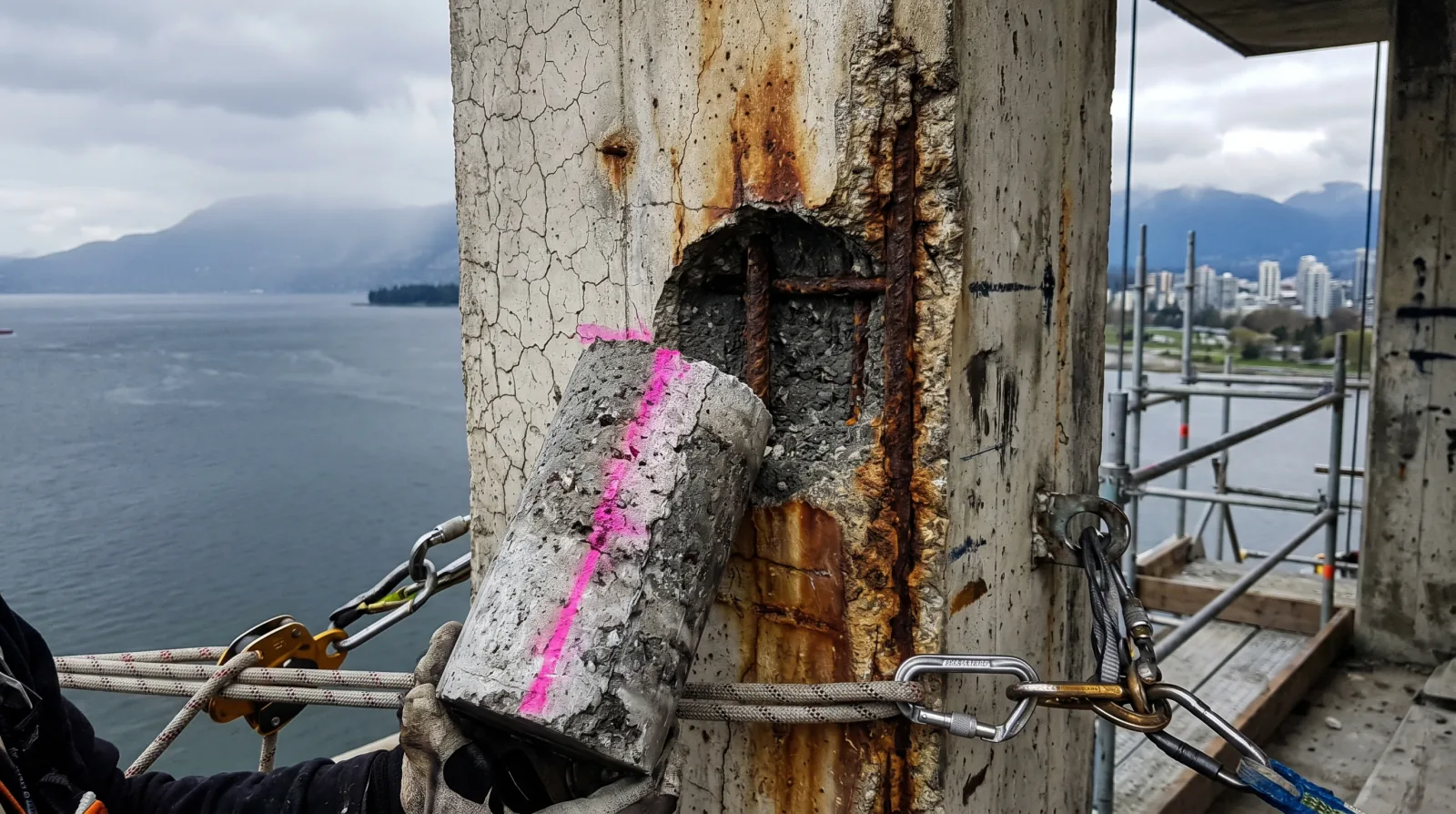
When the concrete on an older building starts cracking and rust stains start bleeding through, the reflexive explanation on the coast is salt. Sea air, de-icing salt, chlorides eating the rebar. And often that’s part of it. But there’s a second mechanism that produces the exact same damage by a completely different chemical route, and on aging Vancouver and Victoria buildings it’s frequently the real driver: carbonation.
It’s worth understanding on its own, because the way you confirm it, and sometimes the way you address it, is different from chloride attack.
Why concrete protects steel at all
Reinforced concrete is a clever partnership. Concrete is strong in compression, steel is strong in tension, and together they carry loads neither could alone. But there’s a second thing the concrete does for the steel that’s easy to overlook: it protects it from corroding.
Fresh concrete is intensely alkaline — a pH somewhere around 12 to 13. In that highly alkaline environment, a microscopically thin protective oxide film forms naturally on the surface of the embedded steel. This film, called passivation, prevents the steel from rusting even though it’s surrounded by moisture. As long as the concrete stays alkaline, the steel stays passivated and protected.
Take away the alkalinity, and that protection disappears. The steel de-passivates, and corrosion — which leads to the expansion, cracking, and spalling familiar from any rebar corrosion problem — is free to begin.
How carbonation lowers the pH
Carbonation is the slow chemical undoing of that protection. Carbon dioxide is present in ordinary air, and it gradually penetrates concrete from the surface inward. As it works its way in, it reacts with the alkaline compounds in the concrete and converts them, lowering the pH of the affected zone.
This happens as a front — a boundary that advances inward over years and decades. Behind the front, near the surface, the concrete has carbonated and lost its high pH. Ahead of it, deeper in, the concrete is still strongly alkaline. The front creeps deeper over time, and the question that decides the building’s fate is simple: has it reached the steel yet?
Once the carbonation front arrives at the depth of the reinforcing steel, the steel is no longer sitting in alkaline concrete. The protective film breaks down. The steel de-passivates. And corrosion starts — no salt required, just CO2 and time.
Carbonation versus chloride attack
Both carbonation and chloride attack end in corroded rebar, expanding steel, and spalled concrete, which is why they get lumped together. But the mechanisms are genuinely different, and the distinction matters for diagnosis:
- Chloride attack happens when salt penetrates the concrete and breaks down the steel’s protective film directly, even while the surrounding concrete is still alkaline. It tends to cause aggressive, localized pitting — deep corrosion at specific points.
- Carbonation lowers the concrete’s overall pH until the protective environment is gone across a whole zone. It tends to cause more general, widespread corrosion along the de-passivated steel.
A coastal BC building can suffer either, and very often suffers both at once — carbonation advancing from one direction and chlorides from the salt air contributing from another. There’s a common misconception worth correcting: carbonation isn’t actually fastest in soaking-wet conditions. It advances quickest at moderate humidity. So our wet climate doesn’t necessarily speed up carbonation by itself — but coastal buildings deal with carbonation and chloride corrosion together, which is why a proper assessment here tests for each rather than assuming.
The pink spray that tells the story
The field test for carbonation is almost elegant in its simplicity. Phenolphthalein is a pH indicator, and it’s sprayed onto freshly exposed or freshly cored concrete during a condition assessment. Where the concrete is still highly alkaline and healthy, it turns a vivid pink. Where the concrete has carbonated and lost its alkalinity, it stays colourless.
The boundary between the pink and the colourless is the carbonation front, made visible. Measure how deep that boundary sits, compare it to the depth of the reinforcing steel — the concrete cover — and you know immediately whether carbonation has reached the steel or how close it is. It’s fast, inexpensive, and definitive, which is why it’s a standard part of assessing older concrete.
Why older, thin-cover concrete is the vulnerable case
Two things put aging buildings most at risk. The first is just time: carbonation advances over decades, so older concrete has had more years for the CO2 front to work its way in. The second is how older buildings were built. Pre-1970s and mid-century construction often used thinner concrete cover over the rebar and more permeable concrete mixes than current standards call for.
Both work against the building. Concrete cover — the depth of concrete between the surface and the steel — is the steel’s primary defence, acting as both a physical barrier and a reservoir of the alkalinity that keeps the steel passivated. Thin cover means the carbonation front has less distance to travel before it reaches the steel, and more permeable concrete lets CO2 advance faster. Put thin cover and permeable concrete together on a building that’s had fifty years of exposure, and carbonation-driven corrosion is close to inevitable. It’s the same vulnerability that shows up in the broader pattern of concrete spalling on strata towers, with carbonation as one of the underlying causes.
Repair and protection options
How you address carbonation depends on how far it’s gone and how much of the steel is already corroding.
Where corrosion is established and concrete is spalling, the repair is the same disciplined process as any reinforced-concrete repair: remove the carbonated and deteriorated concrete back to sound material, clean or treat the corroded steel, and rebuild the section with a repair mortar that restores both the cover depth and the protective alkalinity around the steel. Get the cover and the alkalinity back, and the steel is re-protected.
Where carbonation is widespread but corrosion is still early, two preventive routes come into play. Re-alkalization is a specialized electrochemical treatment that drives an alkaline solution into the carbonated concrete to raise the pH back up and re-passivate the steel — a way to restore protection without breaking out sound concrete. More commonly, anti-carbonation coatings are applied to sound or repaired concrete. These coatings resist the passage of CO2 into the concrete while still letting the concrete breathe out moisture vapour, slowing the carbonation front and extending the time before it reaches the steel. On a coastal building they do double duty, also helping shed wind-driven rain. These coatings sit alongside the elastomeric wall coatings used to protect concrete towers in the toolkit for keeping a concrete envelope protected.
The order of decisions is always the same: assess first, including phenolphthalein testing and cover measurement, then match the response to what the testing actually found. The mistake to avoid is assuming. On the coast, corrosion gets blamed on salt by default — but if the concrete behind the rust comes up colourless under the pink spray, the air and the years did at least as much of the work.
Related guides
- Concrete and Masonry Restoration Hub — restoration approaches for reinforced concrete
- Rebar Corrosion and Concrete Delamination on Coastal Buildings — the corrosion mechanism in detail
- Concrete Spalling Causes on Strata Towers — the visible damage and its drivers
- Elastomeric Wall Coatings for Concrete Towers — protective coatings for concrete envelopes
Frequently Asked Questions
More from Concrete Restoration Guide
Vapour Barrier Failure and Interstitial Condensation in BC Walls
The water staining a Coquitlam condo's interior wall isn't always a leak. Sometimes the wall makes its own water — warm air condensing inside the cavity.
Read article →Corroding Balcony Guardrail Anchors on Vancouver Strata Towers
The rust staining at the base of a balcony railing post in Burnaby isn't cosmetic — it's a corroding anchor pushing the concrete apart, and a safety problem.
Read article →Brick Masonry Repointing on Vancouver Heritage and Older Buildings
Use the wrong mortar to repoint a heritage brick building in New Westminster and you'll spall the brick faces within a few winters. Why hardness matters.
Read article →