Missed the July 2026 depreciation report deadline? Here's what that actually means
July 1, 2026 has come and gone. If your Metro Vancouver strata corporation did not have a current depreciation report by that date, you are now out of compliance with the BC Strata Property Act Regulation. That is not the crisis it sounds like, and it is also not nothing. Here is what non-compliance actually exposes the strata to, and the fastest path back into good standing.
Why this is showing up as a live question right now
A lot of strata councils treated July 1 as a soft target, the way earlier depreciation-report deadlines sometimes were, back when the annual ¾-vote deferral existed. That deferral is gone. Councils that pushed the report down the priority list — because a roof was leaking, or a special levy vote was already on the table for something else, or the council simply didn't have a preparer lined up in time — are now dealing with a strata corporation that is formally non-compliant with a provincial regulation. The first practical question most of them ask is whether that changes anything urgently. The honest answer: not overnight, but it does change the strata's footing on several fronts that matter within the year.
What non-compliance actually exposes the strata to
None of these are hypothetical scare items — they are the concrete ways a missing or lapsed report changes a strata's position.
The Strata Property Act does not impose a fixed penalty for a late depreciation report the way it does for some other filings. The exposure is legal and financial, not a ticket: a strata without a current report has no defensible basis for its reserve fund contributions, which weakens its position if a major repair surfaces and owners dispute a special levy.
Missing the report deadline does not pause the strata corporation's obligation under Section 92 to maintain a contingency reserve fund, or under Section 72 to repair and maintain common property. A council that has not commissioned a report cannot point to it as a reason repairs were delayed — the underlying duty to maintain the building was never suspended.
Buyers' lawyers and mortgage lenders increasingly ask for a current depreciation report as part of the Form B disclosure package. A strata with an expired or missing report can slow down unit sales in the building, because purchasers' counsel flag the gap and request an explanation before closing.
If a strata needs to pass a special levy for envelope or concrete work and does not have a current report to show the funding shortfall, owners who oppose the levy have more room to argue the number was not properly substantiated. A current report is the evidence base a council relies on at the general meeting.
Some strata insurers and commercial lenders now ask for the depreciation report during renewal or refinancing. A lapsed report can trigger additional questions or a request to commission one before terms are finalized.
The fastest path back into compliance
Six steps, roughly in the order a council should work through them.
- 1. Confirm whether you are actually non-compliant
Check the exact date of your last report. The July 1, 2026 deadline applied to stratas that had never had a report, or whose most recent report was issued before December 31, 2020. If your last report is dated after that cutoff, you may still be inside the five-year cycle — confirm before assuming you missed anything.
- 2. Engage a qualified report preparer immediately
BC limits who can prepare a depreciation report to six designated professional groups: engineers, architects, applied science technologists, accredited appraisers, certified reserve planners, and professional quantity surveyors. Get quotes from two or three firms — reports typically run $5,000 to $30,000 depending on building size and complexity.
- 3. Get a current envelope and concrete condition input first
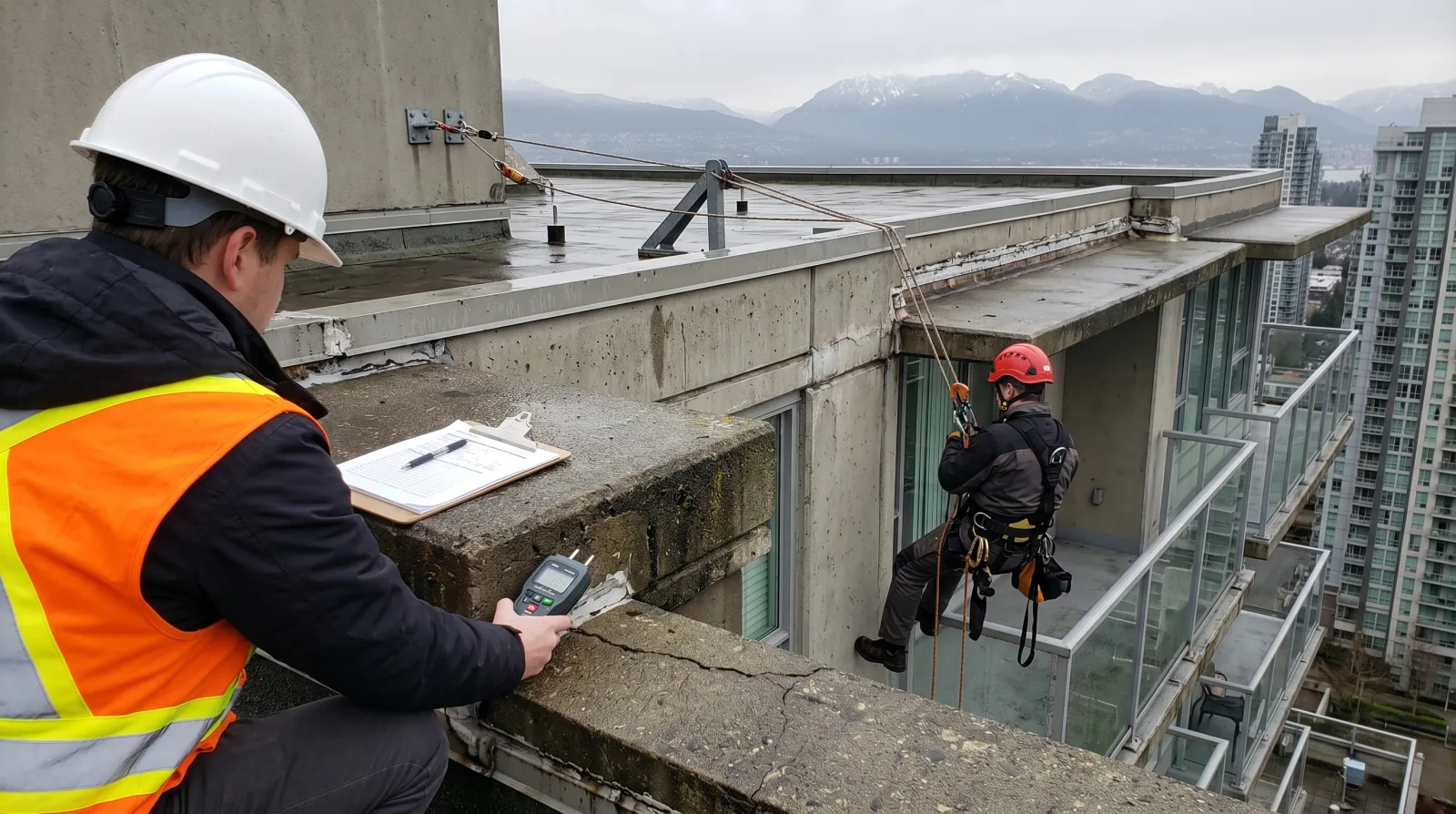
A report preparer working from generic lifecycle tables produces a weaker forecast than one working from real field data. Booking a contractor condition assessment of the envelope, membranes, and concrete before or alongside the report engagement gives the report preparer actual service-life numbers for your specific building instead of database averages.
- 4. Document the compliance gap for the council minutes
Record in the strata council minutes when the report was commissioned and why the prior deadline was missed. This creates a paper trail showing the council acted once the gap was identified, which matters if a dispute over reserve adequacy ever reaches the Civil Resolution Tribunal or BC Supreme Court.
- 5. Do not wait for the report to start addressing known issues
If the strata already knows about a failing membrane, spalling concrete, or a sealant program that is overdue, do not wait for the new depreciation report before acting. The report will confirm the scope and cost, but the Section 72 duty to maintain does not wait on paperwork — an active leak or spalling concrete needs attention now.
- 6. Budget for the levy conversation the report will likely trigger
Stratas that deferred their depreciation report for years are disproportionately likely to have an underfunded reserve, because the annual contribution model was never recalculated against real replacement costs. Prepare owners for the possibility that the new report recommends a meaningful increase to strata fees or a special levy.
Why the envelope condition assessment should not wait for the report
Most Metro Vancouver stratas that missed the report deadline also have an aging building envelope that has not had a formal condition review in years — the two gaps tend to travel together. A report preparer working purely from published lifecycle tables will estimate the building envelope, parkade membranes, and concrete using generic averages for a building of that age and type. That produces a number, but not a particularly defensible one if it is ever challenged at a general meeting or in a dispute.
Booking a physical condition assessment of the sealants, membranes, coatings, and concrete before or alongside the depreciation-report engagement gives the preparer real field data: what the joints actually look like, whether the balcony membranes show early failure, whether there is active spalling. That turns the report from a generic forecast into one grounded in the building's actual condition — and it gives the council an early, informal read on what the report is likely to say, months before the formal document lands.
What this does not change
A missed deadline does not suspend the strata corporation's duty to maintain common property under Section 72 of the Strata Property Act, and it does not pause the requirement to hold a contingency reserve fund under Section 92. If the building has a known leak, active spalling, or a sealant program that is overdue, that work does not wait on the paperwork catching up. Councils sometimes treat the missing report as a reason to hold off on repair decisions until the report tells them what to do — that reasoning runs backwards. The statutory duty to maintain the building was never contingent on having a current report; the report is how the strata plans and funds that duty, not the trigger for it.
Quick answers
What happens if my BC strata missed the July 1, 2026 depreciation report deadline?
There is no automatic fine under the Strata Property Act for missing the deadline, but the strata corporation is now out of compliance with a legal requirement, and it loses the depreciation report as a documented basis for its reserve fund decisions. The underlying duty to maintain common property and fund the contingency reserve continues regardless. The practical fix is to commission a report from a qualified preparer as soon as possible and document that the council acted once the gap was identified.
Can my strata still be fined for a late depreciation report?
The BC government has not published a fixed monetary penalty tied specifically to a late depreciation report the way it has for some other strata filings. The real risk is not a fine — it is weaker legal footing on reserve fund contributions and special levies, resale friction from buyers' lawyers flagging the gap, and possible insurer or lender questions during renewal or refinancing.
How long does it take to get a depreciation report done after missing the deadline?
A qualified preparer typically needs several weeks to a few months to complete a report, depending on building size, how many components need site review, and the preparer's current workload. Getting a contractor condition assessment of the envelope and concrete done in parallel, rather than waiting for the report preparer to schedule their own site visit, is usually the fastest way to move the whole process forward.
Services this guide connects to
Missed-deadline questions
What happens if my BC strata missed the July 1, 2026 depreciation report deadline?
There is no automatic fine under the Strata Property Act for missing the deadline, but the strata corporation is now out of compliance with a legal requirement, and it loses the depreciation report as a documented basis for its reserve fund decisions. The underlying duty to maintain common property and fund the contingency reserve continues regardless. The practical fix is to commission a report from a qualified preparer as soon as possible and document that the council acted once the gap was identified.
Can my strata still be fined for a late depreciation report?
The BC government has not published a fixed monetary penalty tied specifically to a late depreciation report the way it has for some other strata filings. The real risk is not a fine — it is weaker legal footing on reserve fund contributions and special levies, resale friction from buyers' lawyers flagging the gap, and possible insurer or lender questions during renewal or refinancing.
How long does it take to get a depreciation report done after missing the deadline?
A qualified preparer typically needs several weeks to a few months to complete a report, depending on building size, how many components need site review, and the preparer's current workload. Getting a contractor condition assessment of the envelope and concrete done in parallel, rather than waiting for the report preparer to schedule their own site visit, is usually the fastest way to move the whole process forward.
Does a missed depreciation report deadline affect selling a unit?
It can. Buyers' lawyers increasingly request the current depreciation report as part of the Form B Information Certificate disclosure package, and a missing or expired report is a flag that can slow a sale or prompt further questions from the purchaser's side. Getting a new report commissioned reduces that friction for any owner planning to list.
Should we get a condition assessment before or instead of the depreciation report?
Before, ideally, or at the same time — not instead of. The depreciation report is still the legally required document; a condition assessment is not a substitute for it. But a condition assessment gives the report preparer real, building-specific data on membrane, sealant, and concrete condition instead of generic lifecycle tables, which produces a more defensible reserve forecast and gives the council an early read on what the report is likely to recommend.
Who prepares a depreciation report in BC?
As of 2025, preparation is limited to six designated groups: professional engineers and licensees, architects and architectural technologists, applied science technologists and certified technicians, accredited appraisers, certified reserve planners, and professional quantity surveyors. A general contractor cannot prepare the report itself, though a contractor's condition assessment is a useful input the report preparer can draw on.
Get a condition assessment while your depreciation report is being prepared
Allweathercoating provides site assessments and written scopes for strata and commercial envelope work across Vancouver, North Vancouver, West Vancouver, and Burnaby — real field data your report preparer can build on instead of generic lifecycle tables.