Funding a Building Envelope Restoration in a BC Strata
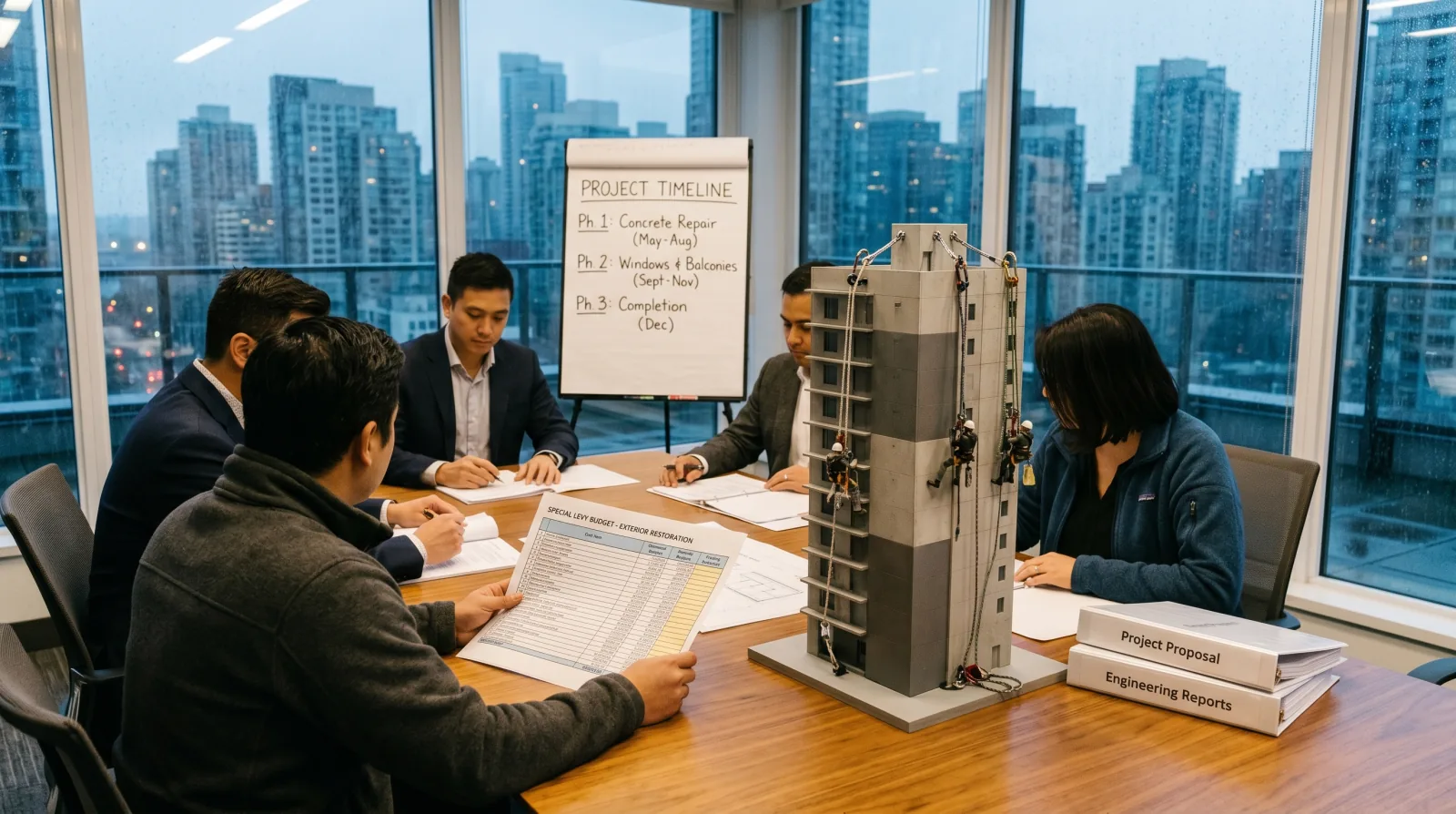
A Coquitlam strata council brought a major facade restoration to a special general meeting and watched the resolution fail. The engineering was sound. The scope was right. The contractor was good. What sank it was money — specifically, that the first time most owners heard a dollar figure was the night they were asked to approve it.
Funding is where envelope restorations live or die in a BC strata. The technical work is the easy part. Getting three-quarters of your owners to agree to spend a large sum is the hard part, and it has its own rules.
Three ways to pay, usually mixed
A strata has three real funding levers for a major restoration, and the strongest plans use more than one.
The contingency reserve fund is money already set aside for major repairs and replacements. If it holds enough, you can fund the work from it directly. In practice, most reserve funds are not large enough to absorb a full envelope restoration on their own, and draining the fund to zero for one project leaves nothing for the next emergency.
The special levy is a one-time charge raised from owners for a specific purpose. It is the workhorse of major strata repairs. Under the Strata Property Act, a special levy needs a 3/4 vote at a general meeting, and the resolution has to state the purpose, the total amount, each strata lot’s share, and the payment schedule.
Strata financing is a loan from a lender that specializes in strata corporations. It spreads the cost over years instead of demanding a lump sum, which matters for owners who cannot write a large cheque on short notice. It adds interest to the project, and approving the loan still typically requires a 3/4 vote.
Most successful funding plans combine these — some from reserves, the balance through a levy, with financing available for owners who need to pay over time.
The 3/4 vote is the real obstacle
Everything funnels through the same gate. A special levy, a major reserve expenditure, and a loan all generally require a 3/4 vote — at least three-quarters of the votes cast at a properly noticed general meeting with quorum.
That threshold is high on purpose, and it means a quarter of voting owners can stop the project. The council does not decide funding; the ownership does. The council’s job is to bring owners a scope they trust, numbers they believe, and a plan they can follow.
The vote fails for predictable reasons: owners hear the number for the first time at the meeting, they do not understand why the work is needed, or they assume the council is gold-plating the scope. Each of those is a communication failure, not a financial one. Councils that pass on the first attempt do the explaining in the weeks before the meeting — information sessions, written summaries, a clear breakdown of each owner’s share by unit entitlement.
The depreciation report is your best funding tool
A current depreciation report changes the entire conversation. It forecasts the building’s major repairs, when they come due, and what they cost, and it models reserve-fund contributions to meet them. Used well, it lets a council fund restoration through steady reserve contributions over years instead of a shock levy.
It also does something a council’s own word cannot: it gives owners independent, third-party evidence that the work is real and the number is honest. A funding vote backed by a credible depreciation report passes far more often than one backed by the council alone. With the 2026 depreciation report deadlines in force, most BC stratas now have a current report to lean on — and the buildings that planned their reserves around it are the ones not scrambling for an emergency levy.
If your report is stale or treats the envelope superficially, fix that first. A report that does not properly account for the building envelope’s condition and timeline will under-fund the reserve and leave you raising a levy you could have avoided.
Phasing the work to spread the cost
A full facade restoration does not always have to happen in one season. Phasing can make a large project fundable.
You can phase by elevation — restore the south and west faces first, since they take the worst of the Pacific storm exposure and degrade fastest, then the sheltered faces in a later budget year. You can phase by work type — sealants this year, concrete repair next, coatings after. Either approach spreads the cash demand and can be funded through smaller levies or reserve draws that clear the 3/4 vote more easily.
Phasing is not free. Setting up access more than once means repeated mobilization cost, and on a tower the access method is a real line item. Deferred elevations also keep degrading while they wait, so a phase pushed too far out can cost more by the time you reach it. The right phasing balances cash flow against those carrying costs, and it belongs in the engineer’s plan from the start — not bolted on after the budget comes up short. This is one of the things a properly coordinated restoration project sorts out before tender.
Build in the lead time
From recognizing the need to starting work, a properly run restoration commonly takes several months to well over a year. You need a condition assessment and scope, an engineer’s tender, contractor bids, a special meeting with proper notice, the vote, levy collection or loan closing, and then scheduling around weather and crew availability.
That timeline is survivable only if you start it before the building forces your hand. A strata that waits until water is actively coming through the wall has lost the luxury of an orderly funding process — now it is an emergency, the scope has grown to include interior damage, and the council is negotiating from a position of weakness. The whole point of the depreciation report and the reserve fund is to make restoration a planned, funded event rather than a crisis.
When an owner cannot pay
A special levy is a debt owed to the strata corporation, secured against the strata lot. If an owner does not pay, the corporation can charge interest and, ultimately, register a lien and force a sale to recover it. Councils generally work hard to avoid that, because forcing a sale over a levy is bad for everyone.
This is exactly where strata financing earns its place. Approving a loan lets owners who cannot manage a lump sum pay their share over time through their monthly contributions, instead of facing a single large bill. Offering financing alongside the levy often turns hesitant owners into yes votes, because the question changes from “can I find this much money this month” to “can I afford a manageable monthly increase.”
Related guides
- Strata Guide Hub — managing major repairs and the building envelope in a BC strata
- Depreciation Report Deadline 2026 and the Building Envelope — why a current report is your funding backbone
- Coordinating a Strata Exterior Restoration Project — getting from scope to completed work
- The Depreciation Report and the Building Envelope — making the report account for the facade properly
Frequently Asked Questions
More from BC Strata Building Envelope Guide
Building Envelope Warranty Claims for BC Strata Corporations
When a New Westminster strata finds an envelope defect, the first question is who pays — the 2-5-10 warranty or the owners. How to tell a warranty defect from maintenance, document it, and meet the deadlines that decide the answer.
Read article →Building Envelope Engineer vs Contractor: Roles on a BC Strata Project
On a Coquitlam strata restoration, the engineer specifies and the contractor builds. Who does what, who warranties what, and why you need both on a project.
Read article →Building Envelope Due Diligence for Vancouver Condo Buyers
Before you write an offer on a Metro Vancouver condo, the building envelope is the single biggest source of surprise costs. What to ask, what documents to read, and what red flags to walk away from — written for buyers, not for engineers.
Read article →