Building Envelope Engineer vs Contractor: Roles on a BC Strata Project
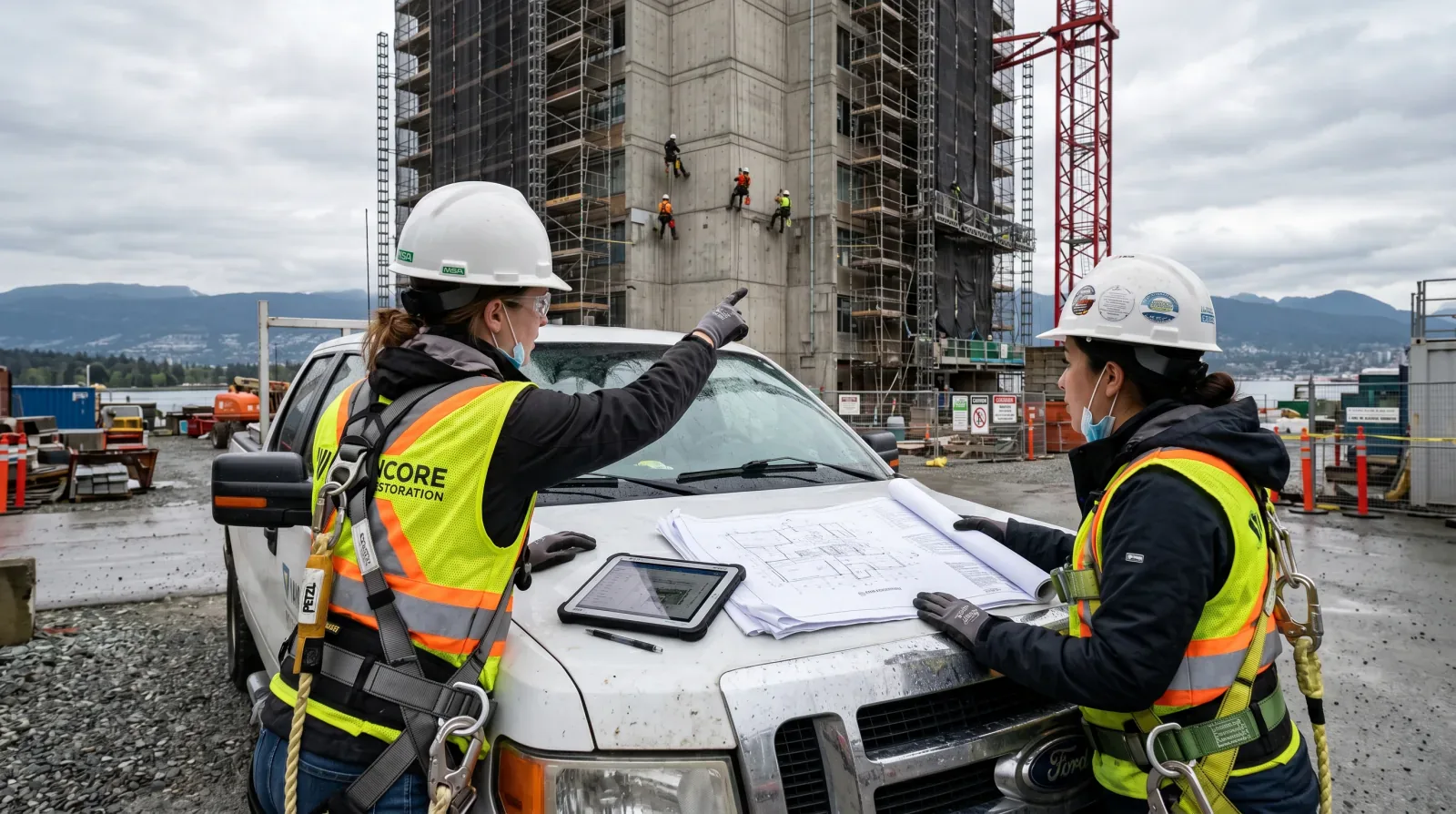
Halfway through a major restoration on a Coquitlam strata, a council member asks the question that comes up on nearly every project: “Why are we paying an engineer and a contractor? Aren’t they doing the same job?” It is a reasonable thing to wonder when two invoices land for what looks like one project. But they are not doing the same job. They are doing two genuinely different jobs, and confusing the two — or trying to save money by dropping one — is how strata restorations go wrong.
Here is who does what, why the separation exists, and how the relationship actually works on a BC building.
The engineer defines the work
The building envelope engineer — often called a building envelope consultant — is the building’s doctor. Their job is to investigate, diagnose, prescribe, and verify. On a strata restoration that breaks down into a few distinct responsibilities:
- Investigation and diagnosis — figuring out what is actually wrong with the building, through inspection and often selective testing. This is where a building envelope condition assessment comes in: it establishes the real scope of the problem rather than guessing from the symptoms.
- Design and specification — writing the technical document that says exactly what is to be repaired, with what materials, to what standard, and in what sequence.
- Tender management — preparing the documents that let multiple contractors bid on the identical, defined scope, so the strata can compare apples to apples.
- Field review — inspecting the work as it proceeds to confirm the contractor is building to specification.
What the engineer does not do is the physical work. They don’t swing a trowel, run the welder, or hang off the building. They define what should be done, set the standard, and confirm it was met. And throughout, they represent the strata’s interests — they are the council’s technical advisor and advocate, not the contractor’s.
The contractor builds the work
The restoration contractor is the trade. They bring the crew, the skill, the materials, and the access — scaffolding, swing stage, or IRATA and SPRAT rope access — and they perform the physical restoration: removing failed materials, repairing concrete, installing membranes and sealant, applying coatings.
The contractor builds to the engineer’s specification. They manage the site and the schedule, raise issues when conditions in the field differ from what the drawings assumed, and document what they install. And they warranty their workmanship and the materials they put in place — the membrane, the sealant, the coating, the concrete repair.
That warranty is one of the two forms of accountability on the project, and it is worth being precise about. The contractor stands behind the build. The engineer stands behind the design and the oversight. They are different promises about different things.
Why the separation matters: covering
The single best argument for keeping these roles separate comes down to one fact about envelope work: most of it gets covered up.
Think about what happens during a restoration. Backer rod gets installed and then disappears behind a bead of sealant. A waterproofing membrane goes down and then vanishes under a topcoat or a layer of paving. Concrete repairs get patched and then hidden behind an elastomeric wall coating. Once those layers are covered, you cannot see whether the hidden work was done correctly. Not next week, not in five years, not ever — not without destructive investigation.
Field review is the answer to that problem. The engineer inspects the work at the stages when it is still visible — before the sealant goes over the backer rod, before the topcoat goes over the membrane — and confirms it was done to spec. It is the one point in the project where a mistake is catchable and correctable before it is sealed inside the wall for the next two decades. Skip the independent review and you are trusting that everything you can’t see was done right, with no way to check.
Why the party who specifies shouldn’t be the party who bills
There is a second reason for separation, and it is about incentives, not skill. When the party defining the scope is also the party billing for the work, there is an inherent tension. An independent engineer specifying the work removes that — the scope is driven by what the building needs, not by what a contractor happens to want to sell.
This is not a slight against good contractors. The best ones generally prefer working to a clear engineered specification. It defines the scope precisely, removes arguments about what was and wasn’t included, and gives an independent record that the work met the standard. A clear spec protects the contractor as much as the strata. When everyone agrees up front on exactly what is being built and to what standard, there is far less to fight about later.
How they actually work together
On a typical BC strata project, the sequence and the relationship look like this.
The strata engages the engineer first, usually because the depreciation report has flagged a major component nearing end of life. The connection between the depreciation report and building envelope work is direct: the report says “this needs attention soon,” and acting on it starts with hiring a consultant to assess and specify, not with phoning a contractor for a quote.
The engineer assesses the building, defines the scope, and prepares tender documents. They help the strata run a fair tender so contractors bid on identical scope, and they assist in selecting the contractor — still representing the strata’s interests, including during selection. The contractor is then engaged under a separate construction contract.
Through construction, the two communicate constantly. The engineer reviews the work in the field, answers technical questions, and approves changes when site conditions differ from expectations. The contractor executes, raises issues, and documents the work. The strata council is kept informed of progress, cost, and decisions throughout. This coordination is the heart of running a strata exterior restoration project in BC — and it works precisely because each party has a defined role and stays in it.
When you can skip the engineer (and when you can’t)
For small, straightforward maintenance — a sealant renewal, a coating refresh — a qualified contractor working to manufacturer specifications can often handle the job directly without a consultant. The cost and process of an engineer aren’t always justified for routine upkeep.
But for a major restoration — structural concrete repair, full membrane replacement, a large envelope scope, anything that touches the building’s water-shedding and structural performance — an independent engineer is strongly advisable, and is often effectively required by the strata’s own process, the depreciation report recommendations, or warranty conditions. The bigger and more hidden the work, the stronger the case for having both. On those projects the engineer’s fee buys you an independent diagnosis, a verifiable standard, and an inspection record that is your only protection if the quality of the covered-up work is ever questioned.
Two invoices, two jobs, two forms of accountability. The contractor builds it and stands behind the build. The engineer specifies it, watches it go in, and stands behind the design. On a serious restoration, you want both signatures on the project.
Related guides
- Strata Building Envelope Guide — planning, process, and decisions for strata restoration
- Coordinating a Strata Exterior Restoration Project in BC — how the project runs end to end
- What a Building Envelope Condition Assessment Covers — the engineer’s first step
- Depreciation Report Deadline 2026 and Your Building Envelope — where the engineer’s role begins
Frequently Asked Questions
More from BC Strata Building Envelope Guide
Building Envelope Warranty Claims for BC Strata Corporations
When a New Westminster strata finds an envelope defect, the first question is who pays — the 2-5-10 warranty or the owners. How to tell a warranty defect from maintenance, document it, and meet the deadlines that decide the answer.
Read article →Building Envelope Due Diligence for Vancouver Condo Buyers
Before you write an offer on a Metro Vancouver condo, the building envelope is the single biggest source of surprise costs. What to ask, what documents to read, and what red flags to walk away from — written for buyers, not for engineers.
Read article →Spring and Fall Building Maintenance Checklist for Vancouver Strata Councils (2026)
A dual-season checklist for Vancouver strata councils and commercial property managers — spring post-winter recovery (April–May) and fall pre-storm prep (August–September). Covers balcony membranes, window sealants, parkade drainage, roof anchors, and concrete condition.
Read article →