Liquid-applied vs. sheet membrane on balconies and decks
Balconies leak at the details, not in the open field: the drain, the wall upturn, the railing posts. A liquid-applied membrane (cold-applied polyurethane or PMMA) cures as one seamless film and self-flashes every one of those details, which is why it fits the irregular, penetration-heavy decks common across Metro Vancouver strata. A sheet or torch-applied membrane gives factory-controlled thickness but joins in the field, and every weld or torched lap is a place a leak can begin. Detailing accounts for the large majority of deck membrane failures, so the choice is really about how many details your deck has and who is forming them.
A liquid suits detail-heavy, occupied strata decks where hot work is a problem and a same-day return matters, especially with a fast-curing PMMA or PUMA resin in the wet season. A welded PVC sheet suits simple rectangular decks, like-for-like replacement where the building already runs vinyl, and cases where factory-consistent thickness is the priority. Both last for years when the substrate is sound, the deck drains, and the crew hits the film build or weld quality; both fail early when any of those is rushed. Here is how to read the tradeoff for a specific deck.
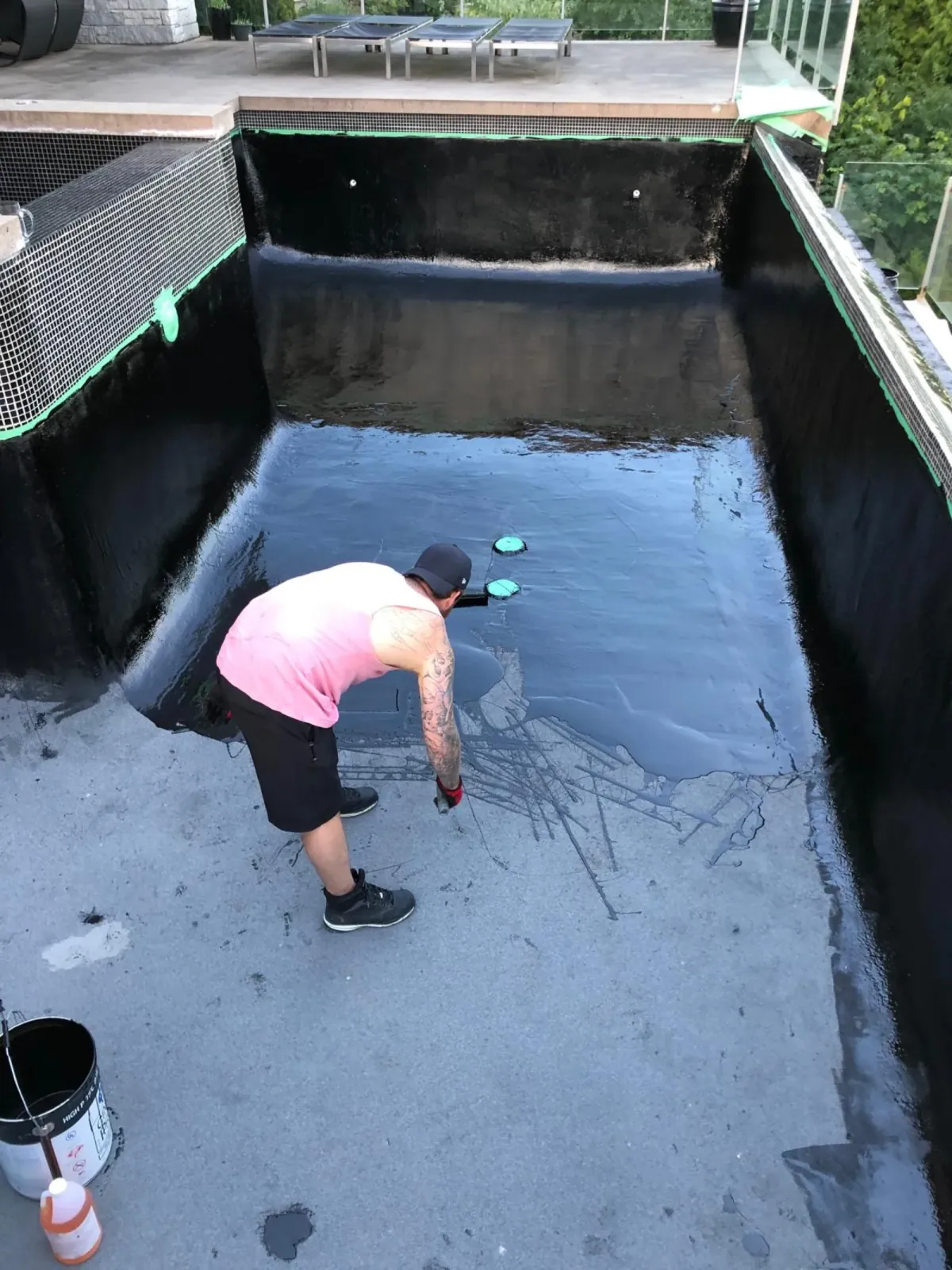
Seamless vs. seamed: why the detail decides it
Watch where a balcony actually fails and you stop arguing about membranes in the abstract. The water gets in at the drain, at the wall-to-floor upturn, and around the railing posts that punch straight through the waterproofing. Detailing at those transitions accounts for the large majority of deck membrane failures. A liquid-applied system flows into the drain, turns up the wall, and wraps each post as one continuous piece, so the detail is the same material as the field with nothing to unstick. A sheet membrane has to be cut and hand-welded around every one of those same details. Done by a good crew it holds; done in a hurry it is the first thing to open up.
This is why deck geometry matters more than the product name. Count the penetrations. A plain rectangle with one drain and one railing line has very few places to get a detail wrong, and a welded sheet handles it fine. A deck with planters, several drains, lighting posts, a pergola footing, and a gas line has a detail at every one of those, and each is another hand-formed flashing on a sheet system. A seamless liquid removes the count entirely: it treats all of them the same way, as places the wet resin flows into and cures around. The more crowded the deck, the more the seamless approach is worth.
What each system actually is
Liquid-applied means a resin, cold-applied polyurethane, or PMMA and the related PUMA resins, rolled, troweled, or sprayed over a primer and cured into a continuous film. The base coat carries the waterproofing, and a wear top-coat plus a broadcast aggregate give the walking surface its grip and its resistance to traffic and UV. There is no seam anywhere on the deck. Sheet membrane on a balcony usually means heat-welded PVC vinyl (Duradek and similar), rolled out and welded at every seam and detail by hot air. On some deck and low-slope roof assemblies you also see SBS modified-bitumen cap sheets, which are torch-applied over an open flame or set in cold adhesive. That torch-versus-cold distinction matters a lot on an occupied building, and we come back to it below.
The mechanism of failure follows from the mechanism of the system. A liquid fails where the film is too thin, over a spot the crew missed the wet-film rate, or where it was applied over a damp or dirty substrate that would not let it bond. A sheet fails at a weld or a detail lap that did not fuse cleanly, often one that looked fine on install day and let go later under thermal movement and traffic. Once water gets under a sheet it does not stay put; it tracks sideways along the deck to the lowest point and shows up as a stain far from the actual breach, which is why leaks under sheet systems are hard to chase.
How coastal Metro Vancouver changes the answer
The BC coast is a hard environment for deck waterproofing, and it pushes the decision in specific directions. First, the rain: long runs of wind-driven rain mean there are few genuinely dry days in the shoulder seasons, and both a clean weld and a standard polyurethane want a dry deck. A fast-curing PMMA or PUMA that tolerates cold, damp conditions is often the only system that can be installed on schedule between October and March. Second, the occupancy: most Metro Vancouver strata decks sit directly over suites, which makes open-flame torch work a fire risk that is hard to justify when torch-free systems exist. Third, salt: buildings near the water in West Vancouver, along the Burrard Inlet, and by the ocean take chloride-laden air that drives corrosion in any exposed steel and rebar, so keeping water off the structure is not just about the finish, it is about the concrete and the framing underneath.
There is also the leaky-condo history to respect. Metro Vancouver spent the 1990s and 2000s learning what happens when water gets into wood-frame envelopes and stays there, and decks were a common entry point. That legacy is why strata councils and their consultants are cautious about deck waterproofing, why they want to see real standards and evaluations, and why "it looks fine" is not an acceptable standard of care. On a wood-frame deck the membrane is often the only thing between the weather and framing that will rot if it stays wet, so the margin for a rushed detail is small.
The occupied-building problem with torch work
On a strata balcony you are working directly over someone\'s suite. A torch-applied membrane bonds with an open propane flame, and that flame does not care that there is a wood-framed floor, a dryer vent, or a cedar planter a few feet away. Torch work on an occupied building means a hot-work permit, a dedicated fire watch kept on station during the burn and for a set period after, and careful protection of everything combustible in reach. It can be managed by a disciplined crew, but the risk is real, and it is avoidable. Cold-applied liquid membranes and self-adhered or cold-bonded sheet systems put down the same waterproofing with no flame at all. For most occupied residential decks in Vancouver, North Vancouver, and Burnaby, a torch-free system is the sensible default, and many consultants specify it outright.
Standards and what to verify on the product
Two families, two reference points. For a cold liquid-applied elastomeric membrane with an integral wearing surface, the material specification is ASTM C957/C957M, which sets the properties and test methods for a membrane on decks not under hydrostatic pressure, including low-temperature crack bridging, adhesion-in-peel after water immersion, and abrasion resistance. Its test regime uses a minimum base-coat dry film of 0.5 mm (0.020 in); a real deck system is built above that. For PVC sheet on a deck under pedestrian traffic, the standard historically referenced in Canada is CAN/CGSB-37.54, which evaluates the PVC membrane but openly notes that skid resistance, abrasion resistance, and puncture resistance under sustained loads are not fully covered by it. That gap is worth knowing: passing the sheet standard does not by itself prove the finished deck is skid-safe or puncture-tough.
The practical check on any Canadian project is the CCMC evaluation. The Canadian Construction Materials Centre, run by the National Research Council, evaluates products for compliance with the National Building Code and publishes an evaluation report with the specific conditions and limits of use. Ask the contractor for the CCMC evaluation number of the exact product, confirm it is current, and confirm the deck is being built to the manufacturer instructions the evaluation is based on. The evaluation covers the material as tested; it does not guarantee the install, so the report and the field practice have to match.
Recoatability: the quiet advantage of liquid
A liquid membrane that has worn thin on the surface but is still bonded to a sound deck can often be cleaned, prepped, and recoated with a compatible layer, extending its life without a full tear-off. That is not a small thing on a strata budget. A sheet system does not work that way. When it is worn out, it comes off and gets replaced, and aged PVC that has lost its plasticizer will not even accept a clean welded patch. The catch with recoating is honesty about the substrate: the existing membrane has to be bonded, the deck has to be dry, and the recoat product has to be confirmed compatible with what is already down, not assumed compatible because both are "polyurethane." A recoat over a lifting or damp membrane just fails twice.
Cost drivers: what actually moves the price
The material family is rarely the main cost driver. What moves a balcony waterproofing price is, first, access: a fifth-floor deck reached by swing stage or from a lift costs more to mobilize than a ground-level patio, and rope access or scaffold time is real money. Second, prep and slope correction: a deck that needs spalling concrete repaired, rotten framing replaced, or the slope rebuilt to drain properly carries far more labour than a sound deck that just needs a new surface. Third, the detail count: every drain, post, and penetration is hand-work on any system, and a crowded deck takes longer. Fourth, the schedule: wet-season work with short weather windows stretches the timeline, and a fast-curing resin buys back some of that. The membrane itself is a smaller share of the total than owners expect, which is why choosing the cheaper material for the wrong deck rarely saves what it seems to.
Lifecycle cost over the life of the deck
Look past the install price to what the deck costs over twenty or thirty years, and the picture shifts. A liquid membrane that can be inspected, spot-repaired, and recoated in place lets a strata extend service life with small, planned maintenance instead of a full replacement, and it keeps the option to add a floating paver surface over it later. A sheet system on a simple deck can run just as long, but when it is done it is done: the replacement is a tear-off and a new install, not a recoat. Neither is automatically cheaper over the life; the deciding factors are how many repairs the deck will need (which tracks with its detail count and exposure) and whether the chosen system can take a recoat when the surface tires. A deck that will be reached, inspected, and refreshed favours a liquid; a simple deck that will be left alone can go either way.
Warranty reality: read what is actually covered
Warranties on deck systems sound reassuring and often cover less than owners assume. A material warranty from the resin or sheet maker typically covers the material as manufactured, and it usually assumes the specified film build, or a sound weld, and correct detailing were delivered. A long headline number on a PVC sheet may say nothing about the field welds or the hand-formed details, which is exactly where sheet systems fail. A liquid material warranty assumes the film was applied at the specified rate, which is why the wet-film records matter. The installer\'s workmanship warranty is the one that covers labour to fix a leak, and its length and scope vary a lot. Before signing, ask in plain terms: is the material covered, are the seams and details covered, is the labour to repair covered, and for how long is each. A warranty that excludes the parts that fail is not the protection it looks like.
What the membrane cannot do
No membrane fixes a deck that never drained or a slab edge that is already spalling. If water ponds because the slope is wrong, that gets corrected before any new system goes down, liquid or sheet, because codes and manufacturers call for positive drainage, typically a 2% slope (about 1/4 inch per foot) to the drains. If the concrete edge is staining brown and sounding hollow, the reinforcing steel is corroding and the concrete repair comes first, or the new membrane goes over a substrate that is still breaking apart underneath it. A membrane also does not carry structural load it was never designed for, so heavy or wheeled traffic on an amenity deck has to be matched to a wear course and a system rated for it. The membrane is one part of a working deck assembly, and it can only do its job if the parts under it and around it are sound.
The two approaches, side by side
Liquid-applied membrane (cold liquid, PU, PMMA)
A waterproofing resin rolled, troweled, or sprayed over a primer that cures into one continuous seamless film with no joints. Cold-applied polyurethane and PMMA (and the related PUMA resins) are the common families on balcony and deck work.
Sheet / torch-applied membrane
A factory-made membrane rolled out over the deck and joined in the field. On balconies this is usually heat-welded PVC sheet; SBS modified-bitumen cap sheets are torch-applied or set in cold adhesive on some deck and roof assemblies.
Decision framework: ten questions that point to the right system
| Question | Points to | Reason |
|---|---|---|
| Deck is irregular or crowded with drains and posts? | Liquid-applied | A seamless liquid self-flashes every penetration as one piece. A sheet has to be hand-cut and welded around each one, and that detailing is where sheet systems leak. |
| Simple rectangular deck, minimal details? | Either, sheet is fine | With few penetrations, the field-seam disadvantage of sheet shrinks. Welded PVC on a clean rectangle is a proven, walkable system. |
| Occupied strata over living space? | Liquid-applied (cold) | Cold liquid means no open flame over suites. Torch-applied bitumen needs a hot-work permit and fire watch, and the fire risk over occupied space is hard to justify when a torch-free option exists. |
| Balconies must return to use fast? | PMMA liquid | PMMA cures in roughly an hour even in cool, damp Vancouver weather, so a deck is back in service the same day. Welded PVC is also quick; slower-curing liquids are not. |
| Existing system worn but the deck is sound? | Liquid-applied | A compatible liquid can be recoated over a prepped, bonded existing membrane. A sheet system that is worn out generally comes off and gets replaced. |
| Building already runs sheet vinyl (e.g. Duradek)? | Consider like-for-like sheet | A matching PVC replacement keeps one known system across the building and lets crews weld into adjacent decks. Confirm the old vinyl is still weldable, not dried out. |
| Wet-season schedule with no dry window? | PMMA liquid | PMMA tolerates cold, damp conditions that stall standard polyurethane. Standard liquids and clean welding both want a dry deck, which is scarce in a Vancouver winter. |
| Factory-consistent thickness is the priority? | Sheet | A sheet arrives at a known thickness the crew cannot thin out. A liquid depends on the crew hitting the wet-film rate everywhere, so it needs a disciplined applicator and film checks. |
| Membrane will be inspected and repaired over decades? | Liquid-applied | A liquid takes a clean spot repair and a full recoat without a tear-off. A sheet takes a welded patch only while the vinyl is still fresh; aged, brittle vinyl will not accept one. |
| Very heavy or wheeled traffic (amenity roof, service cart routes)? | Assess both against the load | Heavy point loads and wheels punish both systems. Match the wear course and thickness to the real traffic, and confirm the chosen system is rated for it, rather than assuming either one is. |
Three Metro Vancouver decks, three calls
1990s wood-frame strata, North Shore, north-facing decks that never dry
Situation: A four-storey wood-frame building on the North Shore with private balconies over suites. The decks face north, sit in shade most of the year, and the old coating is lifting at the door thresholds. There is no long dry window in the forecast, and the council wants the decks back in use fast.
The call: PMMA or PUMA liquid, torch-free.
Why: The decks are over occupied wood framing, so an open flame is the wrong tool: wood framing has no second line of defence and a hot-work fire on the North Shore is a real risk. A cold liquid puts down a seamless film with no flame. Standard polyurethane would stall in the cold, damp shade, but PMMA and PUMA cure by chemical reaction, set in about an hour even at low temperature, and let each deck reopen the same day. The film also self-flashes the door sill and the posts, which is where the old coating let go.
Simple rectangular concrete balconies, Burnaby high-rise, like-for-like replacement
Situation: A concrete high-rise in Burnaby with plain rectangular balconies, one drain each, a single railing detail, and worn welded PVC vinyl already on every deck. The building has run the same sheet system for years and the maintenance crew knows it.
The call: Like-for-like welded PVC sheet.
Why: This is the case where sheet is the honest answer, not liquid. The decks are simple rectangles with almost no penetrations, so the field-seam weakness of sheet barely applies. Keeping one known system across the building lets crews weld new decks into the pattern they already maintain, and factory thickness means the result does not ride on a wet-film rate. The one thing to confirm first is that the existing vinyl is still weldable and has not gone brittle from plasticizer loss, because aged PVC will not take a clean weld.
Detail-heavy amenity roof deck, downtown Vancouver, over lobby and suites
Situation: A shared amenity roof deck downtown with planters, several drains, lighting posts, a pergola footing set, and a gas line penetration, all over a lobby and occupied suites. The deck sees steady foot traffic and the strata wants long service life with minimal future disruption.
The call: Cold liquid membrane, full wear course, with a plan for a floating paver surface over it.
Why: Every planter, post, and penetration on this deck is another flashing detail, and detailing is where sheet systems fail. A seamless liquid wraps all of them as one piece. Over a lobby and suites you also want no flame. Building it as a liquid membrane with a proper wear course, then floating the walking surface above it, keeps the membrane reachable for the inspections a busy shared deck will need. Sheet would mean dozens of hand-welded details, each a possible leak, directly over the most expensive space to have water get into.
Questions to ask before you approve the scope
A membrane job is easy to sell and hard to check after the fact, because once the top-coat is down you cannot see the base coat, the film build, or how the details were formed. These are the questions to put to any contractor bidding the work, with the answers that should worry you.
- What exact membrane system are you specifying, and what standard or evaluation does it carry? Red flag: A vague "waterproof coating" with no product name, no ASTM C957 reference for a liquid, and no CAN/CGSB-37.54 or CCMC evaluation for a sheet is a red flag. The material should be named and its evaluation current.
- For a liquid, what wet-film rate are you applying, and how will you measure it? Red flag: If the answer is "we just roll it on until it looks right," walk away. A liquid that is not applied at its specified film build is expensive paint. Ask for wet-film gauge checks and coverage tracking per deck.
- How are you detailing the drains, the wall upturn, and each railing post? Red flag: The detail is where decks leak. A serious contractor describes the upturn height, the drain flashing, and how each post is sealed. "We will figure it out on site" means the most important part is unplanned.
- Is there any open-flame (torch) work, and if so, what is your hot-work plan? Red flag: On an occupied building the honest answer should push toward torch-free. If they propose torch work over suites, ask for the hot-work permit, the fire-watch duration, and why a cold system was not chosen.
- What are you doing about slope and drainage before the membrane goes down? Red flag: If they plan to waterproof over a deck that ponds without fixing the slope, the new membrane will sit under standing water. Positive slope to the drains comes first, or the warranty means little.
- For a sheet replacement, have you confirmed the existing vinyl is still weldable? Red flag: Welding new PVC into old, brittle, plasticizer-depleted vinyl gives a weak joint that opens later. A contractor who has not checked the age and condition of the existing sheet has not done the homework.
- What does the warranty actually cover: the material, the field seams and details, and the labour? Red flag: A long headline number on the sheet or resin that excludes the field welds, the detailing, and the repair labour is close to meaningless. The parts that fail are exactly the parts often left out.
- What is your weather plan for applying in the wet season? Red flag: A liquid over a damp deck blisters; a weld on a wet lap is unreliable. If the plan ignores the forecast and the substrate moisture, the install is being rushed to the calendar, not the conditions.
How the choice fits the rest of the deck
Which membrane family you land on is one decision inside a full scope. For how the whole deck gets assessed and the systems compared by material, see the balcony membrane systems guide. If you are weighing a surface refresh against a real repair, read balcony repair vs. replace, and to catch a failing deck before it reaches the suite below, see the signs of balcony membrane failure. For the install itself, prep, film thickness, detailing, and inspection, see our balcony waterproofing service. For leaks that have already reached the structure, our waterproofing contractor team scopes the repair end to end.
Quick answers
Is a liquid-applied membrane better than a sheet membrane on a balcony?
Neither is better in the abstract, they win in different situations. Liquid-applied membranes (cold-applied polyurethane and PMMA) cure into one continuous film with no seams, so they self-flash around drains, railing posts, and the wall upturn as a single piece. That is a strong fit for irregular decks and detail-heavy balconies, which describes most Metro Vancouver strata decks. Sheet membranes, usually heat-welded PVC on a balcony, give a consistent factory thickness and are walkable as soon as they are welded, which suits simple rectangular decks and like-for-like replacement. The right call comes from the deck geometry, the schedule, and whether the building is occupied, not from a product brochure.
Why do liquid membranes leak less at drains and upstands?
Because there is no joint to fail at the detail. On a balcony the leaks almost never start in the open middle of the deck, they start at the drain, the wall-to-floor upturn, and the railing posts that puncture the membrane. A liquid system flows into and up those details and cures as one continuous piece with the field, so there is nothing to unstick. A sheet membrane has to be cut and welded by hand around each of those same details, and every one of those welds is a place a leak can begin. Proper detailing accounts for the large majority of membrane failures on decks, which is exactly the part a seamless liquid removes.
Can you recoat a liquid membrane instead of replacing it?
Yes, when the deck underneath is sound and the existing membrane is still bonded. A worn liquid system can be cleaned, prepped, and recoated with a compatible layer, which extends its life without a full tear-off. That recoatability is one of the real advantages of a liquid system over a sheet. The conditions matter though: the existing membrane has to be bonded, not blistered or lifting, the substrate has to be dry, and the recoat product has to be confirmed compatible with what is already down. A recoat over a failing or wet system just seals the problem in.
Liquid vs. sheet membrane questions
Is a liquid-applied membrane better than a sheet membrane on a balcony?
Neither is better in the abstract, they win in different situations. Liquid-applied membranes (cold-applied polyurethane and PMMA) cure into one continuous film with no seams, so they self-flash around drains, railing posts, and the wall upturn as a single piece. That is a strong fit for irregular decks and detail-heavy balconies, which describes most Metro Vancouver strata decks. Sheet membranes, usually heat-welded PVC on a balcony, give a consistent factory thickness and are walkable as soon as they are welded, which suits simple rectangular decks and like-for-like replacement. The right call comes from the deck geometry, the schedule, and whether the building is occupied, not from a product brochure.
Why do liquid membranes leak less at drains and upstands?
Because there is no joint to fail at the detail. On a balcony the leaks almost never start in the open middle of the deck, they start at the drain, the wall-to-floor upturn, and the railing posts that puncture the membrane. A liquid system flows into and up those details and cures as one continuous piece with the field, so there is nothing to unstick. A sheet membrane has to be cut and welded by hand around each of those same details, and every one of those welds is a place a leak can begin. Proper detailing accounts for the large majority of membrane failures on decks, which is exactly the part a seamless liquid removes.
Can you recoat a liquid membrane instead of replacing it?
Yes, when the deck underneath is sound and the existing membrane is still bonded. A worn liquid system can be cleaned, prepped, and recoated with a compatible layer, which extends its life without a full tear-off. That recoatability is one of the real advantages of a liquid system over a sheet. The conditions matter though: the existing membrane has to be bonded, not blistered or lifting, the substrate has to be dry, and the recoat product has to be confirmed compatible with what is already down. A recoat over a failing or wet system just seals the problem in.
Is torch-applied membrane allowed on an occupied strata building?
It can be used, but the fire risk makes it a poor fit over occupied suites. Torch-applied membranes use an open propane flame to bond the sheet, which means the work needs a hot-work permit, a dedicated fire watch during and after the burn, and careful protection of anything combustible nearby. On a balcony directly over people's living space, that is a real hazard, and many strata councils and consultants avoid it for that reason. Cold-applied liquid membranes and self-adhered or cold-bonded sheet systems achieve the waterproofing without an open flame, which is why torch-free options are usually specified on occupied residential decks.
What Canadian standards apply to balcony deck waterproofing membranes?
For PVC sheet membranes used on decks under pedestrian traffic, the standard historically referenced is CAN/CGSB-37.54, which sets the basis for evaluating the PVC membrane, though it does not cover everything that matters on a real deck such as skid resistance, abrasion resistance, and puncture resistance under sustained loads. Cold liquid-applied elastomeric membranes with an integral wearing surface are covered by ASTM C957/C957M. On a Canadian project, the practical point is to confirm the specific product carries a current CCMC (Canadian Construction Materials Centre) evaluation tied to the National Building Code, and that it is installed to the manufacturer instructions the evaluation is based on. The evaluation covers the material; the install still has to match it.
Which membrane cures fastest in Vancouver's wet weather?
PMMA (and the related PUMA resins) cure by chemical reaction rather than by drying, so they set in roughly an hour and tolerate cold, damp conditions that stall standard polyurethane. On an occupied Vancouver building in October or February, that lets a balcony go back into service the same day instead of being fenced off through a run of wet days. Welded PVC sheet is also fast because it is walkable as soon as it is welded, but clean welding still wants a dry deck. Standard liquid polyurethane needs dry-enough, warm-enough conditions and cure time between coats, which is the real constraint in our wet season.
Does a liquid or sheet membrane last longer on a coastal balcony?
Service life is driven more by the quality of the install and the exposure than by the liquid-versus-sheet choice itself. A liquid membrane applied at its specified film thickness over a properly prepped, dry deck, with the drains and upturns detailed correctly, will run for many years on a Metro Vancouver deck. A sheet membrane with sound welds on a simple deck does the same. Both fail early when the detailing is rushed, the substrate was damp, or the deck never drained. On the coast, with heavy wind-driven rain and salt air near the water, the deciding factors are drainage, film build or weld quality, and detailing, not the family of membrane on the label.
Why does slope to the drain matter so much for a balcony membrane?
A membrane keeps water out, but it is not meant to sit under a standing pool for years. Codes and manufacturers call for positive drainage, typically a 2% slope (about 1/4 inch per foot) toward the drains, and some manufacturers accept as little as 1/8 inch per foot. On a Vancouver deck taking heavy wind-driven rain, water that cannot reach the drain sits on the membrane, works at every detail, and shortens the system's life. If the deck ponds because the slope is wrong, that gets corrected before the new membrane goes down. Waterproofing over a flat, ponding deck is building in a problem the membrane was never designed to solve.
What surface preparation does a liquid membrane need before it goes down?
More than many quick quotes account for, and skipping it is the most common cause of early failure. The deck has to be structurally sound, clean, and dry, with any spalling concrete or rotten wood repaired first. The surface is cleaned to remove dirt, laitance, and old failing coating, then primed with the primer the system calls for. Cracks and moving joints get detailed with the right filler or a reinforcing fabric before the base coat. Only then does the base coat go on at the specified wet-film rate, followed by the wear top-coat and aggregate. A liquid put over a damp, dirty, or unprimed deck blisters and peels within a season, and on a high deck that means mobilizing the crew again at full cost.
Can a welded PVC sheet be repaired, or does the whole deck have to come off?
The age and condition of the vinyl decide it. Fresh PVC sheet takes a welded patch cleanly: the damaged area is cut out and a new piece is hot-air welded in. The problem is that PVC loses plasticizer as it ages, gets stiff and brittle, and eventually will not accept a clean weld at all. At that point a patch will not hold and the sound answer is to replace the sheet rather than keep welding into failing material. This is one of the practical differences from a liquid, which can usually be cleaned, prepped, and recoated even when the surface is well-worn, as long as it is still bonded to the deck.
How do I know a liquid membrane was applied at the right thickness?
You verify it during application, not after, because once the aggregate and top-coat are down you cannot see the base-coat film. A disciplined applicator tracks the coverage rate, how much material went onto how many square feet, and checks wet-film thickness with a gauge as they work, because the manufacturer spec is a specific volume of resin per unit area. ASTM C957 sets a minimum base-coat dry film for its testing, and a real deck system is built above that. Ask the contractor how wet-film thickness and coverage will be recorded per deck and kept as part of the job file. A system applied thin loses its waterproofing and crack-bridging, and there is no way to fix that except to add more material.
We are on a tight budget. Is the cheaper system a false economy?
Not always, and it is fair to say so. On a simple rectangular deck where the building already runs weldable PVC, a like-for-like sheet replacement is a legitimate, cost-effective choice, and paying for a premium liquid there buys little extra. The false economy is choosing the cheaper system for the wrong deck: a sheet with dozens of hand-welded details on a penetration-heavy balcony, or a liquid applied thin by a crew that will not track film build. The real cost driver is not the material family, it is the deck geometry, the amount of prep and slope correction needed, access, and the labour to detail everything correctly. We scope those drivers first so the budget goes to the parts that actually decide how long the deck lasts.
Not sure whether your deck wants a liquid or a sheet system?
We assess balcony and roof decks across Vancouver, North Vancouver, West Vancouver, and Burnaby: deck geometry, drainage, penetrations, occupied-building constraints, and slab-edge condition, and match the membrane to the deck instead of to whatever\'s on the truck.