Planning a Vancouver Strata's 2027 Building Envelope Maintenance Budget
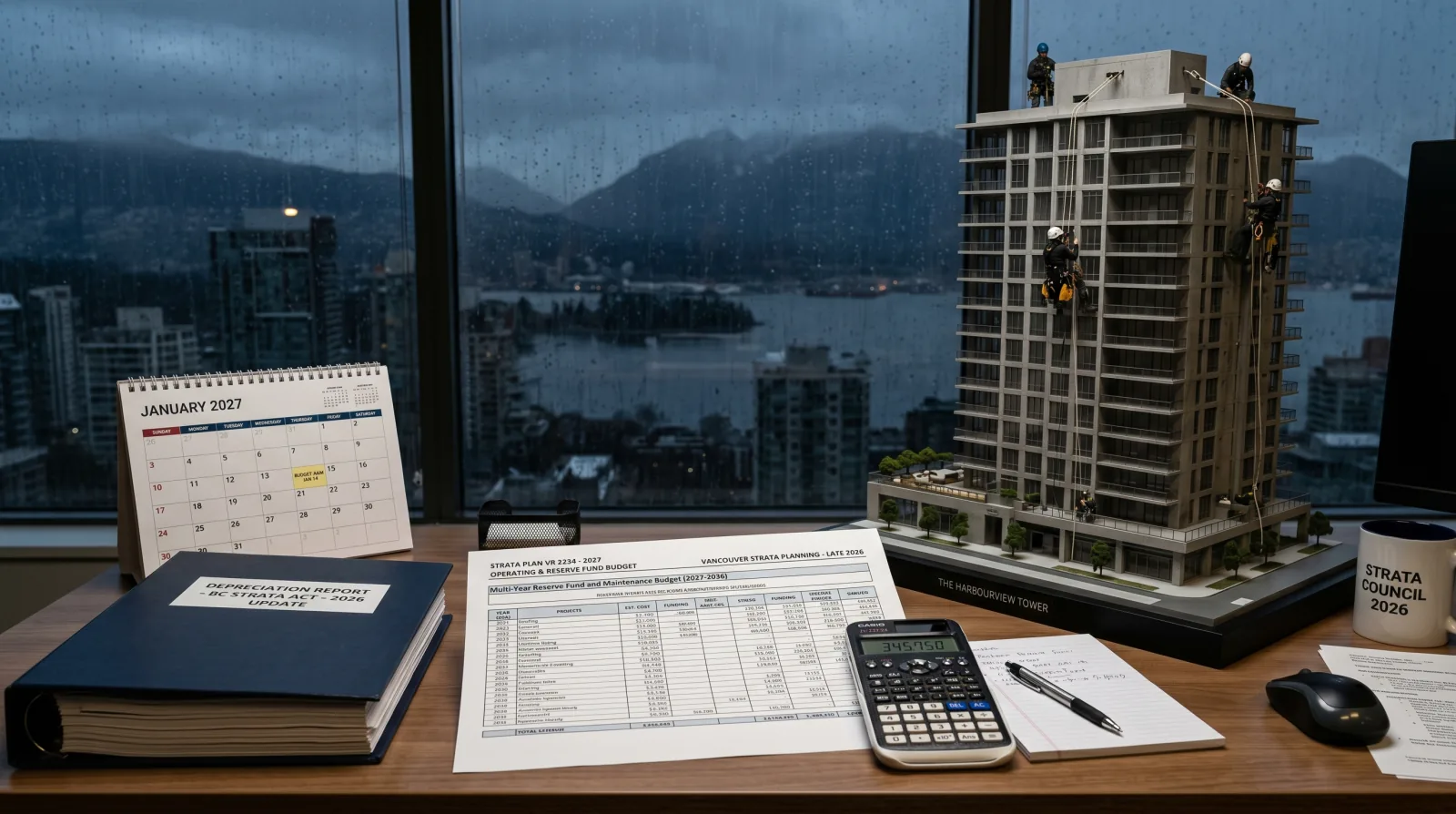
A Richmond strata council sits down to build the 2027 budget with a depreciation report in front of them and a fixed amount of money to work with. The report runs to dozens of pages and projects three decades of expenses. The council’s real problem is narrower and more urgent: what has to happen to the building envelope next year, what does it cost, and how do they fund it without blindsiding the owners with a special levy?
That is the gap between having a depreciation report and having a plan. The report is the raw material. Turning it into a funded, sequenced, risk-prioritized program is the work — and it is the difference between a building that ages gracefully and one that slides into a deferred-maintenance spiral.
The report is the start, not the answer
Under the Strata Property Act, most BC strata corporations must obtain and periodically update a depreciation report unless they qualify for and pass an exemption. The report inventories the building’s major components, estimates the remaining service life of each, and projects when each will need repair or replacement and roughly what it will cost. Recent changes have tightened how often reports must be updated, so councils should confirm their current obligation rather than assume.
What the report gives you is a timeline of upcoming expenses. What it does not give you is a plan. It will tell you the sealant is near end of life and the coating is due in three years, but it will not tell you which to do first, how to sequence the access, or how to fund both without a levy. That part is the council’s job — and it is where most of the value, or most of the trouble, comes from. The relationship between the report and the actual envelope work is covered in more detail in the depreciation report and building envelope guide.
Annual spend versus project spend
The first thing to sort out is which envelope costs are annual and which are projects, because they are funded differently.
Annual items are recurring, predictable, and relatively small. Routine inspections, drain and drainage clearing, minor sealant touch-ups, and small repairs — these come out of the operating budget every year, like any other operating cost. They are the cost of keeping the envelope maintained between major works.
Project items are large and periodic. A full sealant replacement program across the facade, a coating renewal, a concrete restoration, a roof replacement — these are funded from the contingency reserve fund, built up over years of regular contributions, and often spread or financed over time. The depreciation report is mostly concerned with these larger items, because they are the ones that arrive as special levies when no one planned for them.
Separating the two cleanly is the foundation of the budget. Annual maintenance keeps small things small. Reserve funding makes the big things payable when they come due.
Prioritize by risk, not by what’s annoying
When the budget cannot fund everything the report flags — which is most years — the council needs a rule for what comes first. The rule is risk, measured by how fast the cost grows if you wait.
First: active water ingress and structural risk. Anything letting water into the building or threatening the structure goes to the top. These are the items whose cost grows fastest when deferred, because water keeps working and concrete keeps deteriorating. A leak today is a structural repair next year.
Second: protective work that prevents bigger failures. Sealant and coatings that keep water out of the concrete are not cosmetic — they are the cheap layer that protects the expensive one. Renewing a coating or replacing failed sealant on schedule prevents the water ingress that drives the first-tier emergencies. Deferring protective work is how second-tier items become first-tier ones.
Third: cosmetic. Appearance items that aren’t protecting anything come last. They matter for property value and owner satisfaction, but they don’t get worse in a way that threatens the building.
A current condition assessment, read alongside the depreciation report, tells you which items fall into which tier this year. The same prioritization logic runs through any good property manager’s envelope maintenance checklist.
Sequence the work so you don’t redo it
Order matters as much as priority. The right sequence is: inspect first, then seal, then coat, then handle concrete repairs in the proper order within the project.
The reason is simple. The inspection tells you what the other work actually needs to be. If you scope and price a coating renewal before you know the condition of the concrete underneath, you risk coating over a problem — and paying to redo it when the problem surfaces. Assess first, and every downstream decision is based on current information.
Sequencing also lets you bundle access costs. On a tall building, getting crews up the facade — by rope access or swing stage — is a significant part of any envelope job. Doing the inspection, the sealant, and the coating as a coordinated program rather than three separate mobilizations spreads that access cost across the work. The discipline of seasonal upkeep feeding into project planning is laid out in the fall maintenance checklist for Vancouver stratas.
The deferred-maintenance spiral, and how planning breaks it
Here is the pattern that planning exists to prevent. A council facing a tight budget defers the envelope work the report flagged. It saves money this year. But deferred envelope work does not get cheaper — it gets worse. The failed sealant lets water into the concrete. The water corrodes the rebar. The three-year coating job becomes a concrete restoration project. And it arrives as an emergency special levy nobody planned for.
That is the spiral: each deferral makes the next bill larger, until the building is doing expensive emergency repairs that steady maintenance would have prevented for a fraction of the cost. Untreated water ingress does not pause while the council saves money. It compounds.
Planning breaks the spiral. A well-funded contingency reserve, built steadily through regular contributions guided by the depreciation report, pays for major projects without a sudden levy. Special levies become necessary precisely when maintenance has been deferred and a large expense arrives before the fund is ready. Steady funding is cheaper, more predictable, and far less disruptive to owners than emergency levies.
Building the 2027 plan
For the 2027 budget specifically, the council needs three views. A detailed view of what must happen in 2027 — the first-tier items and any scheduled protective work. A two-to-three-year outline of what is coming next, so this year’s decisions don’t create next year’s emergencies. And a longer view of how the reserve fund is being built toward the major projects further out in the report.
The team that builds this is a small one with clear roles. The depreciation report provider gives the financial framework. A building envelope specialist or contractor scopes and prices the actual work. A building envelope engineer is involved where structural or warranty matters arise. The council and property manager pull it together into a funded plan. The cost drivers — building height, access method, the condition of each system, and how much can be bundled — are specific to your building, so the only way to price 2027 accurately is to assess it. Request an assessment and we will help turn the report into a sequenced, budgeted program.
Related guides
- Strata and Property Guide Hub — planning, responsibilities, and process for BC stratas
- Depreciation Report Deadline and the Building Envelope — how the report connects to envelope work
- Property Manager’s Envelope Maintenance Checklist — the recurring items to budget for
- Fall Building Maintenance Checklist for Vancouver Stratas — seasonal upkeep that feeds the plan
Frequently Asked Questions
More from BC Strata Building Envelope Guide
Why Restoration Budgets Grow After the Work Starts
Envelope restoration is the one kind of construction where the real scope is hidden until demolition begins. Councils that understand why handle the change orders far better.
Read article →The Survey That Has to Happen Before Anyone Touches the Building
Older sealants, coatings, and roofing can contain asbestos or lead. In BC the survey is a legal requirement before demolition work starts, and finding out late stops the job.
Read article →The Contingency Line: Why Envelope Budgets Need Room for the Unknown
You cannot see behind cladding until it comes off. A restoration budget without a contingency is a budget that will be exceeded, and everyone in the room knows it.
Read article →