Targeted envelope repair vs. full recladding: how BC stratas make the call
A targeted repair is the smart, cheaper choice when the damage is localized and the cladding still has service life left, and it often costs a small fraction of a full recladding on the same building. A full recladding is the rational spend when the failures are widespread, the wall was never a drained rainscreen, or repeated repairs have stopped holding. What decides it is not a hunch, it is a building envelope condition assessment by a qualified engineer, read against your depreciation report and reserve funding.
Repair is right for buildings with isolated leak sources, a young envelope with one bad detail, or a strata that needs to bridge to a renewal that is already funded a few years out. Recladding is right for first-generation leaky-condo era buildings, walls with wet sheathing across whole elevations, or buildings where the second and third round of patches keep failing. The rest of this guide shows how those pieces fit together, with real Metro Vancouver examples where the honest answer went each way.
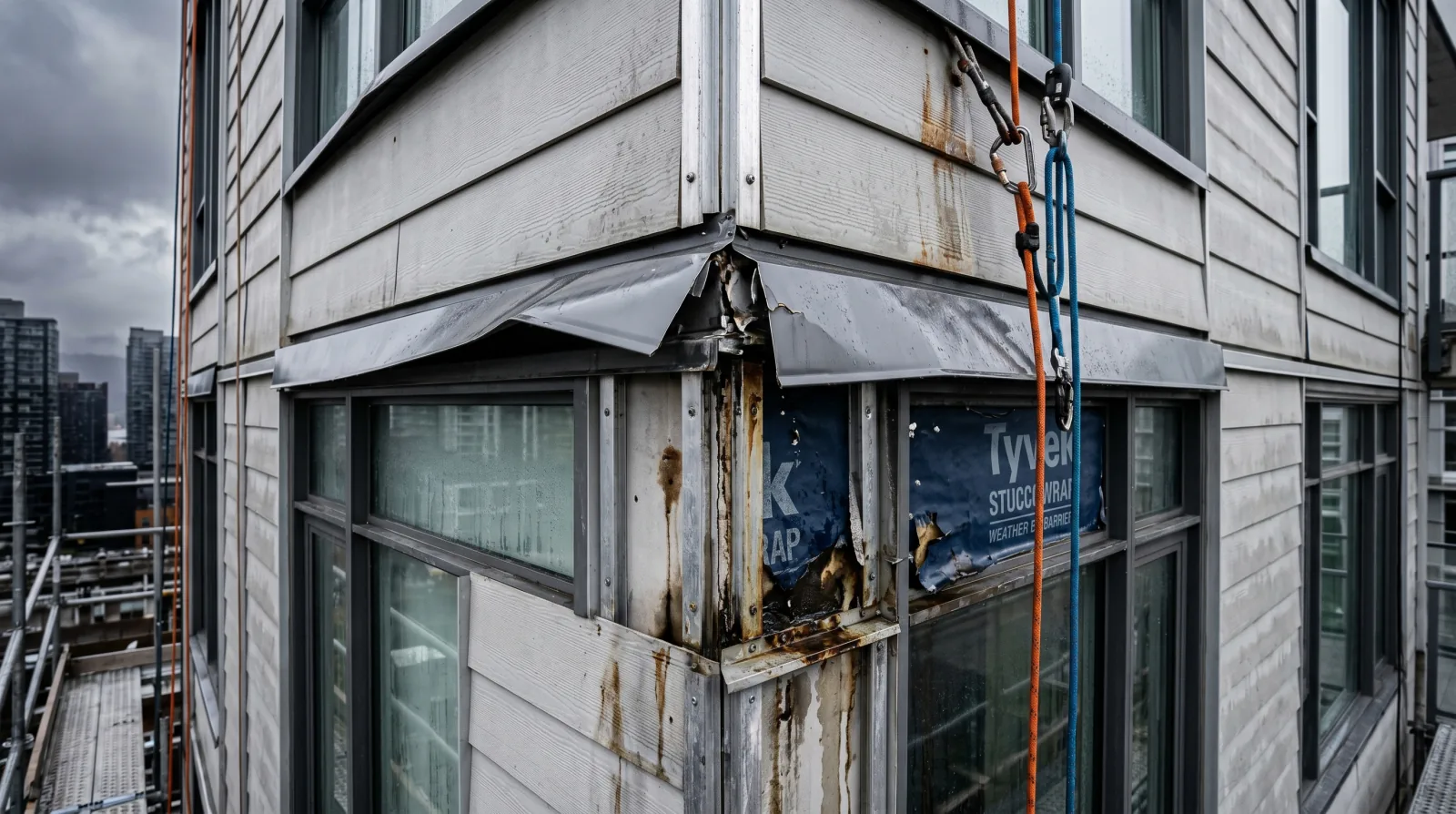
The question is not repair or reclad, it is how much of the wall is failing
Every strata council eventually faces the same decision when the envelope starts leaking: patch it, or take the whole thing off and start again. Framed that way, it sounds like a gamble. It is not. The choice comes down to four things you can actually measure: how far the damage has spread, how much useful life the existing cladding has left, how confident you can be in the cost, and how much disruption the residents can live with. Get those four straight and the answer usually picks itself.
The trap is treating a repair and a recladding as if they compete on price alone. They do not solve the same problem. A repair fixes the details that are failing today on a wall that is otherwise sound. A recladding replaces the wall system because the system itself has reached the end of the road. Spending recladding money on a wall that only needs repairs wastes the reserve fund. Spending repair money on a wall that needs recladding just delays the real bill and lets water keep working behind the cladding in the meantime.
Both approaches are legitimate. The failure is not choosing one over the other, it is choosing without evidence. A strata that reclads a sound wall out of fear has overspent. A strata that keeps patching a failed wall out of budget worry ends up spending more, because it pays for repairs and then pays for the recladding anyway, on top of the extra damage the delay caused. The whole point of this page is to help you tell which situation your building is actually in.
How a targeted repair actually works
A targeted repair starts with a diagnosis, not a truck full of sealant. The engineer or contractor first identifies where water is entering and where it is going. On most walls the entry points are predictable: window and door perimeters, the joints between cladding panels, flashing at the top of walls and above openings, and the transitions where one material meets another. These are the details that move, that get hit hardest by wind-driven rain, and that installers most often rush.
Once the failing details are found, the repair removes the failed material back to a sound edge and rebuilds the detail correctly. Failed sealant is cut out completely, the joint is cleaned and prepared, backer rod is set to the right depth, and new sealant is tooled to the proper shape so it can stretch and compress with the joint. Failed flashing is removed and replaced, lapped and sloped so water runs out and away from the wall instead of behind it. Where sheathing or the water-resistive barrier is damaged at a leak point, that section is opened, dried, and patched with compatible materials before the cladding goes back. The rest of the wall stays in place because the assessment showed it is doing its job.
The quality of a repair lives in the details you cannot see once it is done. Sealant tooled over a dirty joint will let go within a season. A flashing lapped the wrong way sends water into the wall instead of out of it. A patch in the barrier that is not tied back into the surrounding membrane leaves a gap for water to find. This is why the repair is only as good as the specification and the crew, and why an engineer diagnosing the true source matters more than the raw labour. For how we scope and carry out this work, see our building envelope repair service.
How a full recladding actually works
A recladding is a wall rebuild. Crews strip the existing cladding off the treated elevation down to the sheathing, then the engineer and the contractor inspect what is underneath. Decayed sheathing is cut out and replaced. The water-resistive barrier, the layer that actually keeps bulk water out of the framing, is renewed across the whole elevation. On a building that was face-sealed, this is where the drained rainscreen is added: strapping or a drainage mat creates an air gap behind the new cladding so any water that gets past the outer skin can run down the cavity and out through flashing at the base, instead of soaking into the wall.
New cladding, flashing, and sealant then go back on as one coordinated assembly, detailed to current practice at every window, parapet, and transition. Because the whole wall is open, the engineer can specify each detail properly and inspect it before it is covered. That is the real advantage of recladding over repair: nothing stays hidden, so nothing gets guessed at. The wall that goes back up is a designed system, not a patch on an old one.
The drained rainscreen is the point of the whole exercise. A face-sealed wall bets everything on the outer skin staying perfectly watertight forever, which no wall does in a climate like the coast. A drained rainscreen assumes some water will always get in and gives it a fast, drained path back out. That change in design philosophy is why a recladding done right lasts for decades while repairs on a face-sealed wall keep failing. If the building is heading toward a larger renewal, our building restoration team can plan the recladding alongside the other capital work.
Why the BC coast pushes the decision harder than most places
Metro Vancouver gets more than 1,100 mm of rain a year, and a lot of it arrives as wind-driven rain that is pushed sideways against the same south and west elevations, storm after storm. A wall that would hold up fine in a dry climate gets tested here in a way it never would elsewhere. Water is driven into every joint, every crack in the sealant, every flashing that is lapped wrong. The coast does not forgive a face-sealed wall or a lazy detail.
This is why the same building age tells a different story here than in the interior or in a drier region. A 30-year-old wall on the coast has taken three decades of hard, wind-driven rain against its weakest details. When you assess a Metro Vancouver building, you weight the exposed elevations more heavily, because that is where the wall has been worked hardest and where failure shows up first. It is also why a repair that ignores the drainage design on an exposed face rarely holds: the climate keeps pushing water in faster than a surface patch can keep it out.
The leaky-condo legacy is still driving these decisions
A large share of Metro Vancouver's mid-rise and high-rise stock went up during the leaky-condo era, roughly the late 1980s to the mid 1990s, when face-sealed walls were the norm. Those walls counted on sealant alone to keep water out, with no gap behind the cladding for water to drain and dry. In a climate that delivers wind-driven rain against the same elevations year after year, that design fails. Sheathing rots, insulation stays wet, and the leaks show up inside.
The public response was the Barrett Commission, whose report in June 1998 contained 82 recommendations, including wider use of rainscreen systems and better training for the trades that build envelopes. The building rules followed. The City of Vancouver required rainscreen construction in its 1996 building by-law, and the BC Building Code brought in the rainscreen requirement for coastal climates in 2006. A building built after those dates in the affected areas was more likely to be a drained rainscreen from the start. A building from before them, especially a wood-frame walk-up, is a strong candidate for face-sealed construction.
Here is why the history matters to your decision. You cannot repair a face-sealed wall into a rainscreen. If your building is one of the originals and it was never drained, targeted repairs will keep buying you a year or two at a time, but the underlying design keeps failing until the wall is reclad as a proper rainscreen. Many buildings are now on their first or second envelope renewal, and knowing which cycle you are in tells you a lot about whether the next step is another repair or the real thing. To go deeper on the two wall types, read our comparison of rainscreen versus face-sealed walls.
The repeated-repair trap, and how to see it early
The most expensive path a strata can take is not choosing recladding too early. It is repairing the same failing wall over and over while the real problem gets worse. Each repair cycle costs money for access, labour, and materials. If the underlying barrier or drainage design has failed, the leak comes back, and the strata pays again. Meanwhile the water that never really stopped keeps decaying the sheathing and soaking the framing behind the cladding, so the eventual recladding is bigger and costs more than it would have if the strata had faced it sooner.
You can usually see the trap forming. The signs are a leak that returns to the same elevation after each repair, repairs that hold for shorter and shorter periods, moisture readings that come back elevated even after a fix, and a growing list of affected units. When a council notices it is booking the same crew for the same wall every couple of years, that is the pattern. The way out is a proper condition assessment that opens the wall and states plainly whether repairs are still buying real time or just delaying the inevitable. An honest assessment names that moment. A contractor who keeps selling the next patch without ever opening the wall is not helping you escape the trap.
What a building envelope condition assessment actually tells you
You cannot make this call from the sidewalk. A building envelope condition assessment (BECA) by a qualified engineering firm is the document that separates a repair from a recladding on evidence, not opinion. The engineer reviews how the building was originally constructed, opens test cuts in the wall to see the water-resistive barrier and the sheathing behind the cladding, takes moisture readings, and maps where the failures actually sit. That last part is the whole game. If the moisture and the damage are concentrated in a few identifiable details, the assessment scopes a repair. If the barrier is compromised across whole elevations, it scopes a recladding.
The test cuts matter because a wall lies from the outside. Cladding can look fine while the sheathing behind it is soft with rot, and a small stain inside can trace back to a large wet area you would never see without opening the wall. A moisture meter and a few carefully placed cuts turn guesswork into data. The engineer also checks the remaining service life of the cladding and the barrier, which is what tells you whether repair money protects real value or props up a wall you will remove soon anyway.
The BECA also gives the strata council something it needs for the owners: a defensible basis for the decision and any special levy that follows. When you are asking owners to approve a large spend, "the engineer opened the wall and found this" carries far more weight than "we think it needs work." A BECA is different from a depreciation report, and it helps to understand both. For that comparison, see our guide to a building envelope resources hub and the funding sections below.
Cost drivers, cost certainty, and change-order risk
Nobody can quote your building from a web page, and any number here would be made up. What is worth understanding is what moves the price, because that is what you can actually plan around. On a repair, the largest drivers are the access method and the number of discrete details that need work. Reaching a few elevations from rope access is far cheaper to set up than wrapping the whole building in scaffold. The number of failed joints, flashings, and window perimeters then drives the labour. On a recladding, the drivers are the area of wall, the access for months rather than days, the new cladding and barrier materials, and the engineering to design and inspect the assembly.
The bigger difference between the two is cost certainty. A repair has a lower sticker price but a wider range around it, because hidden damage is the wild card. Crews open a wall to fix one detail and find wet sheathing behind the next panel, and the scope grows mid-project. That is why a well-written repair contract sets an agreed unit rate for hidden-damage work before anyone starts, so a discovery becomes a known cost, not an argument. A recladding costs more upfront but the range around it is tighter, because the whole wall comes off and nothing stays hidden to surprise you later. Change orders on a recladding tend to be a small share of the total. Change orders on an under-scoped repair can be a large one.
This is the honest tension in the decision. The cheaper option carries more uncertainty. If your reserve fund is thin and a surprise change order would be hard to cover, that risk matters, and it can be worth paying for the more predictable scope. If you can carry a reasonable contingency, the lower expected cost of a well-scoped repair usually wins. The right answer depends on your building and your funding, which is exactly why the assessment and the numbers have to come before the decision.
Life-cycle cost: the number that should drive the decision
The sticker price is the wrong number to decide on. The right number is the cost per protected square foot per year over the planning horizon. A repair that costs a fraction of a recladding but only holds for two years, then needs doing again, may cost more per year than a recladding that lasts decades. The reverse is also true: a recladding that lasts thirty years is cheap per year, but if the wall only needed a repair that would have held for eight, the recladding wasted money that could have earned interest in the reserve fund or funded another project.
The way to do this honestly is to lay both paths out over the same period. For the repair path, add up the repair now, the likely follow-up repairs, and the recladding you will still need at the end. For the recladding path, it is one large spend that carries the horizon. Then compare the totals, and weigh the disruption each path puts residents through. On a face-sealed wall with widespread failure, the repair path usually loses this comparison badly, because you pay for repairs and then pay for the recladding anyway. On a sound wall with one failing detail, the repair path wins easily. The math only works if the inputs are real, which is why it rests on the condition assessment, not on optimism.
The reserve fund, the depreciation report, and why timing matters
The exterior envelope is common property under the Strata Property Act, so the strata corporation owns the repair, not the individual owners. That work is funded from the contingency reserve fund for planned maintenance, and topped up with special levies when a project is larger than the reserve can carry. Under section 108 of the Act, a special levy has to be approved by a 3/4 vote at a general meeting. Envelope renewals are almost always large enough to need both the reserve and a levy. Because this is your money and your legal process, confirm the exact voting and funding rules with a licensed strata property manager or a strata lawyer before you plan a vote.
This is where the depreciation report earns its keep. The report forecasts when major components, including the envelope, will need attention and what the strata should be putting aside so the money is there when the engineer says the wall needs work. As of July 1, 2024, depreciation reports are mandatory for BC strata corporations with 5 or more lots, on a 5-year cycle, and the old option to waive the report by a 3/4 vote was removed. So most stratas now have a current report to plan against. The report does not diagnose your wall, but it sets the funding path the repair-versus-reclad decision has to fit inside.
Timing follows from funding. When a recladding is already scheduled and funded a few years out, a targeted repair to bridge to that date is often the disciplined choice: you keep the building watertight, you do not raise a levy before you have to, and you let the bigger project happen on the funded timeline. When the reserve does not yet support a full recladding, a phased plan (worst elevation first, or repair the sound faces and reclad the failed ones) captures most of the protection without one overwhelming levy. The discipline is to let the condition assessment and the depreciation report set the timing, not just the cheapest option this budget year.
Warranty reality on repairs and recladding
A warranty is not the same as a guarantee that nothing will leak. It is a written promise to fix defined problems for a defined time, and the useful skill is reading what it actually covers. A targeted repair usually carries a shorter warranty, often two to five years, covering the workmanship and the specific elements that were repaired. It does not cover the parts of the wall nobody touched, and it does not turn an old wall into a new one. If a leak later shows up two panels over from the repair, that is a new problem, not a warranty claim.
A recladding usually carries longer coverage, often a manufacturer warranty on the cladding and membrane plus a contractor workmanship warranty, and terms vary a lot by system. Read the term in years, what is covered (workmanship, materials, water penetration), and what voids it. A common gap is that a manufacturer warranty on a product may only stand if the product was installed exactly to specification and inspected, which is another reason engineer field review during a recladding is worth paying for. If your building is still inside a recladding warranty and a new leak appears, treat it as a possible warranty claim before you treat it as a repair job, because the party that built the wall may owe you the fix.
Where recladding is over-scoped and repair is genuinely right
Not every leak means recladding, and any consultant who reaches for the biggest scope on every building is not doing you a favour. If a BECA finds that the water is coming in at a handful of failed sealant joints, one poorly detailed flashing, or a few window perimeters, and the rest of the wall assembly reads dry and sound, then a targeted repair is the correct and cheaper call. You fix the details that are failing, you protect the service life still in the cladding, and you leave the reserve fund intact for the day the whole wall genuinely needs renewal.
There is also a common case that looks like recladding but is not: an aging concrete high-rise. When the structure is concrete, the concrete wall itself is largely doing the job of the barrier. What ages out on those buildings is the sealant, the coating, and some concrete edges, not a cladding system, because there often is no separate cladding system to replace. The right spend there is a building-wide sealant renewal, concrete repair, and recoating, not a recladding. Prescribing a recladding for a sound concrete wall is the classic over-scope. The skill is reading the assessment honestly: repair when repair is enough, restore when the concrete and coatings have aged, and reclad only when the wall system itself has failed. For related decisions on the roof side of the envelope, our guides on torch-on versus single-ply membranes and roof recover versus tear-off follow the same logic.
How to read a repair-versus-reclad proposal
A proposal you can trust does three things. It states what the assessment found, with evidence: test cuts, moisture readings, photos, and a map of which elevations and details are failing and which are sound. It ties the recommended scope to those findings, so you can see why this wall gets repaired and that wall gets reclad. And it sets out the cost drivers, the access method, the engineering involvement, the warranty, and, for a repair, the agreed rate for hidden-damage work found once the wall is open.
A proposal to be wary of does the opposite. It recommends a scope without showing the evidence, defaults to the largest possible job without saying what is sound, quotes a single number with no allowance for the unknowns of opening a wall, or never asks about your depreciation report and funding. Price matters, but the cheapest bid that under-scopes the repair can cost the most once the change orders land, and the most expensive bid that over-scopes to a recladding can waste reserve funds a repair would have saved. Judge the proposal on whether its logic holds, not just on the number at the bottom. When you are also weighing who does the work, our comparison of a specialist restoration contractor versus a general painter is worth a read.
Four Metro Vancouver scenarios, and the honest call in each
Real building situations show how the same decision goes different ways depending on what the wall is actually doing. In two of these, the honest answer is the cheaper repair.
1980s concrete high-rise, West End, hairline cracking and one wet elevation
A concrete tower from the early 1980s in the West End. The strata reports staining inside a handful of units on the south face after wind-driven rain. A BECA opens test cuts on all four elevations. The south face shows failed sealant at window perimeters and elevated moisture in the sheathing behind two window bands. The other three elevations read dry, with the original coating weathered but the concrete and sealant details sound.
The call: Targeted repair on the south face, monitor the rest.
Why: The failure is real but concentrated. Renewing the sealant and flashing at the failing window bands on the south elevation, drying and repairing the wet sheathing, and recoating that face keeps the building watertight for years. Recladding all four elevations would spend the reserve fund on three walls that are performing. The disciplined move is to fix the failing face from rope access and put the rest on a monitoring schedule tied to the next depreciation report update.
Wood-frame 4-storey strata, North Shore, north-facing decks and face-sealed stucco
A wood-frame building from 1993 on the North Shore, built with face-sealed stucco and no drainage cavity. The strata has already paid for two rounds of sealant repairs on the north and west elevations over eight years. The leaks came back both times. A BECA finds decayed sheathing across most of the north wall and wet insulation behind the stucco on the west face.
The call: Full recladding of the north and west elevations as a drained rainscreen, phased if funding requires.
Why: This is the leaky-condo pattern. The wall was never drained, so water that gets past the stucco has nowhere to go and sits in the framing. Two rounds of repairs failed because they treated the symptom, not the design. You cannot repair a face-sealed wall into a rainscreen. The rational spend is to strip the failed elevations, renew the barrier, add a drainage cavity, and reclad. If the reserve cannot carry both faces at once, do the worst elevation first and schedule the second for the next funding cycle.
Mixed-use mid-rise, Burnaby, recently reclad but one leaking parapet
A mid-rise in Burnaby that was fully reclad as a rainscreen six years ago. A new leak appears at the roofline on one corner after heavy rain. A review finds a single poorly detailed parapet-to-wall transition where the roofing membrane and the wall barrier were not tied together correctly during the original recladding.
The call: Targeted repair of the parapet detail only.
Why: The wall assembly is young and performing. One transition detail was built wrong, and that is what leaks. Recladding a six-year-old rainscreen would be absurd. The fix is to open the parapet, correct the tie-in between the roof membrane and the wall barrier, and reinstate the flashing. This is also worth raising with whoever holds the original recladding warranty, because a workmanship defect at a detail may still be covered.
Concrete high-rise, downtown, at end of coating and sealant life across the building
A concrete high-rise downtown, about 30 years old, never reclad. The concrete structure is sound, but the original sealant is hard and cracking on every elevation, the coating is chalking and failing, and there is minor spalling at a few balcony edges. Moisture testing shows the sheathing is generally dry because the concrete wall itself is the barrier.
The call: Building-wide sealant renewal, recoating, and concrete repair. Not a full recladding.
Why: Here the honest answer favours the larger repair scope, but not recladding. The concrete wall is doing its job, so there is no failed cladding system to replace. What has aged out is the sealant, the coating, and some concrete edges. A full-building restoration that renews all the sealant, repairs the spalling, and recoats the facade is the correct spend. Recladding would mean cladding a concrete wall that does not need it. This is where the difference between a concrete building and a face-sealed wood-frame building changes the whole decision.
The two options side by side
Targeted envelope repair
Localized work on the areas that are actually failing: cut out and replace failed sealant, repair or renew flashing details, patch damaged sheathing or membrane at leak points, and rebuild specific window perimeters or wall transitions, while the sound majority of the wall stays in service.
Full recladding
Removing the existing cladding across the building or a full elevation, inspecting and renewing the water-resistive barrier, adding or upgrading the drained rainscreen cavity, and installing new cladding, flashing, and sealant as one coordinated assembly.
Decision framework: nine questions that point one way or the other
| Question | Points toward | Reason |
|---|---|---|
| Is the damage localized or widespread? | Localized: repair | A few failing details on otherwise sound cladding do not justify tearing off a whole wall. Widespread barrier or sheathing failure means every repair chases the next leak, and recladding becomes the honest answer. |
| How much service life is left in the cladding? | Life left: repair | If the cladding and barrier still have years of performance in them, targeted repair protects that value. If the assembly is at the end of its life, repairs pour money into something you will remove soon anyway. |
| Was it built as a drained rainscreen? | Face-sealed: lean recladding | Many Metro Vancouver buildings from the leaky-condo era were face-sealed, not drained. You cannot repair a face-sealed wall into a rainscreen. Adding a real drainage cavity means recladding. |
| Have past repairs already failed? | Repeat failures: recladding | When a building is on its second or third round of patch repairs on the same elevations and the leaks keep coming back, the repairs are treating symptoms. That pattern is the signal to reclad. |
| What does moisture testing show behind the cladding? | Wet sheathing: recladding | If test cuts and moisture meters show elevated readings and decayed sheathing across an elevation, the wall is wet inside. Surface repairs cannot dry it out or stop it spreading. That elevation needs to come off. |
| What does the depreciation report show? | Depends on horizon | The depreciation report sets the planning horizon and the reserve funding path. If a full renewal is already scheduled and funded a few years out, a targeted repair to bridge to that date is often the disciplined choice. |
| Can the strata fund it now? | Funding drives timing | The envelope is common property funded by the contingency reserve fund and special levies. If the reserve does not support a full recladding yet, a phased approach captures most of the protection without one overwhelming levy. |
| How much disruption can residents absorb? | High tolerance: recladding | Recladding wraps the building in scaffold for months and affects balconies, parking, and views. A repair is contained. If another major project is already scheduled, combining the mobilizations cuts the total disruption. |
| Is another capital project due on the same building soon? | Yes: consider recladding now | If the roof, windows, or balconies are also near renewal, mobilizing scaffold once for a combined project is cheaper and less disruptive than repairing now and recladding in two years off a second setup. |
Questions to ask before you approve the scope
Put these to any contractor or consultant bidding the work. The red-flag answer next to each tells you when to slow down.
-
Did you open test cuts in the wall, and can I see the moisture readings and photos?
Red flag: A recommendation with no test cuts and no moisture data is an opinion, not an assessment. If the answer is "we can tell from outside," treat the scope as unproven.
-
Was this building built as a drained rainscreen or face-sealed?
Red flag: If the contractor does not know or will not check the original drawings, they cannot tell you whether a repair can even work. Face-sealed changes the whole answer.
-
Which specific details are failing, and which parts of the wall read sound?
Red flag: A good scope names the failing details and defends leaving the rest alone. A bid that recommends recladding everything without saying what is sound may be over-scoping.
-
If this is a repair, what is your allowance for hidden damage once the wall is open?
Red flag: No allowance and no unit rate for extra rot means the first surprise becomes a change order argument mid-project. Get the rate for hidden-damage work agreed in writing before you start.
-
If this is a recladding, who designs and inspects the assembly, and will there be field review?
Red flag: A recladding with no engineer field review during construction is the fastest way to build a new wall that still leaks at the details. If nobody checks the work against the drawings, walk.
-
How does this scope line up with our depreciation report and reserve funding?
Red flag: A contractor who never asks about your depreciation report or funding horizon is scoping in a vacuum. The right fix is the one that fits the funded plan, not just the biggest possible job.
-
What warranty comes with this work, and exactly what does it cover?
Red flag: Vague answers like "it is guaranteed" are a red flag. Get the term in years, what is covered (workmanship, materials, water penetration), and what voids it, in writing.
-
Can you phase this so we protect the worst elevation first?
Red flag: If the contractor cannot phase the work to match funding cycles, or insists it is all or nothing, they may be selling the mobilization rather than solving your problem.
-
How will you reach the work, and what does that access cost?
Red flag: Access is a large share of the price. If the bid defaults to full scaffold when rope access could reach a few elevations, ask why. Sometimes scaffold is right, but it should be justified.
If your building also relies on in-house staff for maintenance, it is worth understanding where that stops and specialist work begins. Our comparison of in-house strata maintenance versus a specialist contractor covers that line. And if the leaks are showing up as active water inside units, our waterproofing service can help trace and stop the ingress while the larger decision is made.
Quick answers
How do I know whether my strata needs targeted envelope repair or a full recladding?
You do not decide this from the ground with binoculars. A building envelope condition assessment (BECA) by a qualified engineering firm is what tells you which. The engineer reviews the original construction, opens test cuts in the wall to see the water-resistive barrier and sheathing behind the cladding, checks moisture readings, and maps where the failures actually are. If the damage is concentrated in a few details and the rest of the assembly is sound, they will scope a targeted repair. If the barrier is widely compromised or the wall was never a drained rainscreen, they will recommend recladding. The BECA is the document that lets the strata council make a defensible decision with the owners.
When is a targeted repair the smarter, cheaper call?
When the failures are localized and the cladding still has real service life left. If leaks trace back to a handful of failed sealant joints, a bad flashing detail over an entry, or a few window perimeters, replacing those specific elements keeps the assembly watertight for a fraction of a recladding cost and with far less disruption. Repair is also the right move when a funded renewal is already scheduled in the depreciation report and you just need to bridge to that date. In those cases, spending on a full recladding now would waste reserve funds on cladding you are keeping. Honest engineers will tell you to repair when repair is enough.
When does full recladding become the rational spend instead of another repair?
When you are repairing the same wall for the second or third time and the leaks keep coming back. Repeated patch repairs on the same elevations usually mean the water-resistive barrier or the drainage design itself has failed, and no amount of sealant fixes that. Recladding also becomes the rational choice when the cladding is at or past its useful life, or when the building was built face-sealed rather than as a drained rainscreen. At that point the money spent chasing leaks would be better put toward a wall assembly that actually sheds and drains water. A recladding resets the clock for decades instead of buying another two or three years.
Repair vs. recladding questions
How do I know whether my strata needs targeted envelope repair or a full recladding?
You do not decide this from the ground with binoculars. A building envelope condition assessment (BECA) by a qualified engineering firm is what tells you which. The engineer reviews the original construction, opens test cuts in the wall to see the water-resistive barrier and sheathing behind the cladding, checks moisture readings, and maps where the failures actually are. If the damage is concentrated in a few details and the rest of the assembly is sound, they will scope a targeted repair. If the barrier is widely compromised or the wall was never a drained rainscreen, they will recommend recladding. The BECA is the document that lets the strata council make a defensible decision with the owners.
When is a targeted repair the smarter, cheaper call?
When the failures are localized and the cladding still has real service life left. If leaks trace back to a handful of failed sealant joints, a bad flashing detail over an entry, or a few window perimeters, replacing those specific elements keeps the assembly watertight for a fraction of a recladding cost and with far less disruption. Repair is also the right move when a funded renewal is already scheduled in the depreciation report and you just need to bridge to that date. In those cases, spending on a full recladding now would waste reserve funds on cladding you are keeping. Honest engineers will tell you to repair when repair is enough.
When does full recladding become the rational spend instead of another repair?
When you are repairing the same wall for the second or third time and the leaks keep coming back. Repeated patch repairs on the same elevations usually mean the water-resistive barrier or the drainage design itself has failed, and no amount of sealant fixes that. Recladding also becomes the rational choice when the cladding is at or past its useful life, or when the building was built face-sealed rather than as a drained rainscreen. At that point the money spent chasing leaks would be better put toward a wall assembly that actually sheds and drains water. A recladding resets the clock for decades instead of buying another two or three years.
What is the BC leaky-condo legacy and why does it matter to this decision?
Through the 1980s and 1990s a large number of Metro Vancouver buildings were built with face-sealed exterior walls that relied on sealant alone to keep water out, with no drainage cavity behind the cladding. In the wet coastal climate those walls trapped moisture, rotted sheathing, and leaked. After the Barrett Commission report in June 1998, with its 82 recommendations, the industry moved to the drained rainscreen, which puts an air gap behind the cladding so any water that gets in can drain and dry. The City of Vancouver required rainscreen construction in its 1996 building by-law, and the BC Building Code followed for coastal climates in 2006. That history matters because a building on its first repair cycle and a building already reclad once face very different decisions, and the original construction type (face-sealed versus rainscreen) often points straight to recladding.
Who owns the building envelope in a BC strata, and how is the work paid for?
In a BC strata the exterior building envelope is common property under the Strata Property Act, which means the strata corporation is responsible for maintaining and repairing it, not the individual owners. The work is funded through the contingency reserve fund for planned maintenance, and through special levies approved by the owners when a project exceeds what the reserve holds. Under section 108 of the Act, a special levy needs a 3/4 vote resolution passed at a general meeting. Because envelope renewals are large capital projects, most stratas fund them with a combination of reserve funds and a levy. Confirm the exact procedure and voting details with your licensed strata property manager or a strata lawyer before you plan a vote.
What actually drives the cost difference between a repair and a recladding?
The biggest drivers are the extent of the damage and how you reach it. A targeted repair on a few elevations can often be done from rope access, which avoids the cost and footprint of wrapping the whole building in scaffold. A full recladding almost always needs scaffold or a mast climber for months, plus new cladding materials, a renewed water-resistive barrier, and more engineering involvement to design and inspect the assembly. Hidden damage is the wild card on repairs: once crews open the wall they sometimes find rot or membrane failure that was not visible from outside, which can push a repair scope upward. Recladding tends to be more predictable per elevation because the whole wall comes off and nothing stays hidden. We scope the access method and the engineering involvement as part of the assessment so the strata can budget realistically.
Can we phase a recladding to spread the cost across reserve funding cycles?
Yes, and for many stratas it is the practical path. If the reserve fund does not support recladding the entire building at once, the engineer can prioritize the worst-performing elevations first, then schedule the remaining faces for later funding cycles. The exposed elevations that take the most wind-driven rain, often the south and west faces on Metro Vancouver towers, usually fail first and get done first. A phased plan can also pair targeted repairs on the sound elevations now with a full recladding on the failed ones, so you are not spending on cladding you will keep. The important part is that the phasing is driven by the condition assessment and the depreciation report, not just by what is cheapest this year.
Does a depreciation report tell us to repair or reclad?
Not directly. A depreciation report forecasts when major components will need work and how much the strata should be setting aside, but it is a planning and budgeting document, not a diagnosis of your wall. It might tell you the envelope is due for renewal in a certain window and estimate a cost, which helps you fund the work. The actual repair-versus-reclad decision comes from a building envelope condition assessment that opens the wall and reads its real condition. Use the two together: the BECA tells you what the wall needs now, and the depreciation report tells you whether the money is there and when the larger renewal was planned. As of July 1, 2024, depreciation reports are mandatory for BC strata corporations with 5 or more lots on a 5-year cycle, so most stratas will have a current report to plan against. Confirm the current requirements with your strata manager.
Can targeted repairs void or affect a recladding warranty?
Who did the original work and what the warranty says decides it. If your building was reclad and is still under a workmanship or manufacturer warranty, cutting into that wall for an unrelated repair can affect coverage if it is not done to the original specification. Before any crew opens a wall that is still under warranty, check the warranty terms and, where the leak looks like a defect in the original work, raise it with the party that holds the warranty first. Sometimes what looks like a new repair job is actually a warranty claim on a detail that was built wrong. Getting that order right can save the strata the whole repair cost.
How long does a targeted envelope repair last compared to a recladding?
A well-scoped repair on a sound wall typically buys somewhere from two to ten years, depending on what failed and whether the underlying assembly is healthy. If the repair addresses the true source of the leak and the rest of the wall is dry, it can last a long time. If it is patching over a barrier that is quietly failing, it may only hold a season or two. A properly detailed rainscreen recladding is a multi-decade solution because it replaces the whole system, not just the failing parts. That difference in lifespan is exactly why the life-cycle math, not just the sticker price, should drive the decision.
Is it worth combining a recladding with other capital projects?
Often yes. Scaffold or a mast climber is a large fixed cost, and mobilizing it once for a combined project is cheaper and less disruptive than setting it up twice. If your roof, windows, or balcony membranes are also near the end of their life, doing them at the same time as the recladding spreads that access cost across more work and means residents live through one long disruption instead of several. The catch is funding: a combined project is a bigger single number, so it has to line up with your reserve fund and any special levy the owners approve. Plan it against the depreciation report so the timing and the money match.
What happens if we keep repairing instead of recladding when the wall really needs it?
You end up paying twice. Each repair cycle costs money for access, labour, and materials, and if the underlying barrier or drainage design has failed, the leak comes back and you repeat the spend. Meanwhile water keeps working behind the cladding, so the hidden damage grows: sheathing decays, insulation stays wet, and framing can rot. By the time the strata finally accepts that recladding is needed, the wall is in worse shape and the repair bill has already eaten reserve funds that could have gone toward the real fix. This is the repeated-repair trap, and the way out of it is an honest condition assessment that names the moment repairs stopped being the right tool.
Find out whether your building needs a targeted repair or a full recladding
We assess building envelopes across Vancouver, North Vancouver, West Vancouver, and Burnaby, mapping where the failures actually are, checking moisture and the water-resistive barrier behind the cladding, and matching the fix to your depreciation report and reserve funding, so the strata can decide on evidence and budget it accurately.