Pre-Purchase Building Envelope Inspection for Commercial Buyers in Metro Vancouver
You are about to put several million dollars into a commercial building, and the general inspection came back clean. Mechanical systems fine. Roof has “a few years left.” No red flags. And yet, six months after closing, water is tracking down a parkade wall and a balcony is leaking into the suite below.
This happens because a standard commercial inspection is broad and shallow by design. It touches everything and diagnoses nothing in depth. The building envelope — the walls, windows, roof, balconies, and below-grade waterproofing that keep water out — is exactly where the expensive surprises live, and it deserves its own focused assessment before you remove conditions.
What a general inspection misses
A general building inspection is a useful starting point. It covers the mechanical, electrical, fire, and structural systems at a level that flags obvious problems. But the inspector is moving through the whole building in a few hours, and the envelope gets a visual pass — they note what they can see from the ground and the roof hatch, and move on.
The trouble is that the worst envelope liabilities don’t announce themselves at a glance. Concealed water ingress tracks behind cladding for years before it shows inside. Rebar corrosion works inside the concrete before the surface spalls. Window sealant degrades quietly until a storm finds the weak joint. By the time these conditions are visible to a generalist, they are advanced — and advanced means expensive.
A pre-purchase envelope assessment is the opposite of broad and shallow. It is narrow and deep, aimed squarely at the systems that fail most expensively in coastal British Columbia.
Why Metro Vancouver makes this non-negotiable
The climate here is hard on buildings in ways a dry-climate buyer never has to think about. Environment and Climate Change Canada’s climate normals put regional rainfall around 1,150 to 1,200 mm a year, and most of it arrives wind-driven through the winter — pushed straight at the weather face of the building rather than falling gently.
On the coast, salt-laden air accelerates the corrosion of reinforcing steel inside concrete. And the region carries a structural hangover from the leaky condo era, when thousands of buildings went up with face-sealed details that relied on a single bead of caulking to keep water out. When that sealant ages, water reaches the structure directly.
A building that would comfortably last decades in Calgary or Phoenix can be hiding a major envelope repair bill in Metro Vancouver. The climate is the reason the envelope deserves its own assessment.
What the assessment actually covers
A proper pre-purchase envelope assessment looks at every system that manages water and every part of the structure that water can damage:
- Cladding and walls — stucco, EIFS, panel, brick, or rainscreen systems checked for cracking, displacement, staining, and signs of concealed moisture behind the surface
- Windows and sealants — perimeter and glazing joints assessed for age, adhesion loss, and whether they are original construction and past service life
- Roof and membranes — checked for remaining service life, ponding, flashing condition, and penetration detailing
- Balconies and decks — waterproofing membranes assessed for leaks, and the supporting concrete checked for spalling
- Concrete and parkade structure — surveyed for spalling, delamination, and the rebar corrosion that drives both
- Below-grade waterproofing — foundation walls and slabs checked for water ingress
This is the same scope as a building envelope condition assessment, focused through the lens of a buyer who needs to know what they are taking on before they own it.
Moisture testing and what it confirms
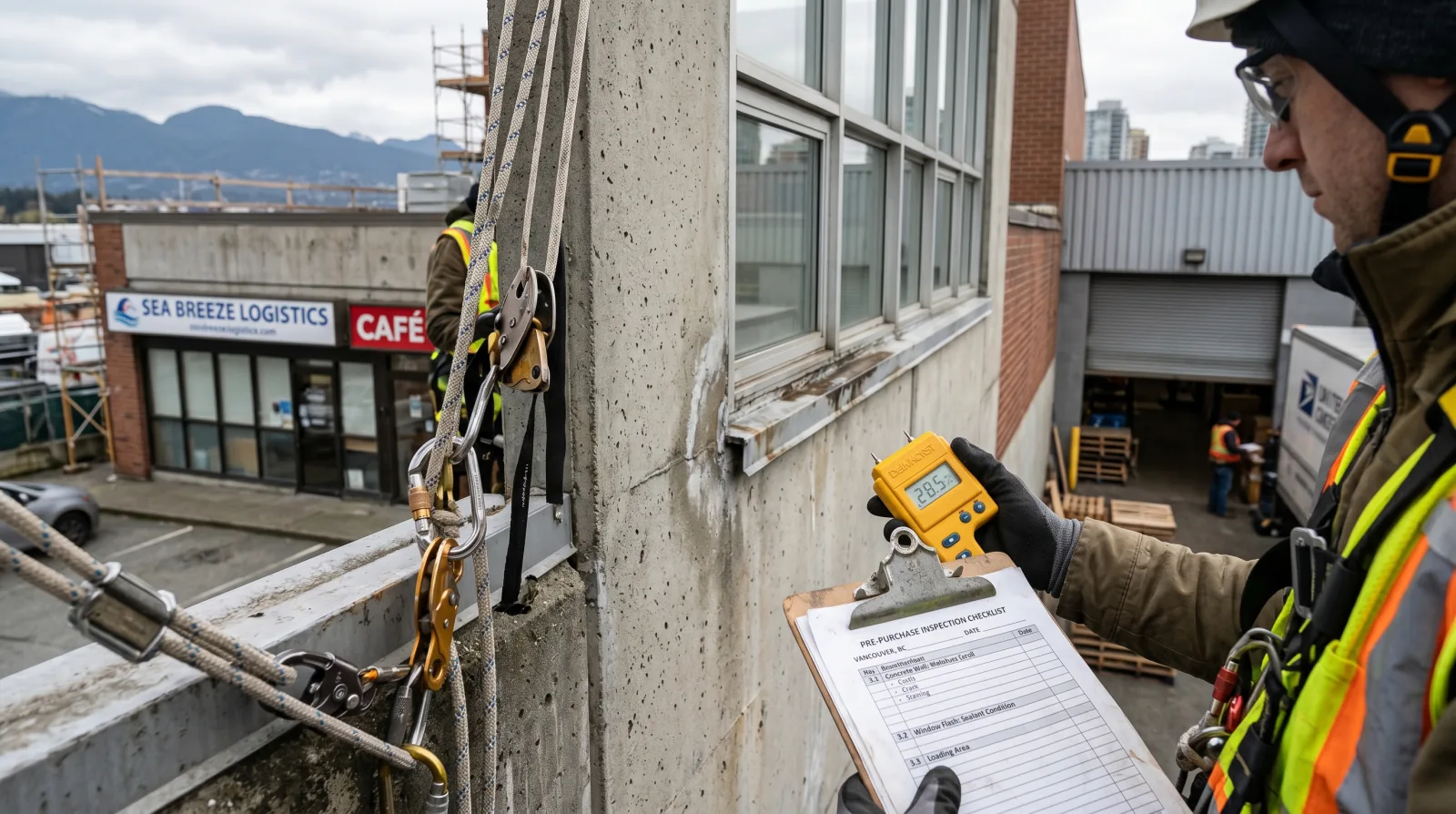
Where the visual assessment raises concerns, moisture testing turns suspicion into evidence. Surface and probe meters read elevated moisture inside walls and assemblies. Infrared imaging can flag wet insulation and thermal anomalies that point to hidden leaks. On a building with suspected concealed water ingress, limited exploratory openings — small, made with the seller’s permission and patched after — confirm whether water has actually reached the structure.
This is the difference between “there might be a problem” and “there is water in this wall, here, and it has damaged the sheathing.” One is a worry you carry into negotiations. The other is a documented fact you can act on. Understanding what causes water ingress in a high-rise helps the assessor know where to look and what the readings mean.
Read the building’s paper trail
The physical assessment is half the picture. The other half is the maintenance history. Ask the seller for everything: past restoration scopes, engineering reports, warranty documents, roof and membrane installation dates, sealant replacement records, and any depreciation report if the building is a strata.
A building with a documented maintenance history is a fundamentally lower-risk purchase than one with no records, even when the two look identical from the sidewalk. Records tell you whether the envelope has been cared for on a schedule or left to run to failure. A gap in the records — no roof history, no record of any sealant work in 25 years — is itself a finding.
How the findings protect your offer
This is the part that pays for the assessment many times over. A documented scope of envelope repairs gives you a bargaining position you do not have otherwise. You can renegotiate the price, request a holdback against the repair cost, or ask the seller to complete the work before closing. You are no longer negotiating against a vague worry — you are negotiating with a number.
The timing is what makes it work. The assessment has to happen inside your due diligence period — after your offer is accepted but before you remove conditions. That window is the only time you have contractual access to the building and the right to walk away or renegotiate. Book it too late, let conditions lapse, and every liability you missed becomes yours, with no recourse. The same discipline that goes into coordinating a strata restoration project — scope it, document it, price it — protects a buyer at the offer stage.
Who should do the work
This is not a job for a generalist home inspector. A commercial envelope assessment should be carried out by a building envelope specialist or restoration contractor experienced on coastal BC buildings, ideally working alongside a building envelope engineer where structural or warranty-sensitive findings come up. The assessor needs to know the local construction eras, recognize the leaky condo detailing problems on sight, and understand what coastal exposure does to concrete and sealant over time.
The cost drivers for the assessment itself are building height, complexity, and how much close-up access the upper elevations and roof require — a tall building needing rope access to reach the upper floors takes longer than a two-storey commercial block. The only way to scope it accurately is to talk through the specific building. Request an assessment through our team and we will work out what the property needs.
Related guides
- Strata and Property Guide Hub — building envelope responsibilities and planning for BC properties
- Building Envelope Condition Assessment: What It Covers — the full scope of an envelope assessment
- Condo Buyer’s Envelope Due Diligence in Vancouver — the residential equivalent for individual buyers
- Coordinating a Strata Exterior Restoration Project in BC — how restoration scopes are built and managed
Frequently Asked Questions
More from BC Strata Building Envelope Guide
Why Restoration Budgets Grow After the Work Starts
Envelope restoration is the one kind of construction where the real scope is hidden until demolition begins. Councils that understand why handle the change orders far better.
Read article →The Survey That Has to Happen Before Anyone Touches the Building
Older sealants, coatings, and roofing can contain asbestos or lead. In BC the survey is a legal requirement before demolition work starts, and finding out late stops the job.
Read article →The Contingency Line: Why Envelope Budgets Need Room for the Unknown
You cannot see behind cladding until it comes off. A restoration budget without a contingency is a budget that will be exceeded, and everyone in the room knows it.
Read article →