Anti-carbonation vs. standard elastomeric coating: protecting reinforced concrete on the BC coast
A standard elastomeric coating sheds wind-driven rain and bridges hairline cracks. An anti-carbonation coating does that too, but its defining job is blocking carbon dioxide from reaching the reinforcing steel, which is what actually corrodes rebar and spalls concrete over decades. On reinforced concrete with spalling, rust staining, or a real corrosion risk, you need a coating with EN 1062-6 CO2 diffusion data, meeting the EN 1062-1 Class C1 threshold of an sd value above 50 m. A standard elastomeric is not automatically anti-carbonation, and assuming it is on an older concrete structure is a costly mistake.
Pick the anti-carbonation coating when there is reinforcing steel to protect: older concrete towers, parkade soffits, balcony edges, and any structure that is carbonating or already spalling on the BC coast. Pick the standard elastomeric when the substrate is stucco, EIFS, or concrete with no rebar corrosion risk, and the real concern is water infiltration, hairline cracking, and appearance. On concrete that is already spalling or delaminating, neither coating comes first: the repair does, and then an anti-carbonation coating protects the result.
The carbonation mechanism, step by step
Fresh concrete is strongly alkaline, with a pore-water pH usually above 12.5. At that alkalinity, a very thin oxide film forms on the surface of the reinforcing steel and stays stable. That film is called the passive layer, and while it holds, the steel does not rust even though it is sitting in a damp, porous material. Sound concrete protects rebar by chemistry, not just by covering it.
Carbon dioxide in the air is the problem. It is a small amount of the air, but it is always there, and it slowly moves into the concrete through the pore network. Inside the concrete it dissolves in the pore water and reacts with calcium hydroxide, the alkaline compound, turning it into calcium carbonate. That reaction consumes the alkalinity. Where the concrete has carbonated, the pH drops from above 12 to around 8 or 9. There is a fairly sharp boundary between the carbonated outer layer and the still-alkaline concrete deeper in, and that boundary is called the carbonation front.
The front moves inward over years. As long as it stays outside the depth of the rebar, the steel is still surrounded by alkaline concrete and the passive layer survives. The trouble starts when the front reaches the bar. At that point the concrete around the steel is no longer alkaline, the passive layer breaks down, and the steel is free to corrode wherever oxygen and moisture are present, which on the BC coast is most of the time.
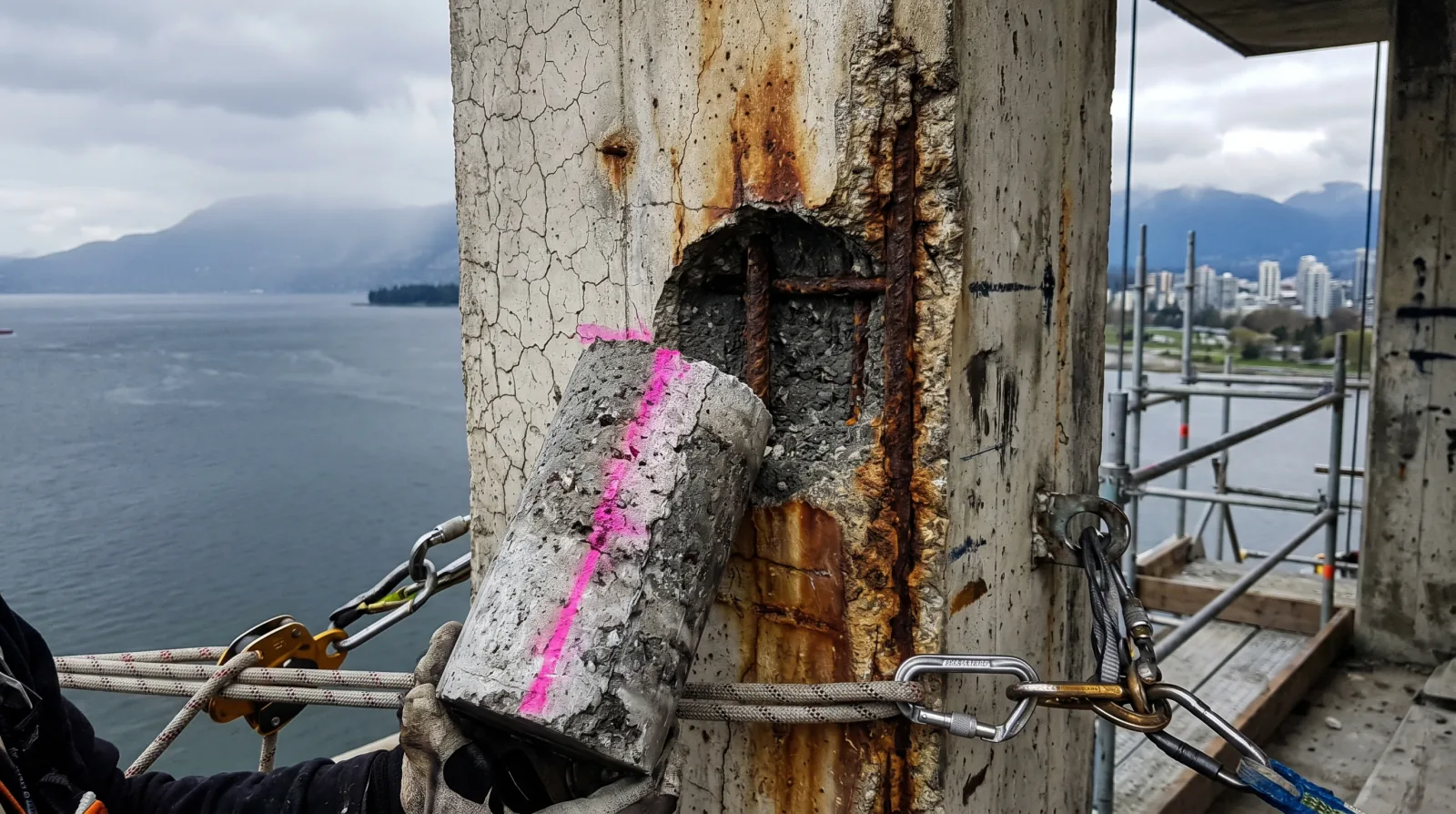
Corrosion is what does the visible damage. Rust takes up several times more volume than the steel it came from. As the bar corrodes and expands, it pushes on the concrete around it. Concrete is strong in compression but weak in tension, so the expansion cracks it, then pops a piece off the surface. That is spalling. Before a piece falls, you often see rust-brown staining bleeding through the surface and hollow, drummy areas where the concrete has delaminated from the bar but not yet dropped. On a balcony edge or a parkade soffit, a spall is not just cosmetic; it is a piece of concrete that can fall, and a bar that is losing cross-section.
How carbonation and chloride stack on the BC coast
Carbonation is not the only way rebar loses its passive layer. Chloride does it too, and near the ocean you often get both at once. This matters in West Vancouver, along the North Shore near the water, and anywhere marine salt air reaches the concrete.
The two attacks are different. Carbonation lowers the pH across a broad area, so the passive layer weakens fairly evenly and corrosion tends to spread. Chloride works differently: it does not need to lower the pH. Chloride ions reach the steel and break down the passive layer in small local spots, which drives pitting corrosion, a deep, concentrated attack that can cut into a bar quickly even while the surrounding concrete still looks fine. Salt air deposits chloride on the surface, and it works its way in through the same pores that let the CO2 in.
On a coastal building both fronts can be moving at once toward the same steel. An anti-carbonation coating slows the CO2 side of that, and by shedding wind-driven rain it limits new chloride and water landing on the face. What it cannot do is pull out chloride that is already in the concrete. That is why concrete near the water should be tested for chloride depth, not just carbonation depth, before the repair is scoped. If the repair only goes back to the carbonation line but chloride is deeper, you seal contaminated concrete behind a good coating and the corrosion keeps going.
Why a standard elastomeric is not automatically anti-carbonation
A standard high-build elastomeric coating is very good at its own job. It builds a thick film, bridges hairline cracks up to roughly 2 mm, and keeps wind-driven rain off the face. On a stucco or EIFS wall, or on concrete where water and cracking are the concern, that is exactly what you want. What it is not built or tested to do is stop carbon dioxide.
A thick film does slow gas movement to some degree simply because it is a barrier. The problem is that "some degree" is not a number you can plan around. Without a CO2 diffusion test result, you have no way to know whether that incidental resistance is anywhere near what a reinforced concrete structure needs. It might be a small fraction of the EN 1062-1 Class C1 threshold, or it might be closer, but you are guessing. Water resistance and CO2 resistance are different properties. A coating can be excellent at shedding water and still let CO2 through at a rate that does nothing useful for the steel. Treating a water-shedding elastomeric as carbonation protection because it is thick is a guess, and on structural concrete it is the wrong kind of guess to make.
What an anti-carbonation coating adds, and how it is measured
An anti-carbonation coating is formulated and tested specifically to resist CO2 passing through the film. The standard test is EN 1062-6, which measures CO2 permeability and expresses the result as an equivalent air layer thickness, written as an sd value in metres. It tells you how thick a layer of still air would have the same CO2 resistance as the coating, so a higher number means more protection. Under EN 1062-1, a coating reaches carbon dioxide permeability Class C1 when its sd value is above 50 m. That is the real, correct benchmark to ask for, tested per EN 1062-6.
The wider framework for protecting concrete surfaces is EN 1504-2, which covers surface protection systems for concrete, including coatings used for protection against carbonation. When you are specifying protection for reinforced concrete, naming EN 1504-2 and the EN 1062-1 Class C1 requirement together tells a serious contractor exactly what performance you expect.
Many anti-carbonation products are also elastomeric, so a single coating can bridge hairline cracks and block CO2 at the same time, which is usually what an older concrete building needs. Note that there are rigid anti-carbonation grades too, which block CO2 well but do not bridge cracks. Match the grade to the substrate: if the concrete has active hairline cracking, an elastomeric anti-carbonation coating that is also tested for flexibility to ASTM D522 is the right pick. When you compare products, ask for the EN 1062-6 sd value directly, because a strong water-resistance number says nothing about carbonation.
Failure modes, and the part owners never budget for
Both coatings share the common failure modes: applied too thin, applied over a wet wall, or applied over a chalky or poorly bonded surface, they blister and peel. Those are avoidable with prep and film-thickness checks.
The failure mode owners never budget for is the silent one on carbonating concrete. A standard elastomeric on an older reinforced concrete building can look perfect for years while the CO2 front it does not stop keeps advancing toward the steel underneath. The coating is doing its job on water and appearance, and the structure is quietly getting worse. By the time rust staining bleeds through or a spall drops, the corrosion is well established, and the fix is no longer a coating; it is a concrete repair. The money that was saved by using a coating with no CO2 data is spent several times over on chipping, steel treatment, and patching.
The other under-budgeted item is the recoat. On a plain elastomeric, missing a recoat means the wall looks tired and lets in more water for a while. On an anti-carbonation coating protecting live steel, missing the recoat window means the CO2 resistance has thinned out and the front is moving again. The recoat is not cosmetic maintenance on a carbonating structure; it is part of keeping the steel protected, and it belongs in the reserve fund on that basis.
Repair first, then protect
No coating fixes concrete that is already spalling. Where the rebar has corroded and the concrete is delaminating, the sequence is not negotiable: remove the failed concrete back to sound material, clean or replace the corroded steel, and patch with a compatible repair mortar. The bond of the repair should be confirmed, for example by pull-off testing to ASTM C1583 on the prepared substrate, so you know the patch will hold. Let the repair cure. Only then does the anti-carbonation coating go on, over the repair and the surrounding sound concrete, to slow the CO2 front from that point forward.
Applying an anti-carbonation coating over active delamination just paints over a problem that keeps growing underneath, and it wastes the coating. This is why carbonation work on a Metro Vancouver building is usually a concrete restoration scope with the coating as the final protective step, coordinated through our building envelope repair service rather than treated as a paint job.
Surface prep and correct specification
Prep decides whether the coating lasts. The concrete must be clean, sound, and dry before anything goes on. That means power washing to remove dirt, algae, chalk, and any loose existing coating; repairing all delaminated and spalled areas as above; opening and treating active cracks; and priming bare and patched areas with a compatible primer, not a generic paint primer. On a wall with a moisture source behind it, the leak has to be found and fixed first, because coating over a wet wall traps water and causes blistering.
The specification has to name real performance, not adjectives. For a reinforced concrete building it should state the product, its EN 1062-6 CO2 diffusion result and whether it meets the EN 1062-1 Class C1 sd value above 50 m, the crack-bridging grade and its ASTM D522 flexibility if the substrate is cracking, the target dry film build, and how wet-film thickness will be measured and recorded during application. Adhesion of the finished coating can be checked by pull-off testing to ASTM D4541. Wind-driven rain performance, where relevant, is tested to ASTM D6904. A spec written this way gives you something to hold the contractor to.
Standards and testing, and what to verify
A short list of what each standard actually tells you, so you can read a proposal:
EN 1062-6 is the CO2 permeability test; the result is the sd value in metres. EN 1062-1 is the classification, and Class C1 means an sd value above 50 m, which is the anti-carbonation benchmark. EN 1504-2 is the surface protection system framework for concrete, including carbonation protection. ASTM D522 is the mandrel bend test for flexibility and elongation, which stands in for crack-bridging ability. ASTM D6904 is the wind-driven rain resistance test for coatings on masonry. ASTM C1583 is the pull-off tensile test used to confirm the bond of a concrete surface or repair before overlay. ASTM D4541 is the pull-off adhesion test for the coating itself. Ask for the numbers that matter for your building: on reinforced concrete that is the EN 1062-6 sd value against the Class C1 threshold, and the ASTM C1583 bond results on the repair.
Cost drivers, without the price tag
What moves the price on this kind of work is not mainly the coating itself. The big drivers are on the concrete side. How much delaminated and spalled concrete has to be removed and patched, how much corroded steel has to be treated or replaced, and how deep the repair has to go once chloride and carbonation testing come back all move the number far more than the choice between an anti-carbonation and a plain elastomeric coating.
Access is the next driver. A concrete tower, exposed balcony edges, and the underside of a parkade often need rope access or swing stage, which costs more than working off the ground and takes weather into account. The number of separate elevations and how broken-up the surfaces are add labour. On the coating itself, choosing an anti-carbonation grade over a plain elastomeric is usually a modest premium; you are paying for tested CO2 resistance, not a different order of cost. The expensive part is always the repair and the access, which is why catching carbonation early, while the concrete is still sound and only a coating is needed, is so much cheaper than waiting for spalling.
Lifecycle reasoning: why the recoat schedule matters more here
On a plain elastomeric over stucco, the lifecycle logic is about appearance and water: recoat every 15 to 20 years or so, and the cost per protected year is easy to reason about. If a recoat slips a year or two, you get some fading and a bit more water, and you catch up at the next cycle.
On an anti-carbonation coating over live reinforced concrete, the logic changes. The coating is the thing slowing the CO2 front from reaching the steel. When the film thins out near end of life, its CO2 resistance drops, and the front starts moving again. So the recoat is not just refreshing a finish; it is renewing structural protection. On a carbonating building, the reserve fund should treat the anti-carbonation recoat as a protection cost with a firm schedule, flagged in the building depreciation report under the Strata Property Act, not as flexible cosmetic maintenance. Keeping it maintained on time is cheaper than any spalling repair the lapse would eventually cause.
Warranty reality
Warranties on this work are worth reading closely. A coating manufacturer's material warranty typically covers the product performing to spec, and it usually depends on the coating being applied at the specified film build over a properly prepared surface, which is why documented wet-film readings and prep records matter. The applicator's workmanship warranty covers the installation. Neither of those is a guarantee that the concrete will not carbonate or corrode; they cover the coating, not the structure.
Be clear about what is and is not covered. A coating warranty does not cover corrosion that was already underway in concrete that was coated without proper repair, and it does not cover failure caused by a moisture source behind the wall that was never fixed. If a contractor offers a long warranty on a coating applied straight over drummy, rust-stained concrete, that is a red flag, not reassurance. The warranty that means something sits on top of a documented repair and a documented film build.
What each coating cannot do
An anti-carbonation coating cannot fix concrete that is already spalling or delaminating; that is a repair. It cannot remove chloride already in the concrete. It cannot protect steel where the concrete cover is missing until that cover is rebuilt. And it is not a traffic-bearing membrane for a parkade deck or a walking balcony surface that ponds and takes wear; those need a proper horizontal waterproofing system.
A standard elastomeric cannot slow carbonation in any way you can rely on, cannot protect rebar chemistry, and cannot substitute for sealant repair at joints and flashings. On a reinforced concrete building at carbonation risk, its limits are the whole reason this comparison exists.
How to read a concrete restoration and coating proposal
A good proposal reads in two clear parts. First the concrete repair: how failed areas were found, how much is being removed, how the steel is treated or replaced, what repair mortar is used, and how the bond is confirmed. Then the coating: the named product, its EN 1062-6 sd value against the EN 1062-1 Class C1 threshold, the crack-bridging grade if needed, the film build, and how thickness will be checked. Prep, priming, weather limits, access method, and warranty should all be spelled out.
If you want to see how each of these coatings behaves against related products, our sibling guides cover the neighbours: elastomeric coating vs. acrylic paint for the basic film-build difference, silicone elastomeric vs. acrylic elastomeric for the resin choice, and elastomeric vs. clear sealer for when you want to keep the concrete look. The full set is on the exterior coatings hub. For how we specify and apply anti-carbonation and elastomeric systems on real buildings, see our exterior coatings service page.
Options compared
Anti-carbonation coating
A coating formulated and tested to resist the passage of carbon dioxide into the concrete, so it slows the carbonation that eventually leads to rebar corrosion. Many are also elastomeric and crack-bridging.
Standard elastomeric coating
A high-build acrylic elastomeric that bridges hairline cracks and sheds wind-driven rain. It is very good at keeping liquid water off the face, but it is not specifically formulated or tested to block CO2.
Scenario walkthroughs
1970s reinforced concrete tower, West End, rust staining on balcony edges
Situation: A roughly 50-year-old cast-in-place concrete high-rise near English Bay. Balcony slab edges show brown rust staining, and a few spots have spalled off, exposing rusted rebar. The concrete cover over the steel was thin to begin with, and decades of Pacific Northwest air have carbonated the surface layer down to the bar depth.
Our call: Repair the spalled areas, then an elastomeric anti-carbonation coating.
Why: The rust staining and spalling are proof the carbonation front has already reached the steel. A standard elastomeric would hide the stains and shed water, but it would do nothing about the CO2 that keeps corroding the exposed and adjacent rebar. The right sequence is to chip back to sound concrete, clean or replace the corroded steel, patch with a compatible repair mortar, confirm the bond, then coat the whole balcony edge and soffit with a tested anti-carbonation product to slow the front from that point on.
Downtown parkade soffit with delamination
Situation: An underground and partly above-grade parkade in downtown Vancouver. Sounding the soffit with a hammer finds hollow, drummy areas where the concrete has delaminated from the rebar below. There is efflorescence and rust bleed. Road salt tracked in by vehicles has added chloride to the normal carbonation.
Our call: Full delamination repair first, chloride testing, then anti-carbonation coating on the repaired soffit.
Why: Delamination means the corrosion is active and the concrete is already losing its grip on the steel. Coating over drummy concrete just traps the problem and wastes the material. This is a concrete restoration scope: remove all delaminated concrete, treat the steel, patch, and only then apply the anti-carbonation coating. Because road salt is in play, the concrete should be tested for chloride depth so the repair goes deep enough, not just to the carbonation line.
Sound but ageing concrete mid-rise, Burnaby, no corrosion yet
Situation: A 25-year-old reinforced concrete mid-rise in Burnaby. No spalling, no rust staining, and sounding finds no delamination. Core testing shows the carbonation front is partway into the cover but has not yet reached the rebar. The building is entering a coating cycle anyway.
Our call: Anti-carbonation coating now, as prevention.
Why: This is the best value case for an anti-carbonation coating. The steel is still passive, the concrete is still sound, and slowing the CO2 front now buys many years before it reaches the bar. It costs a fraction of what a full spalling repair would cost later. Since the building is coating anyway, choosing an anti-carbonation grade over a plain elastomeric adds protection for the steel at a modest premium. This preventive work belongs in the building depreciation report so the reserve fund is ready for the recoat.
Stucco and EIFS wall with hairline cracks, Richmond, no reinforced concrete
Situation: A wood-frame low-rise in Richmond with a stucco and EIFS exterior. There are hairline cracks and some water staining at a few spots, but the wall assembly has no structural reinforced concrete behind the cladding. The concern is water getting in and the cracks showing through.
Our call: Standard elastomeric coating.
Why: This is the case where the honest answer is not the anti-carbonation product. There is no reinforcing steel in the cladding to protect, so there is no carbonation-driven corrosion to slow. Paying for CO2 resistance here buys nothing. A quality high-build elastomeric bridges the hairline cracks, sheds wind-driven rain, and keeps the wall looking right. Spend the money on crack repair, sealant joints, and a good elastomeric, not on a coating property this wall does not use.
Decision framework: which coating for your concrete
| Situation | Recommendation | Reason |
|---|---|---|
| Reinforced concrete with spalling or rust staining already showing? | Anti-carbonation | Spalling and rust stains mean carbonation (often with chloride) has already reached the rebar. Repair the failed areas first, then a CO2-blocking coating slows the reaction going forward. A standard elastomeric does not target it. |
| Older exposed concrete tower, parkade soffit, or balcony edge? | Anti-carbonation | These are the classic carbonation and corrosion locations on the BC coast, thin cover and high exposure. Protecting the concrete chemistry, not just the water, is the priority. |
| Stucco or EIFS facade with hairline cracking and a water concern? | Standard elastomeric | Stucco and EIFS are not reinforced concrete, so carbonation of rebar is not the issue. Crack bridging and water resistance are what matter, and that is what a standard elastomeric is built for. |
| Concrete is sound with no signs of corrosion yet? | Anti-carbonation as prevention | Applied before carbonation reaches the steel, an anti-carbonation coating buys years of protection. This is far cheaper than chipping out spalled concrete and replacing corroded rebar later. |
| Active corrosion and delamination present? | Repair first, then coat | No coating fixes concrete that is already spalling. The corroded rebar and delaminated concrete must be repaired first, then an anti-carbonation coating protects the repair and the surrounding sound concrete. |
| Need both crack bridging and CO2 protection? | Elastomeric anti-carbonation | Many anti-carbonation coatings are also elastomeric, so one product bridges hairline cracks and blocks CO2. Confirm both the crack-bridging data (ASTM D522) and the EN 1062-6 sd value. |
| Building is near the water in West Vancouver or the North Shore? | Anti-carbonation, and test for chloride | Marine salt air drives chloride into the concrete alongside carbonation, and the two attack the same steel. Coat to block CO2, and have the concrete tested so the repair scope accounts for chloride contamination, not just carbonation depth. |
| Horizontal parkade deck or balcony walking surface that ponds? | Traffic membrane, not either coating | Neither an anti-carbonation nor a standard elastomeric wall coating is a substitute for a proper vehicular or pedestrian traffic-bearing waterproofing membrane on a surface that gets ponding and wear. Use the right horizontal system there. |
| Budget only covers part of the building this cycle? | Phase by exposure and risk | Repair and coat the worst carbonation and corrosion locations first, usually the most exposed elevation, balcony edges, and parkade soffits. Flag the remaining faces in the depreciation report for the next funding cycle. |
Questions to ask before you approve the scope
If you manage the strata or own the building, these are the questions that separate a real concrete restoration and protection scope from a repaint dressed up as one. The red-flag answer is noted after each.
- What is the coating's EN 1062-6 CO2 diffusion result, and does it meet the EN 1062-1 Class C1 sd value above 50 m? Red flag: no CO2 number, or "it is elastomeric so it should be fine."
- Was the concrete tested for carbonation depth, and near the water for chloride depth? Red flag: no testing, repair depth chosen by eye.
- How were the failed and delaminated areas found, and how much is being repaired? Red flag: no sounding survey, a flat allowance with no method.
- How is the repair bond confirmed before coating? Red flag: no pull-off testing to ASTM C1583, no mention of bond at all.
- What is the specified dry film build, and how will wet-film thickness be checked and recorded? Red flag: no thickness spec, no monitoring, coverage "by experience."
- Is the coating vapour permeable to liquid water out while resisting CO2 in, and does it suit our wall's moisture condition? Red flag: a fully impermeable film specified with no moisture assessment.
- Is there a moisture source behind the wall that must be fixed first? Red flag: coating scheduled with known active leaks left open.
- What does the warranty actually cover, coating only or structure, and what voids it? Red flag: a long warranty offered over unrepaired, rust-stained concrete.
- What is the recoat interval, and is it flagged in the depreciation report reserve fund? Red flag: recoat treated as optional cosmetic maintenance on a carbonating structure.
- How is the work accessed, and are rope access technicians certified under WorkSafeBC Part 34? Red flag: vague answers on access and no mention of fall protection or certification.
Our team scopes the concrete repair and the coating in a single assessment across Vancouver, Burnaby, the North Shore, West Vancouver, and Richmond, so the CO2 protection sits on top of properly repaired concrete rather than sealing a problem inside. Vancouver takes about 1,189 mm of rain a year, roughly 74% of it between October and March (1991 to 2020 climate normals, Vancouver International Airport), which keeps concrete damp for long stretches and gives corrosion the moisture it needs. Work at height on towers, parkades, and balcony edges is done to WorkSafeBC rules: fall protection is required above the 3 m trigger under Part 11, and rope access is covered by Part 34 of the OHS Regulation, which accepts IRATA and SPRAT certified technicians.
Quick answers
What is the difference between an anti-carbonation coating and a standard elastomeric coating?
Both can be thick, flexible, crack-bridging films, but they are built to solve different problems. A standard elastomeric coating is made to shed wind-driven rain and bridge hairline cracks, and it is tested for those properties. An anti-carbonation coating is specifically formulated and tested to resist the passage of carbon dioxide into the concrete, which is what protects the reinforcing steel from corrosion over time. Many anti-carbonation coatings are also elastomeric, so they do both jobs, but a standard elastomeric is not automatically an anti-carbonation coating. If protecting reinforced concrete from rebar corrosion is the goal, the coating needs CO2 diffusion test data, usually to EN 1062-6, not just crack-bridging and water-resistance claims.
What is carbonation and why does it corrode rebar in concrete?
Fresh concrete is highly alkaline, and that alkalinity forms a thin passive layer on the reinforcing steel that stops it from rusting. Carbonation is the slow process where carbon dioxide from the air reacts with the alkaline compounds in the concrete and turns them into calcium carbonate, which lowers the concrete pH. As that lower-pH front works its way in from the surface and reaches the depth of the rebar, the passive layer breaks down and the steel starts to corrode. Corroding steel expands, and that expansion cracks and spalls the concrete from the inside, which is the flaking and popping you see on older concrete balconies and parkade soffits. An anti-carbonation coating slows the CO2 front, so the concrete stays alkaline around the steel for longer.
Is carbonation a real problem on Metro Vancouver buildings?
Yes, and it stacks with our other coastal problems. Reinforced concrete buildings across Metro Vancouver, especially older towers, parkade structures, and exposed balcony edges, carbonate over decades of exposure to the air. On the BC coast that carbonation runs alongside chloride exposure from marine air near the water in places like West Vancouver and the North Shore, and both attack the same reinforcing steel. The visible result is the same: concrete spalling, rust staining, and delamination where the rebar has corroded and expanded. Many of the concrete restoration scopes on local buildings are driven by exactly this, and an anti-carbonation coating applied after the repair is what slows the clock back down.
Anti-carbonation coating questions
What is the difference between an anti-carbonation coating and a standard elastomeric coating?
Both can be thick, flexible, crack-bridging films, but they are built to solve different problems. A standard elastomeric coating is made to shed wind-driven rain and bridge hairline cracks, and it is tested for those properties. An anti-carbonation coating is specifically formulated and tested to resist the passage of carbon dioxide into the concrete, which is what protects the reinforcing steel from corrosion over time. Many anti-carbonation coatings are also elastomeric, so they do both jobs, but a standard elastomeric is not automatically an anti-carbonation coating. If protecting reinforced concrete from rebar corrosion is the goal, the coating needs CO2 diffusion test data, usually to EN 1062-6, not just crack-bridging and water-resistance claims.
What is carbonation and why does it corrode rebar in concrete?
Fresh concrete is highly alkaline, and that alkalinity forms a thin passive layer on the reinforcing steel that stops it from rusting. Carbonation is the slow process where carbon dioxide from the air reacts with the alkaline compounds in the concrete and turns them into calcium carbonate, which lowers the concrete pH. As that lower-pH front works its way in from the surface and reaches the depth of the rebar, the passive layer breaks down and the steel starts to corrode. Corroding steel expands, and that expansion cracks and spalls the concrete from the inside, which is the flaking and popping you see on older concrete balconies and parkade soffits. An anti-carbonation coating slows the CO2 front, so the concrete stays alkaline around the steel for longer.
Is carbonation a real problem on Metro Vancouver buildings?
Yes, and it stacks with our other coastal problems. Reinforced concrete buildings across Metro Vancouver, especially older towers, parkade structures, and exposed balcony edges, carbonate over decades of exposure to the air. On the BC coast that carbonation runs alongside chloride exposure from marine air near the water in places like West Vancouver and the North Shore, and both attack the same reinforcing steel. The visible result is the same: concrete spalling, rust staining, and delamination where the rebar has corroded and expanded. Many of the concrete restoration scopes on local buildings are driven by exactly this, and an anti-carbonation coating applied after the repair is what slows the clock back down.
How is anti-carbonation performance measured?
The common European test is EN 1062-6, which measures how well a coating resists the diffusion of carbon dioxide through the film. The result is expressed as an equivalent air layer thickness, written as an sd value in metres: it tells you how thick a layer of still air would have the same CO2 resistance as the coating. A higher number means the coating blocks more CO2. Under EN 1062-1, a coating reaches carbon dioxide permeability Class C1 when its sd value is above 50 m, and that is the real threshold to ask for on a reinforced concrete building. When you compare products, ask for the EN 1062-6 CO2 diffusion figure specifically, because a strong water-resistance number tells you nothing about carbonation protection.
Can a standard elastomeric coating also protect against carbonation?
To a degree, but you cannot rely on it without data. A thick elastomeric film does slow gas movement somewhat simply because it is a barrier, so a standard elastomeric may give some incidental carbonation resistance. The problem is that without the EN 1062-6 CO2 diffusion test result, you have no way to know how much, and it may fall well short of the EN 1062-1 Class C1 threshold of an sd value above 50 m that a reinforced concrete building needs. If carbonation and rebar corrosion are the actual risk, specify a coating that is tested and marketed as anti-carbonation, and confirm its CO2 figure. Treating a standard water-shedding elastomeric as if it were carbonation protection is a common and expensive assumption on older concrete.
Do you apply an anti-carbonation coating before or after concrete repair?
After. A coating does not fix concrete that is already spalling or delaminating from corroded rebar. The sequence on a reinforced concrete building is to first remove the failed concrete back to sound material, clean or replace the corroded reinforcing steel, patch with a compatible repair mortar, and let it cure. The bond of the repair should be confirmed, for example by pull-off testing to ASTM C1583, before coating. Only then does the anti-carbonation coating go on, over both the repair and the surrounding sound concrete, to slow the CO2 front and protect the steel going forward. Applying an anti-carbonation coating over active delamination just hides a problem that keeps growing underneath.
Which lasts longer, anti-carbonation or standard elastomeric coating?
Service life is similar because many anti-carbonation coatings are elastomeric and are applied at comparable film build, so both can give 15 to 20 years or more on a sound, prepared vertical surface on the BC coast. The more useful comparison is not lifespan but what each is protecting. A standard elastomeric protects the appearance and keeps water off; when it wears out you recoat and little harm is done in the meantime. An anti-carbonation coating protects the reinforcing steel, so letting it wear out without recoating on a carbonating structure means the CO2 front keeps advancing toward the rebar. On a reinforced concrete building, keeping the anti-carbonation coating maintained on schedule matters more than the raw number of years, because what is at stake is the structure, not just the finish.
How does chloride from marine salt air change the picture on the North Shore and West Vancouver?
Chloride and carbonation are two separate attacks on the same steel, and near the water you often get both. Carbonation lowers the concrete pH so the passive layer on the rebar breaks down across a broad area. Chloride from marine salt air does not need to lower the pH; it breaks down the passive layer in local spots and drives pitting corrosion. On a West Vancouver or North Shore building close to the ocean, salt air deposits chloride on the surface, and it works into the concrete alongside the CO2 front. An anti-carbonation coating slows the CO2, and by shedding wind-driven rain it also limits new chloride and water getting in, but it does not remove chloride that is already in the concrete. That is why concrete near the water should be tested for chloride depth, so the repair goes deep enough and the coating is protecting sound, low-chloride concrete rather than sealing a problem inside.
Will an anti-carbonation coating trap moisture and cause more damage?
A properly chosen one will not, and this is why the product matters. A good anti-carbonation coating is designed to block CO2 and liquid water coming in while still letting water vapour escape from the concrete outward. That balance keeps the concrete able to dry. The risk comes from using the wrong film, for example a fully vapour-impermeable coating on a wall that has a moisture source behind it, which can trap water and cause blistering or freeze damage. This is one reason the substrate must be dry at application and any active water leaks must be fixed first. When you review a proposal, ask that the coating is vapour permeable to liquid water out while resisting CO2 in, and that it suits the moisture condition of your specific wall.
Is an anti-carbonation coating worth it on concrete that has no visible damage yet?
Often yes, and this is where it gives the best value. If core testing shows the carbonation front is partway into the cover but has not reached the rebar, coating now slows the front while the steel is still protected. You avoid the much larger cost of chipping out spalled concrete, treating corroded steel, and patching balcony edges or parkade soffits later. On an ageing but sound Metro Vancouver mid-rise that is entering a coating cycle anyway, choosing an anti-carbonation grade over a plain elastomeric adds real protection for a modest premium. The right place to plan and fund this preventive work is the building depreciation report required under the Strata Property Act, so the reserve fund is ready when the recoat is due.
What should a concrete restoration and coating proposal include so I know it is done right?
A sound proposal separates the concrete repair from the coating and is specific about both. On the repair side it should describe how failed concrete is located (sounding or other survey), how much is removed, how the steel is cleaned or replaced, what repair mortar is used, and how the bond is confirmed, for example pull-off testing to ASTM C1583. On the coating side it should name the actual product, state its EN 1062-6 CO2 diffusion result and whether it meets the EN 1062-1 Class C1 threshold of an sd value above 50 m, and give the specified film build with how wet-film thickness will be checked during application. It should also cover surface prep, priming, weather limits for application, and warranty terms. A quote that just says "apply elastomeric coating" with no CO2 data, no repair detail, and no film-thickness monitoring is not enough for a reinforced concrete building.
Does rope access change how the coating is applied on a tower or parkade?
Rope access changes how the crew reaches the work, not the coating chemistry or the required film build. On a concrete tower, balcony edges, or the underside of an exposed parkade, technicians work on ropes to reach faces that scaffold cannot easily cover, and in British Columbia that work falls under WorkSafeBC. Fall protection is required for work at height under Part 11 of the OHS Regulation, and rope access itself is covered by Part 34, which accepts IRATA and SPRAT certified technicians. The coating still has to go on at the specified thickness, over properly prepared and repaired concrete, with the same CO2 and adhesion performance you would demand from any platform. The access method should never be an excuse for a thinner film or skipped prep.
Worried about carbonation and rebar corrosion on your concrete building?
We assess reinforced concrete on towers, parkades, and balconies across Vancouver, Burnaby, the North Shore, and West Vancouver, checking for carbonation, chloride, spalling, and corrosion, then scope the repair and specify a properly tested anti-carbonation coating to protect the steel going forward.