Silicone vs. acrylic elastomeric coatings on a Vancouver concrete tower: which high-build coating fits
For most Metro Vancouver concrete and stucco towers, acrylic elastomeric is the right default. Both coatings are thick, high-build films that last 15 to 20+ years and both bridge hairline cracks up to roughly 2 mm, so crack bridging is not what decides between them. The real split is vapour permeance. Acrylic elastomeric commonly sits in the 10 to 30 US perm range and lets a damp wall keep drying outward. Silicone elastomeric often sits in the single digits, sheds liquid rain harder, and holds strong colour longer under sun, but that same low permeance is what causes blistering when it goes over a wall that still holds moisture. On a coast where walls stay wet for months, that one number decides most jobs.
Pick acrylic elastomeric when the substrate still carries moisture, when the colour is light and the wall faces street traffic, when the weather window is tight, or when budget is the constraint. That covers most towers in Vancouver, Burnaby, and Richmond. Reach for silicone elastomeric only when three things line up at once: the concrete is confirmed dry, the exposure to wind-driven rain is severe, and the colour is dark enough that dirt streaking will not become a resident complaint. A high, wind-blasted waterfront tower in a deep colour is the honest case for silicone. A pale mid-rise near Metrotown is not.
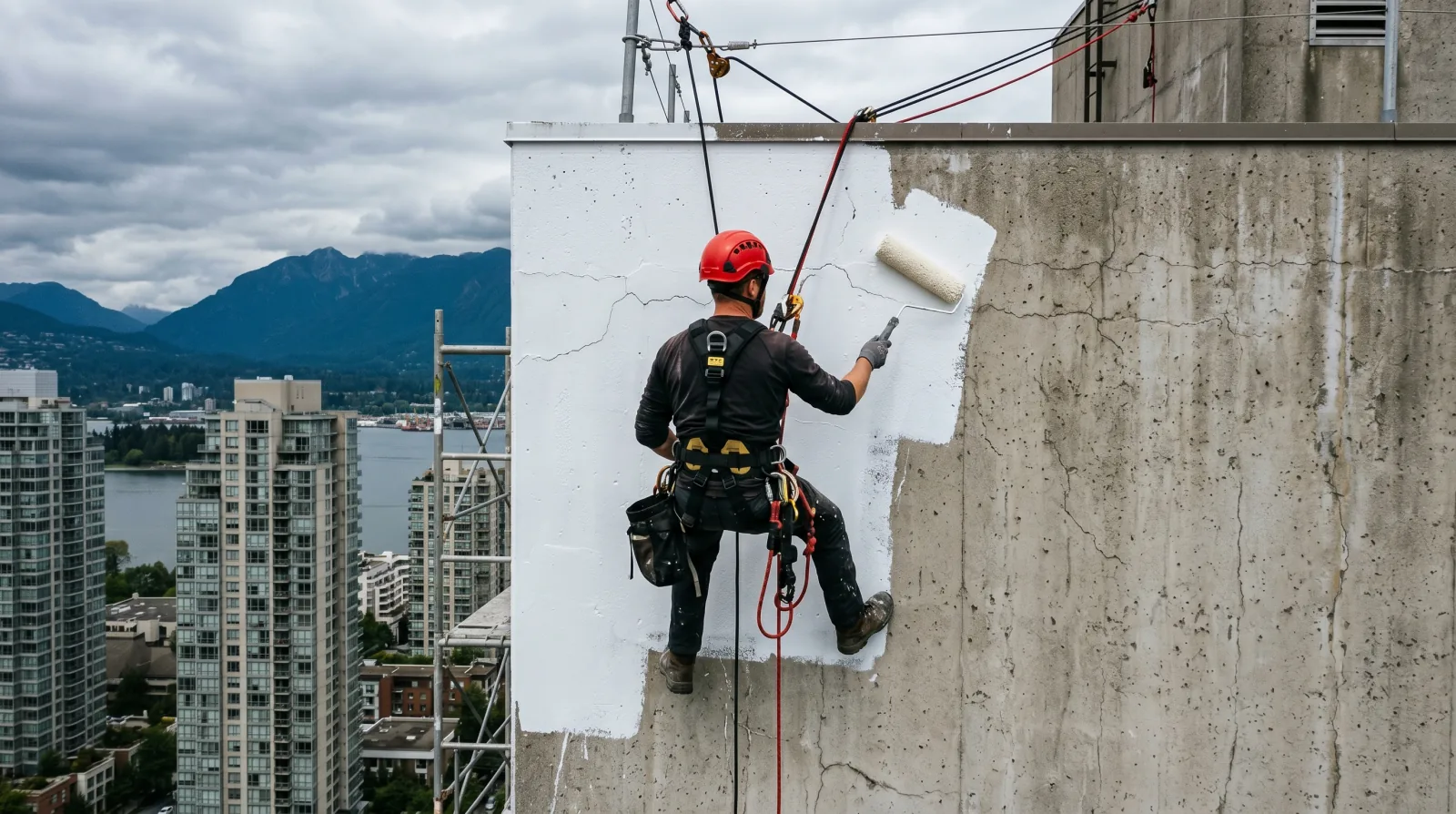
Why the resin matters more than the label
People shopping for a high-build coating on a Metro Vancouver tower often fixate on the word elastomeric and stop there. But elastomeric only tells you the film is thick and flexible enough to bridge hairline cracks. It does not tell you which resin the coating is built on, and the resin is where silicone and acrylic actually part ways. Both families are applied at 20 to 30 dry mils per coat, in two coats, and both stretch and return across the thermal cracking that ruins standard paint. Where they differ is how the film handles moisture, dirt, and sun over 15 years on a coastal wall.
Think of the resin as the part of the coating that decides its personality. An acrylic film is built from acrylic polymer particles that flow together as the water evaporates. The finished film is firm enough at the surface to shed dirt, yet flexible enough in the cold to keep bridging cracks. A silicone film uses a silicone or silicone-modified backbone that gives the surface very low energy. Water beads and rolls off it, which is the whole point. The trouble is that the same low-energy surface does not want to hold on to airborne dirt or to a future coating either, and the film tends to breathe less. Every real difference between these two products traces back to those two backbones.
Breathability: the property that decides most Vancouver jobs
A concrete or stucco wall on the BC coast is almost never fully dry. It holds construction moisture, it takes on rain before and during a coating campaign, and in winter it drives interior vapour outward through the assembly. The coating has to let that vapour escape. Acrylic elastomeric has higher vapour permeance than silicone, so it works as a breathable film: liquid rain sheds off the face while water vapour still moves out of the wall. A silicone elastomeric film has lower permeance. Put a low-perm film over a wall that still holds moisture and the vapour builds up behind it, lifts the coating, and blisters. That failure often shows within the first year, and on a high-rise it means another rope access mobilization to strip and recoat. This is the single biggest reason acrylic elastomeric is the default choice on most local towers.
Vapour permeance is measured in US perms, usually with the ASTM E96 wet-cup or dry-cup method. A higher perm number means the film lets more water vapour pass. The exact number depends on the product and how thick it goes on, so treat the ranges here as typical rather than fixed: acrylic elastomerics commonly land somewhere in the low tens of perms, while many silicone films sit in the single digits. The direction of the difference is what matters. When a wall needs to keep drying to the outside, more perms is safer. This is a building-science idea, not a sales point. A wall assembly should have a clear drying path, and the outermost layer should not be the tightest layer over a substrate that is still wet.
Vancouver's rain load is the reason this is not a small detail. The airport records about 1,189 mm of rain a year, with roughly 74 percent of it falling between October and March, from the 1991 to 2020 climate normals. Walls take on water for half the year and get few long dry spells to release it. Layer on the leaky-condo era, when a generation of local buildings trapped water in walls and paid for it in full envelope rebuilds, and you can see why a careful envelope contractor here treats outward drying as something to protect, not gamble with. For a wider look at how a breathable elastomeric compares to a clear water-repellent, see elastomeric coating versus clear sealer.
Coatings compared
Acrylic elastomeric (100% acrylic high-build)
A water-based, high-build coating made from 100% acrylic resin with a high elastomer content. The standard workhorse for stucco and concrete facades in Metro Vancouver.
Silicone elastomeric (silicone-modified high-build)
A high-build coating using silicone or silicone-modified resin. Prized for water repellency and colour hold, but with tradeoffs on breathability and cleanliness on vertical walls.
Dirt pickup and colour: what residents actually notice
Breathability is a wall-science problem. Dirt pickup is what the strata council sees from the parking lot. Many silicone elastomerics cure to a softer, slightly tacky surface, and that surface catches airborne grime, pollen, and the fine soot that comes off busy downtown Vancouver streets. On a pale wall, that shows up as vertical streaking under the windows and below any ledge within a year or two. Acrylic elastomeric cures firmer and sheds dirt more readily, so light colours stay looking clean longer between washes.
Silicone earns its keep on colour hold. Its chemistry resists UV fade better, so a dark or bright colour on a south or west elevation stays truer for longer. If a building has a strong brand colour it wants to protect, that is a real point in favour of silicone. But there are now dirt-resistant silicone formulations on the market, so if you want silicone for its water repellency on a light wall, ask the manufacturer for their dirt-pickup test data before you commit. The word to watch for is a claim without a number. A sales sheet that says low dirt pickup with no test behind it is not the same as a data sheet that reports a measured result.
Colour hold matters more on some elevations than others. A south or west face in Vancouver takes the most sun, so fade shows there first on both products, just faster on acrylic. A north face barely fades at all, so paying the silicone premium to protect colour on a north wall makes little sense. This is why the resin choice can differ by elevation on the same building, and a good specification does not assume one product must cover every face.
Water repellency and wind-driven rain
The headline strength of silicone is water repellency. It sheds liquid water harder than acrylic, which is genuinely useful on a severely exposed elevation, such as a West Vancouver or North Shore building taking wind-driven rain straight off the water. The catch is that water repellency and breathability pull in opposite directions. The same low permeance that helps silicone shed water is what raises its blistering risk over a damp wall. So the silicone advantage is real only where the substrate is confirmed dry and the exposure is severe enough to need it. On a typical Metrotown or Brentwood concrete tower with normal exposure, acrylic elastomeric already sheds rain well enough and breathes better while doing it.
The right test to ask about is ASTM D6904, the wind-driven rain practice for coatings on masonry. It pushes water at the coated surface under an air pressure that mimics wind and checks how much gets through. Cite it by its role, not by an invented pass mark: the question to a contractor is whether the specified product has been tested for wind-driven rain resistance under ASTM D6904, not what score you can quote. Note that some older coating write-ups point to ASTM E331 or other numbers for this; on a coating over masonry, ASTM D6904 is the correct reference. A full-build acrylic elastomeric passes this test comfortably for normal exposure, so wind-driven rain by itself is not usually enough to force the silicone choice. It takes severe exposure, a dry substrate, and a colour that hides dirt for silicone to be the clear pick.
The failure modes, and how each coating dies
Every coating eventually reaches the end of its life. What matters is how it gets there, because the failure mode tells you the real cost of a wrong choice. Acrylic elastomeric usually ages by chalking and fading. The surface slowly loses colour depth on the sunny faces, and after 15 years or so the film has spent its flexibility. That is a graceful failure. You wash, you prep, you recoat, and the wall is good for another cycle. Blistering is uncommon on acrylic because the film keeps letting vapour out.
Silicone has two failure modes that show up much sooner when the choice was wrong. The first is dirt streaking on light colours, which is cosmetic but real and starts in the first year or two near traffic. The second is blistering, and this one is expensive. When a low-perm silicone film goes over a wall that still holds moisture, vapour pressure builds behind the film, and the film lifts off the substrate in blisters. Once blistering starts, the only fix is to strip the failed film back to sound substrate, let the wall dry, and recoat. On a high-rise that means paying for the rope access mobilization a second time. A third failure to watch is adhesion loss on recoat: because silicone sheds things, a new coating over a cured silicone film can peel off in sheets if nobody tested the bond first.
Surface prep and what a correct specification includes
The resin choice only pays off if the prep is right, and prep is where most coating jobs are won or lost. The sequence is the same for both products: high-pressure wash to strip dirt, algae, chalk, and any loose existing coating; chip out and repair delaminated stucco or spalled concrete; treat active cracks with a filler rated for the movement; prime the bare and patched areas with the manufacturer's matched elastomeric primer, not a general paint primer; and confirm the substrate is dry before the topcoat goes on. Skip or rush any step and the film peels within a season no matter which resin you chose.
Two checks separate a real specification from a hopeful one. The first is a substrate moisture reading before coating, because the whole silicone-versus-acrylic decision hinges on how wet the wall is. The second is a bond check on any repair or overlay. ASTM C1583 is the pull-off tensile test that tells you whether a concrete surface or a patch is sound enough to hold a coating. On a recoat over an unknown or existing coating, ASTM D4541 is the portable pull-off adhesion test that uses a dolly glued to a test patch to measure how hard the film holds. A specification that names these checks and says who documents film build with a wet-film gauge is a specification you can trust. One that just lists a product name and a price is not. The spray versus roller application choice affects film build too, which is why both belong in the same conversation.
Standards and testing worth verifying
You do not need to be a chemist to read a data sheet, but you should know which tests to look for. Vapour permeance is reported from ASTM E96 wet-cup or dry-cup water vapour transmission testing, in US perms. Flexibility and elongation, which drive crack bridging, come from the ASTM D522 mandrel bend test. Wind-driven rain resistance over masonry is ASTM D6904. Bond of a repair or overlay comes from ASTM C1583 on concrete and ASTM D4541 for coating pull-off. Those five cover the properties that decide this choice.
Anti-carbonation coatings are a different family with their own European classification under EN 1062-1 and CO2 permeability under EN 1062-6. Those standards are about slowing carbon dioxide from reaching the steel inside reinforced concrete, which is a real concern on some structures but a separate topic from the breathability question here. Do not let a sales pitch mix them up. If carbonation protection is the goal, that is its own discussion, covered in anti-carbonation versus elastomeric coatings. For the silicone-versus-acrylic decision on a normal facade, water vapour permeance under ASTM E96 is the number that matters, not a CO2 rating.
Cure speed and the Vancouver weather window
Both coatings are water-based, so both need dry conditions to cure. The rule of thumb on the coast is air and surface temperature above about 5 degrees Celsius and no rain for several hours after application, with the exact window set by the product data sheet. Between October and March, when most of the year's rain falls, that window is often a few hours in the late morning before the next rain cell moves in. Acrylic reaches a rain-resistant state faster, so a crew can coat a face and protect it inside a shorter dry spell. Silicone's slower cure needs a longer clear window, which is harder to find in a Vancouver winter and can stretch the campaign across more days.
This is a scheduling cost, not just a chemistry note. On a high-rise, crews follow the weather around the building: coat the sheltered east face while a system passes, move to the south face on the next dry day, and cover fresh work if rain arrives early. A faster-curing acrylic gives the crew more usable windows in the same month, which shortens the rope access campaign. On a tight schedule in a wet month, that alone can tip the choice toward acrylic even before the moisture and colour questions come in.
Cost drivers and lifecycle reasoning
Silicone elastomeric costs more per unit of material than acrylic, and it cures slower. On a high-rise, the slower cure is often the bigger cost, because most of your money on a tower goes to getting crews and product to the wall safely, not to the coating in the pail. A slower cure can mean holding a rope access drop longer or coming back for a second pass, and that time adds up across dozens of drops. Never treat the price per pail as the cost of the job.
Over a full service life, both products can reach 15 to 20+ years when applied correctly on a sound wall, so neither has a clear lifecycle edge from lifespan alone. The lifecycle risk sits in the failure modes. An acrylic film that chalks and fades gives you a planned, predictable recoat. A silicone film that blisters over a damp wall gives you an unplanned strip-and-recoat, sometimes within the first year, at full mobilization cost. When you weigh total cost over 20 years, the safer resin is usually the one less likely to force an early, unbudgeted return trip. That is why the default on a typical coastal wall leans acrylic even though both quote similar lifespans.
For a strata, this connects to the depreciation report required under the Strata Property Act. That report should carry the facade coating as a real asset with a real replacement date, so the council can fund the next recoat instead of being surprised by it. When you plan the reserve, the honest input is the expected service life on your specific walls, not the best-case number on a data sheet. A coating that blisters in year two does not just cost the strip-and-recoat. It resets the depreciation schedule, drains the contingency, and often triggers a special levy that residents did not see coming. Choosing the resin that matches the wall is a reserve-fund decision as much as an engineering one.
There is one more cost driver that is easy to miss: the number of return mobilizations built into the plan. Two elevations coated this year and two next year is two mobilizations, not one, and each carries its own rope access setup and safety cost. If the budget forces a phased approach, phase it by elevation and by risk. Coat the wettest, most exposed face first with the safer breathable product, and hold the sheltered faces for the next funding cycle. That captures most of the protection while it spreads the outlay, and it keeps the same resin across the building so the recoat later stays simple.
Warranty reality and what each coating cannot do
Read the warranty for what it excludes, not what it promises. Most coating warranties cover the material, not the labour to reapply it, and almost all of them exclude failure caused by moisture in the substrate or by inadequate prep. That matters here: if a silicone film blisters over a wall that was never confirmed dry, the manufacturer will point to the moisture exclusion and the warranty will not pay for the rope access to strip and recoat. A warranty is only as strong as the prep and the moisture check behind it.
Neither coating is a waterproofing system. A high-build elastomeric protects the broad face of the wall, but it does not seal window perimeters, panel joints, and penetrations, which is where most water actually enters a building. Coating a wall and leaving failed sealant open just traps joint water behind the new film. Neither product fixes cracks wider than roughly 2 mm; those need routing and filling or concrete repair first. Neither replaces a proper membrane on a horizontal or ponding surface. And neither will save a wall that is failing structurally behind the finish. The coating is the last layer, not the whole envelope.
How to read a contractor's coating proposal
A good proposal names the product and its data sheet, states the specified dry film thickness and how it will be verified, describes the full prep sequence, and includes a substrate moisture check before coating. It should say which elevations get which resin if that varies, and it should schedule a sealant inspection alongside the coating. A weak proposal quotes a lump sum, names a generic elastomeric, and stays silent on prep, moisture, and film build. The silence is the warning. Under Vancouver's climate a coating over an unchecked, possibly damp wall is a coin flip, and the proposal that skips the moisture reading is the one most likely to blister.
Four Metro Vancouver scenarios
The right call changes with the building. Here are four realistic situations and the honest recommendation for each.
1980s concrete high-rise, West End, active hairline cracking, one wet north elevation
Situation: A older concrete tower with hairline cracking across several faces and a north elevation that reads damp on a moisture meter, likely from years of rain and slow drying.
Call: Acrylic elastomeric on all faces.
Why: The damp north wall settles it. A low-perm silicone film there would trap vapour and blister. Acrylic bridges the cracks just as well and keeps the wall drying outward. Using one breathable product across the building also simplifies the recoat later.
Wood-frame and EIFS four-storey strata, North Shore
Situation: A mid-rise strata with stucco over wood framing and some EIFS panels, in a high-rain North Vancouver setting.
Call: Acrylic elastomeric, full stop.
Why: Wood-frame and EIFS assemblies must dry to the outside. The breathable acrylic film keeps that path open. A silicone film could slow outward drying and push moisture back into the sheathing. This is exactly the kind of wall that the leaky-condo era taught the industry not to seal too tight.
Exposed West Vancouver waterfront tower, dark colour, taking wind-driven rain off the water
Situation: A tall concrete tower right on the water in West Vancouver, in a deep charcoal colour, taking severe wind-driven rain. Concrete tests dry.
Call: Silicone elastomeric is the honest first pick here.
Why: All three conditions line up. The exposure is severe, so the harder water shedding earns its keep. The concrete is confirmed dry, so the low permeance is not a risk. The colour is dark and the wall is high above street soot, so dirt streaking will not become a complaint, and the better UV colour hold protects the charcoal. This is the case silicone was made for.
Downtown Metrotown or Brentwood tower, pale colour, street soot
Situation: A concrete high-rise near busy Burnaby streets, finished in a light off-white, with normal exposure.
Call: Acrylic elastomeric.
Why: Silicone would streak with traffic soot on a pale wall within a year or two, and the exposure is not severe enough to need silicone's extra water shedding. Acrylic sheds rain well enough, stays cleaner on the light colour, and costs less. There is no case for the premium here.
Questions to ask before you approve the scope
Put these to any contractor before you sign. The answer, and how readily they give it, tells you as much as the price.
- Which resin are you specifying, and why for this building? Red flag: a generic elastomeric with no reason tied to your wall's moisture, exposure, and colour.
- Did you take a substrate moisture reading, and what did it show? Red flag: no moisture check, or a plan to use silicone without one.
- What dry film thickness is specified, and how will you verify it on the wall? Red flag: no number and no mention of wet-film gauges or coverage tracking.
- Has the product been tested for wind-driven rain under ASTM D6904 and vapour permeance under ASTM E96? Red flag: quoting E331 for wind-driven rain, or having no data sheet at all.
- If this is a recoat, will you run an ASTM D4541 pull-off bond test on a cured patch first? Red flag: coating over an existing or unknown film with no adhesion test, especially over silicone.
- Does the scope include a sealant inspection and replacement at windows and joints? Red flag: coating only, sealant left out.
- Are you specifying the same resin on every elevation, or does it vary by exposure and colour? Red flag: no thought given to the difference between a sunny south face and a damp north one.
- What does the warranty exclude, and who pays the labour if it fails? Red flag: a warranty that covers material only and excludes moisture-related failure without anyone flagging it.
- Are your rope access crews IRATA or SPRAT certified per WorkSafeBC Part 34? Red flag: vague answers about access safety on a high-rise.
Decision framework: which coating for your wall
| Situation | Recommendation | Reason |
|---|---|---|
| Substrate still holds moisture or is hard to dry? | Acrylic elastomeric | Its higher vapour permeance lets the wall keep releasing moisture. A low-perm silicone film over a damp concrete or stucco wall traps vapour and blisters. |
| Light colour on a street-facing downtown tower? | Acrylic elastomeric | Silicone picks up airborne dirt and traffic soot faster, so a white or pale wall streaks sooner. Acrylic stays cleaner between washes. |
| Severe wind-driven rain, colour hold is the priority? | Consider silicone | Silicone sheds water and holds colour under strong UV longer. Worth the premium on an exposed face, but only over a confirmed-dry substrate. |
| Tight weather window, need faster cure? | Acrylic elastomeric | Acrylic cures faster between rain cells. Silicone's slower cure lengthens the campaign in a Vancouver October or February. |
| Budget is the constraint? | Acrylic elastomeric | Acrylic elastomeric costs less per square foot in material and gives 15+ years on a sound wall. The silicone premium only pays off in narrow cases. |
| Active hairline cracking present? | Either, if rated for it | Both are high-build elastomerics that bridge hairline cracks up to roughly 2 mm. Crack bridging is not the deciding factor here; breathability, dirt, and UV are. |
| Dark or bright brand colour on a full-sun south or west face? | Consider silicone | Silicone holds strong colour under UV longer than acrylic. If protecting a deep colour matters and the wall is dry, the premium can pay off. |
| Recoating an existing silicone-coated wall? | Test the bond first | Acrylic does not always stick over cured silicone. Run an ASTM D4541 pull-off test on a cured patch before you commit the whole facade. |
| Wood-frame or EIFS wall on the North Shore? | Acrylic elastomeric | These assemblies must dry outward. A breathable acrylic film keeps that drying path open; a low-perm silicone film can trap moisture in the sheathing. |
| High, wind-exposed waterfront tower, colour is dark? | Silicone can win | Severe wind-driven rain plus dark colour plus a confirmed-dry concrete wall high above street soot is the one case where silicone is the honest first pick. |
Where this fits with the rest of the coating decision
Choosing between silicone and acrylic elastomeric is one step inside a larger call. Before you get to resin, you have to decide whether you need a high-build elastomeric at all, which is the question in elastomeric coating versus acrylic paint. If the wall mainly needs water repellency without a film, a clear sealer may be the answer instead, covered in elastomeric versus clear sealer. The full set of these comparisons lives in the exterior coatings resource hub.
Any coating campaign on a Metro Vancouver tower should run alongside a sealant inspection and replacement, because failed joints let water in behind even the best film. Where a wall shows staining or damp, the assembly needs a proper look through our building envelope repair scope before anything gets coated. For the prep, priming, film-build monitoring, and how we choose the resin for a specific building, see our exterior coatings service page.
Quick answers
What is the difference between silicone and acrylic elastomeric coatings on a concrete building?
Both are thick, high-build, crack-bridging coatings, so they behave the same way over the hairline cracks that form on a moving concrete or stucco wall. The difference is in the resin. Acrylic elastomeric breathes better, meaning it lets water vapour move out of the wall, and it stays cleaner because its cured surface is firmer. Silicone elastomeric repels liquid water better and holds its colour longer under strong sun, but it breathes less and tends to pick up dirt faster on a vertical face. On most Metro Vancouver stucco and concrete towers, the breathability of acrylic is the deciding advantage because our walls carry a lot of rain moisture.
Which lasts longer on a Vancouver high-rise, silicone or acrylic elastomeric?
Both deliver 15 to 20+ years of service on a sound, properly prepared vertical facade on the BC coast when applied at full film build. The practical difference is not total lifespan but how they age. A silicone film tends to hold its colour and gloss longer under UV, so a south or west elevation may look fresher for longer. An acrylic film may fade a little sooner on tinted colours, but it stays cleaner and is far less likely to blister on a wall that still holds moisture. On a coastal building where the wall is rarely bone dry, that lower blistering risk usually makes acrylic the longer-lasting choice in practice.
Does silicone elastomeric coating get dirty faster than acrylic?
On a vertical wall, yes, unless the product is a specific dirt-resistant silicone formulation. Many silicone elastomerics cure to a lower surface hardness, which leaves a slightly tacky film that catches airborne grime, pollen, and traffic soot. On a downtown Vancouver tower near busy streets, that shows up as streaking on light colours within the first year or two. Acrylic elastomeric cures firmer and sheds dirt better. If you want silicone for its water repellency but the wall is a pale colour on a street-facing elevation, ask the manufacturer specifically about dirt-pickup resistance and look for their test data, not just the sales claim.
Silicone vs. acrylic elastomeric questions
What is the difference between silicone and acrylic elastomeric coatings on a concrete building?
Both are thick, high-build, crack-bridging coatings, so they behave the same way over the hairline cracks that form on a moving concrete or stucco wall. The difference is in the resin. Acrylic elastomeric breathes better, meaning it lets water vapour move out of the wall, and it stays cleaner because its cured surface is firmer. Silicone elastomeric repels liquid water better and holds its colour longer under strong sun, but it breathes less and tends to pick up dirt faster on a vertical face. On most Metro Vancouver stucco and concrete towers, the breathability of acrylic is the deciding advantage because our walls carry a lot of rain moisture.
Which lasts longer on a Vancouver high-rise, silicone or acrylic elastomeric?
Both deliver 15 to 20+ years of service on a sound, properly prepared vertical facade on the BC coast when applied at full film build. The practical difference is not total lifespan but how they age. A silicone film tends to hold its colour and gloss longer under UV, so a south or west elevation may look fresher for longer. An acrylic film may fade a little sooner on tinted colours, but it stays cleaner and is far less likely to blister on a wall that still holds moisture. On a coastal building where the wall is rarely bone dry, that lower blistering risk usually makes acrylic the longer-lasting choice in practice.
Does silicone elastomeric coating get dirty faster than acrylic?
On a vertical wall, yes, unless the product is a specific dirt-resistant silicone formulation. Many silicone elastomerics cure to a lower surface hardness, which leaves a slightly tacky film that catches airborne grime, pollen, and traffic soot. On a downtown Vancouver tower near busy streets, that shows up as streaking on light colours within the first year or two. Acrylic elastomeric cures firmer and sheds dirt better. If you want silicone for its water repellency but the wall is a pale colour on a street-facing elevation, ask the manufacturer specifically about dirt-pickup resistance and look for their test data, not just the sales claim.
Is a breathable coating important on a concrete or stucco wall in Vancouver?
It is one of the most important properties for our climate. A concrete or stucco wall on the BC coast almost always carries some moisture, from construction water, from rain that got in before the coating went on, or from vapour driving through from the warm interior in winter. If the coating cannot let that vapour escape, the moisture builds up behind the film, the pressure lifts the coating off the wall, and you get blistering and peeling, often within the first year. Acrylic elastomeric has higher vapour permeance than silicone, so it lets the wall keep breathing. This is why applying any low-perm coating over a damp substrate is a known way to waste strata funds.
When is silicone elastomeric worth the extra cost over acrylic?
Silicone elastomeric costs more per square foot and cures slower, so it needs a reason to justify the premium. The strongest case is a highly exposed elevation, such as a West Vancouver or North Shore building taking severe wind-driven rain off the water, where the coating's job is to shed as much liquid water as possible and hold its colour under strong sun for as long as possible. Even then, it only makes sense if the substrate is confirmed dry and does not need much vapour movement, and if the colour is dark enough or the wall is high enough that dirt streaking will not be a visible complaint. Outside those conditions, acrylic elastomeric gives you the same crack bridging and the same 15+ year service at a lower cost with less blistering risk.
Can you recoat a silicone elastomeric wall with acrylic, or the other way around?
Recoating across resin types needs an adhesion check first. Acrylic does not always bond well over a cured silicone surface, because silicone films are designed to shed things, including new coatings. Going the other way, silicone over acrylic, is generally more forgiving but still needs the existing film to be sound and clean. Before committing a full facade, a competent contractor applies a test patch, lets it cure, and checks the bond by hand and with a simple adhesion test. On a Vancouver high-rise where recoating means another rope access mobilization, spending a day on a test patch is far cheaper than discovering a bond failure across the whole wall a season later.
Do both coatings bridge hairline cracks the same way?
For practical purposes on a stucco or concrete facade, yes. Both silicone and acrylic elastomerics are high-build systems applied at many times the thickness of standard paint, and both are formulated to stretch and return across hairline cracks up to roughly 2 mm wide through thousands of thermal cycles. Crack bridging is a function of film build and elongation, and both product families are tested for it under ASTM D522 mandrel bend. That is why crack bridging is usually not the factor that decides between them. The decision comes down to breathability, dirt pickup, UV colour hold, cure speed, and cost, which is where the two resins actually differ.
What does wind-driven rain resistance mean and which standard tests it?
Wind-driven rain is rain pushed against the wall by wind, which forces water into the smallest openings in the coating and the wall. The correct test for a coating over masonry is ASTM D6904, the Standard Practice for Resistance to Wind-Driven Rain for Exterior Coatings Applied on Masonry. It sprays water at the coated surface under an air pressure that simulates wind and checks how much passes through. Silicone tends to shed this water hardest, which is why it is worth a look on a very exposed West Vancouver or waterfront elevation. On most Metro Vancouver towers with normal exposure, a full-build acrylic elastomeric already passes this test comfortably, so wind-driven rain alone rarely forces the silicone choice.
Why does Metro Vancouver rain change which coating I should pick?
Vancouver gets roughly 1,189 mm of rain a year, and about 74 percent of it falls between October and March, based on the 1991 to 2020 climate normals at Vancouver International Airport (see the Environment and Climate Change Canada climate normals). That means walls stay wet for months at a time and rarely dry out fully in winter. A wall that holds this much moisture needs a coating that lets vapour keep moving outward, which points to acrylic. The leaky-condo era of the 1980s and 1990s left many local buildings with a hard lesson about trapping water in walls, so the safe default here leans toward the more breathable film unless the substrate is confirmed dry.
Can I use silicone elastomeric over an EIFS or wood-frame stucco wall?
Be careful. EIFS and wood-frame stucco assemblies are designed to dry toward the outside, so the outer face needs to stay vapour-open. A low-perm silicone film can slow that outward drying and let moisture build up in the foam or the sheathing behind it. On the North Shore, where these mid-rise strata buildings are common and rain exposure is high, an acrylic elastomeric that keeps the drying path open is the safer specification. If someone proposes silicone on a wood-frame wall, ask them to explain in writing how the wall will still dry, and get a moisture reading of the assembly before any product goes on.
Does rope access change the cost math between the two coatings?
It can. On a high-rise, most of the labour cost is getting people and product to the wall safely, not the coating itself. WorkSafeBC OHS Regulation Part 11 requires fall protection at 3 m (10 ft) or more, and Part 34 governs rope access and accepts IRATA or SPRAT certification (see the WorkSafeBC rope access regulation). Silicone cures slower, so crews may hold a drop longer or come back for a second pass, which adds rope access time. If the coating blisters and has to be stripped and redone, you pay for the whole mobilization twice. That is why picking the resin that will actually stay on the wall matters more than the price per pail.
Not sure whether your tower needs silicone or acrylic elastomeric?
We check substrate moisture, exposure, existing coating condition, and colour before we specify a resin, on stucco and concrete towers across Vancouver, Burnaby, North Vancouver, and West Vancouver, so the coating you pay for actually stays on the wall.