Spray vs. roller and brush application for exterior coatings on Vancouver high-rises
Spraying covers a large open wall fast, but it atomises the coating, and that mist drifts onto cars, windows, and neighbours, which is why it is a poor fit for occupied strata and tight downtown sites. Roller and brush application is slower on open walls but produces a consistent film with no overspray, handles detail cleanly, and pairs naturally with rope access. Both methods hit the specified film build only if wet-film thickness is checked as the work goes, and any sprayed coat should be back-rolled to level it.
For most occupied Metro Vancouver buildings, the answer is hand application: a downtown strata tower with residents\' cars in the lot, a North Shore mid-rise full of window and balcony detail, or a single-elevation recoat on rope access. Spray earns its place on the opposite kind of job: a large, open, low-occupancy elevation with no neighbours in drift range, already set up on swing stage, where speed is the honest advantage. The rest of this page walks through how each method builds a film, why Vancouver changes the answer, and what to check in a contractor\'s proposal.
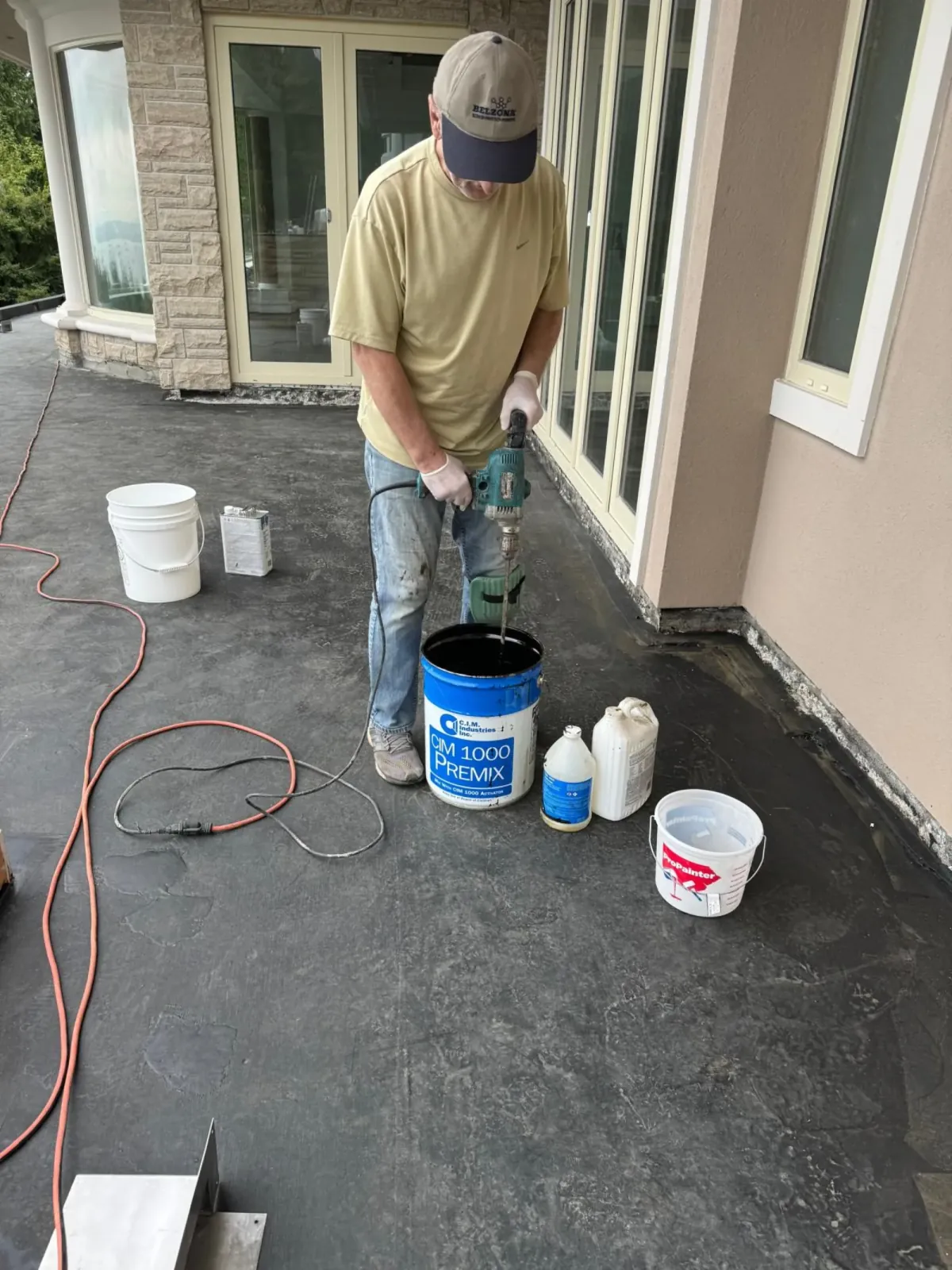
The real question is occupancy, not speed
People assume spraying is the professional choice because it is fast, and on the right job it is. But speed is only one factor, and on a Metro Vancouver strata building it is rarely the one that decides. The decision usually comes down to whether the building is occupied and how close the neighbours and parking are. Spray atomises the coating into a fine mist, and any mist that misses the wall drifts on the wind. On a busy downtown lot, that drift reaches cars, windows, balconies, and the building next door. Roller and brush application removes that problem completely, because nothing atomises and nothing drifts. That is why hand application is the default on occupied buildings, even though it is slower on the open field.
The way to think about it is to start from the site and the people, not from the tool. Ask who is living or working behind the wall, what sits within drift range, and how the crew will get to the surface. Those answers point to the method far more reliably than any claim that one technique is simply better than the other. A method that is right for a vacant Richmond warehouse can be exactly wrong for an occupied downtown tower two bridges away.
How spray atomisation and back-rolling actually work
In spray application, coating is forced through a small opening at high pressure so it breaks into a cloud of tiny droplets. Those droplets travel to the wall and land as a wet film. Because the material is broken up and moving through air, three things happen at once: it covers area quickly, some of it never reaches the wall, and it is easily pushed off course by wind. A high-build elastomeric coating is thick and full of solids, so the gun has to work harder and the pattern has to be controlled carefully to lay down an even film rather than a run here and a thin patch there.
Back-rolling is the step that makes sprayed high-build coatings reliable. Right after the spray pass, while the coating is still wet, an applicator runs a roller over it. That does two jobs. It works the coating down into the texture, pores, and pinholes of stucco or concrete so the film is continuous, and it levels the surface so runs and sags are pulled out. Back-rolling also gives the crew a direct feel for the build. If a spot rolls out too easily, it is thin, and they add material. Spraying without back-rolling is where sprayed jobs go wrong: the wall looks covered, but the film is uneven and the performance is not there.
How roller and brush hand application builds a film
Hand application puts the material on the wall directly. A loaded roller presses coating into the surface and spreads it across the field, and a brush carries it into corners, along frames, at rail bases, and into any detail a roller cannot reach cleanly. Because the applicator is in contact with the wall the whole time, they feel resistance change as the film builds, see lap marks and holidays as they form, and correct them before the coating sets. Nothing is lost to the air, so almost all of the product ends up where it is meant to be.
The trade is time. Rolling and brushing a big open wall takes more hours than spraying it. But on a real building broken up by windows, balconies, soffits, and trim, much of the wall is detail, and detail is slow to mask for spray and quick to cut by brush. So the honest speed gap between the two methods is widest on a bare open elevation and narrowest on a detailed one. On an occupied Vancouver facade with plenty of openings, hand application is often close on time and clearly ahead on cleanliness and film control.
Why Metro Vancouver changes the answer
Local conditions push the choice toward hand application more often than they would in a drier, more open market. Four things drive that.
First, the building stock. Much of the high-rise work here is dense, occupied strata: people are home during the day, their cars are in the lot, and their balconies and windows sit right on the wall being coated. There is no good day to rain overspray on an occupied building.
Second, the lots. Downtown Vancouver and central Burnaby sites are tight, packed in next to parking structures, sidewalks, and neighbouring towers. On a lot like that, drift has somewhere to land within seconds, and the neighbour is close enough that a gust reaches their glass.
Third, the weather. Vancouver gets about 1,189 mm of precipitation a year, and roughly 74 percent of it falls between October and March (1991 to 2020 climate normals, Vancouver International Airport). That makes the dry coating window short through much of the year, and it puts a premium on a method that keeps working through changeable conditions. Spray also loses more hours to wind, because wind-driven rain and gusts off the water carry atomised mist off the wall.
Fourth, the local trade. This is a rope-access-heavy market. A large share of high-rise facade work here is done by IRATA and SPRAT technicians on rope, and rope access pairs naturally with roller and brush, not with spray. So the way the work is actually accessed in Vancouver already tilts toward hand application.
The failure modes that cost you
Three failures show up again and again, and all three are avoidable.
Overspray on property. Mist lands on residents\' cars, on windows and balcony rails, on the sidewalk, and on the neighbour\'s building and vehicles. Dried elastomeric on a car finish or a pane of glass is a real cleanup and repair problem, and on a tight lot the neighbour is within reach on any windy day. This is a liability, not just an inconvenience, and it can wipe out the entire cost saving that spray was supposed to deliver.
A sprayed-only film that hides its own defects. Without back-rolling and gauge checks, a sprayed wall can look fully covered while carrying thin spots, runs, and sags. The problem does not show up on handover day. It shows up a year or two later as uneven weathering, early chalking, or a patch that fails first.
Thinning the product to stretch coverage. High-build coatings are priced by the volume needed to reach the specified film. Thinning the material or spreading it too far lets a crew cover more area with less product, which looks like a saving and is actually a defect: the film goes on below spec and loses the crack-bridging and water resistance you paid for. This can happen with either method, but a fast spray pass makes it easier to hide.
Access method decides more than people expect
The application method and the access method are chosen together, not separately, because they constrain each other. Spraying from rope access is awkward: a technician on rope has to manage the gun, the material hose, and any containment while suspended, and controlling drift from that position is hard. So spray jobs generally go on a swing stage, where a stable platform lets a crew handle the equipment and masking together. Rope access, by contrast, suits roller and brush work. A technician can roll a drop and brush the detail cleanly, which fits single-elevation recoats and detail work on occupied buildings.
Many full-building recoats use both. Rope access and hand application on the tight and detailed areas, swing stage and spray plus back-roll on the large open runs. The point is to scope each face to what it needs rather than force one method across the whole building. All of this work runs under WorkSafeBC OHS Regulation Part 34 for rope access, with fall protection duties under Part 11, which requires fall protection at 3 m (10 ft) or more, using IRATA or SPRAT certified technicians. For how we rig and run this work, see our rope access building maintenance service.
Methods compared
Spray application
The coating is atomised through a gun and driven onto the wall as a fine mist, then usually back-rolled to work it into the surface and even out the film. Fast on large open field areas.
Roller / brush application
The coating is applied by hand: rollers on the open field and brushes at edges, corners, and detail. Slower per square foot, but every part of the wall is worked directly by the applicator.
Surface prep and what a correct spec includes
The method matters, but neither spray nor roller saves a job that skips prep. Whatever the application, the wall has to be pressure washed clean of dirt, algae, chalk, and loose coating, cracks and defects repaired, bare and patched areas primed, and the substrate confirmed dry before the topcoat goes on. Coating over a dirty or damp wall fails the same way no matter how the product is applied.
A correct spec then tells the crew how to prove the film is right. It names the manufacturer\'s wet-film and dry-film thickness targets, and it calls for wet-film thickness monitoring with a wet-film comb pressed into the fresh coat as the work goes. It calls for coverage-rate tracking, meaning the volume of product used is checked against the area covered, so the crew catches a wall that is going on thin before the coat cures. Elastomeric high-build systems are applied at many times the film thickness of standard paint, so hitting that build is the whole point of the product. A spec that is silent on film thickness monitoring is leaving the most important outcome to chance.
Standards and testing to verify
The reason film build matters ties directly to the tests these coatings are rated against, and those tests are worth naming when you evaluate a product. Wind-driven rain resistance for exterior coatings on masonry is measured under ASTM D6904, and that resistance depends on a continuous film at full thickness. Flexibility and elongation, which is what lets a coating stretch across a hairline crack without splitting, is measured by a mandrel bend test under ASTM D522, and a film applied below spec loses that stretch. Adhesion, how well the coating holds to the wall, can be checked with a pull-off test under ASTM D4541 using a dolly bonded to the surface. You do not need to memorise these, but a proposal that references the product\'s tested performance and a plan to hit the film build behind it is a proposal that understands what it is selling.
Cost drivers, without the dollar figures
Anyone quoting a flat per-square-foot rate for a method is guessing, because the real cost moves with the building. On the spray side, the things that move price are the amount of masking and containment the site needs, the number of wind holds the exposure forces, the share of product lost to overspray, and the risk premium for possible overspray damage. On the hand-application side, the main driver is labour hours, which rise with wall area and fall with the amount of detail, since detail is slow to mask for spray anyway. Access is a driver for both: rigging rope on a single elevation is quick, while mobilising a swing stage is a bigger setup. The honest way to price is against the specific building, its occupancy, its site constraints, and its access, not against a method rate.
Warranty reality
Coating warranties assume the product went on at the specified film build. If the film is below spec, whether from thinning the product, spreading it too far, or spraying without back-rolling, the coating cannot perform as tested, and the warranty behind that performance is effectively void even if the paperwork still exists. A manufacturer can decline a claim when the film thickness on the wall does not match the specification. That is why documented wet-film thickness monitoring is not paperwork for its own sake: it is the evidence that the coating was applied the way the warranty depends on. Ask for that documentation as part of closeout on any coating campaign.
What each method cannot do
Spray cannot be run cleanly on a tight, occupied, or windy site without heavy containment, and even then the drift risk never fully goes away. It cannot handle fine detail without masking that cancels its speed advantage, and it is a poor fit for rope access. Hand application cannot match spray\'s speed on a large, bare, open wall, so on a vacant elevation with no neighbours it is the slower and more expensive choice. Neither method fixes what is wrong under the coating: failed sealant joints, cracked flashing, active structural cracks, or a wet wall all need repair before any coating goes on. The application method is a means to a consistent film at spec, and it cannot substitute for the prep and the repairs underneath it.
How to read a contractor\'s proposal for application method
A proposal you can trust states the method plainly for each elevation and does not leave it vague. If any face is to be sprayed, the proposal confirms the coats will be back-rolled and describes the overspray protection plan: the masking and screening, and a wind speed at which spray work stops and the crew covers up. It states how wet-film thickness will be measured and documented and what coverage rate the product needs per square foot. It names the access method, rope access or swing stage, and confirms IRATA or SPRAT certified technicians working under WorkSafeBC rules. It confirms insurance that covers overspray damage to third-party property. When a proposal is silent on overspray protection, film thickness monitoring, or back-rolling, that silence is the warning sign, and you should ask for each item in writing before you approve the scope. For the full coating process end to end, see our exterior coatings service page, and for how coating fits a wider repair scope, our building envelope repair service.
Four Metro Vancouver scenarios
Occupied downtown Vancouver strata tower, full parking
Situation A concrete tower on a tight downtown lot. Underground and surface parking are full of residents' cars, the building is fully occupied, and the property line sits a few metres from the neighbour's wall and their parked vehicles.
Recommended call Roller and brush, mostly on rope access.
Honest reason On a lot this tight, any spray mist that misses the wall has somewhere to land: a resident's car, a neighbour's window, the sidewalk. Even with masking and screening, a gust can carry it past the site. Hand application removes that risk completely, keeps setup light where there is no room for containment, and lets residents keep parking through the campaign. This is the textbook case for rolling and brushing.
Vacant warehouse elevation in Richmond, open field
Situation A large low-rise industrial building in Richmond with long, tall, mostly windowless walls. The building is vacant or lightly used, the lot is wide open, there is no parking against the wall, and the nearest neighbour is well across the yard.
Recommended call Spray plus back-roll from swing stage or boom.
Honest reason This is where spray honestly wins. The wall is one big open field with almost no detail to mask, nobody is living behind it, and there are no cars or neighbours in drift range. Spraying covers the area fast and back-rolling right behind the gun keeps the film even. The speed advantage is real here because none of the constraints that usually cancel it are present.
North Vancouver mid-rise, occupied, heavy detail
Situation An occupied mid-rise on the North Shore with lots of window area, deep balconies, railings, soffits, and trim. Residents are home during the day and the building has landscaping and visitor parking close to the walls.
Recommended call Roller and brush.
Honest reason A wall this broken up by openings would need heavy masking to spray safely, and the masking labour cancels the speed. A brush cuts clean lines at the frames and rail bases and a roller carries the field, so the detail and the open areas are handled in one pass with no mist near the occupied balconies. Hand application is both cleaner and, once you count the masking, competitive on time.
Single south elevation recoat, occupied Burnaby tower, rope access
Situation One weathered south-facing elevation on an occupied Burnaby high-rise needs a recoat. The other faces are in good shape. Access is by rope, not swing stage, and the campaign has to stay light and quick with residents in place.
Recommended call Roller and brush on rope access.
Honest reason A single-face recoat is a distributed scope that fits rope access well. Rigging one elevation on rope is faster than mobilising a swing stage, and a technician on rope can roll the field and brush the detail cleanly. Trying to spray from rope here would mean fighting the gun, the hose, and the containment on the drop, with residents' windows and cars below. Rolling is the controlled choice.
Decision framework: which method for which building
| Question | Recommendation | Reason |
|---|---|---|
| Building is occupied strata or commercial? | Roller / brush | No atomised coating means no overspray on residents' cars, windows, or balconies. This is usually the deciding factor on an occupied building. |
| Tight downtown site next to parking and neighbours? | Roller / brush | Spray drift in wind reaches neighbouring property and vehicles. Hand application removes the drift problem entirely on a constrained site. |
| Large open field on a tall, low-occupancy elevation? | Spray + back-roll | Spray covers open wall fast, and back-rolling keeps the film consistent. Away from people and cars, the speed advantage is real. |
| Lots of detail: windows, balconies, transitions? | Roller / brush | Detail areas need heavy masking to spray safely, which erases the speed gain. Hand application handles edges and transitions cleanly. |
| Access is by rope, not swing stage? | Roller / brush | Managing a spray gun, hose, and containment from rope access is awkward. Rolling and brushing from rope is controlled and clean. |
| Exposure is windy most of the workday? | Roller / brush | Spray loses more hours to wind holds because the mist drifts off target. Hand application keeps working in wind that would stop a spray gun. |
| Film build consistency must be documented? | Either, if monitored | Both methods hit spec if wet-film thickness is checked as the work goes. Spray without back-rolling and gauge checks is where consistency slips. |
| Recoat of a single elevation on an occupied tower? | Roller / brush on rope | A single-face recoat is a light, distributed scope that suits rope access and hand application, with no containment or overspray to manage. |
| Vacant industrial building, big open elevations, no neighbours? | Spray + back-roll | Open field, no cars, no residents, and no adjacent property to protect. This is where spray plus back-roll earns its speed honestly. |
| Full-building recoat with both open and detailed faces? | Often both methods | Swing stage and spray on the big open runs, rope access and hand application on the tight and detailed areas. Scope each face to what it needs. |
Questions to ask before you approve the scope
If you manage a strata or own the building, these are the questions that separate a proposal you can rely on from one that will cause problems later. Get the answers in writing.
- Which method on each elevation, and why? A vague answer or one method forced across the whole building regardless of occupancy or detail is a red flag.
- If spraying, what is the overspray protection plan? There should be a written plan for masking, screening, and covering resident property. No plan is a red flag on an occupied site.
- At what wind speed does spray work stop? A firm stop-work threshold should be stated. "We watch the weather" without a number is not good enough.
- Will sprayed coats be back-rolled? The answer should be yes for high-build elastomeric. If back-rolling is not mentioned, ask why.
- How will wet-film thickness be measured and documented? Expect a wet-film comb during application and records at closeout. "It will look right" is a red flag.
- What coverage rate does the product need per square foot? If they cannot state it, they cannot prove the film went on at spec, which puts the warranty at risk.
- What is the access method, and are the technicians certified? Rope access or swing stage should be named, with IRATA or SPRAT certification under WorkSafeBC rules.
- Do you carry insurance for overspray damage to third-party property? Ask to see proof before any spray work starts, especially on a tight lot next to neighbours.
- What documentation do I get at closeout? Film thickness records and product data support any future warranty claim. No records is a red flag.
For related coating decisions, compare elastomeric coating versus acrylic paint, silicone elastomeric versus acrylic elastomeric, and elastomeric versus clear sealer, or return to the exterior coatings resource hub.
Quick answers
Should elastomeric coating be sprayed or rolled on a Vancouver high-rise?
Whether the building is occupied and how tight the site is decides it, not which method is better in the abstract. Spraying covers large open wall areas fast, but it atomises the coating, which drifts in wind and lands on cars, windows, balconies, and neighbouring property. On an occupied strata or a tight downtown Vancouver site, that overspray is the main problem, and it is why roller and brush application is the usual default there. Rolling is slower on open walls but produces a consistent film with no drift, and it handles detail around windows and balconies cleanly. Spraying earns its place on large, open, low-occupancy elevations away from people and parking, usually where a swing stage is already set up, and it should be followed by back-rolling to keep the film even.
What is overspray and why does it matter on an occupied strata building?
Overspray is the fine mist of atomised coating that does not land on the target wall and drifts away on the wind. On an occupied strata building in Metro Vancouver, that drift can settle on residents' vehicles in the parking area, on windows, on balcony railings and furniture, and on the neighbouring property next door. Once elastomeric coating dries on a car or a window it is a real cleanup and liability problem, and on a tight urban lot the neighbours are close enough that a windy day can carry the mist well past the site. This is the single biggest reason hand application by roller and brush is preferred on occupied buildings: there is nothing to drift. When spray is used, it demands masking, screening, and scheduling around wind, all of which add time and cost.
Does spraying give a more consistent film build than rolling?
Not on its own. Spray can lay down a heavy film quickly, but a sprayed-only coat can also hide thin spots, runs, and sags, so consistency is not automatic. The way sprayed high-build coatings are kept even is by back-rolling right after the spray pass, which works the material into the surface and levels the film. Rolling by hand from the start is inherently more consistent because the applicator is working every square foot directly and can see and fix a thin spot immediately. Either method meets the specified film build if the crew checks wet-film thickness with a gauge as they go and documents it. The failures come from spraying fast without back-rolling or gauge checks and assuming the film is right because it looks covered.
Coating application questions
Should elastomeric coating be sprayed or rolled on a Vancouver high-rise?
Whether the building is occupied and how tight the site is decides it, not which method is better in the abstract. Spraying covers large open wall areas fast, but it atomises the coating, which drifts in wind and lands on cars, windows, balconies, and neighbouring property. On an occupied strata or a tight downtown Vancouver site, that overspray is the main problem, and it is why roller and brush application is the usual default there. Rolling is slower on open walls but produces a consistent film with no drift, and it handles detail around windows and balconies cleanly. Spraying earns its place on large, open, low-occupancy elevations away from people and parking, usually where a swing stage is already set up, and it should be followed by back-rolling to keep the film even.
What is overspray and why does it matter on an occupied strata building?
Overspray is the fine mist of atomised coating that does not land on the target wall and drifts away on the wind. On an occupied strata building in Metro Vancouver, that drift can settle on residents' vehicles in the parking area, on windows, on balcony railings and furniture, and on the neighbouring property next door. Once elastomeric coating dries on a car or a window it is a real cleanup and liability problem, and on a tight urban lot the neighbours are close enough that a windy day can carry the mist well past the site. This is the single biggest reason hand application by roller and brush is preferred on occupied buildings: there is nothing to drift. When spray is used, it demands masking, screening, and scheduling around wind, all of which add time and cost.
Does spraying give a more consistent film build than rolling?
Not on its own. Spray can lay down a heavy film quickly, but a sprayed-only coat can also hide thin spots, runs, and sags, so consistency is not automatic. The way sprayed high-build coatings are kept even is by back-rolling right after the spray pass, which works the material into the surface and levels the film. Rolling by hand from the start is inherently more consistent because the applicator is working every square foot directly and can see and fix a thin spot immediately. Either method meets the specified film build if the crew checks wet-film thickness with a gauge as they go and documents it. The failures come from spraying fast without back-rolling or gauge checks and assuming the film is right because it looks covered.
Can you spray coatings from rope access, or does it need a swing stage?
Spraying from rope access is awkward and usually avoided. A rope technician has to manage the spray gun, the material hose, and any containment while hanging on the ropes, and controlling overspray from that position is difficult. A swing stage gives a stable platform where a crew can handle the gun, the hose, and the masking together, so if a job is going to be sprayed it usually goes on a swing stage. Rope access, by contrast, suits roller and brush work very well: a technician on rope can roll a drop and brush the detail cleanly, which fits distributed scopes, single-elevation recoats, and detail work on occupied buildings. The access method and the application method are chosen together, not separately.
Is rope access or swing stage better for applying coatings in Vancouver?
Neither is better in general; each fits a different job, and the choice ties into how the coating is applied. Rope access is efficient for distributed and detail scopes, single-facade recoats, and work on occupied downtown buildings where setup has to be light and overspray cannot be tolerated, and it pairs naturally with roller and brush application. Swing stage suits large continuous field areas and jobs that will be sprayed, because the stable platform makes managing spray equipment and containment practical. Many full-building recoats use both: rope access for the tight and detailed areas and swing stage for the big open runs. All access work on a Metro Vancouver high-rise runs under WorkSafeBC OHS Regulation Part 34 for rope access, with fall protection duties under Part 11, using IRATA or SPRAT certified technicians. We scope the access method to the building, not the other way around.
Does spraying or rolling cost less on a coating job?
On a large open wall with no occupancy or neighbour constraints, spraying can be faster and therefore lower in labour cost, which is its main advantage. But that advantage shrinks or disappears once you add the masking, screening, containment, wind holds, and wasted product that spray needs on an occupied or tight site, and it disappears entirely if overspray damages a car or a neighbour's property and has to be made right. On most occupied Metro Vancouver strata buildings, roller and brush application is not only cleaner but often the more predictable cost, because there is no containment overhead and no overspray risk to price in. The honest answer is that cost depends on the building, the occupancy, the site constraints, and the access method, so we price it against the specific job rather than quoting a method rate.
How is coating film thickness checked during application?
The reliable way is to measure wet-film thickness as the coating goes on, using a simple wet-film comb pressed into the fresh coat, and to track the coverage rate against the amount of material used per square foot. The specification calls for the manufacturer's wet-film and dry-film thickness to reach the required performance, and shortcutting that, whether by thinning the product or spreading it too far, removes the crack-bridging and water-resistance you are paying for. Dry-film thickness can also be checked once the coating cures. This monitoring matters regardless of whether the coating is sprayed or rolled, but it is especially important with spray, where it is easier to move fast and leave the film thin without noticing. Ask any contractor how wet-film thickness will be checked and documented during the job.
Why does spraying waste more coating than rolling?
When a coating is atomised, not all of it reaches the wall. A share of every pass hangs in the air as mist and drifts, so the transfer efficiency, meaning the fraction of product that ends up on the surface, is lower than with hand application. Wind makes it worse, because more of the mist blows off target before it lands. Rolling and brushing put nearly all of the product on the wall, so the coverage rate is more predictable and easier to check against the specified volume per square foot. On a Metro Vancouver job that means a spray crew usually buys more material to coat the same area, and that extra product is a real cost that offsets some of the labour saving.
Does wind stop spray application on a Vancouver high-rise?
Wind is the main thing that stops a spray crew during the workday. Atomised coating is light, so even a light breeze carries it off the wall and toward cars, windows, and neighbours, which is exactly the drift you are trying to avoid on an occupied site. A responsible spray plan includes a wind speed at which the crew stops and covers the work, and on many exposed downtown and waterfront elevations the wind crosses that threshold often enough to cost real hours. Hand application is far less affected because nothing atomises, so a roller and brush crew can keep working in wind that would shut a spray gun down. On a windy exposure, that difference alone can decide the method.
What is back-rolling and why does it matter after spraying?
Back-rolling is running a roller over the coating right after the spray pass, while it is still wet, to work the material into the surface and even out the film. It matters because a sprayed coat can sit on top of the texture and look covered while hiding thin spots, runs, and sags. Rolling it in pushes the coating into the pores and pinholes of stucco or concrete, levels the film, and gives the crew a direct feel for whether the build is consistent. For high-build elastomeric systems on a Vancouver facade, spraying without back-rolling is a shortcut that shows up later as uneven performance and early failure. If a contractor plans to spray, the proposal should say the sprayed coats will be back-rolled.
Can overspray damage my neighbour's property, and who is liable?
Yes, overspray can settle on a neighbour's building, windows, vehicles, and landscaping, and dried coating on those surfaces is a genuine cleanup and repair problem. On a tight urban lot in Vancouver or Burnaby, the neighbour may be only a few metres away, well within drift range on a windy day. Liability for that damage generally falls on the contractor and, depending on the contract, can reach the building owner, which is why the contractor should carry insurance that covers overspray damage to third-party property, and why a written overspray protection plan should be part of the scope. This exposure is one of the strongest reasons to choose hand application on constrained sites: with no atomised mist, the risk does not exist. Ask to see proof of the relevant insurance before any spray work starts.
How do I read a contractor's proposal to check the application method?
Look for the method stated plainly, not left vague. A solid proposal names whether each elevation will be sprayed or hand-applied, and if sprayed, confirms the coats will be back-rolled. It describes the overspray protection plan, the masking and containment, and a wind speed at which spray work stops. It states how wet-film thickness will be measured and documented and what coverage rate the product needs per square foot. It names the access method, rope access or swing stage, and confirms IRATA or SPRAT certified technicians under WorkSafeBC rules. If the proposal is silent on overspray protection, film thickness monitoring, or back-rolling, treat that as a red flag and ask for it in writing before you approve the scope.
Planning a coating campaign on an occupied Vancouver building?
We scope the access and application method to your building, rope access or swing stage, spray or hand-applied, on strata and commercial towers across Vancouver, Burnaby, North Vancouver, and West Vancouver, with overspray control and documented film build built into the plan.