Opaque elastomeric coating vs. clear penetrating sealer: coat the concrete or keep the look
The choice comes down to one question: does the wall need to be resurfaced, or only protected? An opaque elastomeric coating covers the concrete with a solid colour, bridges hairline cracks up to roughly 2 mm, and hides patching and stains, and it runs 15 to 20 years before recoat, but it is a surface film and cannot go over a damp wall. A clear penetrating silane or siloxane sealer soaks in, keeps the raw concrete look, breathes freely, and cuts water and chloride ingress, but it does nothing for cracks and needs reapplying every 5 to 10 years.
Who each option is right for splits cleanly. Sound architectural concrete you want to keep raw, especially near the water where chloride is the worry, should be sealed. A tired, cracked, patched, or stained wall that the strata wants to look uniform again should be coated, because a sealer changes nothing on the surface and would only lock in the appearance you are trying to fix. Everything below is the detail behind that call, plus how to check that a contractor has specified the right one for your building.
Coat or seal: the real decision
Owners often ask for a coating when what the wall actually needs is a sealer, and the reverse happens just as often. The difference is not subtle. A coating is a thick film that sits on top of the concrete and changes it to a solid painted colour. A penetrating sealer soaks into the pores and leaves the surface looking almost exactly as it did before. So before the product conversation, answer one thing: is the raw concrete look worth keeping, and is the wall sound enough that protection is all it needs? If yes, you seal. If the wall is cracked, patched, stained, or blotchy and you want a clean uniform finish, you coat.
That single question sorts most Metro Vancouver buildings quickly. The hard cases are the ones in between: a mostly sound wall with a few cracked areas, or an architectural concrete facade the owner loves but that has started to stain. Those need a site look, not a phone quote. The sections below walk through how each product works, why the local climate pushes the answer one way, how these systems fail, and the exact questions to put to a contractor before you approve any scope.
How a clear penetrating sealer works
A silane or siloxane sealer is a water repellent that goes into the concrete rather than sitting on it. The difference between the two comes down to molecule size. Silane molecules are the smallest, so they wick deepest into dense concrete and react inside the pore structure to line the pores with a water-repelling layer. Siloxane molecules are larger and often come as a blend of sizes, which gives better coverage on more porous or older concrete. Many products sold today are silane and siloxane blends made to balance deep penetration against surface coverage.
Once cured, the treated concrete repels liquid water and reduces how much chloride the surface absorbs, while still letting water vapour pass out of the wall. That breathability is the point. Because there is no continuous film on top, there is nothing for trapped vapour to lift, so the blistering risk that comes with surface coatings over damp walls is largely gone. The look barely changes, which is why exposed architectural concrete on newer Vancouver buildings is usually sealed, not painted. The limit is cracks. A sealer repels water across a sound surface, but it does not bridge a crack, and any crack wider than a hairline is still an open path into the wall.
How an opaque elastomeric coating works
An elastomeric coating is the opposite approach. It builds a thick pigmented film on the surface, typically 20 to 30 dry mils per coat in two coats, and that film does two things a sealer cannot. It bridges hairline cracks up to roughly 2 mm and returns across thousands of thermal cycles, and it hides everything underneath: patching, staining, colour variation, and old repairs all disappear under the uniform colour. That is why a coating is the answer for a tired, cracked, patchy wall that the strata wants to look new again.
The cost of that performance is that it is a surface film. It demands a dry, well-prepared substrate, and if it fails it fails visibly, as peeling or blistering that everyone can see from the ground. The film also has to be applied to a real, measured thickness. Applied too thin, an elastomeric loses the crack-bridging and water resistance that justify its price, so it becomes expensive paint. That is why film-thickness checks during application matter and why the crack-bridging limit of about 2 mm is a hard number, not a suggestion.
The crack-bridging works because the cured film behaves like a thin sheet of rubber over the concrete. When the wall opens a hairline crack, the film stretches over the gap instead of splitting with it, and when the crack closes again the film returns to its resting length. A concrete facade in Metro Vancouver moves like this every day, warming in the sun and cooling at night, and moves again across the seasons as it takes up and releases moisture. A coating has to survive thousands of these cycles, which is why the elongation of the film matters and why it is measured. A film that has aged and gone brittle stops returning, and that is the point in its life where a recoat is due.
Why Metro Vancouver changes the answer
The local climate is the reason this decision is not the same here as it is in a dry inland city. Vancouver International Airport records about 1,189 mm of precipitation a year (the 1991 to 2020 normals), and roughly 74% of it falls between October and March. That is sustained wind-driven rain against vertical walls for half the year. For a coating, that puts a premium on real wind-driven rain resistance and on a fully dry substrate at the time of application, which is hard to guarantee in a wet October. For a sealer, that heavy rain load is exactly what a good water repellent is built to shed, and the breathability means the wall can keep drying between storms.
Chloride is the second local driver. Along the water in West Vancouver, on the North Shore, and on any waterfront podium or parkade, salt spray carries chloride onto the concrete. Chloride that reaches the reinforcing steel is what starts rebar corrosion. On sound concrete near the water, a deep silane repellent that cuts chloride absorption while staying breathable is often the right protection, and there is no film to blister in that wet, salty exposure. Add freeze-thaw at higher North Shore elevations, moisture already held in older leaky-condo-era concrete, and the amount of exposed architectural concrete on newer downtown and Yaletown towers, and you have a region where the honest answer swings between the two products building by building.
Failure mode: blistering under a film over a damp wall
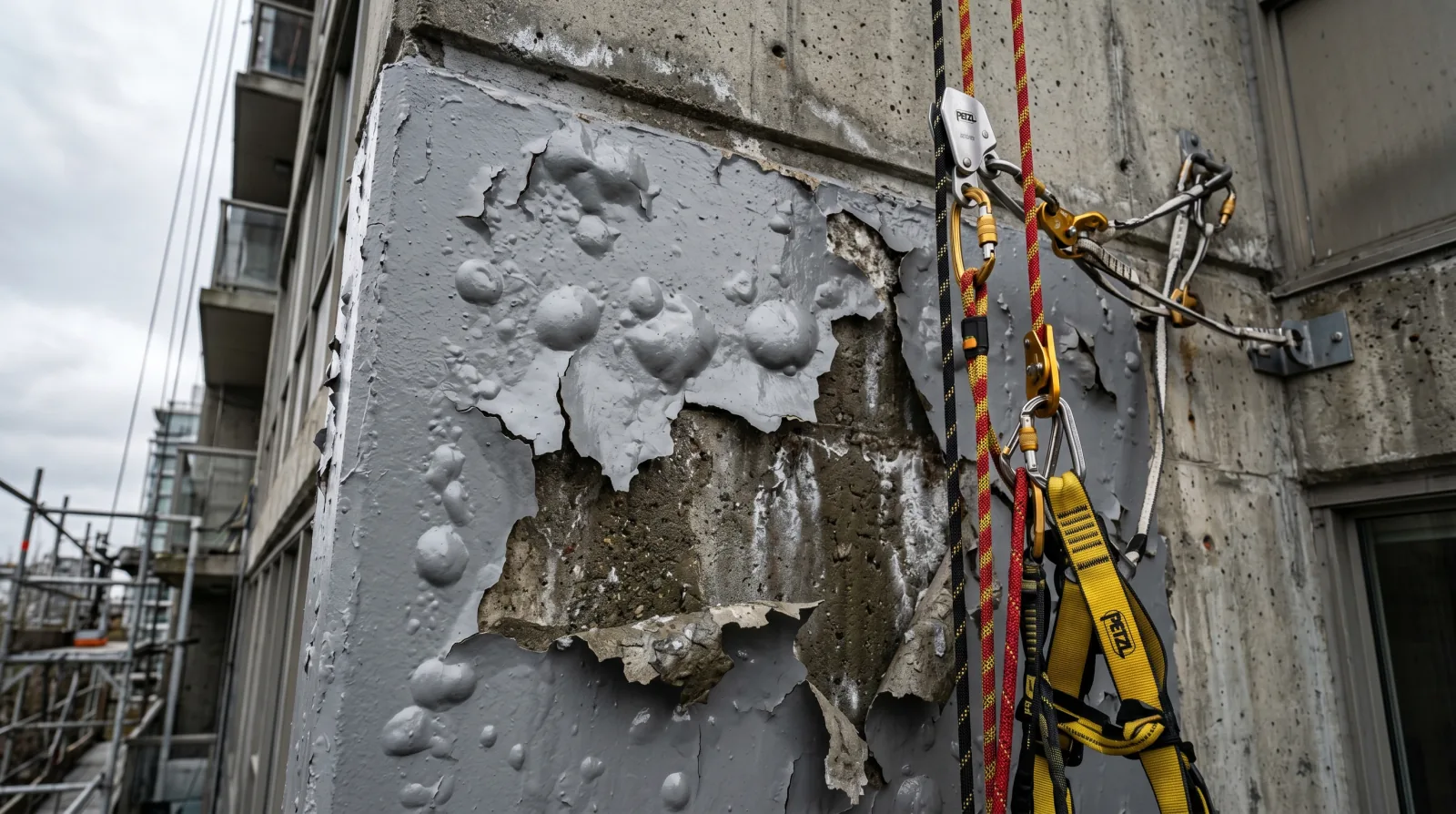
The classic coating failure on the BC coast is blistering. A crew applies an elastomeric film over a wall that is not fully dry, or the wall takes up moisture from behind after the coating goes on. Water vapour trying to leave the concrete cannot pass the film fast enough, so it collects under the coating and pushes it up into bubbles. The bubbles break, the film peels back from the broken edges, and within a season the facade looks worse than before it was coated. This is not a product defect. It is a moisture and prep problem, and it is why the substrate must be confirmed dry before any film goes on, and why a wall that cannot be reliably dried is a candidate for a breathable sealer instead of a coating.
Failure mode: sealing over live cracks
The classic sealer failure is quieter and more dangerous. Someone applies a clear penetrating sealer to a wall that already has active cracks, because the wall looks fine from the street and sealing is cheaper than repair. The sealer repels water across the sound surface, so the wall passes a quick water-spray check and everyone assumes it is protected. But the cracks are still open paths, and water keeps entering at them and reaching the rebar. Because the sealer changed nothing visible, the corrosion runs out of sight for years until rust staining and spalling appear. Sealing over live cracks is not protection. It is hiding the fact that the wall was never repaired.
Failure mode: coating over a previously sealed wall
Here is a mistake that costs Vancouver stratas real money. Someone seals a concrete wall with a penetrating water repellent, then a few years later decides the wall would look better coated. A silane or siloxane sealer is built to make the surface shed things, and a fresh elastomeric coating is one of those things. Put a coating over a recently sealed wall and it may not bond, and then it peels. Before coating any previously sealed wall, the surface has to be cleaned and tested, and often the repellent has to weather off or be mechanically removed first. A competent contractor runs an adhesion test patch, lets it cure, and confirms the bond with a pull-off test (ASTM D4541) before committing the full facade. On a high-rise, discovering a bond failure after the whole wall is coated means another rope access mobilization to strip and redo it.
Surface preparation and correct spec
Prep is where both jobs are won or lost, and the two products ask for different things. A sealer needs a clean, dry, sound surface with no competing repellent or old film on it, but no priming and no film build to measure. A coating needs far more: a high-pressure wash to remove dirt, algae, and chalk; repair of cracks and spalls with compatible material; a dedicated primer on bare and patched areas; confirmation that the substrate is dry; and then application to a measured dry film thickness across two coats.
The way to confirm the surface itself is strong enough to hold a coating is a pull-off tensile test of the concrete surface (ASTM C1583). If the surface layer is weak or the old repairs are delaminating, a new coating will only bond as well as the weakest layer under it, and it will take that layer with it when it fails. A good specification names the exact product, the film thickness for a coating or the reapplication interval for a sealer, the prep steps, and the tests that confirm the surface is ready. A spec that names none of these is not a specification, it is a hope.
Standards and testing to verify
For an elastomeric coating on a Vancouver facade, the tests that matter are resistance to wind-driven rain on masonry (ASTM D6904), flexibility and elongation for crack bridging by the mandrel bend test (ASTM D522), and adhesion by pull-off strength on the coating (ASTM D4541) when overcoating an existing surface. The soundness of the concrete surface itself is checked by pull-off tensile bond (ASTM C1583). Ask for the product test results, not the label claim, because "waterproof" on a can is a marketing word with no fixed meaning.
For a clear penetrating sealer, the evaluation is different because there is no film to test for thickness or bridging. The real references are rapid chloride ion resistance (ASTM C1202) and reduction in water and chloride absorption (NCHRP Report 244), which measure how much the treated concrete keeps out. In Europe the framework to name is EN 1504-2, which covers surface protection for concrete and separates hydrophobic impregnation (what a penetrating sealer does), impregnation, and coating as distinct methods. If a proposal for a chloride-exposed wall near the water quotes none of these, the contractor has not shown that the sealer will actually reduce chloride ingress.
Cost drivers and lifecycle over 20 years
The things that move price are the wall condition and the access, not a single per-foot rate. For a sealer, cost is driven by how porous the concrete is (porous concrete drinks more product), how many coats it needs to reach refusal, and how much of the facade needs rope access. For a coating, cost is driven by the amount of crack and spall repair first, the film thickness the spec calls for, the number of coats, priming, and again the access method and how much the wet Vancouver weather stretches the schedule.
Over 20 years the comparison is about cycles, not one number. A sealer is cheaper per visit but may need two or three reapplications across 20 years. A coating costs more up front but runs one long cycle of 15 to 20 years plus a recoat. Here is the honest part: if the wall is sound and only needs protection, the sealer is usually the lower total cost and it keeps the look, so the coating's longer interval does not win. If the wall is cracked or stained, a sealer is not really an option at all, because it would leave the defects visible, so the two are not competing on cost in that case. We model both against your actual wall condition and square footage rather than quoting a generic per-foot number.
Warranty reality and what each cannot do
Read any warranty carefully, because most of them protect the manufacturer, not the building. A coating warranty almost always depends on the substrate being sound and dry at application and on the film being applied to the specified thickness, so a blistering failure over a damp wall is usually excluded as an application or moisture issue. A sealer warranty typically covers the product performing as a repellent for a stated period on sound concrete, and it will not cover water entering through cracks or joints, because those are outside what the product does.
There are really two warranties on any facade job, and they matter differently. The material warranty comes from the product manufacturer and covers the product itself. The workmanship warranty comes from the contractor and covers how it was applied. A material warranty is close to worthless if the application was wrong, because the manufacturer will point to the application. So the contractor's own workmanship warranty, and whether the contractor will still be in business to honour it, often matters more than the number of years printed on the product data sheet. On a rope access high-rise, ask who carries the risk if the coating blisters in year two, because the cost is not just the material, it is another full mobilization to strip and redo the wall.
That is the key limit to keep in front of the owners. Neither product waterproofs the building. Neither one fixes water getting in at window perimeters, panel joints, penetrations, or failed sealant, and on a facade showing stains that is very often where the water is actually coming from. A coating adds a barrier and bridges small cracks; a sealer repels water on a sound face; both leave the joints to the sealant trade. Any coating or sealing campaign should run with a sealant inspection and replacement, or water keeps entering at the joints and tracks behind the new treatment while the wall looks protected from the street.
How to read a contractor's proposal
A trustworthy proposal starts with the wall condition the contractor actually observed and ties the product to it. It names whether the sealer is silane, siloxane, or a blend, or names the elastomeric product and its film thickness. It lists the prep steps and the tests used to confirm the surface is ready. For a coating over any previously sealed or coated wall, it includes an adhesion test patch and a pull-off test before the full campaign. It quotes the reapplication interval for a sealer or the recoat interval for a coating honestly, and it separates the facade work from any sealant, crack repair, or membrane work rather than pretending the coating does all of it.
The warning signs are the reverse: a proposal that names no wall condition, no product detail, no standards, and no prep; a coating quoted straight over a sealed wall with no adhesion test; a sealer offered for a wall that clearly has active cracking; or a claim that the product will "waterproof" the building. If you see those, slow the decision down and get a real assessment before any money is spent.
Four Metro Vancouver scenarios
The decision reads differently on a real building than in the abstract. Here are four situations we see across the region and the honest call for each, including one where keeping the raw concrete and sealing it is clearly the right answer.
New exposed architectural concrete tower, Yaletown
A recently finished downtown Vancouver tower with board-formed architectural concrete as the intended finish. The strata wants the raw concrete look kept. The wall is sound, no cracking beyond very fine surface lines, no staining yet.
Recommended call: Clear penetrating silane sealer.
Why: The concrete look is the design and the wall is sound, so there is nothing to hide and nothing to bridge. A deep-penetrating silane cuts water and chloride absorption while leaving the finish untouched. Coating this wall would erase the exact appearance the building was designed around, and there is no defect that would justify it. Plan on reapplication in the 5 to 10 year range and keep the sealant joints on the same inspection cycle.
1980s concrete strata, Burnaby, cracked and patchy
A tired mid-rise from the leaky-condo era. The concrete shows active hairline cracking, old grey patches from past repairs, water staining below the windows, and blotchy colour across elevations. The strata wants it to look clean and uniform again.
Recommended call: Opaque elastomeric coating.
Why: This wall has every problem a sealer cannot touch. A clear sealer would leave the cracks open, keep the patches visible, and lock in the blotchy look. The elastomeric film bridges the hairlines up to roughly 2 mm, hides the patching and staining under one colour, and gives the strata a 15+ year interval before the next campaign. Repair the wider cracks and any spalls first, replace failed sealant, confirm the wall is dry, then coat.
West Vancouver waterfront parkade podium, chloride exposure
A podium and parkade face close to the water on the North Shore. Salt spray and wind-driven rain hit it hard. The concrete itself is sound with no meaningful cracking, but the owner is worried about chloride reaching the rebar over time.
Recommended call: Clear penetrating silane sealer (deep penetration grade).
Why: The driver here is chloride, not appearance and not cracking. On sound concrete a deep silane reduces chloride ion absorption while staying breathable, which matters in a wet salty exposure where a trapped-moisture film could blister. Verify the product against chloride resistance data (ASTM C1202) and absorption reduction (NCHRP Report 244). If parts of the podium slab pond water, that is a membrane job, not a sealer job, and it should be scoped separately.
Wall previously treated with a water repellent, owner now wants it coated
A Richmond building was sealed a few years ago with a penetrating water repellent. The owner now dislikes the uneven weathered look and wants a clean coated finish instead.
Recommended call: Do not coat yet. Test first, and the honest answer may be to reseal.
Why: A silane or siloxane repellent is built to make the surface shed things, and a fresh coating is one of those things. Coating straight over it risks a facade-wide bond failure. The correct step is an adhesion test patch left to cure and checked with a pull-off test (ASTM D4541), plus time for the repellent to weather off or mechanical removal. If the owner mainly wants even appearance and the wall is sound, a fresh coat of the same sealer often restores a consistent look at a fraction of the risk and cost of forcing a coating to bond.
Options compared
Opaque elastomeric coating
A thick, pigmented, high-build film that sits on top of the wall, bridges hairline cracks, and completely changes the look of the concrete to a solid colour.
Clear penetrating sealer (silane / siloxane)
A thin, nearly invisible water repellent that soaks into the concrete pores instead of forming a film on top. Silane molecules go deepest; siloxane balances depth and coverage.
Decision framework: coat or seal your wall
| Situation | Recommendation | Reason |
|---|---|---|
| Owner wants to keep the raw concrete look? | Clear sealer | A penetrating sealer soaks in and leaves the surface looking untouched. An elastomeric coating covers the concrete with a solid painted colour. |
| Active hairline cracking on the wall? | Elastomeric coating | A clear sealer does not bridge cracks. An elastomeric film stretches across hairlines up to roughly 2 mm and keeps water out of them. |
| Visible patching, staining, or colour blotching? | Elastomeric coating | A coating hides repairs and colour variation under a uniform finish. A clear sealer shows everything, including the patches, because it changes nothing on the surface. |
| Substrate is hard to dry or stays damp? | Clear sealer | A breathable penetrating sealer lets the wall keep releasing vapour. A surface film over a damp wall traps moisture and blisters. |
| Protecting against chloride and water ingress on sound concrete? | Clear sealer | Silane and siloxane repel water and chloride while breathing, which suits sound concrete that mainly needs protection, not resurfacing. |
| Budget wants the longest interval between visits? | Elastomeric coating | A coating runs 15+ years before recoat. A sealer usually needs reapplication every 5 to 10 years, so more frequent, lighter visits. |
| Wall was recently treated with a penetrating water repellent? | Clear sealer (or test before coating) | A fresh coating may not bond over a water repellent designed to shed things. Reapply the sealer, or run an adhesion test patch before any coating decision. |
| Waterfront or podium with heavy chloride and salt spray, sound concrete? | Clear sealer | On sound concrete near the water, a deep silane repellent cuts chloride absorption while keeping the look, and there is no film to blister in a wet, salty exposure. |
| Mixed condition: some sound raw concrete, some cracked and patched areas? | Elastomeric coating | You cannot seal half a facade and coat the other half and expect it to read as one wall. If any large area needs hiding and bridging, the uniform coating is the honest call. |
| Building has a depreciation report calling for facade protection but no visible defects? | Clear sealer | When the reserve study wants protection on a sound wall and the owners value the concrete look, sealing meets the requirement without resurfacing a wall that does not need it. |
Questions to ask before you approve the scope
If you manage the strata or own the building, these are the questions that separate a real specification from a guess. Under each one is the answer that should make you pause.
- What condition is the wall actually in, and did you inspect it up close? Red flag: a product recommended from photos or the street with no site inspection and no mention of cracking, staining, or moisture.
- Is the concrete sound, or does it need repair before any treatment? Red flag: proposing to seal or coat over rust staining, spalling, or hollow-sounding areas without repairing them first.
- If a sealer, is it silane, siloxane, or a blend, and what is the reapplication interval? Red flag: "a clear sealer" with no product type named and no interval, especially on a chloride-exposed wall near the water.
- If a coating, what dry film thickness and how will you confirm it during application? Red flag: no film thickness stated and no wet-film gauge or coverage tracking, which is how a coating quietly ends up too thin to perform.
- How will you confirm the wall is dry before a coating goes on? Red flag: no moisture check and a promise to coat regardless of weather, which is the direct path to blistering on the BC coast.
- Has this wall ever been sealed or coated before, and how do you know a new coating will bond? Red flag: coating over a previously sealed wall with no adhesion test patch and no pull-off test (ASTM D4541).
- What standards and test data support the product for my exposure? Red flag: label claims like "waterproof" with no ASTM D6904 wind-driven rain data for a coating, or no ASTM C1202 or NCHRP Report 244 chloride data for a sealer.
- Are the window perimeters, panel joints, and sealant included, or separate? Red flag: a facade treatment quoted as if it waterproofs the building while the failed joints, where most water enters, are left untouched.
- What access method will you use, and how does the rainy season affect the schedule? Red flag: no plan for rope access or scaffold and no acknowledgement that the wet season stretches a coating campaign.
- What does the warranty actually cover, and what voids it? Red flag: a warranty presented as full protection without explaining the substrate, dryness, and film-thickness conditions that most warranties require.
Neither one fixes the joints
Whether you coat or seal, the broad face of the wall is only part of the envelope. Most water gets in at window perimeters, panel joints, and penetrations, and neither a coating nor a sealer touches those. A coating campaign should run with a sealant inspection and replacement, and a sealing campaign is no different. If the wall shows staining or damp that suggests water is already tracking through the assembly, the right first step is a look through our building envelope repair scope, then decide on coating or sealing once the assembly is sound. For how we specify and apply both systems, see our exterior coatings service page.
If you are still weighing which coating fits a wall that does need resurfacing, the sibling comparisons help. See elastomeric coating vs. acrylic paint for why a thin paint film fails on a moving concrete wall, silicone elastomeric vs. acrylic elastomeric for the difference between the two elastomeric chemistries, and anti-carbonation coating vs. elastomeric when carbonation protection is the concern. For how the coating gets onto the wall, spray vs. roller application covers the film-build tradeoffs. All of these sit under the exterior coatings resource hub.
Quick answers
What is the difference between an elastomeric coating and a clear concrete sealer?
An elastomeric coating is a thick, pigmented film that sits on top of the concrete. It changes the wall to a solid colour, bridges hairline cracks, and hides patching and stains. A clear penetrating sealer, usually a silane or siloxane, soaks into the concrete pores and leaves almost no film on top, so the wall keeps its natural raw look. The coating resurfaces and protects; the sealer only protects. The simplest way to choose: if you want to keep the concrete look and the wall is sound, seal it. If you want to hide cracks, patches, and stains under a clean finish, coat it.
When should you keep the concrete look instead of coating it?
Keep the concrete look when the raw finish is part of the building design and the wall is structurally sound with no significant cracking to hide. A lot of newer Metro Vancouver buildings use exposed architectural concrete on purpose, and painting over it with an opaque elastomeric changes the whole look, which owners and designers often do not want. In that case a clear penetrating silane or siloxane sealer protects the concrete against water and chloride ingress while leaving the appearance untouched. The tradeoff is that a clear sealer does nothing for cracks or staining, so if the wall already shows those problems, sealing it just locks in the look you were trying to avoid.
Does a clear penetrating sealer protect concrete as well as an elastomeric coating?
For a sound wall with no cracks, a good silane or siloxane sealer gives strong protection against water and chloride ingress while letting the concrete breathe, and it does it without changing the look. But it protects in a different way than a coating. It repels water at and just below the surface; it does not build a continuous film, and it does not bridge cracks. An elastomeric coating adds a thick surface barrier and spans hairline cracks, which a sealer cannot do. So on a cracked or stained wall the coating protects better, and on a sound raw-concrete wall the sealer protects well enough while keeping the finish. Neither one fixes water getting in at open joints or failed sealant.
Coating vs. sealer questions
What is the difference between an elastomeric coating and a clear concrete sealer?
An elastomeric coating is a thick, pigmented film that sits on top of the concrete. It changes the wall to a solid colour, bridges hairline cracks, and hides patching and stains. A clear penetrating sealer, usually a silane or siloxane, soaks into the concrete pores and leaves almost no film on top, so the wall keeps its natural raw look. The coating resurfaces and protects; the sealer only protects. The simplest way to choose: if you want to keep the concrete look and the wall is sound, seal it. If you want to hide cracks, patches, and stains under a clean finish, coat it.
When should you keep the concrete look instead of coating it?
Keep the concrete look when the raw finish is part of the building design and the wall is structurally sound with no significant cracking to hide. A lot of newer Metro Vancouver buildings use exposed architectural concrete on purpose, and painting over it with an opaque elastomeric changes the whole look, which owners and designers often do not want. In that case a clear penetrating silane or siloxane sealer protects the concrete against water and chloride ingress while leaving the appearance untouched. The tradeoff is that a clear sealer does nothing for cracks or staining, so if the wall already shows those problems, sealing it just locks in the look you were trying to avoid.
Does a clear penetrating sealer protect concrete as well as an elastomeric coating?
For a sound wall with no cracks, a good silane or siloxane sealer gives strong protection against water and chloride ingress while letting the concrete breathe, and it does it without changing the look. But it protects in a different way than a coating. It repels water at and just below the surface; it does not build a continuous film, and it does not bridge cracks. An elastomeric coating adds a thick surface barrier and spans hairline cracks, which a sealer cannot do. So on a cracked or stained wall the coating protects better, and on a sound raw-concrete wall the sealer protects well enough while keeping the finish. Neither one fixes water getting in at open joints or failed sealant.
How often does a clear concrete sealer need to be reapplied on a Vancouver building?
On a vertical facade, a penetrating silane or siloxane sealer typically lasts around 5 to 10 years before reapplication, depending on the product, the concrete porosity, and how much wind-driven rain the elevation takes. Vertical walls see less wear than horizontal surfaces, so they hold up on the longer end of that range, but a severely exposed West Vancouver or North Shore face facing the water may need attention sooner. A useful field check is to spray water on the wall: when it stops beading and starts soaking in, the repellent has worn out and it is time to reapply. Because a sealer has no film to peel, reapplication is straightforward and does not require stripping anything first.
Can you apply a clear sealer over concrete that already has cracks?
You can, but it will not solve the crack problem, and that is usually the wrong call. A penetrating sealer repels water across the sound surface, but a crack wider than a hairline is an open path straight into the wall, and the sealer does not bridge it. Water still enters at the crack, and on a reinforced concrete wall that water reaches the rebar. If the wall has active cracking, you either repair the cracks and then seal, or you move to an elastomeric coating that bridges the hairlines as part of the system. Sealing over live cracks and hoping is how owners end up with rebar corrosion behind a wall that looks protected.
Will an elastomeric coating stick to bare concrete that was previously only sealed?
This is where a lot of jobs go wrong. A silane or siloxane sealer is a water repellent, and by design it makes the surface shed things, including a new coating. If you try to put an elastomeric coating over a wall that was recently treated with a penetrating water repellent, the coating may not bond and can peel. Before coating a previously sealed wall, the surface has to be cleaned and tested, and often the repellent has to weather off or be removed first. A competent contractor runs an adhesion test patch and lets it cure before committing the full facade. On a high-rise, discovering a bond failure after the whole wall is coated means another rope access mobilization to strip and redo it.
Which costs less over 20 years, sealing or coating a concrete wall?
What the wall needs decides it, not just the price per visit. A clear sealer is cheaper per application, but it needs reapplying every 5 to 10 years, so over 20 years you may pay for two or three cycles. An elastomeric coating costs more up front but runs 15+ years before recoat. If the wall is sound and you only need protection, sealing is usually the lower-cost path and it keeps the look. If the wall is cracked or stained and would need a coating anyway to hide and bridge those problems, then a sealer is not really an option and the comparison does not apply. We model both against your actual wall condition and square footage rather than quoting a generic per-foot number.
What is the difference between a silane and a siloxane sealer, and which is better for Metro Vancouver?
Both are penetrating water repellents, and the difference is molecule size. Silane molecules are the smallest, so they wick deepest into dense concrete and are the usual choice where chloride protection matters, such as walls and podiums near the water on the North Shore or in West Vancouver. Siloxane uses larger molecules and a mix of sizes, which gives good coverage on more porous or older concrete and often costs less per square foot. Many products on the market are silane and siloxane blends to balance depth with coverage. For dense, sound concrete facing heavy wind-driven rain or salt spray, a deeper silane or a silane-rich blend is usually the safer specification.
Does a clear sealer or an elastomeric coating stop water getting in at the windows and joints?
No, and this is the most common misunderstanding on facade projects. Both products treat the broad face of the wall. Most water actually enters at window perimeters, panel joints, penetrations, and failed sealant, and neither a sealer nor a coating touches those details. If your wall shows staining or damp, the problem is very often at the joints, not the concrete face. Any coating or sealing campaign should run with a sealant inspection and replacement, otherwise water keeps entering at the joints and tracks behind the new treatment while the wall still looks protected from the street.
Can you use a clear sealer and an elastomeric coating on the same building?
Yes, when different elevations genuinely have different needs, but it takes planning and it changes how the building reads from the street. For example, a sound architectural concrete feature wall might be sealed to keep the look, while a cracked and patched service elevation gets coated. The risk is that a sealed wall and a coated wall look nothing alike, so you have to decide that split on purpose, not by accident. You also cannot coat an area that was already sealed without cleaning, testing, and often removing the repellent first, because a coating will not reliably bond over it. On most single strata buildings, owners pick one approach for a consistent appearance.
How do you know if a wall should be repaired before sealing or coating at all?
Look for signs that water is already inside the assembly, not just on the surface. Rust staining, efflorescence (the white powdery deposit), spalling where the concrete surface has broken away, hollow-sounding areas when tapped, and cracks that leak after rain all point to a problem that a coating or sealer will hide rather than fix. Sealing or coating over active water ingress traps the problem and lets rebar corrosion continue out of sight. The correct order is to assess the assembly, repair the concrete and replace failed sealant, confirm the wall is sound and dry, and only then decide between a breathable sealer and a full elastomeric coating. Starting a building envelope repair scope first is the safe path when the wall shows these signs.
How can I tell if a contractor has specified the right product for my wall?
Ask the contractor to state the wall condition they observed and tie the product to it in plain language. For a clear sealer, they should name whether it is silane, siloxane, or a blend, quote the reapplication interval, and reference chloride and absorption test data such as ASTM C1202 or NCHRP Report 244 for chloride-exposed walls. For an elastomeric coating, they should quote the dry film thickness, the crack-bridging limit of roughly 2 mm, wind-driven rain resistance (ASTM D6904), and how they will confirm the substrate is dry before applying. If they are proposing a coating over a previously sealed wall, they must include an adhesion test patch and a pull-off test (ASTM D4541). A proposal that names no wall condition, no standards, and no prep steps is a warning sign.
Coat it or keep the concrete look? We will tell you straight.
We assess concrete and stucco walls across Vancouver, Burnaby, Richmond, and the North Shore, checking cracking, staining, moisture, and existing treatments, so you know whether the wall needs a breathable sealer or a full elastomeric coating before you spend a dollar.