Vinyl Deck Membrane vs Liquid-Applied Membrane for BC Balconies
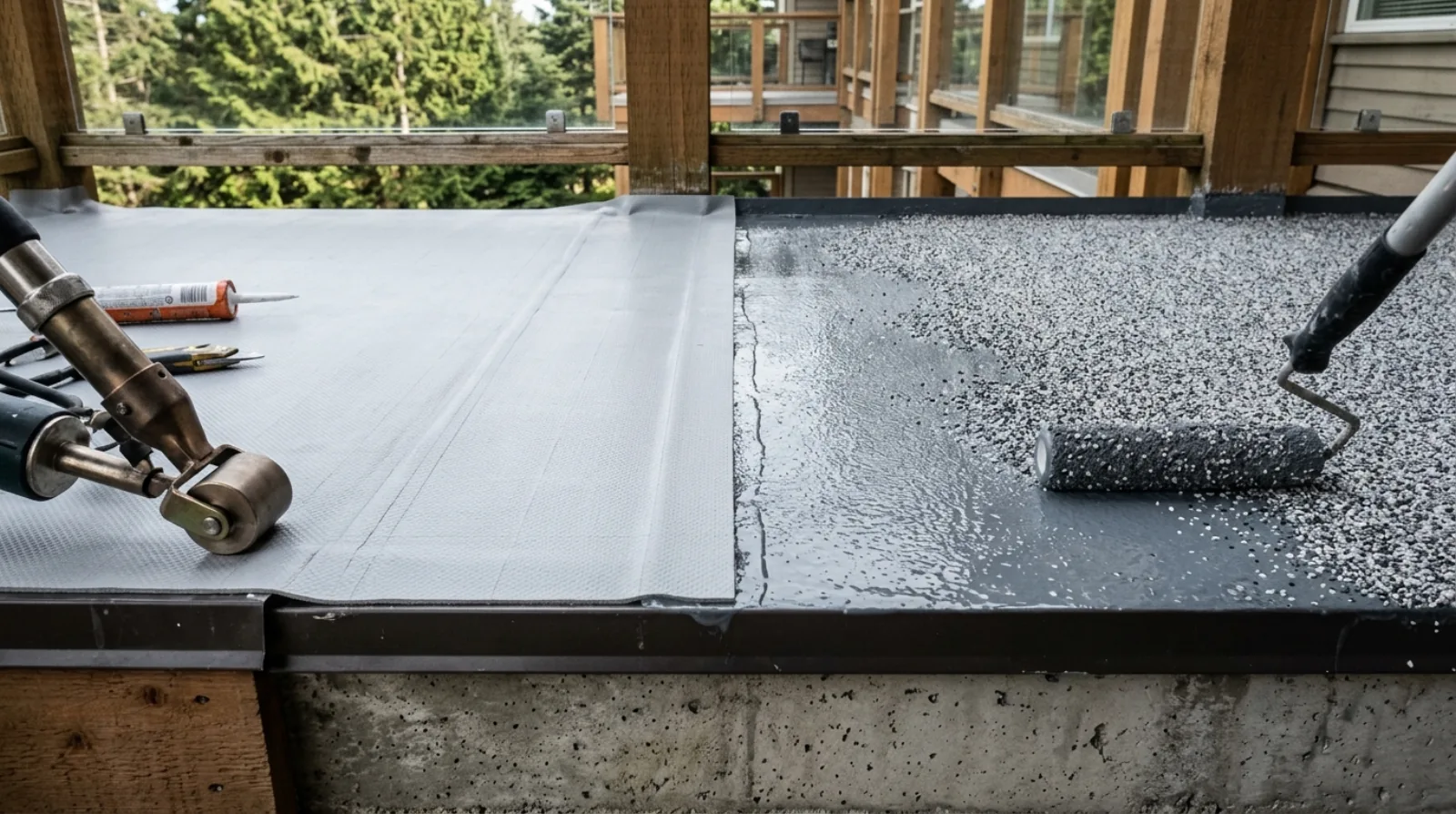
When a Vancouver, North Vancouver, or Burnaby strata council faces a balcony waterproofing replacement, the central technical decision is usually between vinyl deck membrane (sometimes called PVC deck coating) and liquid-applied polyurethane membrane. Both are mature products, both work, and both fail in characteristic ways when installation or maintenance falls short.
This article compares the two systems on the criteria that actually drive a strata’s decision: lifespan, cost, repairability, appearance, and installation logistics in BC’s climate.
The two systems — what each actually is
Vinyl deck membrane
A vinyl deck membrane is a roll of reinforced PVC sheet, typically 1.2–1.5mm thick, with a factory-applied texture for slip resistance and colour built into the sheet. It is mechanically fastened or adhered to a clean wood or concrete substrate, then heat-welded at seams to create a continuous waterproof surface. Standard widths are 1.5–2.0m, so a typical balcony has 1–3 sheets and 0–2 seams.
The installed thickness gives the deck its dimensional stability — it doesn’t move with the substrate the way a thinner coating does. The finished surface is ready for foot traffic the day after installation.
Liquid-applied polyurethane membrane
A liquid-applied membrane is a built-up coating system, typically:
- Primer appropriate to the substrate (concrete, plywood, or repair mortar)
- Base coat of polyurethane resin, often reinforced with a fibreglass mat at high-stress areas (corners, drain collars, perimeter upturns)
- Intermediate coat for additional thickness
- Wear topcoat broadcast with aggregate (typically a fine quartz or rubber granule) to provide slip resistance and protect the membrane from UV and foot traffic abrasion
The total system thickness is typically 1.5–2.5mm when properly applied. The system cures over several days and is ready for traffic typically 24–48 hours after the last coat depending on temperature.
Side-by-side comparison
| Factor | Vinyl Deck Membrane | Liquid-Applied Polyurethane |
|---|---|---|
| Typical lifespan in BC | 12–18 years | 10–15 years |
| Material thickness installed | 1.2–1.5 mm sheet | 1.5–2.5 mm built-up |
| Substrate forgiveness | Tolerates minor imperfections | Demands clean, dry, sound substrate |
| Installation weather window | Cool/wet weather OK | Needs >5°C, dry days |
| Cure time before traffic | <24 hours | 24–48 hours after final coat |
| Geometry forgiveness | Better for simple rectangles | Better for complex shapes, drains |
| Spot repair viability | Difficult (color/seam matching) | Straightforward (same material) |
| Walking surface | Finished, factory texture | Field-applied aggregate topcoat |
| Installed cost | Higher material + labour on complex geometry | Lower on complex geometry; comparable on simple |
| Common failure mode | Seam failure, perimeter lifting | Wear-through, perimeter cracking |
Where vinyl typically wins
- Simple balcony geometry — small rectangular decks with few penetrations. Vinyl installs fast and the seam count is low.
- Cool-weather installation windows — strata that needs to rebuild a balcony in October. Vinyl can be installed when liquid would have to wait until spring.
- Long-life expectation — strata buildings that prefer one rehabilitation cycle every 15+ years rather than two cycles in the same period.
- Finished appearance preference — owners and residents who prefer a consistent factory-finish look over a granular textured surface.
- Substrates with minor imperfections — vinyl is more forgiving of small variations in plywood smoothness or concrete finish.
Where liquid typically wins
- Complex balcony geometry — multiple drains, irregular shapes, deep recesses, integrated planters. Liquid self-conforms.
- Tight detailing at penetrations — railing posts, door sills, plumbing penetrations. Liquid wraps cleanly with no seam to fail.
- Strata that wants ongoing maintainability — spot repairs are simple and can be done by the original contractor or a follow-up trade.
- Budget-constrained rehabilitation — typically the lower-cost option, particularly on smaller balcony counts where vinyl roll-end waste hurts pricing.
- Cross-balcony continuity — terraces, walkways, and continuous outdoor areas where a continuous monolithic surface is preferred over multiple panels.
The failure modes — what actually goes wrong
The failures we see on BC balconies have less to do with the membrane itself and more to do with detailing at the points where the membrane meets something else.
Vinyl deck failure patterns
- Seam separation — heat welds fail when undercooked at installation or after years of thermal cycling. A 50mm seam opening becomes a leak path directly into the substrate.
- Perimeter lifting at door thresholds — vinyl pulls away from the perimeter termination when the substrate moves or the original mechanical fastening was inadequate.
- Drain collar failure — the seal between the vinyl and the drain flange fails as fasteners corrode and the vinyl shrinks slightly over time.
- Aging-related shrinkage — older vinyl decks pull inward as the material loses plasticizer, opening gaps at terminations.
- UV damage and brittleness — on south and west exposures, older PVC becomes brittle and cracks at high-stress points.
Liquid membrane failure patterns
- Wear-through in traffic patterns — the topcoat wears at door thresholds, around chairs, and in foot-traffic paths. When wear reaches the base coat, water can enter.
- Perimeter cracking — the membrane cracks at the perimeter upturn where the deck meets the wall, particularly if the upturn was too thin or the substrate flexes.
- Drain collar separation — same failure mode as vinyl, different repair scope.
- Pinhole leaks in low-build areas — areas that received too thin a coating during installation become pinhole-leak sources within 5–8 years.
- UV degradation of the topcoat — particularly on aggressively south-exposed decks without periodic recoating.
For a full failure-pattern walkthrough, see signs of balcony waterproofing failure and repair vs. replace decision criteria.
Substrate prep — the work that determines longevity
For both systems, what happens before the membrane goes down determines lifespan more than the membrane choice itself.
For vinyl on a wood substrate:
- Plywood condition assessment, with replacement of any soft, delaminated, or rotted sheets
- Smooth sanded surface free of fasteners, splinters, or step changes
- Slope verification toward drains (1:50 minimum, 1:25 preferred)
- Perimeter detail prep — wall flashing or curb prep, door threshold prep
For liquid on a concrete substrate:
- Mechanical surface profile (shot blasting or grinding) to achieve substrate roughness specification
- Moisture content verification — concrete must be below the manufacturer’s allowable moisture content
- Crack treatment with detail mat or sealant prior to base coat
- Drain collar prep including pre-flashing with detail mat
Skipping substrate prep is the single most common cause of premature failure on both systems. A balcony rehabilitation that quotes 30% less than the others has typically excluded substrate prep from the scope.
Installation logistics in BC’s climate
Liquid membranes need a continuous dry, warm-enough window — typically 3–5 days of dry weather above 5°C with no rain forecast — for primer, base coat, intermediate coat, and topcoat to cure properly. In Metro Vancouver, this realistically limits liquid installation to mid-April through mid-October, with the most reliable windows in July and August.
Vinyl can be installed in cooler and damper conditions because the sheets arrive cured and only the adhesives and heat-weld seams need controlled environments. Vinyl projects can sometimes extend into early November or restart in late March, giving project managers more flexibility on schedule.
For a strata council, this means:
- Vinyl — easier to schedule a fall project after summer maintenance work is complete
- Liquid — harder to schedule late in the season; book early for summer installation windows
Long-term maintenance comparison
Vinyl deck maintenance is largely binary — the deck is intact and watertight, or it’s failed and needs replacement. Spot repairs are rarely worth attempting on aged vinyl because matching the original sheet visually and reliably is impractical. Strata councils plan for full replacement when major failure points appear.
Liquid membrane maintenance is incremental. Wear topcoats can be reapplied every 5–8 years to refresh slip resistance and protect the underlying base coat. Pinhole repairs, perimeter touch-ups, and drain collar resealing extend the life of the installed system. With routine touch-up, the practical lifespan of a liquid system can match or exceed vinyl.
This maintenance difference affects how each system shows up in a depreciation report. A vinyl deck typically gets a binary remaining-life rating (good for 8 more years, then full replacement). A liquid system often gets a more nuanced rating (good for 5 more years to recoat, then 10 more years with routine maintenance).
What this means for a typical BC strata decision
The vinyl-vs-liquid decision should not be made in a tender package. By the time the contractor is bidding, the system choice should already be made — based on:
- The current balcony substrate (wood vs concrete vs hybrid)
- The balcony geometry and complexity
- The expected installation season
- The strata’s preference for full-replacement vs ongoing-maintenance lifecycle
- The available installers and their proven experience with each system
A building envelope consultant, restoration project coordinator, or qualified contractor should be brought in at the planning stage to make this call, with the system specified in the tender documents. Strata councils that put both systems out to tender end up comparing apples to oranges — the lowest bid usually wins, but the system that gets installed may be the wrong one for the building.
Related guides
- Balcony Waterproofing Hub — signs of failure, membrane types, repair vs. replace
- Vancouver Strata Balcony Membrane Maintenance — annual inspection and care routine
- Balcony Waterproofing: Repair vs. Replace — decision tree for spot repair vs. full replacement
- Coordinating Strata Exterior Restoration — how to manage the full project
Frequently Asked Questions
More from Balcony Waterproofing Guide
Understanding Strata Balcony Membrane Maintenance & Water Ingress in Vancouver
Strata balcony membranes bear the brunt of Vancouver's intense rain. We review the lifespan of vinyl, liquid polyurethane, and PMMA waterproofing systems, outline maintenance duties under the Strata Property Act, and explain how to prevent moisture damage.
Read article →What Causes Water Ingress in High-Rise Buildings?
Water ingress can cause major structural damage. We break down the top causes of leaks in concrete structures, from wind-driven rain bypassing failed window perimeters to structural expansion joint tears and cracked stucco.
Read article →