Condensation in new versus older buildings
A 1975 West End tower, a 1994 face-sealed walk-up in Coquitlam, and a 2024 rainscreened mid-rise handle indoor moisture in three different ways, because each generation built its walls around different assumptions. Knowing the era is half the diagnosis: it tells you where that building's condensation will show, and what the first suspect should be.
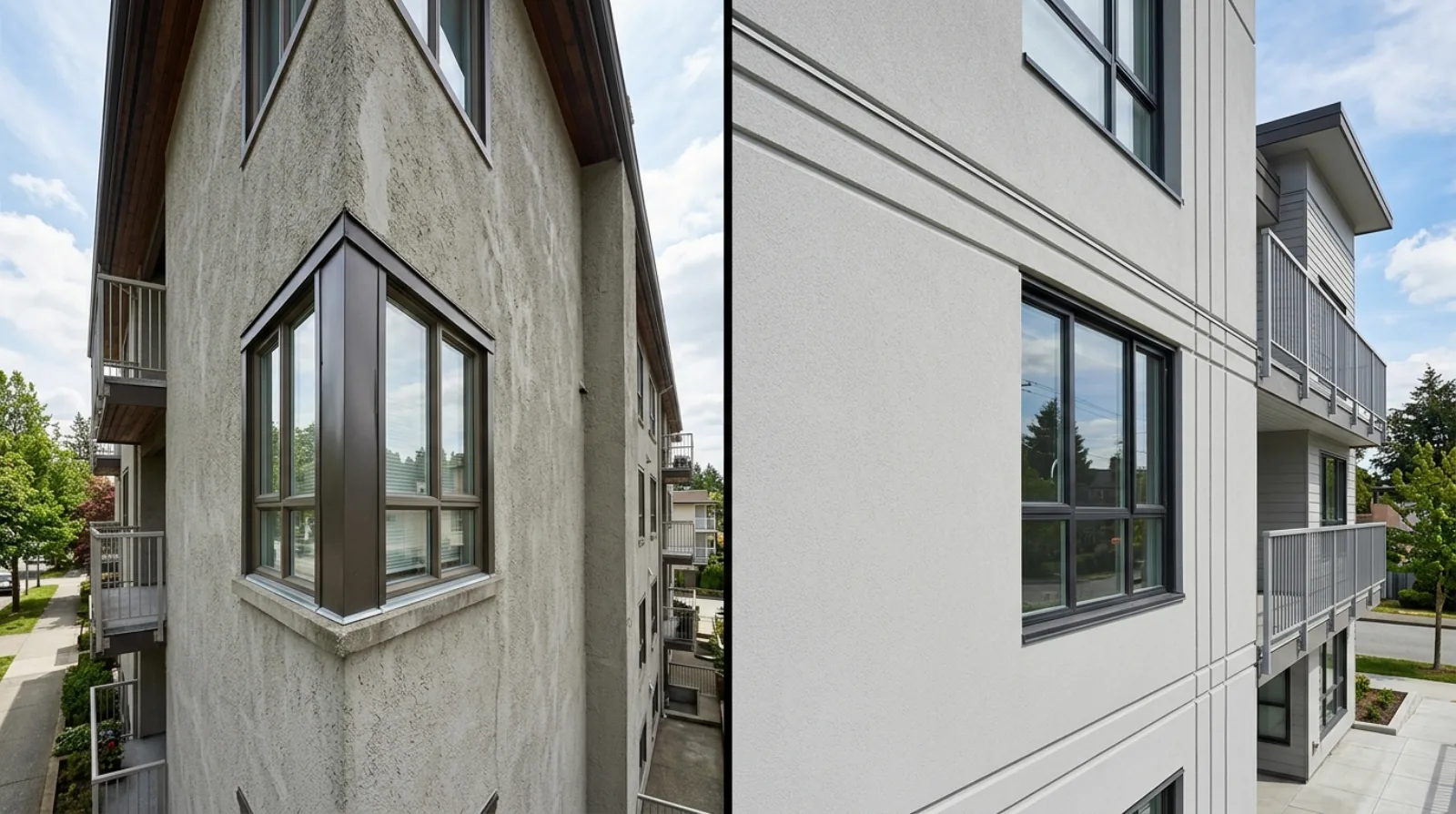
Three generations, three moisture personalities
Metro Vancouver's housing stock sorts into three broad construction generations, and each one moved the moisture problem rather than solving it.
| Era | How it was built | How it condenses |
|---|---|---|
| Pre-1980s: leaky and cold-surfaced | Concrete towers with exposed slab edges and aluminum frames; wood-frame walk-ups with little deliberate air or vapour control. Assemblies leak air freely in both directions. | Surface condensation on the coldest details: window frames, perimeter floors, closet corners. Walls themselves often stay dry because leakage keeps them ventilated and heat loss keeps them warm. |
| 1980s to early 2000s: the face-sealed era | Tighter wood-frame construction with face-sealed stucco and EIFS cladding that relied on the outer surface shedding all water, a strategy Vancouver's rain overwhelmed. | The era's defining problem was rain trapped in assemblies rather than indoor condensation, but interior moisture added to the same trapped load. Buildings not yet rainscreened remain the region's most moisture-sensitive stock. |
| Post-rainscreen to current: tight and mechanical | Rainscreened cladding with a drained cavity, continuous air barriers, thermally improved details, and suites tight enough that ventilation is a designed mechanical duty rather than an accident. | Little accidental drying and no accidental ventilation: indoor moisture stays until fans and HRVs export it. Wet windows appear in the first winter wherever ventilation is underused, undersized, or switched off. |
The old stock: cold surfaces, forgiving walls
The pre-1980s generation, the concrete towers of the West End and Kerrisdale and the wood-frame walk-ups scattered from Marpole to New Westminster, leaked heat and air generously. That leakage was a moisture management system nobody designed: indoor humidity escaped continuously, and warm assemblies dried whatever caught them. What the era could not manage was its own structure. Slab edges, cantilevered balconies, and unbroken aluminum frames delivered outdoor cold straight to interior surfaces, so these buildings condense in stripes and corners, on the details, night after cold night. The mechanics live in the thermal bridging guide, and the pattern is so consistent that we can often name the wet corners of a 1970s tower from the sidewalk.
Decades of piecemeal tightening have complicated the picture. Every window replacement and weatherstripping pass removed some accidental ventilation without adding deliberate ventilation, which is why an old building's condensation complaints often date from its upgrades. The walls got colder on the inside faces that remained leaky, a combination the interstitial condensation guide explains in full.
The middle stock: the era that trapped water
The mid-1980s through late 1990s built tighter wood-frame buildings wrapped in face-sealed stucco and EIFS, a strategy that asked the outer surface to shed every drop of Vancouver's rain forever. It could not. The result was the leaky condo crisis, roughly $4 billion in damage across 900+ Lower Mainland buildings, and its lesson matters to this hub: assemblies that cannot dry accumulate moisture from any source, rain or indoor air alike. Vancouver required rainscreen construction from 1996 and coastal BC followed by 2006, per BC Housing Builder Insight 06, which is the dividing line buyers and councils should know. Un-remediated face-sealed buildings remain the stock where indoor moisture joins trapped rain in assemblies with nowhere to dry, and where damp reports deserve the fastest professional attention.
Era is a starting point, and buildings drift
Few buildings still perform to their construction year. A 1972 tower with 2015 windows behaves like neither era: colder assemblies than 2015 construction, less accidental ventilation than 1972 intended. A face-sealed 1994 walk-up that went through rainscreen remediation now dries like modern stock. Suite renovations shift the picture unit by unit, adding pot lights, opened walls, and sealed windows in an unrecorded patchwork, which is how one line of suites in an otherwise dry building develops its own microclimate.
So the era sets the opening hypothesis, and the building's paper trail corrects it: permit history, past envelope reports, window replacement dates, and council minutes on damp complaints. On the buildings we assess, twenty minutes with the records regularly changes which mechanism gets tested first, and it spares residents a round of habit lectures for a problem their renovated windows created.
The new stock: tight boxes with a duty cycle
Current construction fixed the rain problem and the air problem, then handed the moisture problem to machinery. A new tower's suites are airtight enough that the moisture from cooking, showers, and construction materials curing off stays indoors until exhaust fans and HRVs export it. Run the equipment and the suite stays dry; ignore it and the first winter produces streaming windows in a building with a flawless envelope, the pattern the ventilation guide exists for. First-winter condensation in new buildings is common enough that councils should treat it as a commissioning and education issue before anyone suspects the envelope.
For buyers and councils weighing a specific building, era belongs in due diligence alongside the records, a checklist our guide to envelope due diligence for condo buyers covers. And when any era's damp report needs a diagnosis rather than a theory, that is assessment work: reading the building's construction, its complaint pattern, and its weather correlation together, the way our building envelope repair service approaches every era of Metro Vancouver stock, from the hub's oldest towers to suites still shedding construction moisture.
Quick answers
Why do brand-new buildings get condensation in their first winter?
Two reasons stack. New concrete, mortar, drywall mud, and paint release construction moisture into the suite air for months after completion, so a new building's first heating season carries its wettest indoor air. And modern construction is airtight, so that moisture stays inside until mechanical ventilation removes it. A new suite whose occupants run the HRV and fans as designed usually clears by the second winter; one that does not stays wet.
What is construction moisture?
The water built into a new building by its own materials. Concrete cures carrying water for months, and lumber, drywall compound, paint, and adhesives all release moisture as they dry in place. A newly completed suite sheds that load into its air through the first year or more of occupancy, which is why new buildings often condense hardest in their first winter and improve noticeably by the second, with no change in how residents live.
Why did leaky 1970s buildings have fewer wet windows?
They ventilated by accident. Draughty windows and uninsulated, unsealed assemblies exchanged indoor air with outdoors continuously, exporting moisture all winter, and the same heat loss that ran up bills kept interior surfaces comparatively warm relative to their era's humidity. The suites were colder and far more expensive to heat, and their frames still condensed on cold snaps, but the constant leakage meant indoor moisture rarely accumulated enough to soak a suite the way a sealed one can.
New vs older building questions
Why do brand-new buildings get condensation in their first winter?
Two reasons stack. New concrete, mortar, drywall mud, and paint release construction moisture into the suite air for months after completion, so a new building's first heating season carries its wettest indoor air. And modern construction is airtight, so that moisture stays inside until mechanical ventilation removes it. A new suite whose occupants run the HRV and fans as designed usually clears by the second winter; one that does not stays wet.
What is construction moisture?
The water built into a new building by its own materials. Concrete cures carrying water for months, and lumber, drywall compound, paint, and adhesives all release moisture as they dry in place. A newly completed suite sheds that load into its air through the first year or more of occupancy, which is why new buildings often condense hardest in their first winter and improve noticeably by the second, with no change in how residents live.
Why did leaky 1970s buildings have fewer wet windows?
They ventilated by accident. Draughty windows and uninsulated, unsealed assemblies exchanged indoor air with outdoors continuously, exporting moisture all winter, and the same heat loss that ran up bills kept interior surfaces comparatively warm relative to their era's humidity. The suites were colder and far more expensive to heat, and their frames still condensed on cold snaps, but the constant leakage meant indoor moisture rarely accumulated enough to soak a suite the way a sealed one can.
Which era of Metro Vancouver building has the worst moisture problems?
For envelope moisture, the face-sealed wood-frame stock of the leaky condo era, roughly the mid-1980s to late 1990s, which suffered rot damage of roughly four billion dollars across more than nine hundred Lower Mainland buildings. For indoor condensation specifically, the answer is different: old towers condense on their cold details and new towers condense when ventilation is underused. Each era has a signature problem rather than one era owning them all.
What changed with rainscreen construction?
Rainscreen walls put a drained, ventilated cavity behind the cladding, so rain that gets past the outer face drains out instead of soaking the assembly. Vancouver required rainscreen construction from 1996 and coastal BC followed by 2006, per BC Housing's Builder Insight guidance. For condensation the cavity also helps assemblies dry outward. What rainscreening does not do is ventilate suites: indoor moisture in a rainscreened building still needs fans and HRVs.
Does home warranty cover moisture problems in a new condo?
BC's mandatory home warranty for new construction runs on the 2-5-10 structure: two years on materials and labour, five on the building envelope including unintended water penetration, and ten on structure, per BC Housing. Envelope defects that admit water are squarely warranty territory, which makes early documentation valuable. Condensation from suite operation is a different matter, and warranty providers distinguish the two, which is another reason diagnosis should precede claims.
Do old concrete towers or old walk-ups condense worse?
They condense differently. Concrete towers concentrate condensation at their thermal bridges: slab edges, balcony connections, and metal frames produce cold stripes and corners that collect water nightly while the rest of the suite stays dry. Wood-frame walk-ups spread the risk: their assemblies are warmer to the touch but far more vulnerable to hidden moisture inside walls, because wood rots where concrete merely stains. The tower shows its problem; the walk-up hides it.
Should condo buyers check a building's moisture history?
It belongs on the due diligence list regardless of era. Depreciation reports, engineering assessments, and council minutes reveal window renewal plans, past leak investigations, and recurring damp complaints, and the building's construction era predicts its likely weak points before a viewer steps inside. A 1970s tower invites questions about slab edges and frames; a 1990s walk-up about rainscreening; a new tower about ventilation commissioning. Era plus records beats either alone.
Do new buildings depend entirely on mechanical ventilation?
Effectively, yes, and that is a design decision rather than a defect. Current airtight construction assigns moisture removal to equipment: bathroom and kitchen exhaust, and increasingly heat recovery ventilators that supply and exhaust continuously. The building performs as designed only while the equipment runs. Suites where residents switch off the HRV for noise or bills, or never learn what the switch does, reliably develop the wet windows the design assumed the equipment would prevent.
Why does building era matter when diagnosing damp?
Because era predicts mechanism, and mechanism decides the fix. The same wet corner reads differently in a 1975 tower, where the first suspect is a cold slab edge, than in a 1995 walk-up, where trapped envelope water joins the list, than in a 2024 tower, where ventilation use leads. Era-informed diagnosis starts the investigation at the most probable cause for that construction generation, which shortens the path and cheapens the answer.
Can an older building be brought up to modern moisture performance?
Substantially, and usually in stages tied to capital renewal. Window replacement with thermally broken frames removes the worst cold surfaces. Overcladding with exterior insulation and a rainscreen cavity warms the structure and manages rain the modern way. Air sealing and ventilation upgrades rebalance the indoor side. Few stratas fund all of it at once; the workable path folds each measure into work the depreciation report already schedules, renewal by renewal.
Damp report in a building of any age?
We diagnose moisture on every generation of Metro Vancouver building, from 1960s concrete towers to suites still in their first winter, across Vancouver, Burnaby, and the North Shore.