Interstitial condensation: when the wall wets itself from inside
Condensation on a window announces itself every morning. Condensation inside a wall assembly works in the dark, wetting sheathing and framing for whole seasons before a stain or a renovation gives it away, and when it finally surfaces it looks exactly like a leak. This guide covers the mechanism, the assemblies it favours in BC, and how it gets confirmed on site.
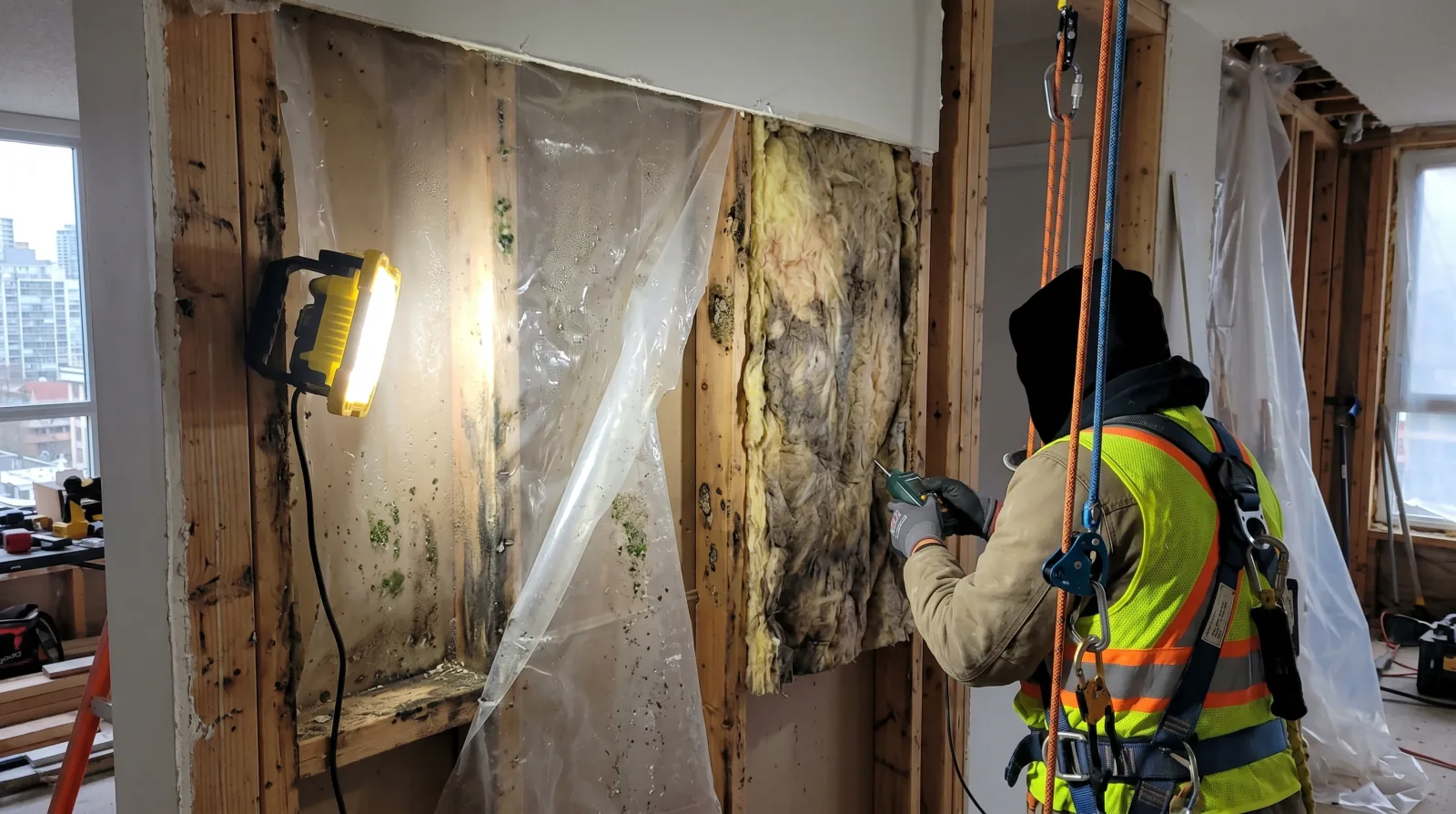
The mechanism in one walk-through
Take a January evening in a Burnaby wood-frame low-rise. The suite sits warm and occupied, its air loaded with the day's cooking and showers. Outside it is a few degrees above freezing. Somewhere between the painted drywall and the cladding, the temperature drops from room-warm to nearly outdoor-cold, layer by layer through the assembly.
Now give that moist indoor air a path into the wall: an unsealed electrical box, a gap where the poly was cut for a renovation, the shrinkage crack along a window frame. Warm air moves through the gap, cools as it crosses each layer, and the moment it touches a surface below its dew point, water appears. On the back of the sheathing. On the inner face of the poly where it was pushed against cold insulation. Along a rim joist. The suite side stays bone dry while the middle of the wall collects water, night after night, all season.
That is the whole phenomenon. Everything else in this guide is about where it happens, how to spot it, and how to stop it.
Why it mimics a leak so convincingly
When accumulated moisture finally shows, it shows the way leaks show: a stain spreading on drywall, paint lifting, a soft baseboard, rot discovered when a kitchen wall comes open. Every instinct says water got in from outside. Investigations get pointed at the roof, the windows, the cladding joints, and on an older building those suspects always look guilty enough to charge.
The discipline that prevents the wasted repair is the same weather correlation covered in our condensation versus leak guide: interstitial damp deepens through cold snaps and heavy-occupancy weeks, while leaks answer to the rain. The five field clues below do the rest.
Field clues that point inside the wall
Damp that ignores the rain record
Staining that grows through cold dry weeks and eases in mild wet ones runs opposite to every leak pattern. Interstitial condensation follows outdoor temperature, because colder weather chills the hidden surfaces inside the wall where the moisture is forming.
Stains with no exterior detail above them
A leak needs an entry point, and investigators can usually name a suspect: a window head, a junction, a joint. Interstitial staining appears mid-wall or along framing lines with nothing on the exterior to blame, because the water source is the room air itself.
Moisture readings that peak inside the assembly
Probe readings that run wetter at the sheathing than at the interior finish suggest moisture accumulating within the wall rather than passing through from outside. A leak wets from the exterior in; interstitial condensation wets the middle of the sandwich.
A pattern that follows framing and fasteners
Ghosting lines along studs and rows of screw heads show where thermal bridges chill the interior face. The same physics runs inside the assembly, so condensation concentrates at the coldest buried surfaces first, and the stains map the structure behind the drywall.
Musty odour without visible water
Moisture held inside an assembly can support hidden deterioration long before anything shows on the paint. A persistent musty smell on exterior walls, with dry interior surfaces, is a classic prompt for exploratory openings.
The assemblies that get it in BC
Metro Vancouver's housing stock offers this mechanism plenty of targets. Pre-1980s wood frame often has no deliberate air barrier at all, so winter after winter of indoor air migrates through the walls; those buildings survived because they were also leaky enough to dry. Later stock is tighter but inconsistently so, and every renovation since has punched holes in whatever air control existed: pot lights, new wiring, opened walls closed without resealing.
Concrete towers earn their own version. Furred-out interior walls hide cold concrete behind thin insulation, and suite air that reaches that concrete condenses on it, feeding the damp closets and perimeter staining familiar to owners in older West End and Metrotown towers. The related problem of cold interior surfaces in these buildings is covered in the thermal bridging guide, and the control layers that govern all of it are the subject of the vapour barrier and airtightness guide.
Retrofits deserve a caution of their own. Insulation added to a wall's inboard side drops the winter temperature of everything outboard of it. Do that without sealing the air paths and the assembly condenses harder than it ever did before the upgrade. Insulate and air-seal as one scope, and prefer exterior insulation where the design allows: warm sheathing collects no condensate.
Confirming it, and fixing it
Confirmation is investigative work: mapped moisture readings, logged indoor humidity, thermal imaging, and finally a small exploratory opening at the worst reading. Wet on the inner face of the sheathing with a clean weather barrier behind the cladding settles the question. The opening also answers the harder one, how much decay the seasons have already caused, which sets whether the scope is sealing and ventilation or framing repair. A structured investigation of this kind is what our building envelope hub describes, and it is the point where a council should have professionals involved rather than guessing.
The fix always attacks the two inputs. Cut the moisture supply: air-seal the leakage paths, improve exhaust ventilation so suite humidity drops. Warm the cold planes: continuous insulation, thermal breaks, assembly repairs through a scoped building envelope repair where the wall itself needs work. Buildings that get both inputs addressed stop condensing inside. Buildings that get repainted keep their secret one more season, at compound interest.
Quick answers
What is interstitial condensation?
Interstitial condensation is condensation that forms inside a wall, roof, or floor assembly instead of on a visible surface. Warm indoor air carrying water vapour moves into the assembly, meets a layer cold enough to sit below the air's dew point, and deposits liquid water there: on sheathing, on the back of cladding, on framing. The wall wets from within while every visible surface stays dry, which is what makes it dangerous.
How does indoor moisture get inside a wall assembly?
Two transport routes. Air leakage carries moist air bodily through gaps: electrical boxes, unsealed drywall joints, window perimeters, plumbing penetrations. Vapour diffusion moves water molecules slowly through the materials themselves. Air leakage moves far more moisture in real buildings, which is why a wall with a technically correct vapour barrier but a leaky air barrier can still condense heavily inside, right at the spots where the air escapes.
Why does interstitial condensation get mistaken for a roof or wall leak?
Because the visible evidence is identical: a stain, blistered paint, damp drywall, sometimes rot found during a renovation. The water simply arrived from the opposite direction. We have seen stratas fund sealant programs and flashing repairs chasing stains that a winter of indoor moisture had produced from inside. The tell is correlation: interstitial damp tracks cold weather and indoor humidity, while a genuine leak tracks rain events on the exposed elevation.
Interstitial condensation questions
What is interstitial condensation?
Interstitial condensation is condensation that forms inside a wall, roof, or floor assembly instead of on a visible surface. Warm indoor air carrying water vapour moves into the assembly, meets a layer cold enough to sit below the air's dew point, and deposits liquid water there: on sheathing, on the back of cladding, on framing. The wall wets from within while every visible surface stays dry, which is what makes it dangerous.
How does indoor moisture get inside a wall assembly?
Two transport routes. Air leakage carries moist air bodily through gaps: electrical boxes, unsealed drywall joints, window perimeters, plumbing penetrations. Vapour diffusion moves water molecules slowly through the materials themselves. Air leakage moves far more moisture in real buildings, which is why a wall with a technically correct vapour barrier but a leaky air barrier can still condense heavily inside, right at the spots where the air escapes.
Why does interstitial condensation get mistaken for a roof or wall leak?
Because the visible evidence is identical: a stain, blistered paint, damp drywall, sometimes rot found during a renovation. The water simply arrived from the opposite direction. We have seen stratas fund sealant programs and flashing repairs chasing stains that a winter of indoor moisture had produced from inside. The tell is correlation: interstitial damp tracks cold weather and indoor humidity, while a genuine leak tracks rain events on the exposed elevation.
Which wall assemblies are most prone to interstitial condensation?
Assemblies with cold layers reachable by indoor air: older wood-frame walls with interrupted or damaged polyethylene, walls where renovations cut the air barrier, under-insulated concrete assemblies whose interior furring hides cold concrete, and any wall stuffed with extra insulation but never air-sealed, which makes the outer layers colder without stopping the moist air reaching them. Buildings from before airtightness was taken seriously carry the most risk in Metro Vancouver.
What are the visible signs that condensation is forming inside a wall?
From inside a suite: staining or ghosting lines that follow studs and fasteners, paint that blisters mid-wall with no plumbing nearby, a musty smell on exterior walls, and damp that worsens in cold dry weather. From the exterior: staining bleeding from cladding joints, and on openings, sheathing found wet on its inner face. None is conclusive alone. Together with a weather-correlated log they justify moisture probes and a small exploratory opening.
How is interstitial condensation confirmed on site?
By finding the moisture where the mechanism says it should be. Surface and probe moisture readings are mapped across the suspect wall, indoor humidity is logged over days, and thermal imaging locates the cold planes. The decisive step is a small exploratory opening: if the inner face of the sheathing carries condensation staining while the outer face and the weather barrier look clean, the water formed inside. The opening also reveals how far any rot has progressed.
Can adding insulation make interstitial condensation worse?
Done carelessly, yes. Insulation added to the inboard side of an assembly makes everything outboard of it run colder in winter. If moist indoor air can still reach those now-colder layers, condensation risk goes up, which is how well-meant retrofit projects have created moisture problems older leakier walls never had. The safe sequence pairs added insulation with air sealing, and puts insulation outboard of the sheathing where the design allows it.
Does interstitial condensation damage the structure?
Given seasons to repeat, yes. Wood sheathing and framing that get wet each winter and never fully dry lose strength to decay, fastener corrosion sets in, and insulation packs down and underperforms, chilling the wall further. It is the same deterioration path the leaky condo era made infamous, driven from the inside instead. The quiet timeline is the problem: assemblies can degrade for years before a stain or a renovation exposes the damage.
How is interstitial condensation fixed?
By cutting the moisture supply and warming the cold planes, in whatever mix the assembly needs. Air sealing closes the leakage paths that feed the wall. Ventilation improvements lower the indoor humidity that loads the air. Where the assembly itself is the weakness, envelope work: continuous exterior insulation to keep the sheathing warm, and repair of any decayed framing found along the way. The right mix comes out of the investigation, and it differs by era and assembly.
Can a wall dry out on its own once it has condensed inside?
Sometimes, if the wetting season is short and the assembly can dry in at least one direction. Vancouver makes that hard: winters are long, outdoor air stays damp into spring, and vinyl-clad or face-sealed walls dry slowly in both directions. An assembly that takes on more moisture each winter than it sheds each summer accumulates year over year, which is why moisture problems inside walls should be investigated promptly instead of waited out.
Stains with no leak to blame?
We investigate hidden moisture on strata and commercial buildings across Vancouver, Burnaby, and the North Shore, with testing and exploratory openings that find where the water is really coming from.