Vapour barriers and airtightness: two jobs, one confused reputation
Ask a room of strata owners what protects their walls from indoor moisture and most will say the vapour barrier. The honest answer is that the poly sheet gets the credit while the air barrier does the heavy lifting. Moisture enters walls by two mechanisms, diffusion and air leakage, and they are not close in scale. This guide separates the two jobs and explains where the effort belongs.
Two transport mechanisms, side by side
Both mechanisms start from the same fact: a heated Vancouver suite in winter holds more moisture than the air outside, and that moisture pushes toward the cold. The difference is the vehicle.
| Aspect | Vapour diffusion | Air leakage |
|---|---|---|
| How the moisture travels | Water molecules diffuse through solid materials, one molecule at a time, driven by the vapour pressure difference between warm moist inside and cold dry outside. | Moist air moves bodily through gaps and cracks, carrying its whole water load with it: electrical boxes, poly seams, window perimeters, plumbing and duct penetrations. |
| How much moisture it moves | Slow and small. Diffusion through an intact wall face is a trickle the assembly can usually handle over a season. | Orders of magnitude more. A single ongoing air leak can deliver more water into an assembly in one winter than diffusion would in years. |
| What controls it | The vapour barrier or vapour retarder: polyethylene sheet in most BC frame walls, or coatings and materials with low vapour permeability. | The air barrier system: sealed sheathing or membranes, gaskets, sealant joints, and taped connections, continuous across every assembly and junction. |
| How it fails | Rarely dramatically. Problems arise mainly when a low-permeability layer sits on the wrong side of the assembly and blocks drying. | Through every unsealed hole, and every renovation adds more. Failure is local, invisible, and concentrated: each leak path condenses moisture at its own cold exit. |
| Where the effort should go | Getting the layer on the warm side and choosing materials that let the assembly dry. More poly is rarely the answer. | Relentless continuity. Air sealing at boxes, perimeters, and penetrations returns more moisture protection per dollar than any other envelope work of its size. |
The scale gap is the point to carry away. Diffusion is a molecule-by-molecule process that intact materials slow to a trickle. Air leakage is a freight service: every cubic metre of escaping air hauls its full moisture cargo into the assembly and unloads it at the coldest surface on the route. A wall with perfect poly and a leaky air barrier loses the moisture war; a wall with modest vapour control and excellent airtightness usually wins it.
Where the moisture ends up
What makes air leakage destructive is concentration. The leak path is fixed, the cold exit is fixed, so the same square hand-span of sheathing takes the whole winter's delivery. That is the supply line behind the hidden wetting described in the interstitial condensation guide: wet insulation around one outlet, a rot pocket at one window corner, staining along one rim joist, in a wall that looks fine everywhere else.
The cold exits themselves are the bridged details mapped in the thermal bridging guide. The two mechanisms cooperate: bridging sets where the cold surfaces are, leakage decides how much moisture reaches them. Fix either half and the damage slows; fix both and it stops.
What this means for Metro Vancouver's building stock
Old stock forgave everything by leaking everywhere. Pre-1980s walls in Vancouver and Burnaby lost so much heat that their assemblies stayed warm and dry, and airflow dried the rest. Those buildings outran the moisture problem, at the cost of every heating dollar. Each retrofit since, new windows, weatherstripping, insulation top-ups, has slowed the escape of heat without necessarily sealing the escape of air, and a wall that is colder but still air-leaky is the exact recipe for hidden condensation. Retrofits need to seal and insulate as one scope, never insulate alone.
New stock inverts the problem. Current construction is tight enough that the accidental ventilation is gone, so the moisture stays in the suite air until mechanical ventilation exports it, which is why the newest towers produce wet-window complaints in their first winter and why the ventilation guide matters most in the newest buildings. The full era-by-era pattern is mapped in the new versus older buildings guide within this hub.
The exterior side of airtightness
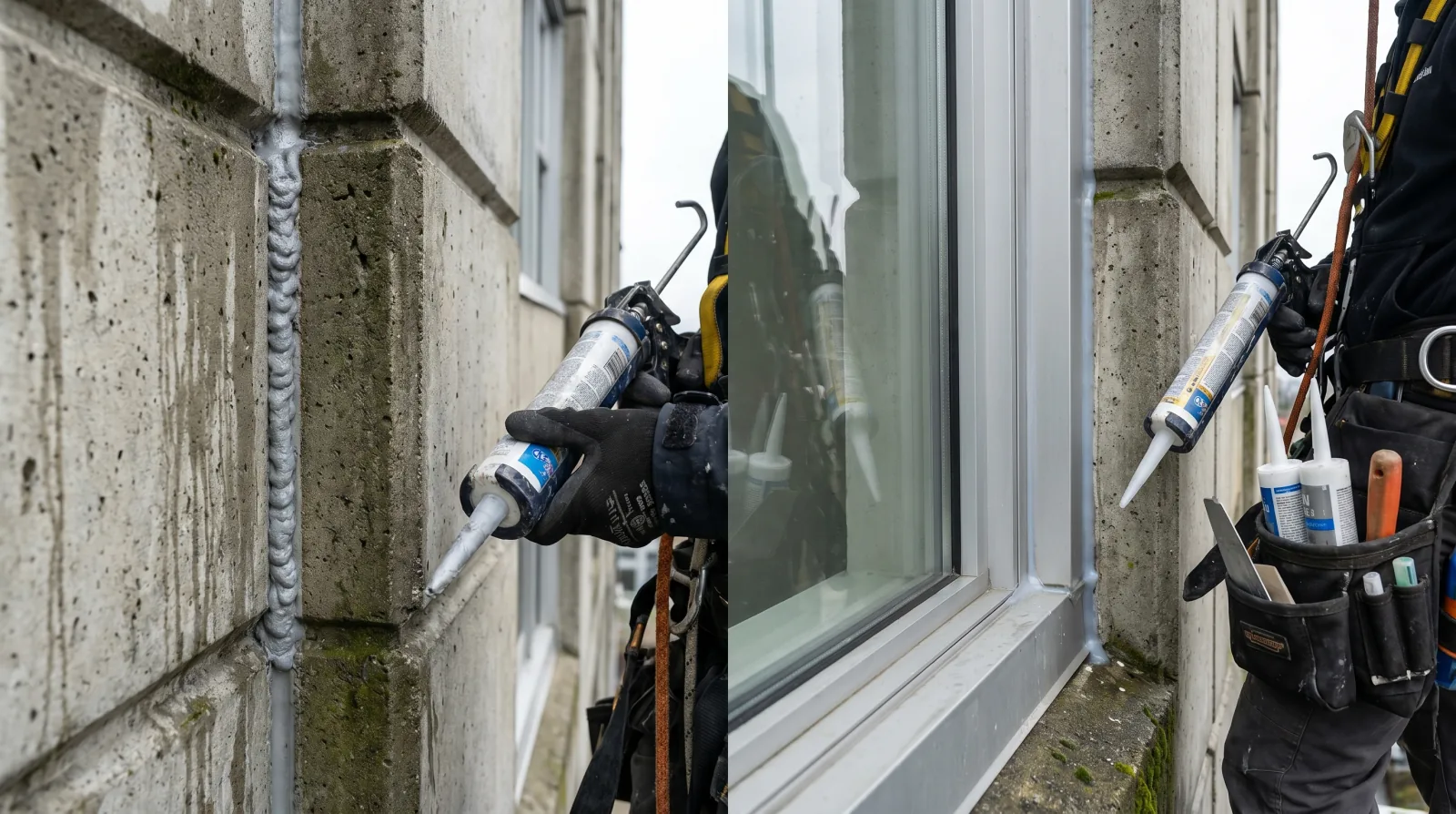
Suite-side sealing gets the attention, but on concrete and curtain wall buildings a large share of the air barrier lives outside: the sealant joints between panels, around window perimeters, and at penetrations. Those joints age in Vancouver's rain and UV on a service-life clock, and when they fail they leak air outward in winter and water inward in every storm, a double failure covered across our sealant and caulking hub. Joint renewal on a tower is rope access work, and it is one of the few envelope scopes that improves airtightness, weather-tightness, and appearance in a single pass, the kind of work our building envelope repair service scopes and delivers.
The takeaway for a council weighing priorities: before funding anything exotic, find out where the building leaks air and seal it. It is unglamorous work measured in tubes of sealant and rolls of tape, and it protects more wood and drywall per dollar than any other line on the moisture budget.
One habit protects all of it going forward: treat every renovation as an air barrier event. Each opened wall, new pot light, and relocated outlet either restores the continuity it cut or leaves a permanent leak path, and the difference is a few minutes of sealing while the wall is open. Councils that put that sentence in their renovation approval conditions spend less on moisture damage a decade later.
Quick answers
What is the difference between a vapour barrier and an air barrier?
They stop two different transport mechanisms. A vapour barrier resists water molecules diffusing through materials; in most BC wood-frame walls it is the polyethylene sheet behind the drywall. An air barrier stops bulk air movement through the assembly, and it is a system: sealed membranes, gaskets, tapes, and sealant working as a continuous surface. One sheet of poly can serve both roles, but only if every seam, edge, and penetration is sealed, which is where most walls fall short.
Which moves more moisture into a wall, air leakage or vapour diffusion?
Air leakage, and by a wide margin. Diffusion pushes individual molecules through materials slowly, while a leak path carries whole air volumes with all the moisture they hold, hour after hour, all heating season. Building science has recognized for decades that a small hole in the air barrier outperforms an entire wall of diffusion as a moisture delivery mechanism, which is why airtightness, on this specific question, matters more than the vapour barrier most owners worry about.
What is the poly sheet inside BC walls actually for?
The polyethylene sheet behind the drywall in most BC frame construction is the vapour barrier, placed on the warm side of the insulation so indoor moisture cannot diffuse into the cold parts of the wall and condense there. Where it is continuous and sealed it also serves as the air barrier. Cut, punctured, or unsealed, it still slows diffusion but lets air leakage through, and air leakage is the bigger mover of moisture.
Vapour barrier and airtightness questions
What is the difference between a vapour barrier and an air barrier?
They stop two different transport mechanisms. A vapour barrier resists water molecules diffusing through materials; in most BC wood-frame walls it is the polyethylene sheet behind the drywall. An air barrier stops bulk air movement through the assembly, and it is a system: sealed membranes, gaskets, tapes, and sealant working as a continuous surface. One sheet of poly can serve both roles, but only if every seam, edge, and penetration is sealed, which is where most walls fall short.
Which moves more moisture into a wall, air leakage or vapour diffusion?
Air leakage, and by a wide margin. Diffusion pushes individual molecules through materials slowly, while a leak path carries whole air volumes with all the moisture they hold, hour after hour, all heating season. Building science has recognized for decades that a small hole in the air barrier outperforms an entire wall of diffusion as a moisture delivery mechanism, which is why airtightness, on this specific question, matters more than the vapour barrier most owners worry about.
What is the poly sheet inside BC walls actually for?
The polyethylene sheet behind the drywall in most BC frame construction is the vapour barrier, placed on the warm side of the insulation so indoor moisture cannot diffuse into the cold parts of the wall and condense there. Where it is continuous and sealed it also serves as the air barrier. Cut, punctured, or unsealed, it still slows diffusion but lets air leakage through, and air leakage is the bigger mover of moisture.
Do older Vancouver buildings have vapour barriers at all?
Much of the pre-1980s stock has no deliberate poly, and what passes for an air barrier is whatever the plaster, sheathing, and paint happen to provide. Those buildings survived because they leaked in both directions: heat losses kept assemblies warm enough to stay dry, and generous airflow dried what did get wet. Tighten one of those walls without a plan and the old forgiveness disappears, which is why insulation retrofits on old stock need moisture thinking.
Can a building be too airtight?
What reads as "too airtight" is under-ventilation for how airtight the building has become. Every hour of accidental leakage a wall loses to sealing is an hour of ventilation the mechanical systems now owe the occupants. Tight construction with working exhaust and supply is the driest, most comfortable combination available. Tight construction with the ventilation left as an afterthought produces wet windows in the first winter, a pattern Metro Vancouver's newest buildings demonstrate every year.
What happens at a gap in the air barrier?
The gap becomes a moisture concentrator. Warm moist air streams through it all winter, cools as it crosses the assembly, and drops its moisture at the coldest surface along the path, the same spot every night. That is why air leakage damage is local and repeatable: wet insulation around one electrical box, a rot pocket at one window corner, staining along one rim joist, while the rest of the wall stays dry.
How is airtightness actually tested?
With pressure testing. A blower door depressurizes the building or suite while instruments measure how much air the envelope admits, which yields a leakage rate and, with smoke or infrared alongside, a map of where the paths are. On existing buildings the practical version is often targeted: thermal imaging during cold weather shows leak paths as warm streaks from outside or cold streaks from inside, and smoke pencils confirm them one by one.
Where do air leaks usually hide in a suite?
At every place trades cut a hole after the poly went up. Electrical outlets and switch boxes on exterior walls, pot lights punched into insulated ceilings, plumbing and duct penetrations, the gap between window frame and rough opening behind the trim, baseboard lines where drywall stops short, and attic hatches. Individually each is small. Together they are the suite's real ventilation system, running unmanaged through the insulated assemblies where moisture does damage.
Does paint work as a vapour barrier?
Specific low-permeability primers, marketed as vapour barrier or vapour retarder paints, measurably slow diffusion and are a recognized retrofit where adding poly is impractical, such as older plaster walls. Ordinary paint passes far too much vapour to serve that role. And no paint of any kind works as an air barrier: paint films bridge no gaps, so the air leakage paths that move most of the moisture pass straight through a painted wall's outlets, joints, and penetrations untouched.
Should renovations in older suites add poly to opened walls?
A renovation that opens an exterior wall is the cheapest moment the building will ever have to improve that wall, and current BC Building Code practice governs what goes back in. The details matter more than the sheet: a warm-side barrier sealed as part of a continuous air barrier helps; poly stapled up with open seams adds little; and a low-permeability layer positioned where it blocks the assembly from drying can make things worse. Renovation-scale envelope questions deserve envelope advice.
Why does airtightness matter more than most owners think?
Because owners picture heat loss when they hear air leakage, and the heating bill is the smaller half of the story. The larger half is moisture: leaking air is the main route by which indoor humidity reaches cold hidden surfaces inside assemblies, where it condenses and feeds the slow deterioration that surfaces years later as stains, soft framing, and repair scopes. Air sealing is moisture protection disguised as an energy measure, and it is cheap.
Wondering where your building leaks?
We assess envelope joints, sealants, and moisture paths on strata and commercial buildings across Vancouver, Burnaby, and the North Shore, and we scope the sealing work that actually protects the assemblies.