Thermal bridging and cold spots: why the corner goes black first
Condensation never lands randomly. It lands on the coldest surfaces a suite offers, and in most Metro Vancouver buildings those surfaces sit where the structure itself carries heat out through the insulation: slab edges, balcony connections, corner framing, metal frames. Understand the bridges and the staining map of a whole building becomes predictable, floor after floor.
Heat takes the easiest road out
Insulation works by making the wall a difficult road for heat. A thermal bridge is an easy road left open: any material that conducts well and runs unbroken from the warm side to the cold side. Concrete, steel, and aluminum all qualify enthusiastically. Wherever they cross the envelope, heat streams out along them, and the interior surface at the indoor end of the bridge runs cold, sometimes dramatically colder than the wall a hand-span away.
Cold interior surfaces are the demand side of every condensation problem in the condensation and moisture hub. The suite supplies moist air; the bridge supplies a surface below its dew point; water changes address. That is the whole transaction, repeated nightly from October to April, and it explains the least intuitive fact in this field: two identical households can live identically and only the one behind the bridged wall gets the black corner.
The usual suspects, ranked by how often we meet them
Exposed slab edges in older concrete towers
Floor slabs that run from the heated interior straight out to the exterior face, edge exposed to the weather, conduct heat out along the entire building perimeter. The interior floor and ceiling near the exterior wall run cold, and the perimeter strip of every suite becomes a condensation zone. Common in Metro Vancouver towers built before thermally broken details.
Cantilevered concrete balconies
A balcony poured as a continuation of the floor slab is a fin of interior concrete standing in the rain and wind. It drains heat from the suite behind it all winter, chilling the floor strip and wall around the balcony door. The industry name is apt: a cooling fin, doing for the suite exactly what fins do for an engine.
Corner framing and closet walls
Building corners concentrate framing and dilute insulation, and closets on exterior walls add still air and stored goods on top. The result is the coldest painted surface in most suites, which is why the closet corner is so often the first place staining appears, and why the pattern repeats suite above suite.
Studs, screws, and framing lines
Every stud is a small bridge through the insulation beside it. On cold mornings the wall surface over each stud runs slightly cooler, collects slightly more moisture and dust, and over years prints faint ghost lines of the framing onto the paint. Steel studs bridge harder than wood.
Old window frames and lintels
Aluminum frames without thermal breaks, steel lintels over openings, and uninsulated concrete window surrounds all deliver outdoor cold to indoor surfaces. The frame condensation covered in the window guide is this same mechanism at its most visible.
Winter is the season to look. The colder the outdoor air, the harder every bridge works and the wider the temperature gap an infrared camera or a hand on the wall can find. Dust ghosting helps too: over years, slightly damp, slightly cool stripes collect fine dust and print the hidden framing onto the paint, a free map of the bridges that needs no equipment at all, only a low angle of light.
The balcony problem, above and below
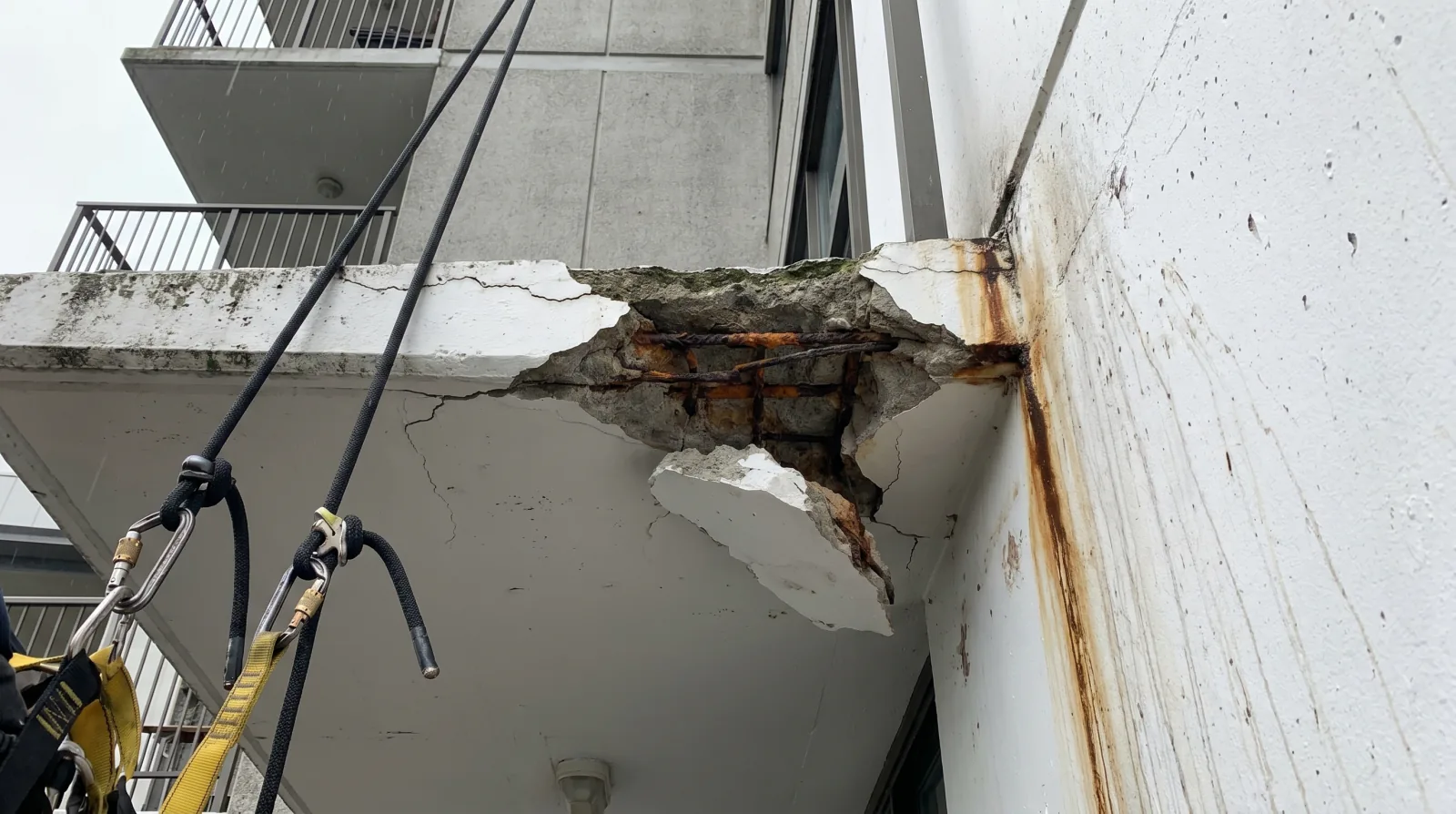
Cantilevered balconies earn a second look because they misbehave in two directions at once. Thermally, the slab chills the suite behind it, as covered above. Structurally, the same exposed slab takes Vancouver's full rain load on its top surface and its edge, and decades of that exposure is how balcony edges and soffits end up like the photo above: cover concrete spalled away, reinforcing steel corroding in the weather. The two problems arrive together on the same era of building, which is why balcony assessments should read both.
The moisture side of that deterioration, membrane condition, drainage, and the signs a balcony is taking on water, lives in our balcony waterproofing hub. Any balcony already dropping concrete fragments is past the reading stage: barricade below it and get a professional review promptly.
What the fixes look like
On an existing building the structure is the structure, so the realistic goals are warming the indoor end of each bridge or intercepting the moisture, and the options rank by depth of intervention. Habits and layout come first: furniture off the exterior walls, closet doors ajar in winter, ventilation keeping the moisture supply down, all covered in the winter humidity guide. These do not warm the bridge a single degree; they reduce what it can condense.
Interior insulation is the middle option, warming the painted surface while pushing the cold plane deeper into the assembly. It works when paired with airtightness, and backfires without it, for the reasons the interstitial condensation guide explains: colder structure plus reachable moist air equals hidden wetting.
Exterior insulation is the complete answer, wrapping the structure so slab edges and framing sit inside the warm zone. On existing towers it arrives as overcladding during major envelope renewal, which is a capital project on a depreciation-report timescale, planned years ahead. The practical strata move is to make sure thermal performance is in the scope conversation whenever recladding, window renewal, or major coating work is being planned anyway, through an assessment such as our building envelope repair service provides. Fixing the bridges while the scaffolding is already up costs a fraction of a dedicated project later.
Quick answers
What is a thermal bridge in plain terms?
A thermal bridge is a path where heat bypasses the insulation because a conductive material runs unbroken from inside to outside. Concrete slabs, steel studs, and aluminum frames conduct heat far better than the insulation around them, so wherever they cross the wall they act like a wick, pulling heat out and leaving the interior surface along that path cold. Cold interior surfaces are where room moisture condenses first.
Why do closet corners turn black first?
A closet on an exterior corner stacks every disadvantage at once. Corners concentrate framing and thin out insulation, so the surface runs cold. Closet doors stay shut, so heated room air never warms it. Clothes and boxes block what little air movement exists. The result is the coldest, stillest painted surface in the suite, condensing moisture nightly and drying slowest, which is exactly the sustained damp that staining needs.
Why does a concrete balcony make the suite behind it cold?
When a balcony is a cantilevered extension of the floor slab, the same piece of concrete runs from the heated living room out into the weather with no break. Concrete conducts heat well, so the slab drains warmth from the suite and sheds it outdoors along the balcony's whole area, like a cooling fin. The floor strip and wall around the balcony door run cold all winter, and condensation finds them.
Thermal bridging questions
What is a thermal bridge in plain terms?
A thermal bridge is a path where heat bypasses the insulation because a conductive material runs unbroken from inside to outside. Concrete slabs, steel studs, and aluminum frames conduct heat far better than the insulation around them, so wherever they cross the wall they act like a wick, pulling heat out and leaving the interior surface along that path cold. Cold interior surfaces are where room moisture condenses first.
Why do closet corners turn black first?
A closet on an exterior corner stacks every disadvantage at once. Corners concentrate framing and thin out insulation, so the surface runs cold. Closet doors stay shut, so heated room air never warms it. Clothes and boxes block what little air movement exists. The result is the coldest, stillest painted surface in the suite, condensing moisture nightly and drying slowest, which is exactly the sustained damp that staining needs.
Why does a concrete balcony make the suite behind it cold?
When a balcony is a cantilevered extension of the floor slab, the same piece of concrete runs from the heated living room out into the weather with no break. Concrete conducts heat well, so the slab drains warmth from the suite and sheds it outdoors along the balcony's whole area, like a cooling fin. The floor strip and wall around the balcony door run cold all winter, and condensation finds them.
How can cold spots in a suite be found?
Thermal imaging is the fast way: an infrared camera maps surface temperatures across a wall in seconds and paints the bridges as cold streaks. A surface thermometer does the same work point by point. Low-tech evidence works too: the corners that stain, the wall sections where dust prints ghost lines over studs, and the spots residents say feel cold to the touch are all findings, and they usually agree with the camera.
Do steel framing and concrete bridge more than wood?
Substantially. Steel and concrete conduct heat far better than wood, so a steel stud or an exposed concrete element moves much more heat through the same wall area than a wood stud would. This is why older concrete towers, with their exposed slab edges, uninsulated columns, and metal frames, produce the strongest cold-spot patterns in the region, and why ghost lines print more sharply on steel-framed walls.
Can thermal bridging be fixed from inside a suite?
Partially, and with care. Interior insulation over a cold wall or slab edge warms the room-side surface, which reduces visible condensation. But it also makes the structure behind it run colder, and if moist room air can still reach that structure, moisture can accumulate where nobody sees it. Interior fixes need an air-sealing plan alongside the insulation, and on chronic problems the durable fix is on the outside of the structure.
What is a thermal break?
A deliberate interruption of a conductive path with a low-conductivity material. In modern windows it is a plastic section separating the outer and inner halves of an aluminum frame. In new concrete construction, engineered break assemblies connect balcony slabs to floor slabs through an insulating joint while still carrying the structural load. The principle is the same at every scale: cut the conductive path so heat has to cross an insulating layer.
Why are older concrete towers the worst for cold spots?
Because their era built the structure straight through the envelope. West End, Kerrisdale, and Metrotown towers from the 1960s and 1970s typically have exposed slab edges at every floor, cantilevered balconies with no break, minimal wall insulation, and aluminum frames without thermal breaks. Each detail is a bridge, and together they make the suite perimeter one continuous cold zone. The buildings are structurally sound; they simply predate the thermal detailing.
Does repainting a black corner fix anything?
It resets the evidence and nothing else. The corner is cold because of the structure behind it, and the next winter of nightly condensation will restain the new paint on the old schedule. Repainting has a place after the cause is addressed, as the finishing step. As the whole response, it is the most commonly purchased non-fix in strata maintenance, repeated every few years while the underlying damp keeps working on the drywall.
Will exterior insulation fix thermal bridging?
It is the most complete fix available, because insulation outside the structure keeps the concrete and framing warm rather than fighting them from inside. Overcladding with continuous exterior insulation warms slab edges, columns, and studs all at once, and it typically happens during recladding or major envelope renewal when the building is already being reworked. Balconies are the stubborn exception: a cantilevered slab cannot be wrapped, only mitigated.
Is a cold room in winter a sign of thermal bridging?
Sometimes. A perimeter room that never holds heat despite working heaters may be losing it through bridged details: slab edges, a balcony, corner framing, old frames. But heating balance, duct issues, and simple air leakage produce the same complaint. What distinguishes bridging is surface evidence: cold-to-the-touch spots, condensation, and staining in the classic locations. A thermal imaging pass during an envelope assessment sorts the causes quickly.
Same cold corner in suite after suite?
We map cold spots and their causes on strata and commercial buildings across Vancouver, Burnaby, and the North Shore, and we tell you which fixes belong in the next capital project.