Condensation or a leak? How to tell before you spend money
Mixing up condensation and envelope leakage is the single most common misdiagnosis in Metro Vancouver building maintenance. The two problems leave the same evidence, a damp patch and a stain, and demand opposite repairs. Four reads separate them: pattern, timing, location, and weather correlation. This guide works through each one the way we do on an assessment.
Why this call gets made wrong so often
A resident finds water pooling on a window sill in January and phones the property manager about a leaking window. It is a reasonable guess. The window is where the water is, and windows do leak. So a contractor recaulks the perimeter, the invoice gets paid, and in February the sill is wet again, because the water was never coming through the window. It was coming out of the room air, condensing on glass and aluminum that a cold snap had chilled below the dew point.
We see the reverse error too, though less often: staining written off as "just condensation" while a slow leak rots the wall behind it. Both errors trace to the same shortcut, diagnosing from a single glance at where the water sits. The reliable method reads four kinds of evidence together, and none of them requires opening a wall.
The four reads, side by side
On an assessment these get worked in order, and each one narrows the field. The table shows what each read looks like for the two causes.
| Read | Points to a leak | Points to condensation |
|---|---|---|
| Pattern: where the water shows | Concentrated near one detail: a window head, a wall-to-roof junction, a specific stretch of ceiling. One suite, or a vertical stack of suites, on one elevation. | Spread across cold surfaces: bottom edges of glass, metal frames, closet corners, the wall behind furniture. Often several suites at once, on the shaded orientations. |
| Timing: when it appears | Tracks rain events. Shows during or shortly after storms, and the worst episodes line up with wind-driven rain on that elevation. | Tracks temperature and occupancy. Worst on cold clear mornings, after showers and cooking, and through the coldest weeks of winter, rain or no rain. |
| Location: what kind of surface | Follows gravity and structure. Stains at ceilings, window heads, and the tops of walls, often below or beside an exterior detail that can admit water. | Follows cold. Glass, aluminum frames, perimeter floor slabs, uninsulated corners, and any surface a thermal bridge keeps chilled. |
| Weather correlation: what the log says | A dated log of episodes lines up with the rain record and wind direction. Dry spells produce quiet weeks even in January. | Episodes line up with outdoor temperature drops and indoor moisture events. A cold dry snap makes it worse, which no leak ever does. |
One read alone can mislead. Wind-driven rain can wet a whole elevation and mimic a spread-out pattern, and a cold snap that follows a storm can stack both mechanisms in the same week. Two or three reads agreeing is the standard we work to before scoping anything.
Timing is the strongest single signal
If a council keeps only one piece of evidence, keep the dates. A log of when the water appears, held against the local weather record, does more diagnostic work than any amount of staring at the stain. Vancouver's rain arrives in named, datable events, and its cold snaps are just as datable. Water that shows through a dry cold week has no envelope story to tell. Water that arrives with every southeasterly has no condensation story to tell.
The log matters for the next step too. When the evidence points outside, the investigation moves to our water ingress hub, which covers where leaks start and how they travel, and the dated episodes tell the investigator which elevation and which storms to reproduce with a hose. When the evidence points inside, the questions become thermal and mechanical: where are the cold surfaces, and where is the moisture coming from?
The condensation trail from here
Confirmed condensation splits into two further questions. First, surface or hidden? Water on glass and painted corners is surface condensation, manageable through ventilation and the thermal fixes covered in the cold spots guide. Staining with no cold surface in sight raises the harder possibility of condensation inside the wall assembly, which mimics a leak so well it fools professionals.
Second, one suite or many? A single damp suite in an otherwise dry building usually reflects that suite's moisture load and habits. The same damp repeating across an elevation reflects the building, and building-scale causes are the strata's to fix. The condensation and moisture hub maps which guide covers which cause.
When the answer is a leak after all
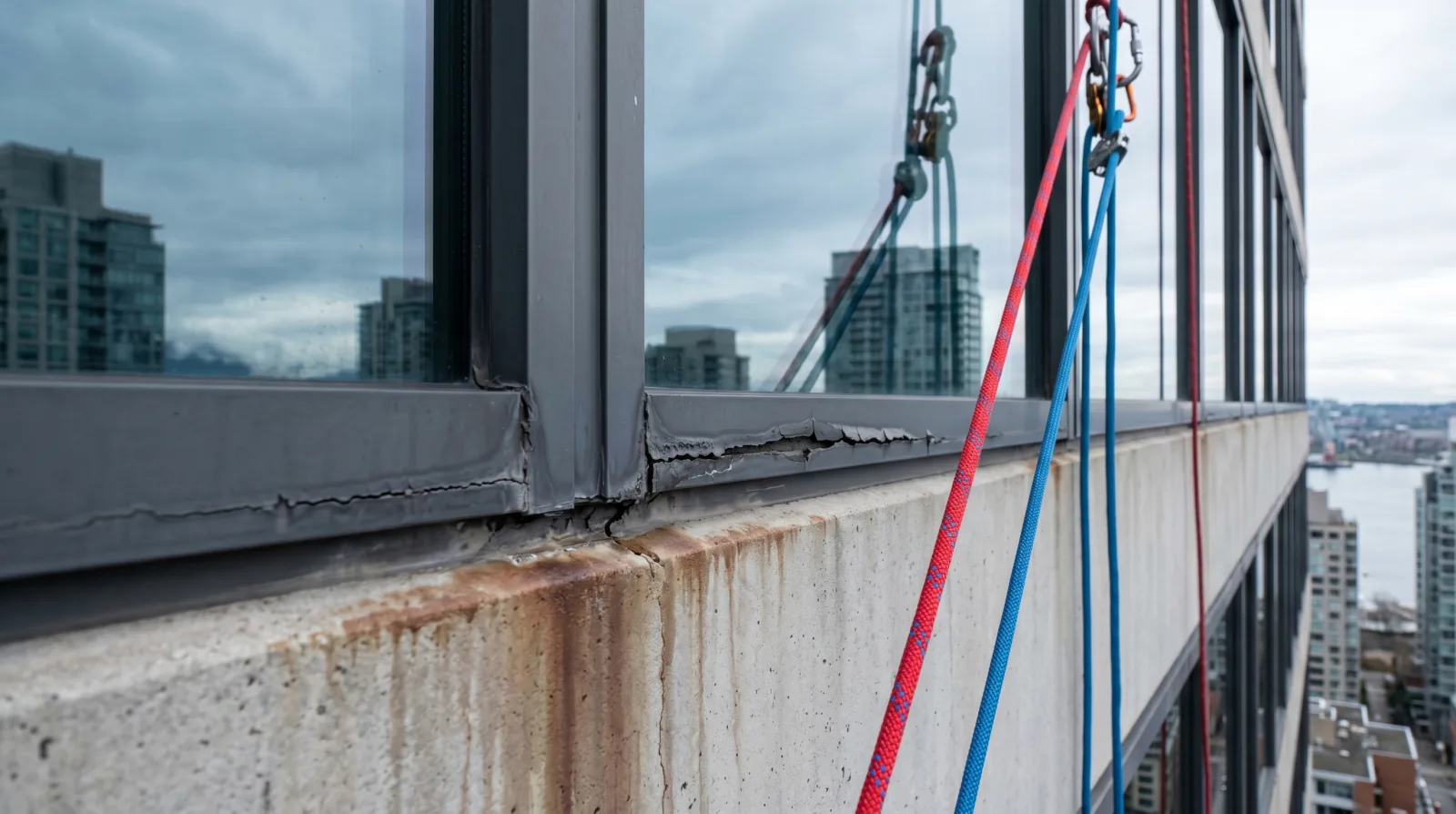
Roughly half the "condensation" calls we attend turn out to involve real water entry somewhere, often alongside a condensation problem that was masking it. Cracked perimeter sealant like the joint in the photo above admits storm water in exactly the place condensation also collects, which is why window complaints deserve the full four reads rather than a coin flip. Active entry is a repair scope, and an urgent one on wood-frame buildings: our leak repair service traces the entry point before repairing it, so the fix lands on the actual hole.
The worst outcome is the one where nobody diagnoses anything and the damp simply gets repainted every spring. Moisture problems should be fixed promptly, whichever mechanism drives them. Paint hides the evidence for a season; it has never once dried out a wall.
Quick answers
How do I tell if water on my wall is condensation or a leak?
Read four things in order: pattern, timing, location, and weather correlation. Water concentrated near one exterior detail, arriving with storms, points to a leak. Water spread across cold surfaces such as glass, frames, and closet corners, arriving with cold mornings and heavy indoor moisture, points to condensation. A dated log of when the water appears, held against the local rain record, settles most cases before anyone opens a wall.
Why does condensation get mistaken for a leak so often?
Because the end state looks identical: a damp patch, a stain, blistered paint. The observer sees water near a window and assumes the window let it in, when the glass and frame simply gave indoor moisture its coldest landing spot. It is the single most common misdiagnosis we encounter on Metro Vancouver buildings, and it sends crews to recaulk windows that were never leaking while the actual cause, cold surfaces plus indoor humidity, carries on.
Does a leak only show up when it rains?
Storm-driven leaks do, which is what makes the rain correlation such a strong signal. A few leak types break the rule: below-grade seepage under hydrostatic pressure can run days after the rain stops, plumbing failures ignore weather entirely, and a blocked drain can overflow on a schedule of its own. So a dry-weather drip rules out wind-driven rain at a facade detail, and it moves plumbing and drainage up the suspect list alongside condensation.
Condensation vs leak questions
How do I tell if water on my wall is condensation or a leak?
Read four things in order: pattern, timing, location, and weather correlation. Water concentrated near one exterior detail, arriving with storms, points to a leak. Water spread across cold surfaces such as glass, frames, and closet corners, arriving with cold mornings and heavy indoor moisture, points to condensation. A dated log of when the water appears, held against the local rain record, settles most cases before anyone opens a wall.
Why does condensation get mistaken for a leak so often?
Because the end state looks identical: a damp patch, a stain, blistered paint. The observer sees water near a window and assumes the window let it in, when the glass and frame simply gave indoor moisture its coldest landing spot. It is the single most common misdiagnosis we encounter on Metro Vancouver buildings, and it sends crews to recaulk windows that were never leaking while the actual cause, cold surfaces plus indoor humidity, carries on.
Does a leak only show up when it rains?
Storm-driven leaks do, which is what makes the rain correlation such a strong signal. A few leak types break the rule: below-grade seepage under hydrostatic pressure can run days after the rain stops, plumbing failures ignore weather entirely, and a blocked drain can overflow on a schedule of its own. So a dry-weather drip rules out wind-driven rain at a facade detail, and it moves plumbing and drainage up the suspect list alongside condensation.
Why is my ceiling wet when it has not rained for days?
Three candidates. Condensation forming on a cold ceiling surface or on the slab above it, common under uninsulated roof decks and slab edges. A plumbing or heating line weeping somewhere above. Or slow migration from an earlier rain event, since water stored in an assembly can take days to track through and show. The moisture pattern, a moisture meter, and a look above the ceiling separate them quickly.
Can a building have condensation and a leak at the same time?
Yes, and older Metro Vancouver buildings often do. A failed window perimeter seal admits storm water while the same window's aluminum frame condenses on every cold morning. The two problems then feed one damp patch, and fixing only one leaves the report open. Where the evidence is mixed, both mechanisms get tested: spray or hose testing for the envelope path, surface temperature and humidity readings for the condensation path.
What does it mean when many suites report damp at the same time?
Simultaneous reports across suites usually point at a shared cause. If the suites share an orientation and the reports follow a storm, suspect an envelope detail repeated on that elevation. If the reports arrive with the first cold week of winter, and the damp sits on windows and cold corners in each suite, suspect condensation driven by the building's shared thermal weaknesses. Either way, a multi-suite pattern is the building talking, and it justifies a proper assessment.
Which weather goes with condensation episodes?
Cold snaps, especially clear ones. Outdoor temperature drops pull interior surface temperatures down with them, and windows, frames, and thermally bridged corners fall below the dew point of the room air first. Vancouver's coldest stretches often arrive with dry outflow winds, so a damp problem that peaks in dry, cold weather is close to diagnostic for condensation. Storm-correlated damp, arriving with wind-driven rain on the exposed elevation, reads the opposite way.
What should a strata council record when a damp report comes in?
Date, suite, exact location of the water, what the weather had been doing for the previous two days, and photographs with something for scale. Ask the resident when it started, whether it comes and goes, and what makes it worse. Three or four dated entries build the correlation that diagnosis depends on, and the same log becomes evidence if the problem later turns into an insurance or warranty matter.
What tests confirm whether moisture comes from outside or inside?
For the envelope path: controlled water testing on the suspect details, moisture meter readings tracked during and after wetting, and exploratory openings where the evidence justifies them. For the condensation path: surface temperature readings across the suspect walls, indoor humidity monitoring over days rather than minutes, and thermal imaging to map the cold spots. The two test families are cheap compared with repairing the wrong thing.
Why does misdiagnosing condensation as a leak waste so much money?
Because envelope repairs are the expensive kind. A strata that recaulks an elevation, reflashes windows, or recoats a wall to chase what was condensation spends real money and changes nothing, then loses confidence in the next contractor too. The damp returns with the next cold snap, the finishes keep deteriorating, and the actual fixes, insulation at cold spots, working exhaust, humidity habits, sit untouched. Diagnosis first is the cheapest step in the whole sequence.
Wet wall, unclear cause?
We diagnose damp on strata and commercial buildings across Vancouver, North Vancouver, West Vancouver, and Burnaby, and we test before we scope, so the repair you fund matches the problem you have.