The North Shore Freezes and Thaws More Than Downtown Does
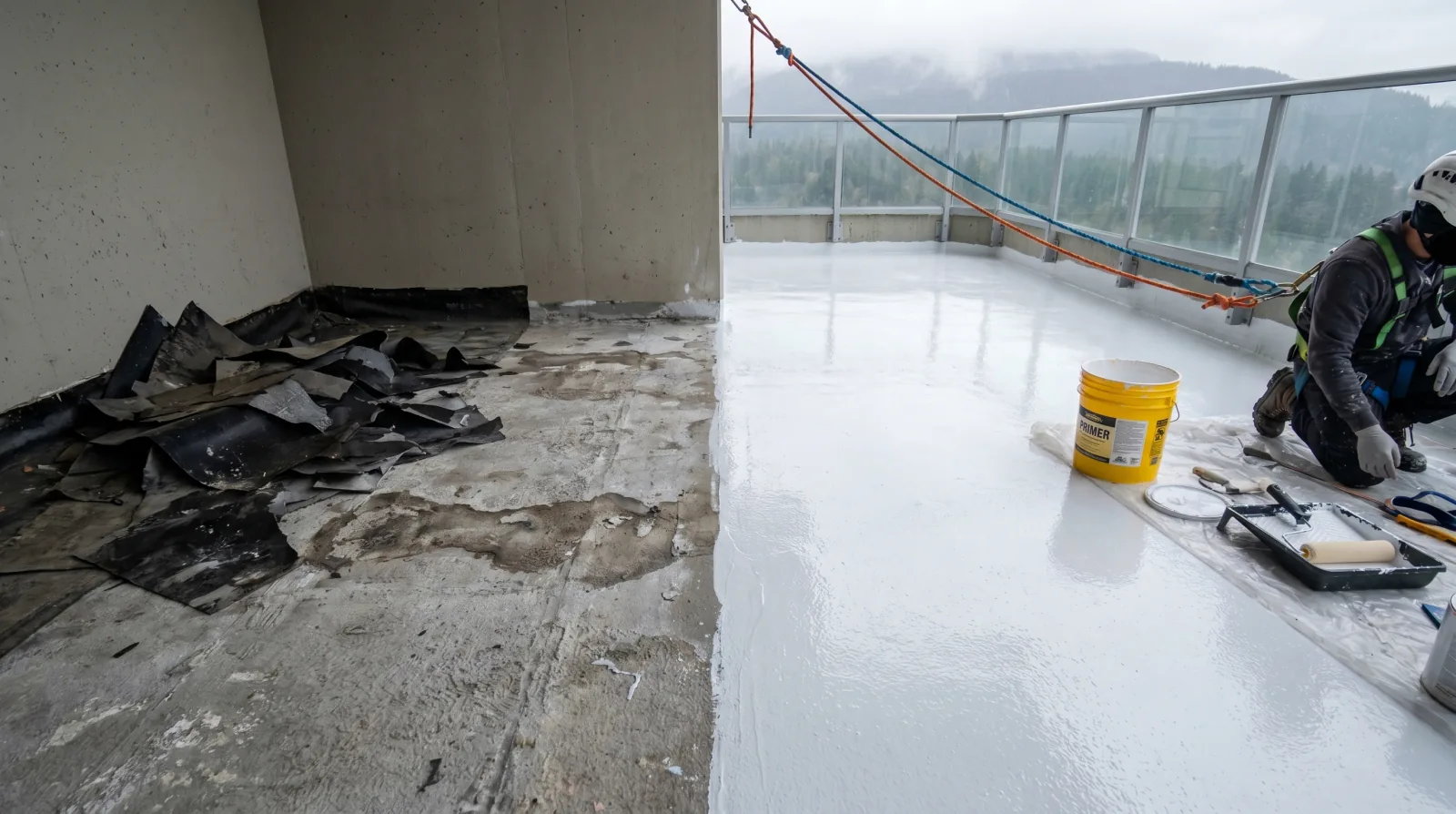
Two buildings in Metro Vancouver, twelve kilometres apart, built in the same decade to similar standards. One sits near the water downtown. The other is partway up a slope in North Vancouver.
The second building is deteriorating faster, and it is not because it was built worse.
Elevation changes the winter
Air temperature falls with height. A building several hundred metres up a North Shore slope experiences a measurably colder winter than one at sea level a short drive away.
The consequence that matters is not the depth of cold. It is how often the temperature crosses zero.
At the waterfront, many winter nights stay above freezing. Partway up the slope, those same nights drop below it and rise above it again the following day. Each crossing is a freeze-thaw cycle, and through a Metro Vancouver winter the difference in cycle count between the two locations is substantial.
The same applies to buildings in Coquitlam, Port Moody, and Burnaby at elevation, and to any building with a shaded elevation that stays cold while the rest of the structure warms.
Cycles do the damage, not the depth of cold
This is the point that gets this mechanism dismissed in a mild climate.
Water held in the pore structure of a porous material expands as it freezes. Where the material is saturated and has no void space to accommodate that expansion, the pressure damages it internally. Each cycle causes a small amount of damage, and the damage accumulates.
A continental climate that freezes in November and stays frozen until March delivers approximately one cycle to a building’s exterior. A coastal climate that hovers around zero and crosses it repeatedly delivers many.
That makes Metro Vancouver’s mild winter more aggressive for this particular mechanism than a colder one, which is the opposite of what most owners assume.
Saturation is the variable you control
The critical word is saturated. Dry material does not suffer freeze-thaw damage, however many cycles it experiences.
Which means the damage on a building maps its water problems. The locations that deteriorate are the locations that stay wet:
Horizontal surfaces that hold water, including balconies where the slope has failed, as described in the post on balcony deck drain retrofits.
The base of walls, where splash from grade and runoff from above keep material saturated.
Slab edges, where water tracks back along the soffit after a drip detail has stopped working.
Mortar joints and masonry on elevations that stay damp, which is the process behind the adhered veneer failures covered in the post on adhered stone veneer failure.
Anywhere a drainage detail has failed and water now collects where it previously drained.
That leads somewhere useful. You cannot change the number of freeze-thaw cycles at a given elevation. You can change whether the material is saturated when they happen, and drainage and detailing are therefore freeze-thaw protection, whatever else they are called on the invoice.
Coatings and membranes are affected too
Freeze-thaw reaches coatings and membranes as well as concrete and masonry.
Water trapped between a coating and its substrate expands when it freezes and lifts the coating away. That is a common contributor to the blistering and debonding described in the post on coating adhesion failure and blistering, and it explains why coating failures often appear or worsen over a winter.
Membranes in ponding areas are subject to the same effect at any defect where water has got underneath, and the ice formation enlarges the defect each season.
Air entrainment, and what older buildings lack
Air-entrained concrete contains a deliberate distribution of microscopic air voids. Freezing water expands into those voids rather than pressurizing the paste, which improves freeze-thaw resistance substantially.
Whether a given building has it depends on the original concrete specification. It is standard practice for exposed concrete now, and it was applied inconsistently on older construction, particularly on elements not considered exposed at the time.
This is not something that can be added retroactively. It is useful to know because it explains why two buildings of similar age in similar exposure deteriorate at different rates, and it informs how aggressively the drainage on a given building needs to be managed.
Salt makes it worse
Where de-icing salt is applied, the damage accelerates considerably. Salt affects freezing behaviour at the surface and produces more severe scaling, and it brings the chloride attack on reinforcement described in the post on concrete sealers versus coatings on parkade slabs.
Entrances, walkways, ramps, and any area where salt is applied and water collects are the worst combination present on most buildings. On the North Shore, where salt use is more frequent, that combination gets more exposure than it does downtown.
Which repairs hold up and which do not
Freeze-thaw exposure narrows what works as a repair, and materials that perform adequately in a sheltered location fail quickly in a cycling one.
Patch repairs on an exposed elevation need the compatibility properties set out in the post on concrete repair mortar selection, and they need low permeability specifically. A patch that absorbs water is a patch that will suffer the same freeze-thaw damage as the concrete it replaced, on a faster schedule because it is new material at an interface.
Sealant joints on high-exposure elevations see more movement than the same joints on a sheltered face, because thermal cycling is what drives joint movement. Products with higher movement capability earn their cost on those elevations, and the joint geometry has to be right for the reasons covered in the post on sealant joint design.
Coatings need to be either genuinely watertight or genuinely permeable. A coating that admits some water and then resists its escape traps moisture in exactly the place where freezing will lift it off.
Exposure varies within one building
A single building experiences several different freeze-thaw environments, and treating it as uniform produces a specification that is wrong somewhere.
North elevations stay cold and damp and cross zero more often than south elevations, which warm during the day. South and west elevations see the largest daily temperature swings, which drives thermal movement rather than freeze-thaw specifically. Elements that project from the building, including balconies, canopies, and parapets, lose heat on multiple faces and reach lower temperatures than the wall behind them.
That last point matters more than it appears. A projecting balcony slab is thermally exposed on top, underneath, and at its edge, so it cools further and faster than the building it is attached to. It is also the element most likely to be holding water, which is why balconies concentrate freeze-thaw damage on buildings where the wall itself is in reasonable condition.
Mapping the elevations by exposure before specifying repairs is a short exercise that produces a better-targeted scope than a single specification applied everywhere.
Inspect at the right time of year
Inspecting in late winter or early spring shows the accumulated damage from that season while it is fresh and before repairs, weathering, and cleaning obscure it.
Comparing an autumn inspection with a spring one for the same building shows what a single winter did, which is far more informative than an annual snapshot at an arbitrary date. Buildings at elevation on the North Shore benefit most from that comparison, because they have the most to show.
It also puts the findings in front of a council at the right point in the year to plan work for the following dry season, rather than a season later.
Sources and further reading
- Canadian Standards Association, CSA A23.1 Concrete Materials and Methods of Concrete Construction, air entrainment and exposure class provisions, referenced 2026
- National Research Council Canada, National Building Code of Canada, climatic design data for British Columbia locations, referenced 2026
- Canada Mortgage and Housing Corporation, Best Practice Guide: Wood-Frame Envelopes in the Coastal Climate of British Columbia, referenced 2026
- Allweathercoating condition assessment records, North Shore and Metro Vancouver, 2026