The Hole in the Wall Everyone Designed to Be a Hole
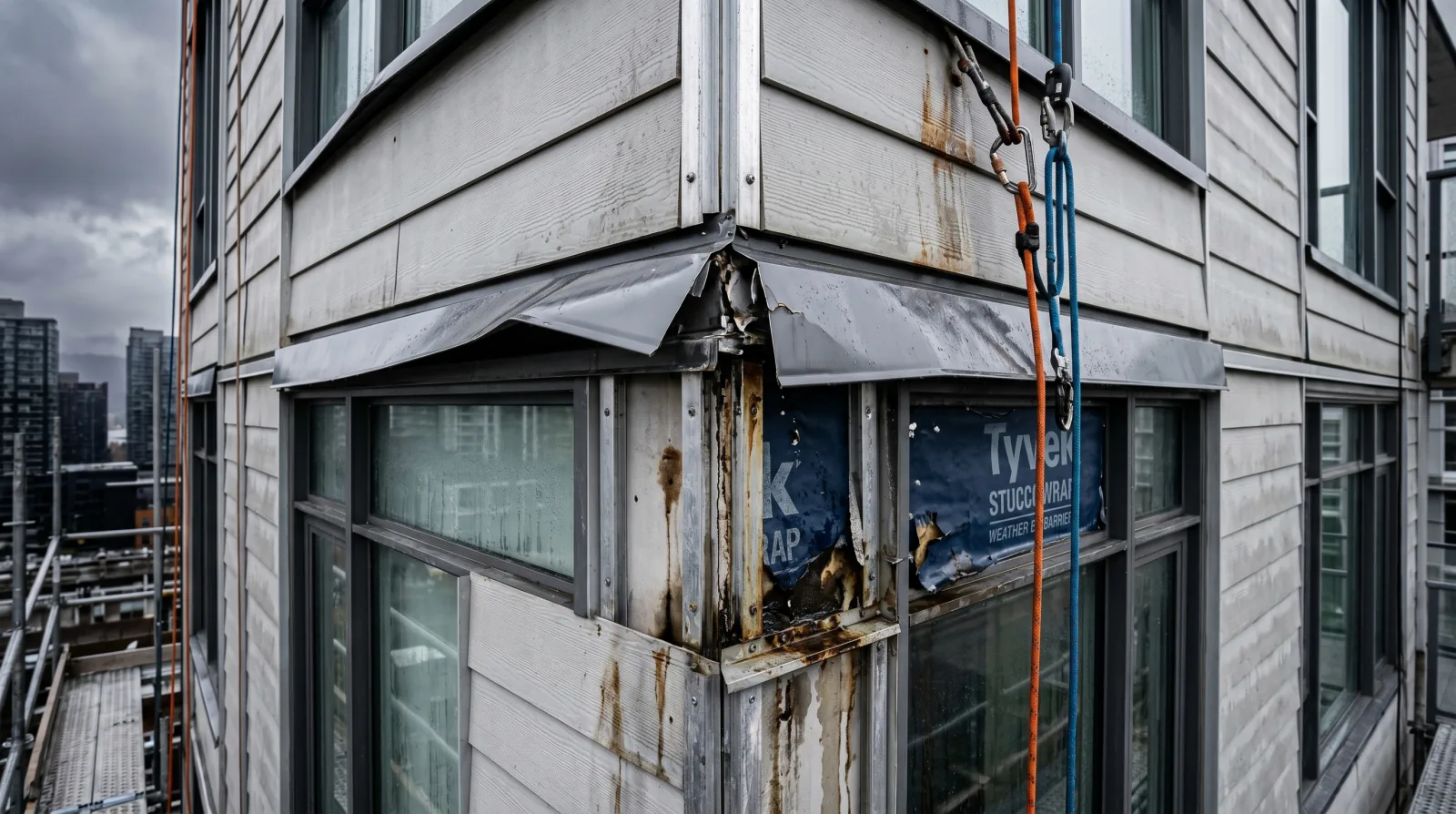
A building envelope is a barrier with holes cut in it. Windows, doors, pipe penetrations, vents. Each one is a place where someone had to decide how to keep water out of an opening, and on nearly all of them the decision is the same: seal it shut and keep the seal intact.
Louvres are the exception. A louvre exists so that air can move through the wall, which means it cannot be sealed. It has to admit air in a climate where the air arrives sideways carrying water for several months a year.
That single difference explains why louvres leak in ways that resist the repairs applied to everything else on the building, and why the most common response to a louvre leak makes it worse.
What a louvre is actually doing
A louvre handles water in three stages rather than one.
The blades are the first stage. They are angled to knock down the bulk of the water while letting air pass, and in steady vertical rain they do nearly all the work.
The drain pan is the second stage. It sits under the blade assembly and catches what the blades miss, which in wind-driven rain is a meaningful volume. The pan slopes toward weep openings at the sill that return the water outside.
The connection to the wall is the third stage. The rough opening the louvre sits in has to be tied into the wall’s drainage plane, so that any water reaching the back of the frame is directed outward rather than into the cavity. This is the same principle described in the post on metal flashing detail failures, applied to an opening that never closes.
A louvre only works if all three stages work. The blades alone are not waterproof and were never intended to be.
The failure almost always starts with the pan
In Metro Vancouver the sequence is consistent enough to be predictable.
Blades collect airborne debris. Dust, pollen, cottonwood fluff in June, leaf fragments in autumn. On exhaust louvres serving kitchens or parkades, a greasy film accumulates that binds the dry material into a mat rather than letting it blow clear.
That mat migrates down into the drain pan and settles over the weep openings. The pan stops draining and starts holding water.
A pan holding standing water is a steel or aluminium tray in permanent contact with moisture, which is a condition it was never designed for. Steel pans corrode through at the low point. Aluminium pans survive longer but fail at fasteners and seams, particularly on the salt-exposed buildings covered in the post on salt spray corrosion.
Once the pan is perforated, every drop the blades fail to stop enters the wall assembly directly. The louvre has become an open hole with a decorative grille over it.
Why sealing the perimeter makes it worse
Water appears on the interior wall below a louvre. Someone inspects from the outside, sees a perimeter joint that looks tired, and seals it.
This is the wrong repair in most cases, and it is actively harmful in some.
A louvre with a blocked or perforated pan is admitting water through the blades, which is the path the assembly was designed around. The perimeter joint is not the entry point. Sealing it removes one of the routes by which trapped water was finding its way back out, and the assembly now retains more water than before.
The same reasoning applies to the weeps themselves. Weep openings at a louvre sill look like defects to anyone who has not been told what they do, and they get caulked shut with some regularity. That converts a functioning drainage assembly into a bucket. The pattern is identical to the one described in the post on blocked weep holes, where the openings that make the wall work are mistaken for the openings that let water in.
Perimeter sealant at a louvre has a real job. It seals the joint between the louvre frame and the adjacent cladding against direct entry, at the head and the jambs. It is not a substitute for drainage, and at the sill it usually should not be continuous at all.
Reading the symptoms
The two failure modes leave different evidence, and telling them apart before opening anything saves a great deal of exploratory work.
Perimeter entry stains the wall outside the louvre frame. Water tracks down the cladding below the jambs and sill, and the staining follows the outline of the frame. It appears in sustained rain of any direction, because it does not depend on water being driven through the blades.
Drainage failure appears inside. Water shows up in the duct, on the interior face of the wall below the sill, or as a damp patch on the ceiling of the space below. It correlates strongly with wind-driven rain and often with a particular wind direction, because that is the condition that pushes water past the blades in volume.
The wind direction correlation is worth recording. A louvre that leaks only during the southeasterly systems described in the post on atmospheric rivers and the building envelope is telling you that its blades are being overwhelmed and its pan is not coping, which is a drainage diagnosis rather than a sealant one.
The fan changes everything
The factor that separates louvre leaks from every other penetration on the building is that something is deliberately moving air through them.
An intake louvre with a fan running is under negative pressure. The fan pulls air inward, and it pulls water inward with it. Water that would have drained out of the pan under gravity gets drawn past the pan and into the duct, where it runs along the bottom until it finds a joint.
This produces leaks that track the mechanical schedule rather than the weather. A parkade exhaust system that reverses to intake mode, or a make-up air unit that runs on a timer, will produce interior water at the times the equipment operates. Building staff report that the leak is intermittent and unpredictable, and the pattern only resolves when someone compares the reports against the equipment run times.
It also means a louvre that passes a water test with the fan off can fail badly with it running. Any testing that does not replicate the operating condition is testing the wrong assembly. The spray rack methodology described in the post on field water testing needs to be run in both states on a louvre, and the results compared.
Exhaust and intake fail differently
The two are worth separating because the maintenance differs.
Exhaust louvres are pushing air outward, which resists water entry most of the time the equipment runs. Their problem is accumulation. Whatever the exhaust carries ends up on the blades, and in kitchen or parkade service that means a greasy deposit that holds everything else. An exhaust louvre with a badly fouled blade assembly restricts airflow as well as blocking drainage, so the mechanical performance degrades alongside the envelope performance.
Intake louvres stay cleaner because they are drawing filtered-side air rather than loaded air, but they are under negative pressure during rain and that is the condition that drives water inward. An intake louvre in good visual condition can be the worst leak on the building.
Corridor pressurisation intakes deserve particular attention. They run continuously in many Metro Vancouver buildings, they are frequently located at the top of stair towers where wind exposure is highest, and the water they admit travels into the shafts covered in the post on stair tower and corridor leaks, where it can appear several floors away from its source.
What a proper repair covers
The work divides into the same three stages as the assembly.
Clearing and testing the drainage path. Remove the blade assembly where it is removable, clean the pan completely, clear every weep, and pour water into the pan to confirm it leaves. A pan that holds water after clearing is either flat, back-sloped, or perforated, and each of those is a different repair.
Repairing the pan and frame. Corroded pans get replaced rather than patched, because a patched steel pan in standing water resumes corroding at the patch edge within a season. Where the frame itself has corroded at the sill, the repair extends into the opening.
Restoring the connection to the wall. The membrane transition between the rough opening and the drainage plane of the wall is the part most likely to have been damaged or omitted, and it is the part that decides whether water reaching the back of the frame leaves the building or enters it. This is the same detailing described in the post on mechanical penetration sealing, with the added difficulty that the opening stays open.
Then sealant, at the head and jambs only, at the joints that are meant to be sealed.
The scope boundary is where these repairs fail
A louvre is a mechanical component installed in an envelope opening. That sentence contains the whole problem.
The mechanical contractor treats the louvre as a grille and the wall as somebody else’s work. The envelope contractor treats the wall as their scope and the louvre as equipment they should not touch. The leak is at the boundary between the two, and a tender that does not name the boundary explicitly will produce two repairs that both stop short of the actual defect.
The fix is to write the boundary into the scope. Name who removes and reinstalls the louvre, who is responsible for the pan, who ties the membrane into the opening, and who carries the warranty for the completed assembly. The scope-definition problems described in the post on envelope tender scope of work apply here with unusual force, because the ambiguity is structural rather than accidental.
It also matters for the warranty. A leak at a louvre with split responsibility produces exactly the situation set out in the post on warranty claims, where each party’s warranty excludes the other’s work and the building owns the defect.
Put louvres on the maintenance calendar
Most buildings have never cleaned a louvre. They are high up, they are unglamorous, and nobody has ever specified an interval for them.
An annual clean before the wet season, combined with a pour test of the drain pan, addresses the largest share of this failure mode. It belongs in the drainage clearing that the post on post-restoration maintenance planning puts on the seasonal calendar, alongside roof drains and scuppers.
Where the louvres are at height and rope access is already scheduled for gutter and scupper clearing, adding them to the same visit costs little. The access is the expensive part and it is already paid for.
For a building with a known intermittent leak and no identified source, louvres are worth checking early. They are one of the few envelope components whose leaks correlate with equipment operation rather than weather alone, which makes them easy to overlook and straightforward to confirm once the possibility is on the table. A thermal survey of the type described in the post on thermal imaging envelope surveys will often show the wetted area below a louvre clearly, provided the survey is scheduled when the equipment has been running during rain.
Sources and further reading
- BC Housing, Building Enclosure Design Guide, provisions on wall penetrations and openings, referenced 2026
- National Research Council Canada, guidance on rain penetration control at wall openings, referenced 2026
- Air Movement and Control Association International, louvre water penetration test standards, referenced 2026
- Allweathercoating inspection and repair records, Metro Vancouver, 2026
Frequently Asked Questions
More from
Nobody Reports a Leak in the Stairwell
Common areas have no resident watching them. Water in a stair tower or a corridor runs for years before anyone raises it, and by then it has reached the structure.
Read article →Where the Roof Meets the Wall, Two Trades Meet a Problem
The junction between a roof membrane and a wall assembly is the most failure-prone detail on most buildings, and it belongs to nobody in particular.
Read article →Water in the Elevator Pit Is a Building Envelope Problem
The lowest point in the building collects whatever gets past the below-grade waterproofing. Elevator contractors can pump it out, but they cannot stop it arriving.
Read article →