Flashing details that fail
The most expensive failures on Metro Vancouver walls trace back to the cheapest parts on them: bent metal at window heads, roof junctions, deck connections, and parapet tops. A flashing failure concentrates a whole wall's water at one hidden point, which is why a missing piece the size of a shoe can produce a repair measured in square metres of rebuilt framing.
Why metal details carry the wall
A rainscreen wall, as our anatomy guide lays out, moves water down a concealed path and hands it off at every interruption: window, door, roof edge, deck, parapet. Every handoff is a flashing. The open field of a wall almost never rots, because rain spreads across it as a thin film and the assembly drains it easily. The junctions are where water collects into streams, and streams are what flashings exist to manage.
That is the logic behind an observation any envelope contractor in Vancouver will confirm: the damage is never proportional to the part. Our crews have opened walls where a single absent kickout, a detail that costs less than lunch, accounted for the entire rebuild of a two-storey wall section. The causes of water ingress on high-rises tell the same story at tower scale.
The four details, and how each one goes wrong
Head flashings over windows and doors
The bent metal above every opening catches cavity water and throws it clear on a drip edge. It fails by sloping backward after installation error or building movement, by missing its end dams so water pours off the ends into the wall, or by being sealed to the cladding above so the cavity can no longer drain onto it. The window below then takes the wall’s water as its own leak, and gets misdiagnosed for years.
Kickout flashings at roof-to-wall junctions
Where a sloped roof edge dies into a wall, the kickout is the small angled piece that throws roof runoff away from the cladding. It is the most commonly missing flashing in the region, left off during original construction or removed in a reroof. Without it, a concentrated stream of roof water enters the wall at one point, storm after storm. We find more localized rot behind absent kickouts than behind any other single detail.
Saddle flashings at guards, decks, and walls
Where a guard wall or a deck divider meets the building, a saddle flashing wraps the three-way junction. It fails at its soldered or sealed corners, or was never a saddle at all, just caulking pretending to be one. These junctions collect water from two directions, so a small corner split feeds moisture into the wall and the deck structure at once. Probe them on every walk-around.
Parapet caps on flat-roofed walls
The metal cap on top of a parapet keeps rain out of the wall’s open top, the most exposed edge on the building. Caps fail through loosened fasteners and wind uplift, through open or poorly lapped joints between cap sections, and through pinholed or aged sealant at laps. A parapet wall wets from the top down, so by the time staining shows on the face, the wood or masonry inside has been wet for a long time.
The failure you paid someone to install
A large share of flashing failures are purchased, on an invoice, from another trade. Reroofing crews strip and discard kickouts because reinstating them slows the job. Window replacement contracts skip the head flashing tie-in because the new frame "has its own drainage." Painters bridge drip edges with coating until water tracks back along the underside of the metal instead of dropping clear. None of this is malicious; it is what happens when trades work on a wall system nobody has made them responsible for understanding.
The geometry details matter as much as the presence of the metal. A head flashing needs slope to move water outward, end dams to stop it running off the sides, and a drip edge standing clear of the cladding so the water releases instead of tracking back along the underside by surface tension. Each of those features costs nothing at the brake press and everything to retrofit. When our crews photograph a suspect flashing, those three features are what the photos are checking, because a flashing that exists but lacks them fails at its own corners.
The defence is procedural. Any contract touching the roofline, the windows, or the cladding should name the flashings in scope and require their reinstatement to a detail, and someone who understands the drainage path should look at the work before final payment. A council that adds one line to a reroofing contract can save itself a wall.
Finding failures before the rot does
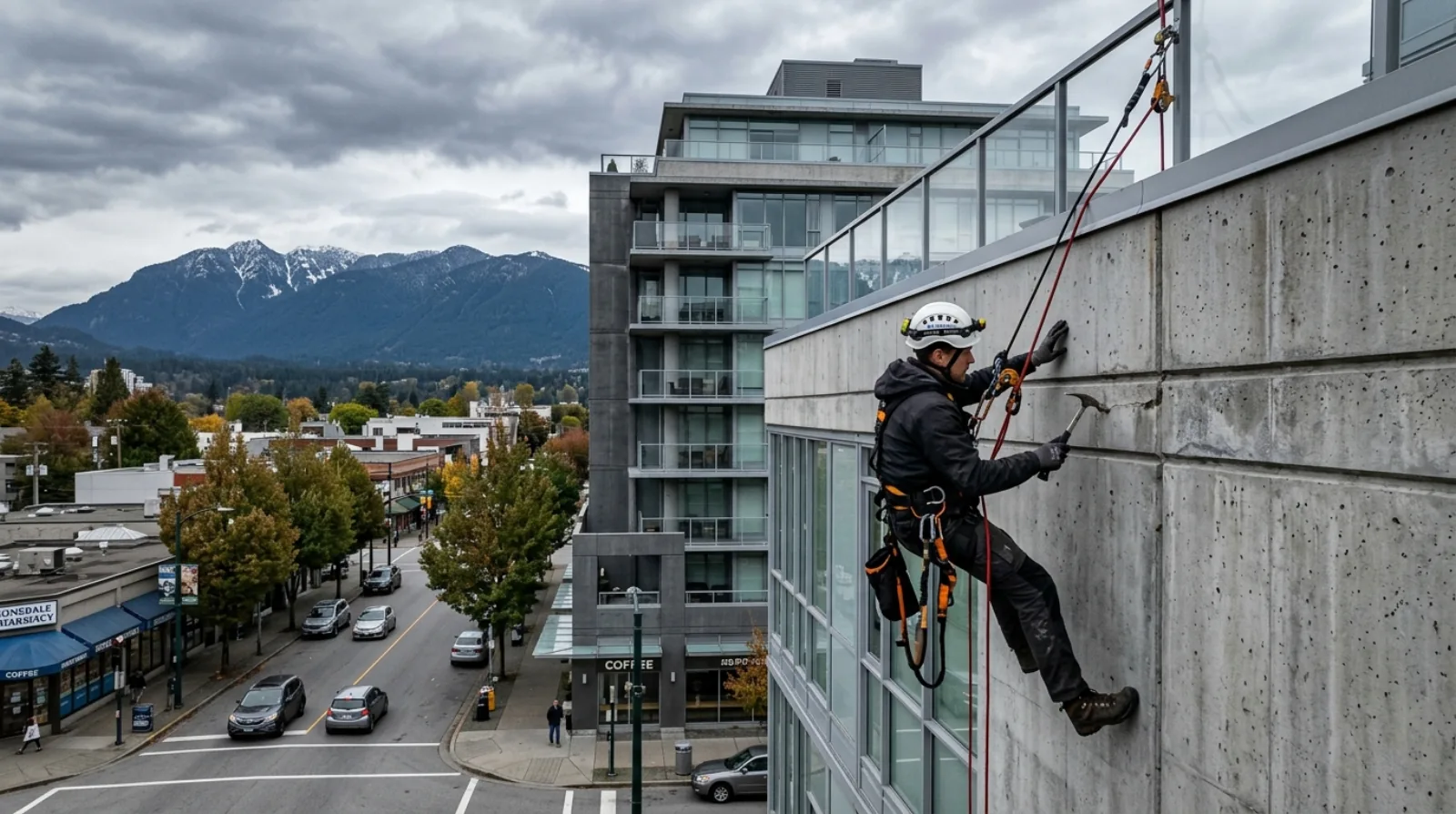
Flashing problems telegraph early if someone looks. Stain stripes, moss bands, rust tracks from fasteners, lifted cap edges visible against the sky: all of it reads from the sidewalk with binoculars. The annual inspection checklist builds this into a routine, and the companion guide on weeps and cavity venting covers the drainage openings that flashings feed. On towers, close inspection belongs to rope access, where a technician can put a hand and a camera on every suspect lap for a fraction of staging cost.
When water is already showing inside, resist the urge to caulk the nearest joint and hope. Entry points and exit points rarely align, and a systematic trace, laid out in our leak investigation guide, beats serial guessing every time. And when the investigation lands on a failed or absent flashing, repair it in metal, tied into the barrier, through our building envelope repair service or a contractor who will document the detail. Sealant alone, as covered in our sealant and caulking guide, is a supporting material at flashing laps and a poor stand-in for the flashing itself. For where these details sit in the larger wall system, the rainscreen hub holds the full set of guides.
Quick answers
What is a head flashing and why does it matter?
A head flashing is the sloped metal above a window, door, or other wall opening. In a rainscreen wall it catches water draining down the cavity and directs it back out past the cladding face, with a drip edge that throws it clear of the frame below. It matters because every opening interrupts the drainage path, and the head flashing is what reconnects it. A failed one delivers the wall’s collected water straight to the window assembly.
What is a kickout flashing and what happens when it is missing?
A kickout flashing is the short angled piece at the bottom of a roof-to-wall junction that kicks roof runoff away from the cladding and into the gutter. When it is missing, the concentrated stream from the roof edge runs down inside the wall at a single point. That produces deep, localized rot, often while the surrounding wall stays healthy, and it is among the most common findings behind unexplained interior stains on Metro Vancouver low-rises.
What is a saddle flashing on a building?
A saddle flashing is a shaped metal piece that wraps a three-way junction, typically where a guard wall, deck divider, or partition wall meets the building face. Water arrives at these junctions from two directions, and no flat flashing or sealant bead can cover the geometry. Saddles fail at their corners, where fabrication seams split or the sealant that substituted for proper soldering ages out, feeding water into wall and deck framing at once.
Flashing failure questions
What is a head flashing and why does it matter?
A head flashing is the sloped metal above a window, door, or other wall opening. In a rainscreen wall it catches water draining down the cavity and directs it back out past the cladding face, with a drip edge that throws it clear of the frame below. It matters because every opening interrupts the drainage path, and the head flashing is what reconnects it. A failed one delivers the wall’s collected water straight to the window assembly.
What is a kickout flashing and what happens when it is missing?
A kickout flashing is the short angled piece at the bottom of a roof-to-wall junction that kicks roof runoff away from the cladding and into the gutter. When it is missing, the concentrated stream from the roof edge runs down inside the wall at a single point. That produces deep, localized rot, often while the surrounding wall stays healthy, and it is among the most common findings behind unexplained interior stains on Metro Vancouver low-rises.
What is a saddle flashing on a building?
A saddle flashing is a shaped metal piece that wraps a three-way junction, typically where a guard wall, deck divider, or partition wall meets the building face. Water arrives at these junctions from two directions, and no flat flashing or sealant bead can cover the geometry. Saddles fail at their corners, where fabrication seams split or the sealant that substituted for proper soldering ages out, feeding water into wall and deck framing at once.
Why do parapet caps cause so much water damage?
Parapet caps guard the open top of a wall, the one surface that takes rain vertically and dries slowest. When cap joints open, fasteners loosen under wind uplift, or lap sealant pinholes, water enters the top of the wall assembly and travels down inside it. Damage stays hidden because the wall face below can look clean while the core saturates. On flat-roofed Vancouver buildings, parapets deserve first stop on any inspection.
Why do small flashing failures cause such large repairs?
Flashing failures concentrate water. A wall sheds rain as a distributed film, and the assembly handles that easily; a failed flashing takes that distributed water and delivers it to one hidden location, storm after storm, for years. Wood framing and sheathing rot fastest under exactly that repeated point-loading. So a piece of bent metal worth a few dollars decides whether a wall drains or quietly composts, which is the arithmetic behind most big envelope repair scopes.
What does a failed flashing look like from the ground?
From the ground, a failed flashing shows as a pattern rather than a part: a vertical stain stripe starting below a roof edge, algae or moss growing in one wet band, staining concentrated under one window corner, rust streaks from cap fasteners, or a visible gap where metal has lifted. Binoculars and a camera with zoom turn a sidewalk walk-around into a useful screen. Confirming the cause still needs a close look, often by rope access on taller buildings.
Do flashings need end dams?
Head flashings and sill flashings need end dams, the small upturned folds at each end that stop water from simply running off the sides into the adjacent wall. A flashing without end dams protects the middle of the opening and betrays both corners, which matches the damage pattern we find at window jambs. End dams are cheap at fabrication time and awkward to add later, so their absence usually dates to original construction or a budget reroof.
Can sealant substitute for a missing flashing?
Sealant cannot substitute for a missing flashing. Caulking is a maintenance material with a service life measured in years, while a flashing is geometry that works by gravity for decades. A sealant bead standing in for a kickout or a saddle will fail on its own schedule and then hide the entry point it created. Sealant belongs at flashing laps and terminations as a supporting player. Where metal is missing, the honest repair is metal.
How often should building flashings be checked?
Flashings should get a dedicated look once a year, ideally in fall before the heavy rain arrives, plus a follow-up after any major wind event or any roofing, window, or cladding work by other trades. Trade damage is the quiet one: reroofs that discard kickouts and window swaps that omit head flashing tie-ins create failures on a brand new invoice. Fold the check into the annual envelope walk-around rather than treating it as a separate program.
Who should repair flashings on a high-rise building?
High-rise flashing repair belongs with crews certified for the access and competent in the metal work: IRATA or SPRAT rope access technicians working under WorkSafeBC Part 11 fall protection rules, installing or refastening flashings to an envelope detail rather than improvising at height. Rope access suits this work well because flashing repairs are small, scattered, and high, exactly the profile where scaffolding costs dwarf the repair itself.
Seeing stains below a roofline or window?
We trace and repair flashing failures on strata and commercial buildings across Vancouver, North Vancouver, and Burnaby, by rope access where the details are out of reach.