WRB membrane options compared
The water resistive barrier is the layer nobody sees and everything depends on: the membrane over the sheathing that catches whatever crosses the cladding and cavity. Four families compete for the job behind Metro Vancouver walls: building paper, synthetic housewrap, self-adhered sheet, and fluid-applied coatings. Each earns its place in a different assembly, and each has a known way of getting into trouble.
The second line is the real line
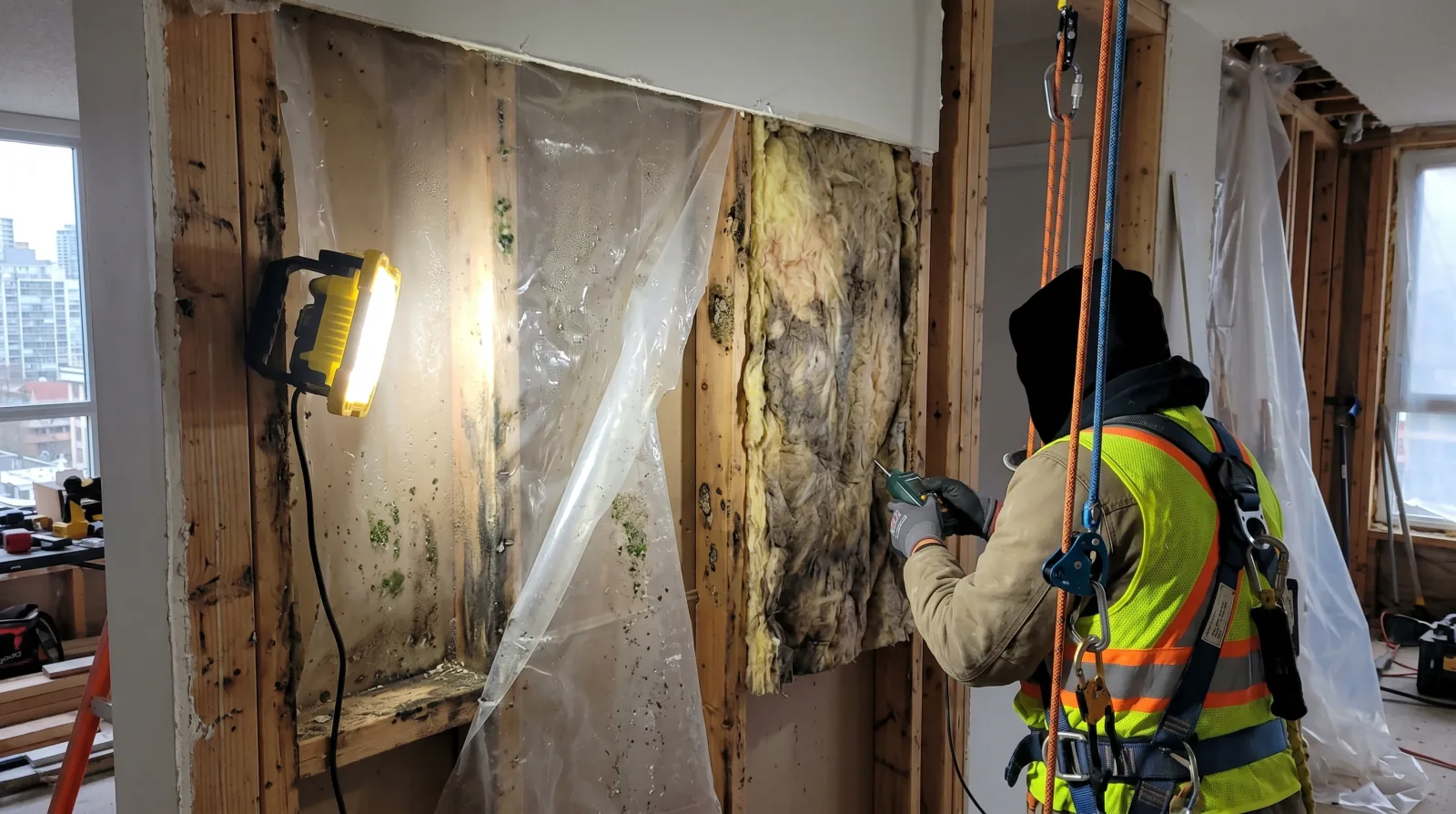
In the rainscreen logic laid out in our assembly guide, the cladding is allowed to leak because the WRB behind the cavity is not. Every drop that crosses the gap lands on this membrane and rides it down to a flashing or a weep. That makes the WRB the true waterproofing layer of the wall, installed in a week, buried for decades, and impossible to inspect afterward without opening the cladding.
The stakes are regional history. Leaky condo era walls paired thin or absent paper with no drainage cavity at all, and the result is documented at the scale of roughly $4 billion across more than 900 Lower Mainland buildings. Modern practice gives the barrier a cavity to work behind, and the remaining question is which membrane family fits which wall.
Four families, compared
| Membrane | What it does well | Where it gets into trouble |
|---|---|---|
| Building paper (asphalt-impregnated kraft) | The traditional choice behind stucco, often in two layers. Sheds water reliably, self-seals modestly around fasteners as asphalt softens, forgiving of trade handling, and its track record spans a century of walls. | Tears during construction wind, degrades where it stays wet against blocked drainage, and laps depend entirely on installer discipline. Long exposure before cladding closes in weakens it. |
| Synthetic housewrap (spun-bonded polyolefin) | Light, wide rolls cover walls fast with fewer laps. High vapor permeability lets the wall dry outward. Tough against tearing, tolerates weeks of exposure during construction better than paper. | Surfactants in some cedar and stucco assemblies can compromise water repellency. Fastener holes do not self-seal, so detailing tape and cap staples carry real weight. Quality varies widely by product line. |
| Self-adhered sheet (peel and stick) | Bonds fully to the sheathing, so water cannot travel laterally behind it. Seals around its own fasteners, laps fuse into a continuous plane, and it doubles as an air barrier when detailed as one. | Low vapor permeability in many formulations can trap outward drying if the assembly is not designed for it. Demands clean, dry, primed substrates and careful rolling; a cold, damp Vancouver install window tests all three. |
| Fluid-applied membrane | Rolled or sprayed onto the sheathing as one continuous coating with no seams at all, wrapping complex geometry, penetrations, and transitions without laps. Excellent air barrier continuity on the same pass. | Thickness control is the whole game: thin spots fail invisibly. Needs cure windows the coastal shoulder seasons resist, and repair or tie-in by later trades requires compatible products, which nobody on site checks by default. |
How designers actually choose
Three questions drive the selection. First, what cladding is coming, since stucco brings its two-layer paper tradition, panel systems pair naturally with wraps or adhered sheets, and the options are weighed alongside the cladding choice itself. Second, does the barrier also need to be the air barrier, which pushes toward self-adhered and fluid-applied products that hold air pressure as well as they shed water. Third, how will the wall dry: a vapor-open wrap lets the assembly breathe outward, while a tight membrane demands a wall designed to dry some other way.
That third question is where walls get hurt quietly. Moisture trapped in an assembly by mismatched vapor properties condenses inside the wall instead of draining from it, a failure mode our article on vapor barrier failure and interstitial condensation walks through in detail, and the broader physics live in our condensation and moisture hub. A WRB is one voice in that conversation, and it has to harmonize with the insulation, the vapor barrier, and the cavity in front of it.
The air barrier question rides along
Modern specifications often ask the WRB to do double duty as the air barrier, the continuous layer that stops wind from pumping air, and the moisture it carries, through the assembly. The two jobs have different physics. Water resistance is about shedding liquid downhill; air tightness is about sealing a pressure boundary at every lap, fastener, and penetration. Papers and mechanically fastened wraps shed water well and hold air poorly, which is fine when the air barrier lives elsewhere in the wall. Self-adhered and fluid-applied membranes can do both jobs in one layer, which is much of why consultants reach for them on towers, where stack effect and wind pressure work the envelope hardest. Ask any retrofit designer which layer is the air barrier in your wall; the answer should be immediate and specific.
Installation is the product
Every membrane family fails the same way: at its edges, laps, and penetrations, installed by whoever was on the wall that day. A mid-grade wrap detailed with patient, shingle-lapped discipline outperforms a premium adhered sheet stuck to damp sheathing in November. This is why retrofit specifications, covered in our retrofit process guide, put consultant review of the barrier before cover-up, with photographs filed for the strata record. Ask for those photos on any project you fund; they are the only inspection this layer will ever get.
For owners of existing buildings, the practical WRB program is protective. You cannot service the membrane, but you can control how much water reaches it: clear weeps and vents, intact flashings, live sealant. When localized barrier damage does surface, on towers our rainscreen services crews open, repair, and reseal specific locations by rope access, which keeps a hidden-layer repair from becoming a recladding bill. The rest of the decision chain lives in the rainscreen hub.
Quick answers
What is the difference between building paper and synthetic housewrap?
Building paper is asphalt-impregnated kraft sheet, the traditional water resistive barrier behind coastal stucco, valued for shedding water and modestly self-sealing at fasteners. Synthetic housewrap is a spun plastic fabric: lighter, tougher, faster to install in wide rolls, and far more vapor permeable, letting walls dry outward. Paper is forgiving and proven; wrap is durable and quick. Both perform when lapped shingle style and detailed carefully.
What is a self-adhered WRB?
A self-adhered WRB, often called peel and stick, is a membrane that bonds fully to the wall sheathing instead of hanging on fasteners. Full adhesion stops water from travelling sideways behind the barrier, laps fuse into a continuous plane, and the sheet can double as the air barrier. In exchange it demands clean, dry substrates, patient rolling, and an assembly designed around its lower vapor permeability.
What is a fluid-applied WRB?
A fluid-applied WRB is a liquid membrane rolled or sprayed directly onto the sheathing, curing into a waterproof, airtight coating with no seams. Its strength is continuity: no laps, and complex corners, penetrations, and transitions get wrapped in one pass. Its risks are thickness control, since a thin pass fails invisibly, and cure conditions, which Metro Vancouver’s cool damp shoulder seasons do not hand out freely.
WRB membrane questions
What is the difference between building paper and synthetic housewrap?
Building paper is asphalt-impregnated kraft sheet, the traditional water resistive barrier behind coastal stucco, valued for shedding water and modestly self-sealing at fasteners. Synthetic housewrap is a spun plastic fabric: lighter, tougher, faster to install in wide rolls, and far more vapor permeable, letting walls dry outward. Paper is forgiving and proven; wrap is durable and quick. Both perform when lapped shingle style and detailed carefully.
What is a self-adhered WRB?
A self-adhered WRB, often called peel and stick, is a membrane that bonds fully to the wall sheathing instead of hanging on fasteners. Full adhesion stops water from travelling sideways behind the barrier, laps fuse into a continuous plane, and the sheet can double as the air barrier. In exchange it demands clean, dry substrates, patient rolling, and an assembly designed around its lower vapor permeability.
What is a fluid-applied WRB?
A fluid-applied WRB is a liquid membrane rolled or sprayed directly onto the sheathing, curing into a waterproof, airtight coating with no seams. Its strength is continuity: no laps, and complex corners, penetrations, and transitions get wrapped in one pass. Its risks are thickness control, since a thin pass fails invisibly, and cure conditions, which Metro Vancouver’s cool damp shoulder seasons do not hand out freely.
Which WRB is best behind cladding in Vancouver?
No single WRB wins behind every Vancouver cladding, because the barrier is chosen with the assembly around it. Two-layer building paper remains standard behind rainscreen stucco. Housewrap suits plank and panel claddings on wood frame. Self-adhered and fluid-applied products earn their premium on complex geometry, on towers where air barrier continuity matters, and in retrofits where the consultant wants adhesion. The detailing quality decides more than the product family.
Does a WRB need to be vapor permeable?
A WRB needs vapor permeability matched to its wall, which is a design decision rather than a virtue in itself. Permeable barriers, paper and most wraps, let moisture inside the assembly dry outward through the cavity, the default logic for coastal wood frame. Low-permeability self-adhered sheets can work well, but the designer must confirm the wall can dry some other way. A tight barrier on a wall that needed outward drying traps moisture in the sheathing.
How are WRB laps and penetrations detailed?
WRB laps run shingle style, each upper sheet over the one below, so gravity carries water down the face and never behind an edge. Horizontal laps face down-slope; vertical laps get taped or sealed per the product. Penetrations, every pipe, vent, duct, and fastener cluster, get wrapped or flashed with compatible tapes, boots, or liquid detailing tied into the barrier plane. Window and door openings tie the WRB into pans and head flashings.
Can a WRB be repaired without removing the cladding?
A WRB cannot be meaningfully repaired without opening the cladding, because the barrier is fully concealed and its failures are local tears, laps, and tie-ins that must be seen to be fixed. What maintenance can do from outside is protect it: keep weeps draining, keep flashings intact, keep sealant live, all of which limit how much water reaches the barrier. Localized cladding openings, by rope access on towers, let crews repair specific WRB defects without full recladding.
What WRB will I find in a leaky condo era wall?
A leaky condo era wall typically hides a single layer of building paper, or occasionally none at all, applied tight behind face-sealed stucco with no cavity in front of it. The paper was asked to do a job the assembly never gave it room to do: with no drainage gap, water sat against it until laps wicked and the paper broke down. Test openings during assessment report the actual condition, which varies wall by wall even on one building.
Does the WRB matter more than the cladding choice?
For keeping the structure dry, the WRB and its detailing outrank the cladding. The cladding sheds most of the rain and takes the visual credit, but the barrier is the layer that decides whether the water crossing the cavity ever touches sheathing. A premium cladding over a torn, badly lapped barrier rots on schedule; a modest cladding over a continuous, well-detailed barrier protects the wall for decades. Budget attention accordingly during any retrofit.
Why is two-layer building paper used behind stucco?
Two layers of building paper behind stucco solve a bonding problem. Wet stucco or its lath fastening tends to adhere to the outer paper layer, and an adhered barrier can crack and bridge with the stucco instead of shedding water freely. The outer layer takes that sacrifice; the inner layer stays free to drain as the true barrier. It is a century-old detail that survived into modern rainscreen stucco because it keeps working.
How long does a WRB last inside a wall?
A WRB’s service life depends on how wet it runs, so the honest answer is conditional. Kept mostly dry behind a draining, venting cavity, paper and wrap products routinely outlive their cladding’s first recoat cycles, and adhered membranes longer still. Held wet against blocked drainage, the same products degrade in a few seasons. That is why weep maintenance, a cheap habit, buys barrier life, an expensive asset nobody can inspect without opening the wall.
Questions about the layer you cannot see?
We assess and repair concealed barrier problems on strata and commercial buildings across Vancouver, Burnaby, and the North Shore, with rope access for localized openings on towers.